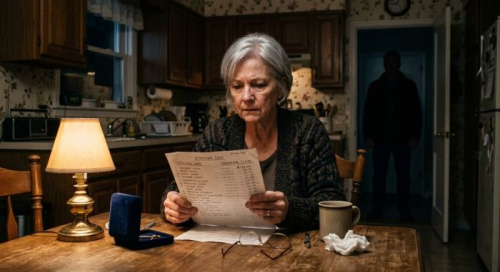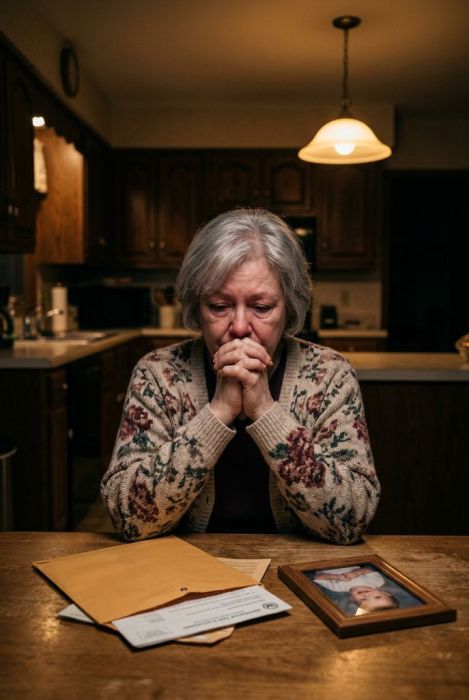
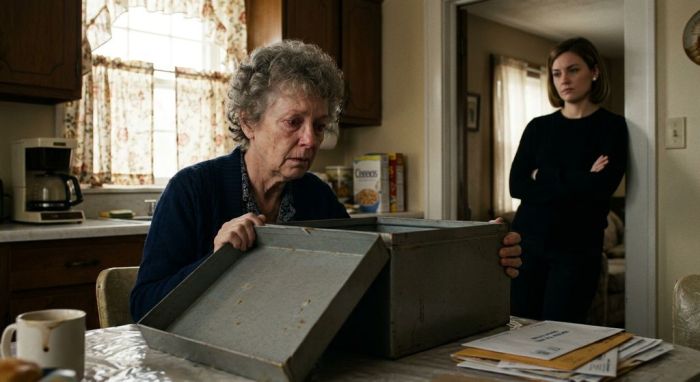
The day I came home from St. Ann's Hospital, my house smelled like lemons and looked like a stranger had been living in it. Not a messy stranger — the opposite. Every cushion fluffed, every dish put back in the wrong cabinet, the mail stacked in a tower straight enough for a bank lobby. And on the dining table, right in the patch of window light, sat my fireproof file box, lid off, tipped open like a suitcase at customs.
I remember the sound I made. It came out before I could stop it — a low, animal noise I'd only made twice in my life, once when Frank died and once when the doctor said there was a shadow on my lung. Because the box wasn't just open. It was empty, scraped clean down to the gray felt lining Frank had glued in himself back in 1989, the winter we started buying savings bonds.
For a full, bitter minute I stood there blaming myself, the way you do when your mind wants to soften the blow before it lets you feel it. Maybe I moved them. Maybe I forgot. Maybe I was getting old, and old people lose things, and everybody had been telling me for months I needed more help around the house.
Then I heard the bedroom door open behind me.
"Mom," my niece Whitney said, soft as cream. "You're home early. I was going to come pick you up."
Whitney had been "helping" me since the pneumonia. Six weeks earlier I'd been fine — sixty-seven, retired from running the cafeteria at Zanesville High for twenty-nine years, still raking my own leaves. Then a cold turned into a fever that put me in a hospital bed with tubes in my arm. My daughter Sarah lives in Denver. My son Ben is in Columbus with a newborn. So when Whitney offered to stay at the house and keep an eye on things, I cried with relief.
Whitney is my brother Danny's girl. Danny died young, a heart attack at forty-nine in the Ford plant parking lot, and Frank and I helped raise her more than most people remember. We paid for her first year of community college. We bought her a used Civic when hers died. We loved her, and she used it like a skeleton key.
"The bonds," I said, my voice thin as a radio on its last bar of battery. "The file box. There was a folder. Blue ones, mostly — Series EE, the ones Frank loved because his father bought them during the war. Forty-one years of them. Birthdays. Christmases. The bonus years at the plant. Every time he came home with a little blue envelope he'd slide it into that box and say, 'That's our disappearing act, Maggie. Money that knows how to hide.'"
"I took them to the bank for you," Whitney said, smiling with all her teeth. "You kept worrying about them in the hospital, Mom. You asked me to make sure they were safe. So I put them in your safety deposit box down at First Federal. I have the receipt right here."
I had never asked her to touch the file box. But that's the genius of a good liar — they hand you a story that makes you the confused one, so you swallow your own suspicion just to keep the peace. I stood in my own kitchen, sick with relief and shame, and thanked her. I actually said thank you.
It took me another week to walk down to First Federal and check.
Ron Kessler has run that bank branch since 2004. He was Frank's best friend since the eighth grade, best man at our wedding, the one who read the eulogy when I couldn't. He saw my face and pulled the drawer open before I could say a word. There was no bond folder in the deposit box, and no receipts either, because Whitney never opened the box.
"Maggie," he said, very gently. "Sit down before you fall down."
The bonds weren't just gone — they'd been cashed. Three different banks across three counties over the last five weeks, starting the week I went into the hospital. Whoever did it had a notarized power of attorney in my name, and a signed gift letter, and a story about an elderly aunt who wanted her niece to have everything. The tellers remembered Whitney. She'd worn my pearl earrings to two of the appointments — the ones Frank gave me for our thirtieth anniversary — and complimented their nail polish.
I felt the floor tilt, not because I was surprised, but because part of me had still been hoping I was wrong. That's the terrible mercy of denial. It lets you practice for grief.
Ron called my daughter for me. Sarah was on a plane by nightfall.
I want to tell you I raged. I want to tell you I marched to Whitney's apartment that same day and demanded answers. But the truth is, I spent the first three days sitting in the kitchen with Frank's old barn coat on my shoulders, even though it was July, because I kept reaching for him and he wasn't there.
And then, on the fourth morning, I remembered the coat.
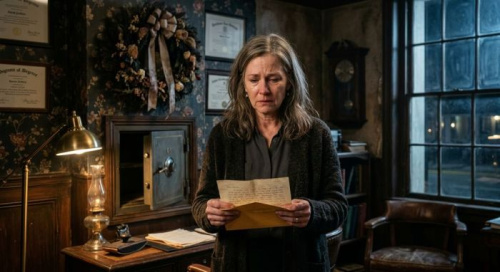
The notebook was in the inside pocket, the one Whitney would never have touched because the coat smelled like the garage and hung by the mudroom door where nobody nice ever looked. Frank had started it in 1989. Page after page of his thin, careful handwriting: date purchased, amount, serial number, whose birthday was coming. The last line, in shaky pencil, said, Forty-one years. That's our retirement, Mag. Don't let anyone talk you out of it.
Tucked behind the back cover, taped flat, was a letter. He'd written it eight months before the stroke that took him. It was addressed to Ron Kessler: Ron, if anything ever happens and anyone pressures Maggie about the bonds, treat this as my signature on the record. They're hers. Every one of them. She worked twenty-nine years feeding other people's children and never once complained. I won't have her feeding her own sorrow in a county home. — Frank Delaney.
I sat there in the kitchen light, holding that letter, and felt something dangerous and quiet move in my chest. Not rage. Something older and colder, the way you feel when you finally understand the shape of the thing that's been biting you in the dark. That was the day I stopped being the woman Whitney robbed.
The police report was filed that afternoon — not by me, by Sarah, who has her mother's spine and none of her hesitation. The detective, a young man named Ortiz with kind eyes and a weary smile, looked at the notebook and the letter and said the word I'd been avoiding: felony. Forgery, identity theft, and in Ohio, when you do it to a relative over sixty-five, it comes with a very heavy hat — elderly exploitation.
But here's what Whitney didn't know: paper savings bonds don't disappear just because someone steals them. You report them to the Treasury, and the Treasury replaces them. The serial numbers Frank wrote down so carefully became the second version of those bonds. Three weeks after we filed, the replacements arrived, fresh and blue, worth exactly what they were always worth. Ninety-eight thousand dollars, give or take. The disappearing act Frank promised was real — the money was just waiting for me to call it home.
Whitney, meanwhile, was living her best life. She'd bought a used boat and a brand-new Jeep and put a down payment on an apartment in Naples, Florida. She told her mother, my sister-in-law Elaine, that I'd gifted her the bonds as a thank-you for nursing me through the pneumonia — and Elaine believed it, because Elaine has spent forty years believing everyone she loves is good.
The hard part was the waiting. The detective said to give Whitney enough rope, and I did. I watched her carry my pearl earrings to family dinners. I stood at my own kitchen counter and let her tell me, very gently, that the bank had made a mistake and I should let Ron go. I smiled and agreed and asked her if she'd like more pie.
You might be thinking I should have confronted her at once. But a liar will take accusations and turn them into ammunition. She'd already told four people I was getting confused. By the time I could prove anything, half the family would have believed her version of me. The only way to win was to let her think she'd already won.
So we waited until my birthday. Sarah and Ben insisted on taking me to Luigi's, the little Italian place Frank and I went to on anniversaries. Whitney came late, in a new dress, and announced to the whole table that she was moving to Naples on Saturday. "My aunt has been so generous," she said, eyes on me, sweet as syrup. She hoped I'd come visit.
That was the moment. The room was full of warmth and garlic bread and easy laughter. And the front door opened.
It was Ron, in his good suit, with a man I didn't know — tall, clean-shaved, carrying a leather case. Elaine thought it was a surprise singer. Whitney went pale as milk the instant she saw Ron, and stood up, napkin dropping, talking very fast about how she'd been meaning to call him.
The man with the leather case was a special agent with the U.S. Treasury. He explained, in the calm voice men use when they're about to ruin your evening, that certain paper bonds — serial numbers listed in Frank Delaney's notebook — had been reported stolen. That replacement bonds had been issued. That the stolen originals could not legally be cashed by anyone, no matter what paperwork they carried. And that Whitney had attempted to cash the last block of them at a branch in Cambridge that very morning.
"Mistakes happen," he said, glancing at Whitney, whose new earrings were, I noticed, my pearls. "But the notary on the power of attorney has already identified your signature, not hers. The judge who signed the document verifies he never signed it. And the banker in Cambridge has your face on a camera that doesn't lie."
Someone at the table laughed, a nervous, wrong-sounding laugh, because everyone thought it was a birthday prank. Then Whitney screamed — a wet, wrenching noise — and she said the words everyone waits too long to hear: "She gave them to me! She said I was like a daughter to her! Ask her! Go on — ask her!"
I didn't raise my voice. I didn't even stand. I reached into my handbag and pulled out the notebook, worn at the spine, and Frank's letter, still taped flat behind the cover. I passed them to my son-in-law and said, quietly enough that only the table could hear: "She can tell everyone I gave them to her. But Frank wrote down every serial number in 1989, and he wrote down who they were for in 2021. The notebook doesn't know how to lie."
The police arrived eleven minutes later. They took Whitney out through the kitchen so the dining room wouldn't have to watch. Elaine cried into her napkin. Sarah held my hand until my knuckles went white. And that was the end of Whitney's Florida apartment.
She was charged with forgery, theft, identity fraud, and exploitation of an elderly person. Her boyfriend — the man who'd been nudging her toward borrowing the money for his betting accounts — was charged as an accomplice. There's a word for what happens when two people think they're smarter than a dead man's handwriting, and it isn't a nice one.
The part that matters happened later, the week after the arraignment. I stood in my kitchen and opened the fireproof box. The replacements were inside, blue and new, with a copy of the notebook resting on top like a lid. I closed the box and ran my hand over the gray felt where Frank's glue had held for thirty-five years.
And I laughed — a rusty, watery laugh that startled Sarah so badly she dropped a mug. "It's all right," I told her. "I was thinking about your father. He spent forty-one years buying us a retirement, and then he left me the only treasure nobody can steal. A record. A paper trail of every dime, in a handwriting that says 'mine' better than any deed."
I gave two thousand dollars to the Carnegie Library, where Frank proposed on the steps in the rain with a savings bond he'd bought that morning because he was too proud to propose with nothing in his pocket. The boat went back to the dealer. And in October, Ruth and I took the train down to the Smokies and stayed in a cabin with a porch and two rocking chairs, and I slept eleven hours a night and ate grits I didn't have to cook.
Sarah keeps Frank's letter in a frame in her Denver kitchen. Elaine comes over every Sunday now, and we bake pies and don't mention her daughter, and one of us always cries a little, and then we laugh about the time Danny tried to waterproof the basement with tar and a spatula.
I don't have a tidy lesson to hand you. But if someone in your own family has made you feel small and confused and foolish, here's what I'd tell you over coffee: keep the paper. Keep the letters, keep the serial numbers, keep the records of the life you built. Not out of mistrust — out of truth. The people who love you will never need them, and the people who don't intend to hurt you anyway. A quiet paper trail is the one gift that can't be lied away.
The fireproof box sits on my dresser now. Inside it there's a folder of blue bonds with a new date on them, Frank's coat hangs in the mudroom, and the notebook is exactly where he left it. Some nights I open the lid just to look at the felt — thirty-five years of glue, and love, and a man who knew the difference between giving me things and leaving me free.
The money's in my name. The house is mine. The pearls came back in a brown evidence envelope three days after the arrest, and I had them restrung. And last Sunday, at the library, I put a new bond in the donation box — forty dollars, bought for my great-granddaughter, born last spring. I wrote her name on it in my own hand, and I thought about Frank, and I smiled.
Some treasures can't be stolen. It took my brother's daughter to teach me that. I hope it doesn't take yours.