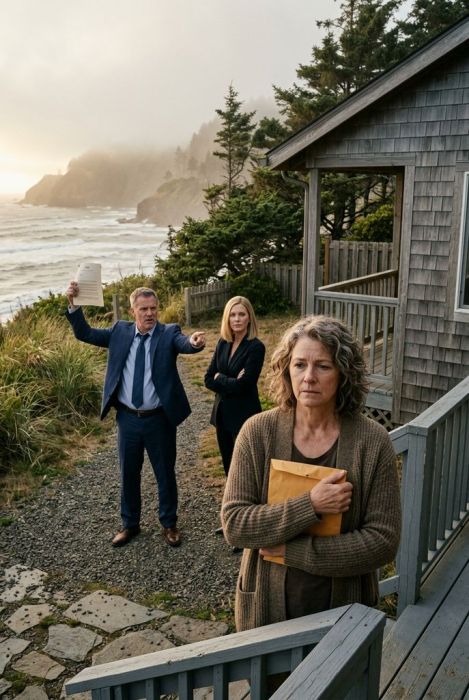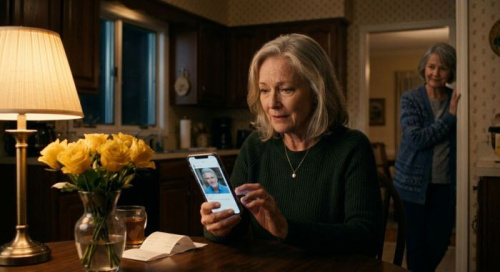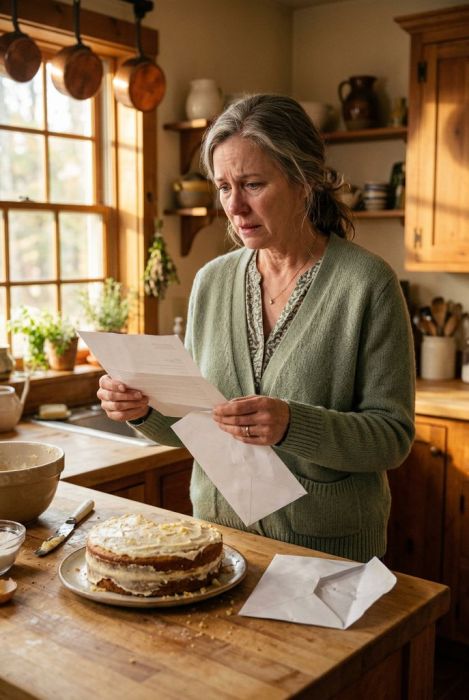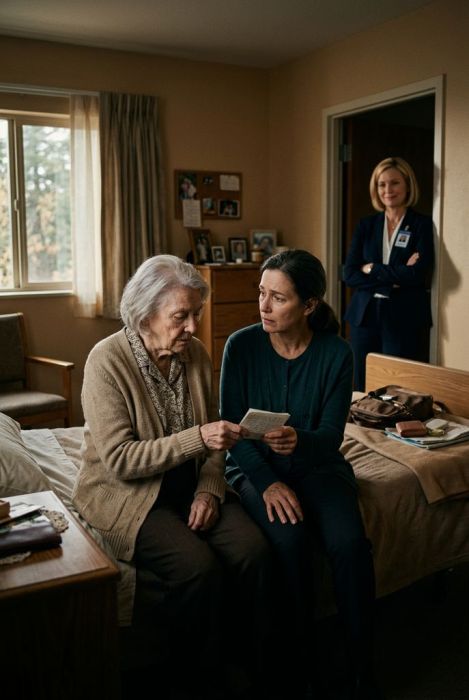
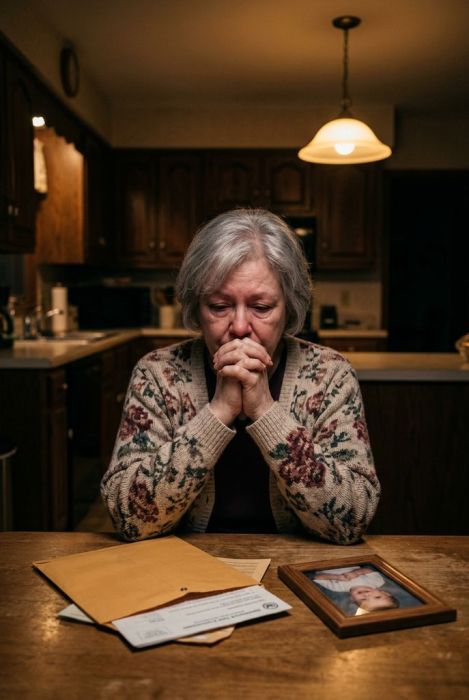
The day my niece told a state investigator that I shook her three-year-old son, I was frosting a birthday cake for a little girl named Sophie, whose mother works nights as an ER nurse. It was a Tuesday in October, the kind of crisp golden morning that made the maple tree on my front lawn look like it was on fire. Six children were napping on their little mats in what used to be my dining room. And then Dana walked in without knocking, holding Mason by the hand, and behind her stood a woman in a navy blazer carrying a badge and a manila folder.
"Sunny Lane Daycare, thirty-one years," I said to the investigator, whose name was Ms. Rivera. "Not one mark on my record. Not one complaint. I raised three children of my own in this house, and I helped raise Dana myself. She worked beside me for six years."
Dana looked at the floor. Mason, my great-nephew, had a bruise on his small forearm the color of a plum. He was three years old. He loved the wooden train table in the corner, and he called me Nana Sunny, because my name is Sandra and the house has been called Sunny Lane longer than I have.
Ms. Rivera was polite, which somehow made it worse. She asked to see the room where the children slept, and she asked me to walk her through my morning routine, and every word out of my mouth sounded guilty to my own ears. I kept staring at that little boy's arm. I kept thinking about how many times I had bandaged that same arm, kissed it, tickled it to make him laugh. And Dana stood there with her hand on his shoulder, and she never once looked me in the eye.
I have loved that girl since the day she was born. My brother Rick and I were close, and when he died in a car accident ten years ago, Dana was twenty-one and lost in a way that broke my heart. She came to live with us for a while. I taught her how to burp a baby, how to puree carrots, how to spot a fever at a glance. When she said she wanted to open her own daycare, I co-signed her loan and handed her twelve thousand dollars out of the retirement cushion my husband Jim and I had scraped together for thirty years. She never paid a cent of it back, and I never asked. That was how our family worked. You helped the people you loved, and you didn't keep score.
Little Sprouts, her daycare, struggled from the start. It was two towns over, in a strip mall with a cracked parking lot, and she could never quite fill her rooms. I told her she was welcome at Sunny Lane anytime, to watch, to learn, to borrow my curriculum binders or my laminator. She came a lot. She knew every corner of my house, every drawer, every cabinet. She knew where I kept the spare key, and she knew that the old security cameras had been dead since the April storm took a tree branch through the wiring.
That is the part I still have trouble believing she counted on.
Two weeks before she brought Ms. Rivera to my door, Dana appeared at my kitchen window with Mason in her arms and a smile I hadn't seen in months. Her lead teacher had quit, she said. Little Sprouts had failed a surprise inspection — just paperwork, she promised. She needed to enroll Mason at Sunny Lane "temporarily," just until things settled, because she couldn't trust him with strangers. Of course I said yes. I never charged her for his care. Family doesn't pay family.
That first week was pure joy. Mason and I made pancakes shaped like moons. He learned to put his cup in the sink without being asked. He fell asleep on my shoulder during afternoon stories, and I would carry him to his mat and whisper that he was the best little spoon in all of Ohio. He was a sweet, gentle boy, and I loved him the way I loved all of them, the way I have loved more than four hundred children in three decades.
The second week, Dana came to pick him up and lingered in the doorway. She watched me herd the last three children to their parents, and I caught her studying the house, the way a person studies something they intend to buy. "You know, Aunt Sandy," she said, half laughing, "someday this old place will be mine. You'll be rocking on the porch and I'll be running Sunny Lane with my own name on the sign." I laughed then. I should not have laughed.
The bruise appeared on a Thursday. I noticed it when Mason reached for a crayon at the art table, a dark oval on his forearm, and I knelt down and asked him if he fell on the playground. He shook his head. He didn't say anything else. I made a mental note to tell Dana, thinking maybe a buckle or a car seat strap had pinched him. I never got the chance. The next morning, she walked through my front door with Ms. Rivera and told the state of Ohio that I had grabbed her son and shaken him hard enough to leave marks.
The pediatrician had called it "consistent with intentional force." Those words are still branded on my brain. They were read aloud in my living room while my great-nephew built a tower of blocks with his good arm, unaware that his mother was trying to burn my life down.
Within a week, two parents pulled their children out of Sunny Lane. A man three streets over whose daughter I had watched for seven years posted on the town Facebook page, and the comments multiplied like weeds. I quit answering the phone. Jim found me on the pantry floor at two in the morning, surrounded by flour bags, and he just sat down beside me and held my hand until the floor got cold. "We'll fight this, Sandy," he said. "You and me. We always have."
But I did not know how to fight a thing like that. I lay awake replaying every second of every day Mason had spent in my care, trying to find a moment where I might have grabbed him too hard, pulled him too fast, held him too tightly. I could not find one. I have never shaken a child in my life. I have caught them mid-fall off slides, snatched them back from open stove doors, fished them out of ponds, and I have never once left a bruise on any of them.
The idea came to me on a Thursday night, the same Thursday he got hurt, while I was putting away the Christmas decorations in the closet. There, pushed behind the wreaths, was a cardboard box with my son Marcus's handwriting on the side: BEAR — CHRISTMAS DECOR. Marcus installs security systems for a living. Last spring, after the storm killed the old cameras, he had come over with a tool bag and a stubborn look. "Mom," he said, "you watch other people's kids all day. You're not going to be the one house on the block with zero cameras." He had installed two small ones with his own money: a nursery cam disguised as a children's picture book on the bookshelf, and a tiny lens hidden in the stuffed bear that sits in the reading corner, the one the kids call Brownie. I had thought it was overkill. I had forgotten the whole thing until that Thursday night.
I will not tell you what I felt when I pulled up the footage. I will tell you that I sat down on the floor of my own living room and did not move for a long time, because the recording showed the reading corner at 3:20 in the afternoon, and Mason was there, and Dana was there. She had come to pick him up early, and she had taken him to the corner "to say goodbye to Brownie." The camera in the bear's eye watched her look over her shoulder at the old camera bracket with its dead green light, and then her hand closed around her son's small arm. His face crumpled. She hushed him, looked around again, and squeezed again, harder, to make the mark darker. "Shh, honey," she said. "It's okay. Nana needs a long rest."
I called Ms. Rivera the next morning, and I asked her to come alone. She watched the footage in my kitchen, and when it ended she sat very still, and then she said, very quietly, "Ma'am. That is not a bruise from a fall." She made one phone call, and then another. She told me to stay home, to keep the footage safe, and to say nothing.
The end came the way I never could have planned it. Dana showed up at my door a week later, bold as brass, with a demand. "You're going to lose your license anyway," she said. "But I can make it all go away. Sign Little Sprouts over to me as the new Sunny Lane — a fresh lease, my name on the door — and I'll tell them you didn't mean it, that you're old and tired and it was a one-time thing. We both get what we want." She was standing in my living room, in the house where I had taught her every kindness she ever showed the world, offering to trade my reputation for her failing strip-mall daycare.
I didn't say a word. I just picked up the remote and pressed play.
Jim went very quiet. Marcus stepped between Dana and the door, not out of anger, but so she couldn't leave. And her husband Kyle, who I had begged Dana to treat better, watched the screen with his face going gray. He watched the mother of his child squeeze their three-year-old's arm to frame the woman who had changed his diapers. By the time the recording ended, Kyle was holding Mason against his chest with both arms, and he did not look at Dana at all. "You did this to our son," he said, "to steal her business." Dana started screaming that the video was fake, that I had doctored it, that Marcus was a liar. And then Ms. Rivera came through the front door with two troopers, because she had been waiting down the street, because sometimes good people plan things too.
Dana was arrested that evening. The charges came later: filing a false report, falsifying evidence in an investigation, and endangering the welfare of a child. The county prosecutor did not go easy on her, because the last one involved her own son, and the photographs the pediatrician had taken matched the footage frame for frame. Her daycare closed within a month. Parents pulled their children when the story made the news, and the strip mall landlord finally got his key back. Kyle filed for divorce and sole custody, and a judge agreed that Dana could only see Mason with supervision, which is a gentle way of saying she lost him.
As for me, the state sent a letter that I have framed now, hanging next to the thirty-one years of class photos. It says the report against me was unfounded, that no action was taken, that my license remained in good standing. The parents who left came back, some of them crying. The Facebook post went down, and a new one went up in its place, a long one, written by Sophie's mother at two in the morning, about the woman who had fed her daughter when she could barely feed herself, and who had never once made a child feel unsafe.
The best part is Mason. Kyle enrolled him at Sunny Lane full-time, and every morning he runs in and throws his arms around my knees. The first morning he came back, he held my face in his small hands and said, "Nana Sunny. The bear is my friend." I cried into his hair, and my husband pretended not to notice.
Some nights, when the house is quiet and the last parent's taillights have disappeared down the lane, I open the little app on my phone and look at the reading corner, where Brownie sits in his same spot, watching over children who have no idea they are loved that fiercely. Not because I'm afraid anymore. Because love, it turns out, keeps an eye on the people we trust the most. And sometimes, it has to keep the receipt too.