My husband handed me a key on our thirty-fifth anniversary, tucked inside a velvet box the size of a matchbook.
Gary slid it across the table at La Vista, the steakhouse where we'd sat before our wedding rehearsal back in 1989. "Thirty-five years," he said, and for a moment he looked like the boy who taught me to two-step in a church parking lot. "Open it."
Inside was a brass key on a leather fob. Engraved into the leather, in tiny gold letters: 1417 CEDAR HOLLOW, DRIPPING SPRINGS.
"What is this?" I asked.
"Our retirement." He took my hand and his eyes were wet, and I believed him. "I've been working on it for a year. A cabin on the lake, Nancy. Just you and me and the sound of the water. I wanted to give it to you before I told anyone else."
I cried. I'm not ashamed of that. I cried because for two years I'd watched him pull away — the late nights, the new cologne, the phone he flipped face-down at dinner — and I thought I'd lost the man I married. But here he was, the old Gary, handing me the moon.
He kissed my forehead and said he had a job site to check in the morning. He'd drive me out himself tomorrow and show me the whole place. I fell asleep with the key under my pillow like a girl.
He left at six. I was in my car by eight-fifteen with the address glowing in my phone. I told myself I was only going to peek, one little peek, so I could picture it all afternoon.
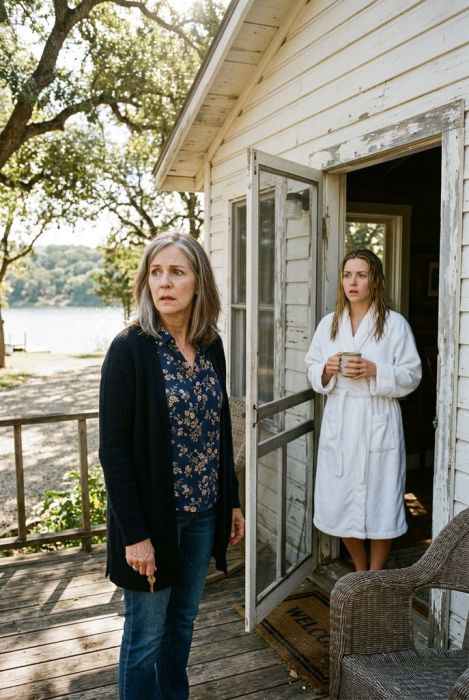
The cabin sat at the end of a gravel road lined with live oaks — white clapboard, a porch that wrapped around to the water. It was beautiful, exactly the kind of place I'd clipped from magazines for thirty years. My hand shook as I climbed the steps, the brass key warm against my palm.
The door opened before I could use it.
A woman stood in the doorway with wet blonde hair and a white robe. She looked about thirty. Her toenails were painted the blue of a frozen snow cone, and she held a mug that said GIRL BOSS. "Oh," she said, smiling. "You must be the appraiser. Gary said you'd be by around nine."
I looked past her. A guitar leaned against the fireplace. Two wine glasses sat on the counter, one with lipstick on the rim. A man's flannel jacket — Gary's, the one with the burnt cuff from the barbecue — hung over the arm of the couch.
"I'm sorry," I said. "Wrong house."
I made it half a mile down the gravel road before I pulled over and lost my breakfast in the weeds.
I taught reading at Wills Point Elementary for thirty-two years. I retired at fifty-seven with a gold watch from the PTA and a card signed by four hundred children. My father, Frank Reilly, was a tool-and-die man who worked double shifts his whole life and left me a hundred and eighty thousand dollars when he passed in 2012. In the letter tucked into his will, he wrote: "This stays yours, baby. Texas is a community property state, and I don't want my son-in-law's name on a penny of it."
I put it in our house anyway. I told Gary the house was ours, the money was ours, everything was ours. That's the kind of wife I was. That's the kind of fool, too.
Gary and I met in 1987 at a party in Round Rock. He was a carpenter with a pickup truck and a smile that could start a fire. He built Whitfield Custom Builds from that truck into one of the busiest small contractors in Travis County. We raised our daughter Allie in a yellow house on Maple Street, and for a long time we were the couple other couples wanted to be.
The last two years, that yellow house got quieter. Gary lost twenty pounds and bought cologne I'd never smelled before. He worked weekends on "flips" that never turned up. His phone sat face-down at dinner, and when I asked who was texting, he said "the crew."
My girlfriends told me to check the credit card statements. Allie — our daughter, a CPA in Houston — told me to look at the bank app every morning. "Mom," she said, "I love Dad, but something is off with the money. I can smell it."
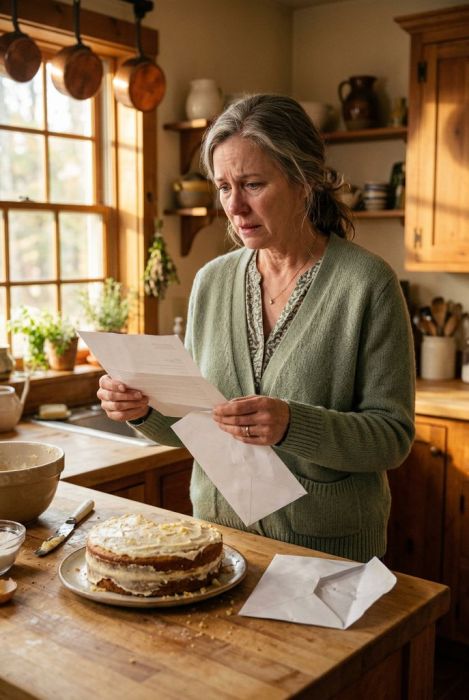
I ignored them. I was raised to trust my husband, and I was raised to believe a good marriage just survives a rough season. I baked his favorite lemon cake and pretended the season would pass.
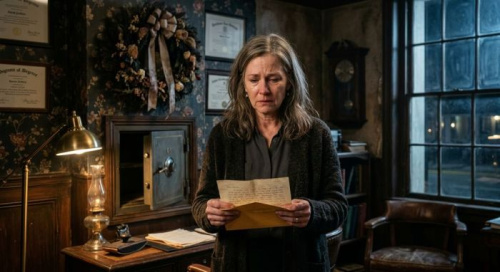
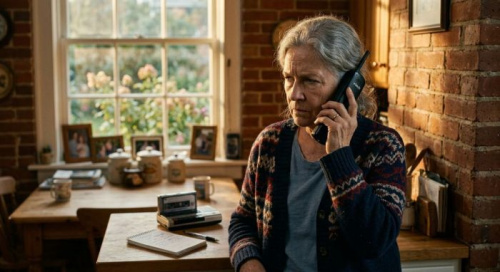
The morning after the cabin, I finally did what I'd been too afraid to do. I went through his home office — the cluttered cabinet I'd organized for thirty years, the one he never locked because, before this, he'd never had secrets.
The credit card statement was first. Two ribeyes at a steakhouse in Buda on a night he'd said he was at a job site. A hotel in Wimberley. A small gold ring from a jeweler. Not my size.
The second thing was worse. A photocopy of a home equity loan application on our family house — two hundred and ten thousand dollars. And on the signature line, my name, written in a hand so close to mine that I almost believed it.
Almost. I taught handwriting for three decades. My "y" has never once had a tail. The "y" on that page had a long, confident curl. Somebody had studied my signature and gotten one letter wrong.
I sat on the floor of his office with the photocopy in my lap and let the truth settle into me like cold water. My husband had forged my name to borrow against the home my father's money had helped buy. He had a cabin. He had a girl with wet hair and a GIRL BOSS mug. And he had handed me the key like a love letter, because the truth was — he wanted me to thank him for robbing me.
I did not confront him. Thirty-two years in a classroom taught me that the loudest child is rarely the one who needs the most attention, and the quietest one often wins the day. So I got quiet.
In the same cabinet I found the purchase agreement. Buyer: Cedar Hollow Holdings, LLC. Members: G. Whitfield, fifty-one percent. L. Cole, forty-nine. The earnest money had been wired from our home equity line — my father's inheritance, laundered through a loan I never signed, sitting on a lake with a stranger's toothbrush in the bathroom.
L. Cole. Lindsay Cole. Twenty-nine years old, worked at a title company in South Austin — which explained how a closing with a forged spousal signature had sailed through. Her social media was full of the cabin. Her bio read: "Girl boss. Lake life."
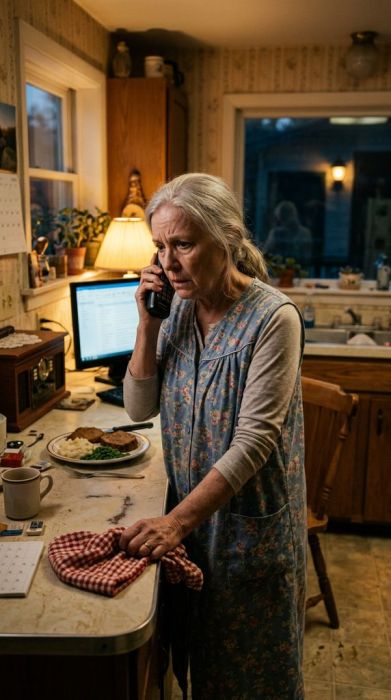
I called Allie first. She listened without interrupting, and when I finished she said: "Mom, I'm getting you a lawyer in Houston. Do not sign a single piece of paper. Do not even smile at him."
The lawyer was Diane Reyes, an ex-prosecutor with a voice like gravel and an office wall of trophies. Diane read the photocopy, looked up, and said: "He's done. He just doesn't know it yet."
But there was a trap, and Diane explained it plainly. In Texas, you can't sell a homestead without both spouses signing. Gary didn't want to sell the house. He wanted the house gone — the equity moved somewhere I couldn't reach. That's what the key was really for. A wife who feels guilty for doubting a generous husband will sign anything he slides across the table.
"So we let him think I'm grateful," I said.
Diane smiled. "We let him think you're stupid. There's a difference."
The plan was simple. I would play the grateful wife. I'd let him plan his big reveal — he wanted to show me the cabin in front of the family, make a moment of it. While he was busy being a hero, we gathered everything: the statements, the forged loan documents, the LLC records, the credit cards he'd opened in my name on his own.
There was one piece I couldn't gather alone. I needed Lindsay.
Five days later, when his truck GPS told me Gary was working in Bastrop, I left an envelope in the cabin's mailbox. The note inside said: "I know who you are. I'm not angry at you — yet. Meet me at the Oasis on Tuesday at ten, alone, and I'll make sure you're not the one who pays for his choices."
She came. That's how I knew Gary had lied to her, too — a girl who's sure of her man doesn't show up shaking to a stranger's coffee.
She told me Gary had said the marriage was over. That I was unwell and couldn't manage money. That everything he was doing was to protect "their future." He'd promised her the ring I'd found on the statement. Then she showed me his texts — the ones where he laughed about how easy I was, how I'd cried at dinner over a two-dollar key. She was twenty-nine years old, and she had the decency to look sick while she read them aloud.
"He forged your name," she whispered. "He told me you signed everything willingly."
"He'll tell you whatever you need to hear," I said. "He's very good at it. He's been doing it to me for thirty-five years."
Lindsay agreed to help. A week later she recorded a phone call — legal in Texas, one party consents — in which Gary bragged about the lake house, the loan, and his plan to leave me with nothing but the key I'd cried over. She handed over the LLC documents and the closing file. It was enough to put a man away for a long time.
Diane filed the fraud complaint with the Travis County Sheriff and the Texas Attorney General's office. The bank froze the equity line. I kept smiling at Gary through all of it, and I kept baking his lemon cake, and I let him believe he had already won.
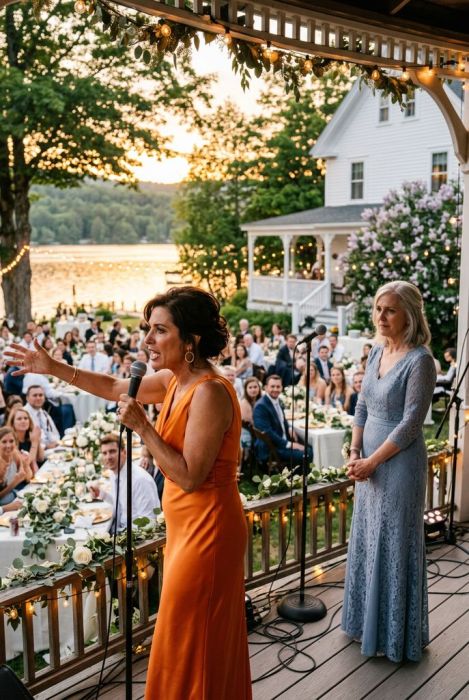
The reveal party was set for the first Saturday in October. Gary invited Allie, my sister Carol, and a dozen friends — he wanted witnesses for his great gift. He stood in the middle of the cabin with a champagne glass and a speech about thirty-five years of love.
"Nancy and I built everything together," he beamed. "And this — this is for all of it. Our retirement, right here on the lake."
I stood up. "Say 'thank you, sweetheart'?" he prompted. Everyone laughed.
"I will," I said. "But first I have a question. Gary — who is Lindsay Cole?"
The room went very quiet. His smile held one beat too long.
"She's... she was the Realtor," he said. "She helped me find the place."
"Is that right?" I said. "She tells a different story. So does the State of Texas."
The door opened, and two deputies came in behind Diane Reyes. Diane carried the file — the forged application, the LLC records, the recording. Lindsay walked in right behind them, and for the first time in my marriage, I watched my husband's face do something I'd never seen. It crumbled.
"Nancy, listen," he started.
"I listened," I said quietly. "I listened for thirty-five years. Now it's your turn."
They read him his rights in front of our friends, in front of my sister, in front of the cabin he bought with my father's money. One of his crew partners was there too, and I watched him pull out his phone and start calling. Whitfield Custom Builds unraveled before Gary ever reached the squad car — the phantom flips, the padded invoices, the loans. It all came apart like wet cardboard.
Gary was charged with forgery, theft, and fraud — felonies, all of them. The judge gave him eight years and ordered restitution. The equity line was voided because the signature was forged, and the bank had to unwind it. The cabin sold, and the money went back to the people he had stolen from. He lost his license, his company, and the girl — Lindsay moved to Colorado two weeks after the trial, and I don't hate her. She was a fool, but she was a young fool, and she paid for it by standing in a courtroom and telling the truth.
The yellow house on Maple Street is still mine. I paid off the mortgage with the restitution, and every Sunday Allie drives up from Houston and we sit on the porch and she tells me I'm the bravest woman she knows.
People ask why I don't sell the house and start fresh somewhere else. But that house is mine. My father's hands helped build it. My daughter learned to ride her first bike on its sidewalk. I'm not letting anyone else decide what happens to it — not my husband, not a judge, not a girl with wet hair and a white robe.
The brass key sits on my nightstand. I don't know what to do with it yet. Maybe I'll have it melted into a bracelet. Or maybe I'll leave it right where it is, a reminder of the day I learned that the people who love you can still rob you — and that being a fool for love doesn't mean you have to stay one.
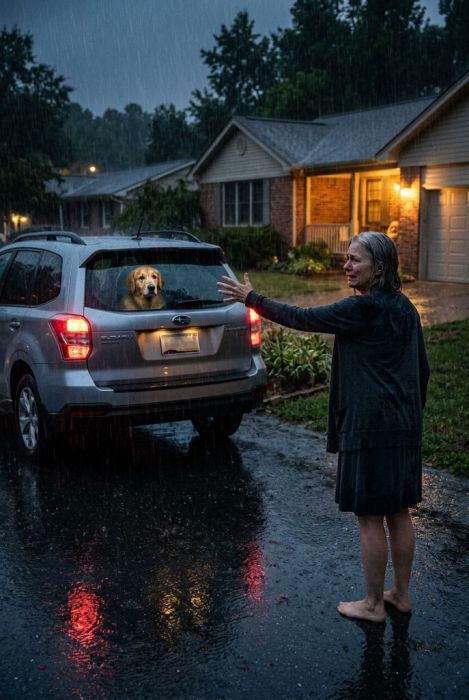
Yesterday I drove out to Dripping Springs one last time, just to watch the new owners move into the cabin — a young couple with a golden retriever. The wife was hanging a wreath on the door. She waved. I waved back.
"You lived here?" she called.
"No," I said. "I just came to see who got the good ending."
She laughed, and I drove home with the windows down, and I didn't hate anyone. That's the part nobody tells you about justice — it doesn't fix the heartbreak. But it does something better. It lets you close the door and walk away without looking back.