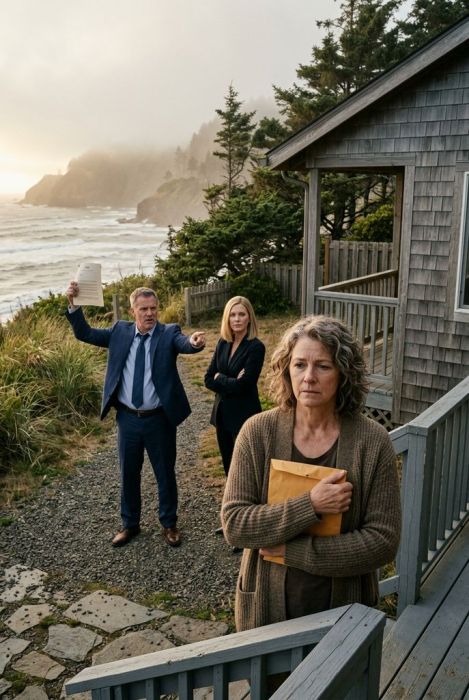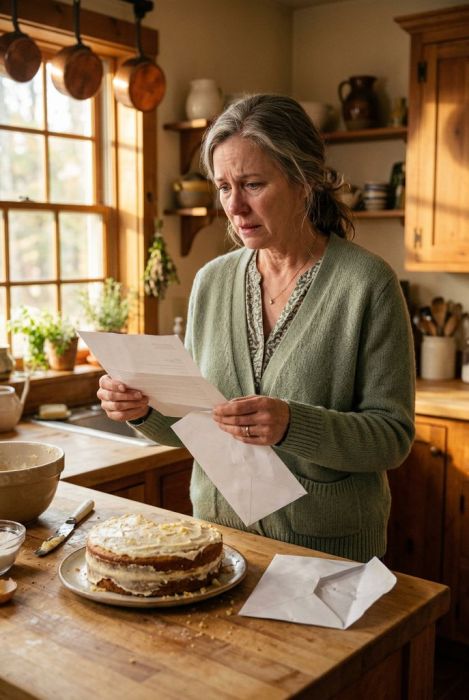
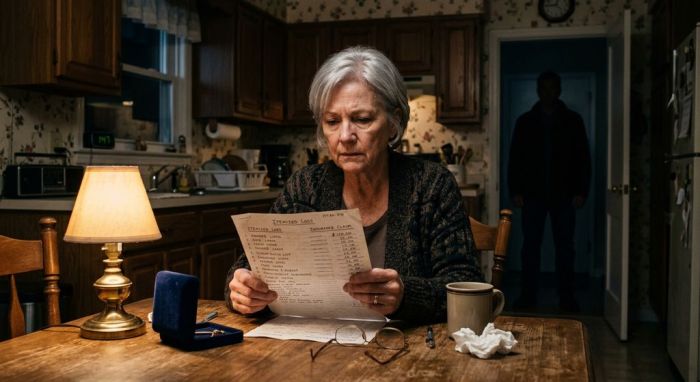
The day after my husband's funeral, my son stood in my kitchen holding a photocopy of Hal's insurance list and told the mother who had changed his diapers that she had stolen his father's coin collection.
"You were the only one here when he died," Craig said. The paper rattled in his hand, and I realized he was shaking — not with grief, but with something harder and colder. "I've done the math, Mom. That collection is worth over a hundred and eighty thousand dollars, and the safe is empty."
I had buried Hal at noon. By two o'clock, my own son was calling me a thief in the house where I'd raised him for thirty-eight years.
Hal and I had built everything we had together, dime by dime. The one thing he loved almost as much as his family was the collection of coins he'd started when he was twelve years old — Indian Heads, silver dollars, a complete run of Mercury dimes he'd bought with his newspaper money. Every coin had a story, and Hal told them all to anyone who would listen.
"I didn't take anything," I said quietly.
"Then you won't mind proving it." Craig laid the paper on my counter and smoothed it flat, the way a salesman sets out a contract. "I'm gonna be straight with you, Mom. Dad put me in charge of the estate, and I can't have people whispering that his own widow ran off with his retirement."
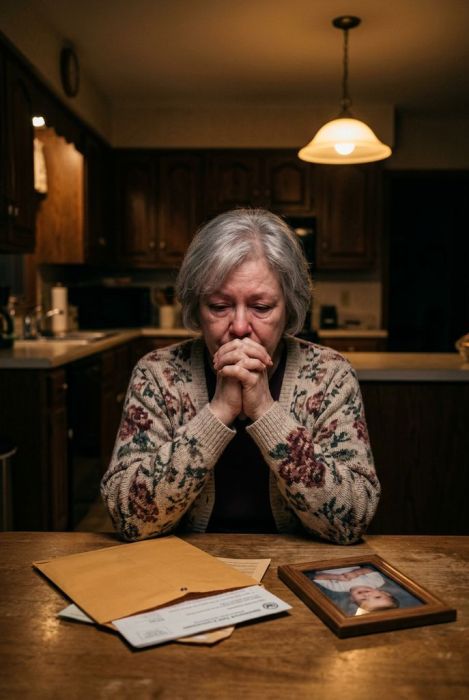
I stared at the ink on that page. Hal had updated the list himself last March, in his careful handwriting, with the word "APPRAISED" underlined in red at the bottom. The last time I'd seen it, it lived in the top drawer of his desk in the study. I had no idea how Craig got it, and I was too tired to ask.
"I'm in mourning, Craig."
"We all are," he said, and there was something thin and hollow in the way he said it. "That's why we need to get this settled fast. I made an appointment for Friday at nine. Eastland Polygraph Services, over on Congress Street. It's the best firm in Maine, and they're clean. You take the test, you're cleared, and everybody moves on."
I looked at my son — my beautiful, stubborn boy, who had once run to me with a scraped knee and a mouthful of lost tooth. I searched for the child I'd known and found only a stranger in an expensive suit, tapping his keys against his palm like he was waiting for a closing to go through.
"Fine," I said. "I'll take your test."
I didn't tell him who ran Eastland Polygraph Services. And I didn't tell him that I'd already called my brother.
Vince is twenty-two years older than me in the ways that matter and twelve years older on paper. He spent thirty years as a Maine State Police detective, worked every kind of case you can imagine, and retired with a drawer full of commendations and a reputation that still opened doors. When I called him that night, crying so hard I could barely speak, he listened to the whole story without interrupting once.
"When's the test?" he asked.
"Friday at nine."
"Then I've got three days to figure out who's lying," Vince said. "And baby sister, it was never you."
I should explain about Craig. He was an only child, born late, treasured beyond measure. Hal worked two jobs when Craig was little so I could stay home with him. We gave him piano lessons he quit, baseball gloves he outgrew, and a new car the day he turned sixteen. When he said he wanted to be a real estate agent, Hal used every contact he had to get him a start at a good agency, and for a while, Craig was the golden boy of our little corner of Portland.
Then the gambling started. We didn't know for years. Craig was smart about hiding it — clever, charming Craig, who could sell ocean views to people who lived on the third floor. It came out the night he showed up at our door at midnight, white as a sheet, with a loan shark's number saved in his phone and a story about a card game in South Portland that had gone wrong.
Hal paid the debt. Sixty thousand dollars, from money we'd set aside for our own old age, and he never once made Craig feel small about it. "Everybody stumbles," Hal said. "What matters is that he gets up."
But Hal kept the safe in the study after that. He told me it was just so the coins would have a proper home, and I believed him, because I wanted to. Hal updated his insurance list every spring without fail, and he started keeping the spare key on his own ring instead of in the kitchen drawer where Craig used to find it.
I only understood why much later, and by then it was too late to save anyone.
Hal got sick in the fall. It was quick and mean and unfair, the way those things always are. By winter he was in the hospital bed we'd rented for the study, with morphine drips and a parade of nurses and the two of us pretending not to see what was coming. Craig visited when he could, which was less and less as the weeks wore on, and I told myself his silence was grief. People grieve in different ways, I told the neighbors. He's just busy with work.
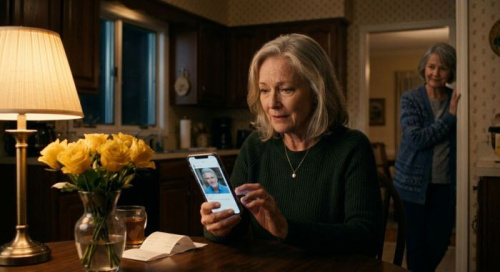
The night Hal died, Craig stopped by around eleven. I was asleep in my chair beside the bed, worn out from two days without rest, and he shook my shoulder gently and told me to go lie down, he'd sit with Dad for a while. I remember thinking what a good son he was. I remember patting his arm, shuffling to the bedroom, and falling into the deepest sleep I'd had in months.
Hal passed at 3:40 in the morning. I woke to the monitor's flat line and a house that felt suddenly, terribly empty. When I went downstairs, the front door was unlocked, and Craig's car was already gone.
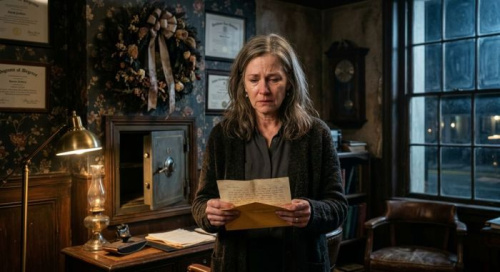
I found the safe open the next morning, when I went to find Hal's favorite blanket to fold for the hospice nurse. The money was still there — we'd always kept a little cash — but the coin boxes were gone. Every one of them. The velvet trays, the plastic albums, the old oak chest Hal's grandfather had given him. All of it, vanished into the cold January air.
I didn't tell anyone. I thought maybe the nurses had moved things, or that grief was playing tricks on my tired mind. I told myself I'd find the collection in a closet somewhere, safe and sound, and I buried my husband without mentioning it to a soul.
I was still a fool that afternoon, standing in my own kitchen, watching my son accuse me of theft. But I wasn't as much of a fool as Craig hoped.
The appointment was at nine on Friday, and I arrived at eight-forty-five in my best black dress, the same one I'd worn to Hal's service. Craig was already there, pacing the waiting room, his phone in his hand like a weapon. Behind a glass door, a man in a gray cardigan was calibrating a machine that looked older than both of us.
"I brought witnesses," Craig said, and gestured to a bench where his aunt Ruth and my cousin Mike sat with matching pitying expressions. "So everybody can see the results are real."
"That's fine," I said. "I've got nothing to hide."
The examiner opened the door then, and Craig's face did something complicated. He knew the name on the door — LINDQVIST, in gold letters. He'd heard that name at Thanksgiving dinners and birthday parties, attached to the old detective uncle who lived up north and told long stories about cases from the 1990s.
What Craig didn't know — and what he'd never bothered to ask — was that his Uncle Vinny had become certified in polygraph examination after he retired, and that Eastland Polygraph Services had been his business for ten years.
"Good morning, Mrs. Marshall," Vince said, and his voice was perfectly professional, betraying nothing. "I understand we have a delicate situation today."
Craig recovered quickly. "Right. Sir, I want to be clear — I hope she passes. I really do. She's my mother."
Vince nodded and invited me inside. The test itself is a blur in my memory — wires and straps, questions repeated three times over, the little pen scratching across the rolling paper. Vince asked me about the coins, about the safe, about whether I'd sold anything, about whether I had ever taken so much as a silver dollar without Hal's blessing. I answered every question the same way, with the truth, and my hands were steady by the end.
"Her results are clean," Vince announced when it was done. "She's telling the truth."
Craig's relief was theatrical. He hugged me — actually hugged me, right there in front of Aunt Ruth and Cousin Mike — and said he'd known it all along, that he was sorry, that his grief had made him say things he regretted. It was the performance of a lifetime, and for one small, weak moment, I almost believed it.
Then Vince closed the door and said, "Before you go, Craig, there's one more thing."
He set a small digital recorder on the table and pressed play.
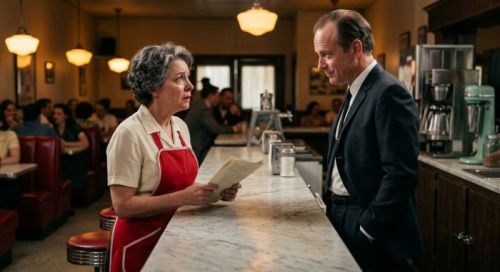
The room went very quiet. The voice that filled the room was Craig's — unmistakably his, that salesman's smoothness, that practiced charm — and the man he was talking to about "the polygraph examiner" was Vince, meeting him the night before at a diner on Forest Avenue, just as my brother had planned.
"Look, I don't know how these things work," Craig's voice said. "But I hear the machine can be... made to lean one way or the other. I've got five thousand in cash right now, and there's another ten in it for you if she comes out dirty."
Silence. Then: "Why would you want your mother to fail?"
"Because she took the collection," Craig said, "and she's gonna pay for it. That's all you need to know."
"Where is the collection now?"
"None of your business." The recording crackled. "Do we have a deal or not?"
The real Craig in the room had gone gray. His mouth opened and closed, but no sound came out.
"That's tampering with a court-ordered examination and attempted subornation," Vince said calmly, "and if you're wondering how I know about the storage unit, your wife told me. She found the boxes at Lakeside Storage, unit 114, when she went looking for your 'business papers.' She's been carrying the receipt in her purse for three days, trying to work up the courage to do the right thing."
The conference-room door opened, and Diane walked in. My daughter-in-law, who I'd always thought of as cool and distant, who I'd blamed for pulling my son away from us — she was crying, and she set the crumpled receipt on the table with a hand that shook.
"I'm sorry, Joan," she whispered. "I couldn't let you take the blame for what he did."
From there, everything happened the way it does in every small city when a respected family falls apart. The police arrived with a warrant, and Craig was arrested in front of his own aunt and cousin — the "witnesses" he'd brought to watch me fail. The boxes came back from storage, most of the coins intact, though Hal's best pieces — the 1909-S VDB penny, the Walking Liberty dollars, a dozen Mercury dimes in mint condition — had been sold to dealers across New England to cover a gambling debt that had doubled since the night Hal bailed him out.
Craig's confession was not long in coming. The plea deal stripped him of his real estate license, ordered restitution, and gave him a record that would follow him for the rest of his life. Diane divorced him that spring and moved with the kids to her sister's place in Vermont, and for the first time in years, she and I talk on the phone like family.
I kept the house on Chestnut Street. I kept the safe too, though I don't use it much. The estate attorney wrote me a letter officially closing the matter with my name cleared "in full," and I framed it beside Hal's photograph in the hallway, where the mailman and the neighbors can see it when they come to visit.
As for the coins — I sold most of them in the end, through an honest dealer Vince trusted, and I used the money to endow a music scholarship at Deering High School, where I taught choir for thirty years. Hal would have liked that: coins turning into song, into kids who couldn't afford lessons, into a chorus of young voices at the winter concert.
I kept five pieces for myself. Hal's first Indian Head penny. The 1892 silver dollar his grandfather gave him. Three Mercury dimes he carried in his pocket every day of our marriage, worn thin and soft as river stones. I keep them in a blue velvet box on my dresser, and when I hold them, I can almost hear him telling their stories again.
The grandchildren come to visit some weekends now that Diane has joint custody and Craig's gone. Emmy, who is seven, asked me once if the coins were worth a lot of money. I told her yes, but not the way people think. "They're worth what they mean," I said. "Your grandfather carried these three dimes every day for over forty years. That's what makes them priceless."
She put the Indian Head penny in her pocket and promised to keep it safe, and I thought about how Hal would have loved her, and how some things, once given freely, can never be stolen.
It's spring in Portland now. The harbor smells like salt and diesel, the lilacs are blooming along Congress Street, and I walk past the gold letters on the polygraph office every now and then, just to wave at my brother. People still stop me at the market to tell me how sorry they are for what happened, and I always tell them the same thing.
"I did lose a son," I say. "But I found the truth, and a daughter I never really had."
The collection is gone. The house still smells like Hal's coffee. And somewhere in a state storage facility, on a shelf under a number, there are boxes of my husband's coins waiting to be sold for the education of children he never met.
He would approve. He was always a man who believed in putting something back, and in the end, the only thief in our family learned the one lesson he never wanted to hear: that coveting your neighbor's treasure only makes you poor — even when your neighbor is your own mother.