The first time I saw my name on a piece of paper I had never touched was a Tuesday morning, eight-fifteen, in the roastery I'd helped build with my own two hands.
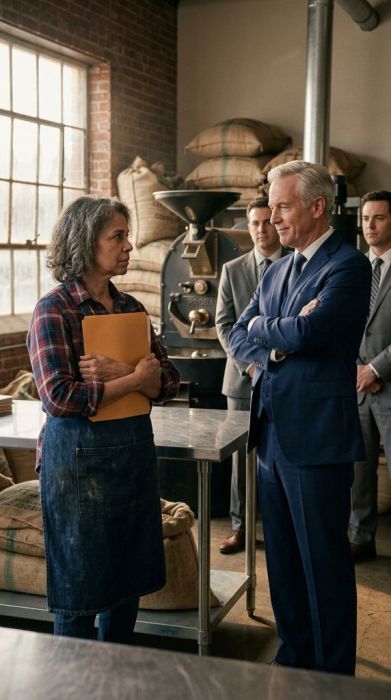
Two men in gray suits stood beside Gary Whitaker at the end of the counter. Behind them, the old Probat roaster hummed the way it always did this time of day, and the smell of the Peruvian batch filled the front room. For a second, everything felt normal. Then Gary cleared his throat and handed me a letter.
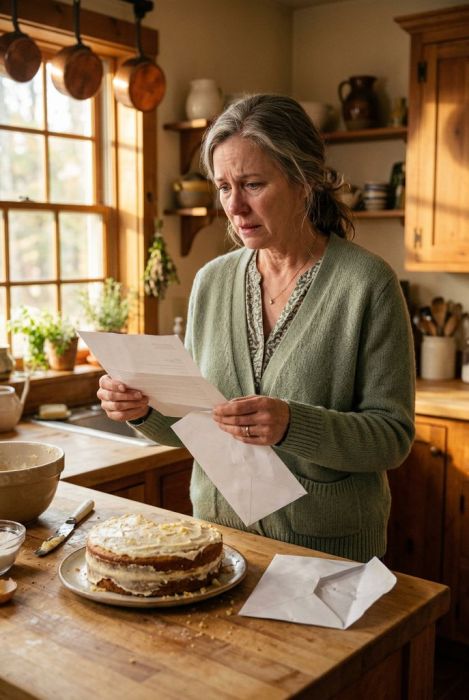
"RE: Sale of Mountain Arrow Coffee Company." Beneath it, a paragraph informed me that BrewBridge Partners had acquired the company for two point six million dollars, that the transaction had been approved by "the sole signing officer," and that my employment "concludes effective immediately."
I read it twice. Then I looked at Gary, my partner of thirty-three years, the man who'd sat at my kitchen table when we were both twenty-eight and broke, and I asked him the only question that mattered.
"Who signed this?"
He wouldn't meet my eyes. "You did, Evie. Back when Nate was sick. You don't remember — you had so much on your plate."
Except I did remember. I remembered every signature I'd ever put on anything for that company, because since 1987 I have signed my legal name the same way, Evie Marie Malone, in full, every letter, on every document that mattered. My father taught me that after a bad check emptied our grocery money when I was sixteen. "Never abbreviate your own name, sweetheart," he said. "It's the one thing nobody can take from you."
The consent form in front of me said "E. Malone."
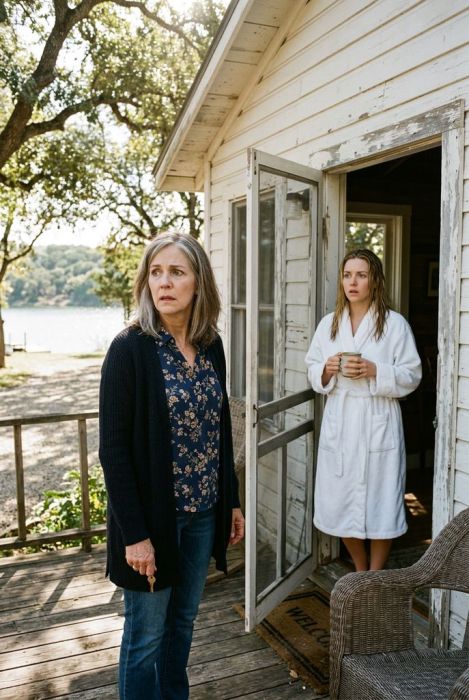
I didn't say anything about that right then. I just folded the letter, hung my apron on the hook by the door, and walked out into the gray Virginia morning while the two suits watched me go.
My husband Nate and I started Mountain Arrow in our garage in 1990. He roasted in a five-pound machine he'd rebuilt from scrap, and I drew the label on a napkin — the little blue mountain with the arrow through it — while our daughter Julia napped in a playpen beside the workbench. We sold our first bag to the diner three blocks away, then to a hotel, then to half the restaurants in Roanoke. Every label, every bag design, every blend name was mine. Nate cooked the beans and I gave them their soul.
Gary came in the second year, a friend of a friend who'd just lost his job at a bank. He put up twenty thousand dollars and wanted in. We gave him forty percent and a handshake, and he was good at it, too — the books, the schedules, the smooth talk with suppliers. He stood beside Nate at Julia's christening and beside me at Nate's funeral. That was the thing about Gary. He was always there, always helpful, always just slightly to the side of the frame, watching.
Nate died four years ago. Pancreatic cancer, the fast kind. He was sixty-one, and for the last three months of his life he made me promise only one thing: don't let anybody cheapen what we built. I thought he meant the coffee. I didn't know then how carefully he'd made sure of it.
After the funeral, Gary started "handling things" so I could grieve. He moved the company bank accounts to a different branch. He changed our insurance. He told me to focus on the roastery, "the way Nate would have wanted." I was so tired, so hollow, that I let him. I didn't go to the shareholders' meeting that year, or the year after. Julia told me I was giving away too much, but I couldn't see it. Grief makes you trust the people who stay.
The sale was announced in the Roanoke paper three days after the letter. "BrewBridge Partners Acquires Roanoke Coffee Icon." There was a photo of Gary shaking hands with a man named Hollis Renn, both of them smiling in front of our roaster. My phone rang all day. Journalists. The diner owner down the street. My old barista, crying. I sat on the couch with my daughter, and Julia held my hand and said, "Mom, you have to fight."
"I don't even know what I'm fighting," I said. "According to the paper, I sold my own company."
Except I hadn't. And that was the part Gary forgot to consider — that when you build something with your hands and your name, you know every single inch of it, the way you know your child's face.
I called Marcus Bell, the accountant who'd done our taxes since 1995. He'd been there for every filing, every expansion, every hard year. "Evie," he said, very quietly, "I never notarized any succession consent. And I have the original." When I asked him to describe it, I heard him shuffle papers. "The signature is flat, Evie. No loop on the E. It's not yours."
The notary stamp on the page belonged to a man named Travis Cole. Gary's golf partner. Travis had notarized it, according to the document, the week before Nate's funeral. But I knew, with a certainty that sat cold in my stomach, that I had never stood in front of Travis Cole in my life.
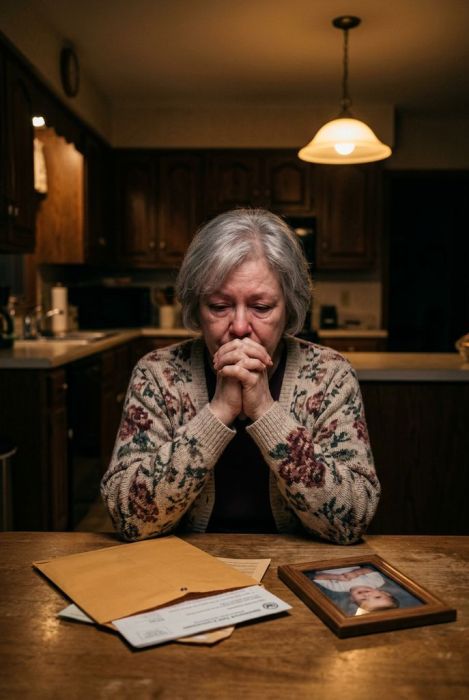
That's when I remembered the safety deposit box.
Nate opened it at Blue Ridge Bank when we incorporated, and for thirty years we paid the forty-two dollars a year without thinking about it. The key lived in my jewelry box, taped to the back of my grandmother's hand mirror. I hadn't opened the box since Nate died. That Sunday, with Julia beside me and the bank manager watching, I turned the key.
Inside was a stack of things I'd forgotten: the original incorporation certificate, our first wholesale contract, the receipt for the five-pound roaster, a drawer full of old napkin labels — and an orange folder with our address in Nate's handwriting.
Julia opened it first. When she looked up at me, her face had gone pale. "Mom," she whispered. "He thought of everything."
The folder held the trademark registration for Mountain Arrow Coffee Company — the name, the label, the little blue mountain with the arrow through it. And there, in the line marked "Owner," was my name, in full, in ink: Evie Marie Malone.
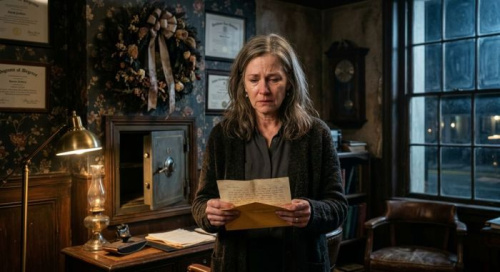
Nate had registered the mark in my name alone, a year before his first surgery. Behind the certificate was a handwritten letter, dated the week of his diagnosis. I read it four times in that quiet bank vault, holding the paper so tight my knuckles went white.
"Evie. If you're reading this, I'm gone. I registered the name in your name because the company was never about the money. It was about you drawing that label on a napkin while Julia slept in the playpen. I signed nothing away, and I put nothing in my name alone that could be used against you. If anyone ever tries to take it, remember: the name is yours. It always has been."
In his last weeks, Nate had asked me to sign a few papers, "housekeeping stuff," he'd called it. He'd looked tired and small against the hospital pillows, and I'd signed whatever he put in front of me without reading, because it was Nate, and I trusted him like I trusted the sunrise. Now I understood what he'd really been doing. He'd been building the safe I never knew I needed, brick by quiet brick, with a lawyer and an accountant and a bank box that cost forty-two dollars a year.
That Monday, I called Cassandra Hale and drove to her office with the orange folder. Cass was sixty-three, sharp as a tack, and she'd handled our estate for years. She read the registration, read Nate's letter, and then she did something I'd never seen her do before — she took off her glasses and wiped her eyes.
"Evie," she said, "BrewBridge didn't buy a coffee company. They bought a name. And the name belongs to you. Gary sold them something he could never deliver."
She wrote to BrewBridge that afternoon. I watched her type the words, and each one felt like hammer blows landing where they belonged: the consent was a forgery, the notary had never met me, the trademark was not part of any valid transfer, and the sale was void. The deal froze within forty-eight hours. Hollis Renn's legal team, I was told later, went very quiet and then very busy.
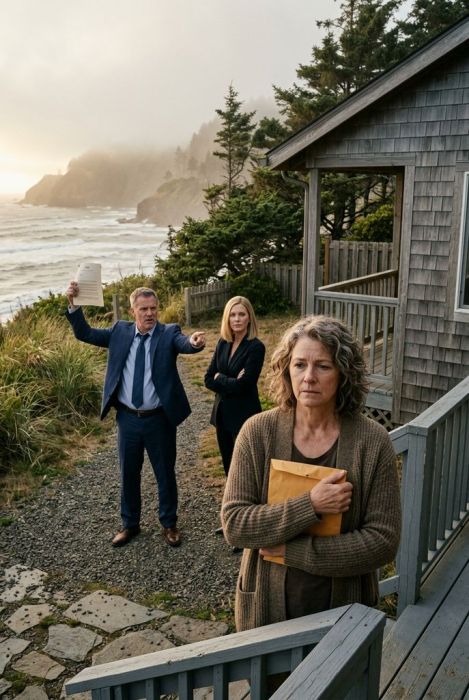
Gary came to my house that Friday, uninvited, red-faced, pounding on the back door. Julia stood behind me in the kitchen. Cass stood by the window with her phone in her hand, recording, the way we'd planned.
"You can't do this, Evie," he said. "You don't know how these things work. The deal is done. The money is spent. I'll give you a consulting role, five percent, everyone keeps their jobs — just call off the lawyers."
"Consulting role," I repeated. "In the company I built."
"Be reasonable," he said. "You're sixty-one. You've been coasting since Nate died. I did the work. I made the sale happen. I made us rich." He stepped closer, and his voice turned soft, the way it always did when he was about to lie. "You signed it, Evie. You just don't remember. Stress does that."
"The signature," I said, "is E. Malone. I haven't signed anything as E. Malone since 1987." I saw his face change, just a flicker, and I felt the calm settle over me that comes when you stop being afraid. "And I've never met Travis Cole. He's your golf partner, Gary. Sunday foursome, third tee, the one who owes you a hundred dollars from last summer's skins game."
His mouth opened. Nothing came out. Julia stepped forward and put her hand on my shoulder, and Cass's phone gleamed in the window light, and I watched thirty-three years of careful theater collapse in a single moment.
The closing meeting happened a week later at BrewBridge's office in Richmond. Hollis Renn had asked me to come in person, and I knew why — he wanted to see me, with his own eyes, the woman whose name his lawyers had been reading all week. Gary was there too, wearing the same navy suit, trying to smile, telling anyone who would listen that it was all a misunderstanding.
I let him talk. I let him tell the room that I was "emotional," that I'd "forgotten," that the company was better off with people who understood business. And when he finally ran out of words, I set the orange folder on the conference table and opened it.
I didn't raise my voice. I didn't need to. I held up the registration certificate so the whole room could see my name in full, in ink, in the line marked Owner. Then I placed Nate's signature from the incorporation papers beside the signature on the forged consent, and finally, I slid the forged page across the table to Hollis Renn myself.
"Mr. Renn," I said, "you paid two point six million dollars for a name that belongs to me. The man who sold it to you never owned it. He signed my name, Mr. Renn. He signed my name to sell the life my husband and I built together."
The room got very quiet. Hollis Renn looked at the papers for a long time, then at Gary, and I watched a grown man in an expensive suit shrink into his chair. His own lawyers began to speak — statutory fraud, misrepresentation, void ab initio, deposits to be returned, damages to be pursued. Gary tried to stand, tried to say something, but the state police officer I had quietly requested, the one Cass had coordinated with the week before, stepped through the door with a calm that made the room go still.
"Gary Whitaker," he said, "you need to come with us."
I won't pretend I felt nothing when I saw him handcuffed in that conference room, because I did. I felt thirty-three years of dinners, and handshakes, and standing beside his father's casket, and all the ways a person can fool everyone who loves them. I felt the weight of it. But I also felt the strange, clean lightness of a thing finally over.
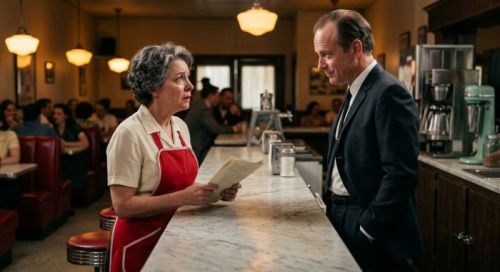
BrewBridge, to their credit, came back to me three weeks later with a different kind of offer. No forgery, no fancy lawyers. Hollis Renn himself drove to Roanoke, ordered a pour-over at my counter, and asked, very politely, whether I'd consider a licensing agreement that would put Mountain Arrow in two hundred stores, with the roastery, the staff, and the name all staying exactly where they belonged. I told him I'd think about it. I told him I wanted to see the draft first, every line, in full, with my own eyes. He laughed and said that was exactly why he wanted to do business with me.
Gary was indicted on charges of forgery and attempting to obtain property by false pretenses. I went to the first hearing, not to watch, but to sit in the back row and remind myself that justice, when it comes, often arrives in quiet rooms with ordinary paperwork. His wife of forty years filed for divorce. The lake house he'd planned to buy with the sale money went on the market. I heard he lost the Sunday foursome too — Travis Cole stopped returning his calls.
As for me, I hired back all fourteen people. I kept the old Probat roaster, and the napkin label, and the smell of the Peruvian batch in the mornings. I named the holiday blend "Nate's Last Cup," and it sold out in eleven days, and I stood in the roastery at dawn one morning and cried a little, and then I laughed at myself, and then I got back to work.
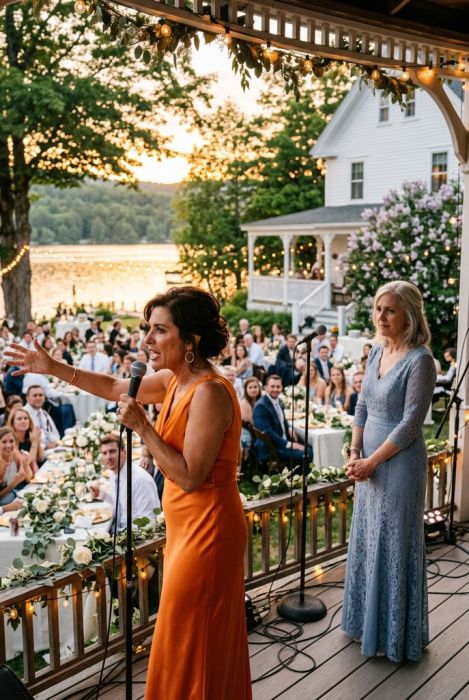
Julia asked me once, at the reopening party, whether I hated Gary. I thought about it while the string lights flickered and the neighbors toasted the new blend.
"I don't hate him," I said. "I just finally understand him. He thought the company was a thing you could sell. But the company was a name my husband trusted me to keep."
I tapped the glass case where the orange folder now lives, between the first napkin label and the receipt for the five-pound roaster. "You can forge a signature," I told her. "But you can't forge a life's work."
She hugged me, and the music started up, and somewhere in the crowd someone called out that the coffee was the best they'd ever had, and I smiled, because it was — because it always had been, and because the name on the door was still mine.