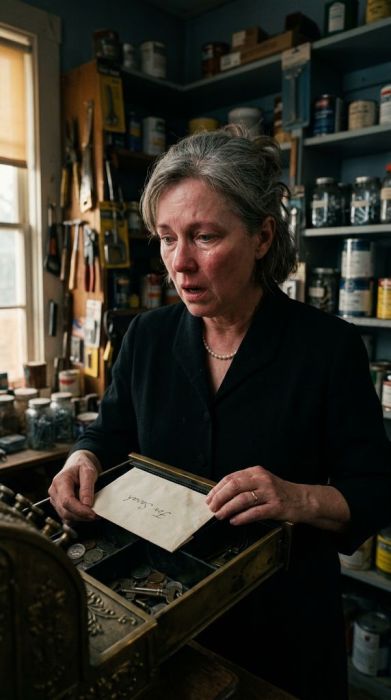
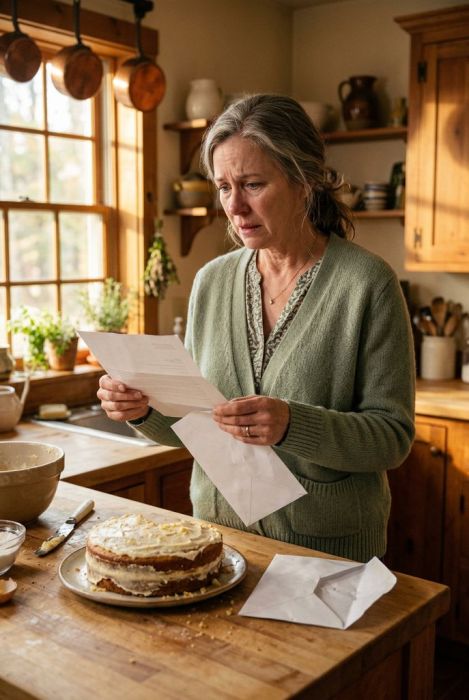
The day the county envelope landed in my mailbox, I was frosting a lemon cake for Rita's grandniece's baby shower. The cake was the only reason I answered the mail at all that afternoon. I had been avoiding the mailbox for weeks, the way you avoid a phone you're afraid to answer. Since Ray died eighteen months ago, every piece of mail seemed to carry another piece of bad news — another bill, another form, another reminder that he was gone and I was still here, trying to figure out how to keep breathing.
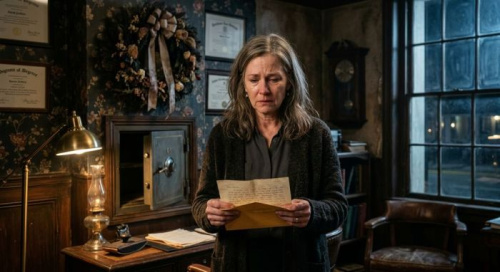
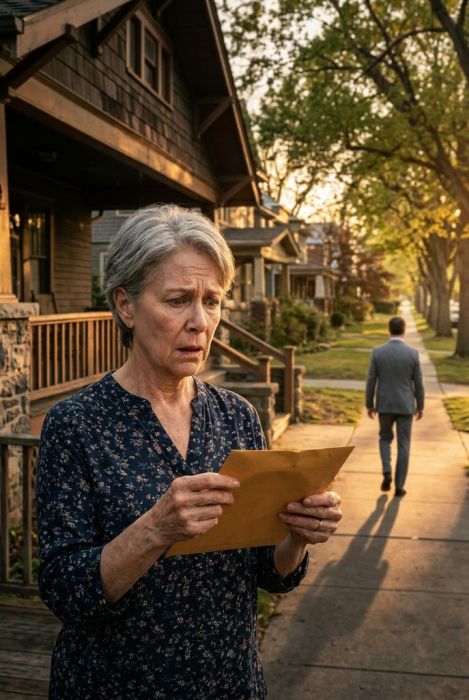
The envelope was plain and official, the kind that makes your stomach drop before you even open it. The return address said the County Auditor's Office. I thought it was a mistake at first. Ray had always paid the property taxes himself, every single year, in person, the way his father had done before him. "Never let the county forget you own it, Dot," he used to say, tapping his chest. "You pay them to your face, they treat you like a person." I tore the envelope open with my thumb and read the words that turned the whole afternoon cold.
"NOTICE OF DELINQUENT PROPERTY TAX — SALE SCHEDULED."
I had to read it three times. The address listed on the notice was the little yellow house on Juniper Street — the first house Ray ever bought, the one he'd fixed up with his own two hands when we were twenty-three and had nothing but each other and a rusty pickup truck. We'd rented it to the Millers for eleven years. It had never, not once in forty years, been delinquent on a single tax bill. And yet there it was, in black and white: the house was going up for auction because the property taxes hadn't been paid for two years.
My hands were shaking so badly I had to set the cake down.
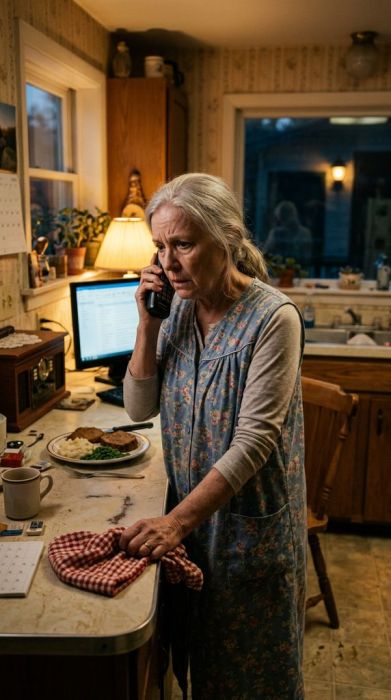
I called Rita before I even thought about it. She was the first number in my phone, the way she'd been the first person in my life since first grade. We'd shared every secret, every heartbreak, every triumph. She was the one who sat beside me at Ray's funeral and held my hand through the whole service without letting go. She was the one who moved my garden chairs to the shade and brought me soup when I couldn't get out of bed. When Ray's business papers became too much for me, when I couldn't look at the ledgers without crying, she was the one who said the words that became my lifeline.
"Let me handle the paperwork, Dot," she'd said, stroking my hand. "You just grieve. That's all you have to do right now. You just grieve, and I'll take care of everything else."
I'd signed the power of attorney without reading it. That's the part I have to live with, the part that still burns. She handed me a pen and a stack of papers and told me it was so she could pay the bills and collect the rents, and I signed my name in all the little boxes because I trusted her more than I trusted my own handwriting. She was Rita. She'd been Rita since we were six years old, trading crayons and hiding our lunch money together in a hollow tree behind the school. She was not the kind of person you read documents for.
Now, standing in my kitchen with the county notice in my hand, I kept waiting for her to tell me it was all a mix-up. That the county had made an error. That she'd take care of it.
"Rita," I said, my voice thin as thread, "there's a notice here about the Juniper house. It says the taxes weren't paid. Two years' worth. They're going to auction it."
There was a pause. A long one. I heard her exhale, and something in the sound of it made the hairs on my arms stand up.
"Oh, that," she said lightly. "That's just a form letter, honey. The county sends those out by mistake all the time. I'll call them Monday and get it straightened out. Don't you worry your head about it."
But I did worry. I couldn't stop worrying. Something about the way she said it — too fast, too bright, the way she talked when she was selling raffle tickets for the church and didn't want anyone asking questions. I'm not a suspicious person. I never have been. But grief has a way of sharpening your eyes, and that afternoon, for the first time in fifty years, I looked at my best friend and felt a cold thread of doubt wind around my heart.
I didn't call her back. Instead, I did something I'd never done before. I went into Ray's study — the little room I'd been avoiding since he died — and I started opening drawers.
What I found there over the next few days broke me open in ways the funeral never could.
Ray had been a careful man. Not a flashy one, but careful. He kept copies of everything: every deed, every title, every bank statement, every tax receipt, filed in manila folders with neat labels in his careful block handwriting. And because he was careful, he'd also kept something else: a small green notebook, the kind you buy at the hardware store, with every property listed and every tenant's rent written down in pencil. The last entry in that notebook was dated the month after he died.
The handwriting wasn't Ray's. It was Rita's.
I sat in his chair and went through that notebook page by page, and with every page my stomach dropped lower. The rents were still coming in — six houses, steady money, just like always — but they weren't going into the account I knew about. The account I'd given her access to. There were other numbers in the margins, amounts I didn't recognize, little initials that didn't match anyone I knew. And under the Juniper house, she'd written one word in the margin, circled twice.
"Auction."
My daughter Sarah came home that weekend. She'd been living in Chicago for eight years, married to a man I barely knew, and we'd drifted into the kind of polite distance that hurts worse than a fight. I called her because I didn't know who else to call, and she was on a plane before I'd finished explaining. That was the first good thing to come out of this mess — my daughter came home. She looked at the notebook, looked at the county notice, looked at me, and said, "Mom, we're going to the courthouse tomorrow."
The county recorder's office smelled like old paper and floor wax. Sarah asked for the tax records on all six of Ray's properties, and the clerk, a young woman with kind eyes and a voice that went quiet when she saw what we were looking at, printed out a page for each one. Three of the pages made my knees buckle. Three of Ray's houses — the Juniper house, the house on Grove Street, and the little gray duplex on Mill Road — were in active tax default. Two of them had already been sold at auction six months ago.
I remember asking the clerk, in a voice I didn't recognize as my own, who had bought them.
She looked at the records and read the name off the page. "Whitmore Holdings, LLC," she said. "Registered to a Rita Anne Whitmore."
My best friend of fifty years had bought my husband's houses out from under me at a tax auction. She'd stopped paying the taxes — using the power of attorney I'd signed in my grief — let the county seize them, and then bought them back herself, in her own company's name, for pennies on the dollar. She'd collected the rents the whole time and pocketed them. And she'd done it all with a smile on her face and casseroles in my freezer, telling me to "just grieve."
I won't pretend I handled it with grace. I sat down in that courthouse hallway and I cried until I couldn't see straight. Sarah held me, and the clerk brought me a cup of water, and I cried because I was angry and hurt and humiliated and so, so tired. Forty years Ray and I had built those houses. Every nail, every dollar, every Saturday he spent fixing a faucet while I painted a bedroom. And she'd taken it all while I was learning to sleep alone.
But Ray was careful. And because Ray was careful, I had one more thing in his study: a fireproof lockbox I'd almost forgotten, hidden behind a loose board in the back of his closet. I found it that night, after Sarah had gone to bed, and I opened it with the combination I'd watched him set a hundred times — our anniversary, backwards.
Inside were the original deeds to all six houses. Ray had kept them himself, the way his father had, rolled up and rubber-banded and smelling faintly of sawdust. And under the deeds, in the bottom of the box, there was a note in Ray's handwriting that I'd never seen before. It was dated two weeks before he died.
"Dot, if anything ever happens to me, don't sign anything without Henry. Henry knows. I love you."
Henry. Henry Whitaker, the lawyer Ray had played poker with for thirty years, the man who'd drawn up the trust for our wills and who'd come to the funeral with red eyes and a firm handshake. I'd forgotten all about Henry. Rita had made sure I did — she'd told me, early on, that Henry had "retired" and that she'd found us a "new, younger man" to handle our affairs, someone more modern. I'd never questioned it. I'd never called Henry once.
I called him at seven the next morning. He answered on the first ring, and when I told him my name, his voice went heavy. "Dot," he said slowly. "I've been waiting for this call for a year and a half."
Henry told me everything. He'd had suspicions about Rita for months — little things that didn't add up, money that moved sideways, tenants who'd called his office asking why they'd been told to make checks out to a "property management company" that didn't exist. He'd tried to warn me twice, but Rita had intercepted the messages. She'd told me he was senile, that he'd lost his mind, that he'd been saying terrible things about everyone since his wife died. And because she was Rita, and Henry was just an old man I hadn't seen in years, I'd believed her.
"Here's the good news, Dot," Henry said. "Those tax sales are void. Both of them. The law requires the county to send notice to the property owner by certified mail, to the registered address on file. Rita signed for those notices herself — she signed your name, using the power of attorney, and she never gave them to you. That's not just a mistake. That's fraud. Forgery. Financial exploitation of an elderly person, which in this state is a felony."
I didn't feel powerful when he said it. I felt sick. I'd spent a year and a half trusting the wrong person, and the price was written in county records with a name I'd known since I was six years old.
But there was still one house left. The little gray duplex on Mill Road hadn't gone to auction yet. It was scheduled for the county sale that Friday, and Henry told me that Rita planned to be there, ready to add it to her little collection.
"We could go through the courts," Henry said. "We'd win. But it would take months, and she'd have time to sell the other two and disappear with the money. There's a faster way. Are you up for it, Dot?"
I thought about Ray. I thought about the note he'd left me. I thought about forty years of Saturdays and sawdust and the feeling of a house that was truly, finally, ours. And I said yes.
Friday morning, I put on my good blue dress, the one Ray had bought me for our fortieth anniversary, and I walked into the county courthouse like I was walking into church. Sarah was on one side of me. Henry was on the other, carrying a leather folder that held the original deeds and a stack of certified documents. And there, in the front row of the auction room, sat Rita, in her good navy suit, with a smile on her face and a checkbook in her hand.
The auctioneer called the Mill Road duplex. Rita raised her paddle, smooth and confident, like she'd done it a hundred times. And I stood up.
I've replayed that moment a thousand times since, and it never gets old. I walked to the front of that room and I said, "Excuse me. That property is not for sale."
Rita turned and saw me, and for the first time in fifty years, I watched her face go pale. Her smile didn't fall — it froze, like a photograph. "Dot," she said, and her voice was wrong, too high, too bright. "What are you doing here, honey? This is no place for you."
"This is exactly the place for me, Rita," I said. "Because that house belongs to me. It always has. And so do the other two you bought at auction with money that was never yours."
I held up the original deed, and the auctioneer — an old man with a kind face who'd known Ray his whole life — leaned forward and read the name on it. Then Henry stood and began to speak in that slow, measured way of his, laying it all out in front of God and the county: the power of attorney, the forged signatures, the tax notices she'd signed and hidden, the tenants she'd told to pay her directly, the shell company registered in her name. He laid the certified documents on the table one by one, and with each one, Rita's face went a shade whiter.
"It's a misunderstanding," she said, but nobody was listening. "We're best friends. Fifty years. I would never — "
"You signed my husband's name," I said. "You stole my houses. And you called me honey the whole time you were doing it."
The sheriff had been called by then — Henry had arranged it quietly before the auction even started. Two deputies came in and stood beside Rita, and the room went so quiet you could hear the old clock on the wall. Rita looked at me, and in her eyes I saw something I'd never seen in fifty years of friendship: not shame, not regret. Just panic, and a cold, animal surprise that she'd been caught.
"Dot, please," she whispered. "We can work this out. Just you and me. Like we always did."
"Just you and me," I repeated. "That's the problem, Rita. It was never just you and me. You had a whole plan, and I was the only one who didn't know about it."
The deputies led her out. She didn't look back, and I didn't watch her go. I stood there in my good blue dress, in the courthouse my husband had paid taxes to for forty years, and I held the deed to my house in my hand and I did not feel victorious. I felt old, and tired, and a little bit hollow. I'd lost a best friend — and the friend I'd lost had never been the woman I thought I knew.
But here's the thing about Ray's houses. They came back. All three of them. Henry filed the motions that week, and because the sales were void from the start — fraud, plain and simple — the county set them aside and returned the properties to me. Rita was charged with forgery, identity theft, and financial exploitation of an elderly person. The newspaper ran the story, and people in this town, the town Ray had helped build, read every word of it. The woman who'd brought everyone casseroles for thirty years lost her church committees, her bridge club, her place in line at the bakery. Her own daughter stopped answering her calls.
I didn't gloat. I'm not built for gloating. But I'll admit, when the letter came confirming that the Juniper house was mine again, I sat on the porch and I cried — not for what I'd lost, but for what I'd almost lost. For the way grief had made me small, and trusting, and easy to take from.
It's been two years now. I still live in the house Ray built. I still collect the rents, and I pay the taxes myself, in person, every year, the way he taught me. Sarah and I are close again — she visits every other month, and her husband is a good man who calls me "Mom" and means it. I sold the duplex on Mill Road, not to a stranger, but to a young couple, newlyweds who remind me of Ray and me at twenty-three. I put the money toward a trust for my granddaughter, the one who's due in the spring.
And every now and then, when I'm in the garden and the afternoon sun is warm and the world feels quiet, I think about Rita. I think about fifty years of friendship and a checkbook and a forged signature, and how a person can know you your whole life and still never really see you. I don't hate her anymore. Hate is heavy, and I've carried enough weight.
I think Ray knew. That's what gets me, in the end. The note in the lockbox, the careful files, the deeds kept safe — he'd seen something in Rita I couldn't see, and he'd built the walls to keep me safe anyway. He'd left me a way back, when I couldn't find one myself.
The little yellow house on Juniper Street has a new coat of paint now. I did it myself, a Saturday project, with a roller and a ladder and Sarah's husband holding the base. It's rented to the young couple, and they pay me every first of the month, in person, with a handshake. "Never let the county forget you own it," Ray used to say.
I never will. And nobody's ever going to take it from me again.