The first time I ever seriously thought about flying to meet Daniel, I had the airline app open on my phone and my good suitcase pulled down from the attic. It was a Tuesday night in early March. I remember because I had just come home from the Widow's Circle at St. Andrew's, and Peggy had hugged me goodbye at the church door and whispered, "Maggie, honey, that man is a blessing. Go. Be happy. Harold would want this for you."
What I didn't tell Peggy, what I couldn't tell anyone yet, was that I had already started to wonder if Daniel Whitmore was real at all.
My husband Harold had been gone six years. He died the way the doctor said he would, quiet and sudden, a stroke that took him between the kitchen and the front porch. For forty-two years he had been my whole world, and then, in the space of an afternoon, the world just stopped. The quiet followed me from room to room. It sat down at the dinner table across from me. It climbed into bed beside me and reminded me, every single night, that I was alone.
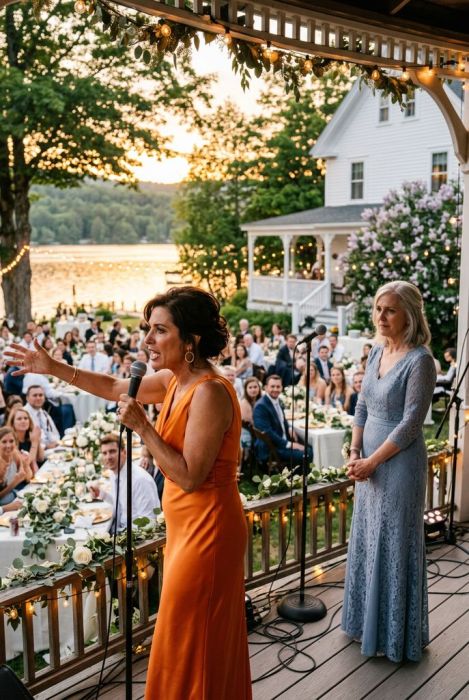
It was my daughter Elena who first suggested the Widow's Circle. "Mom, you need people," she said from Chicago, where she worked as a paralegal. Then one rainy October evening, I drove to St. Andrew's basement and sat in a folding chair with eleven other women who had all lost the other halves of themselves.
That was where I met Peggy Sorensen.
Peggy was sixty-seven, a widow of nine years, with silver hair cut neat and kind eyes that crinkled when she smiled. She had lost her husband, Ray, to a long illness, and she talked about him the way I talked about Harold — with love that had softened into something almost peaceful. "You're going to be all right, Maggie," she told me. "It just takes time. And company. You can't do grief alone." I went back the next week. And the week after. Peggy and I started sitting together. She'd bring coffee, I'd bring cookies. She became, faster than anyone since Harold, my person.
So when, one night in February, I mentioned that I missed having someone to talk to at night, she looked at me with that warm smile and said, "You know, I have a friend. A widower. A lovely man. His name is Daniel Whitmore, and he's a retired civil engineer, and he's been alone even longer than you. Would it hurt to say hello?"
I laughed it off. "Peggy, I'm sixty-four years old. I'm not going on dates."
"It's not a date, honey. It's just a hello. What do you have to lose?"
What did I have to lose. I think about that question a lot now. The answer, it turned out, was nearly everything I owned.
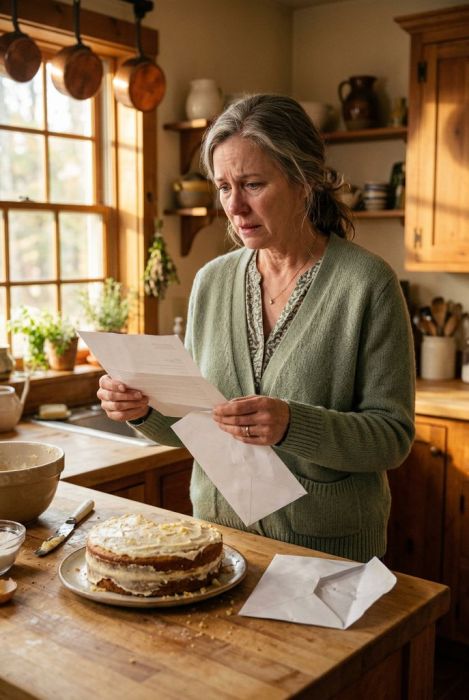
Daniel's first message came the next evening, through a dating app Peggy set up for me on my phone because I was "hopeless with technology," as she liked to say with a fond laugh. "Hello, Margaret," it read. "Peggy tells me you lost your husband, and that you loved him very much. She says you make the best lemon bars in Iowa. I'd like to know the woman who bakes with that much care."
I answered. By the end of the week, we were talking every night, and I was reading his messages over my morning coffee like they were love letters.
Daniel Whitmore was everything I thought I'd never have again. He was sixty-eight, a widower of five years, a retired civil engineer working on a project in South America, he explained, which was why we couldn't meet right away, but he promised it wouldn't be forever. He asked about my garden. He asked about Harold, and he listened, truly listened, when I told him about our forty-two years. "You loved him the way love is supposed to be," he said once, his voice thick with feeling. "Some of us never get that. I'm grateful you're sharing it with me."
He called me his angel. The first time he said it, I laughed out loud in my empty kitchen. The fiftieth time, I pressed the phone to my ear and cried.
The gifts came after that. A bouquet of yellow roses, delivered to my door with a note signed only "D." A box of expensive chocolates. A card for Valentine's Day that made me weep into my pillow. Peggy came over the day the roses arrived and clapped her hands. "See? I told you, Maggie. A gentleman. A real blessing."
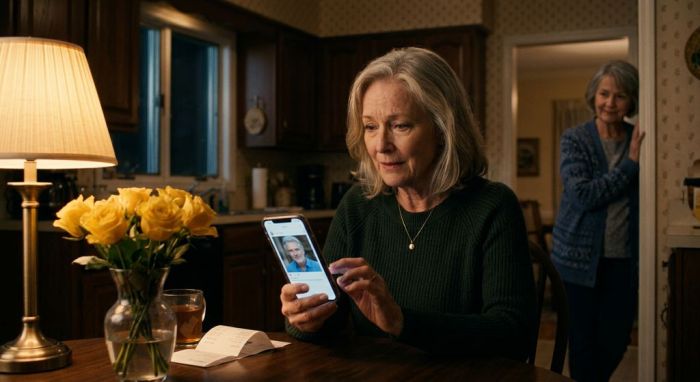
The one thing Daniel never did was show me his face. He sent photographs — a handsome, silver-haired man in a suit on a boat; the same man in a hard hat at a construction site; the same man holding a fishing rod on a lake at sunset. He sent voice notes, deep and warm, and we talked on the phone for hours. But every video call failed. "My laptop camera cracked when I dropped it on a site in Cali," he said. "Soon. I promise you'll see all of me soon." I believed him. He had come into my life through my dearest friend. What kind of person doubts a blessing that arrives wearing the face of trust?
The first time he asked for money, I almost didn't notice how it had happened. It was June, four months in. He was on the phone, his voice low and worried. "Angel, I'm ashamed to even ask this," he said. "But a subcontractor on this project walked off with the payroll, and the bank here is holding my bond. I'm short six thousand dollars until the insurance company sorts it out. I'd never ask, but I don't know who else to turn to."
I should have said no. The part of me that had been a nurse for thirty-one years, the part that had balanced our checkbook with Harold, whispered: ask him why the bank can't help. But the part that had been so lonely, the part that had already imagined a future with him, spoke louder. "Of course," I said. "I'll help you."
I told Peggy about it at the next Widow's Circle. I expected her to warn me. Instead, she took my hand and squeezed it. "Maggie, a man who's ashamed to ask for help is a man worth helping," she said. "If you love him, you trust him. That's what love is, honey." So I wired six thousand dollars to an account Daniel gave me, a bank in a city I'd never heard of. He called me that night, his voice breaking, and said I had saved him. He told me he was going to spend the rest of his life making it up to me.
Two months later, he needed nine thousand more. His daughter — a grown woman in Atlanta, he explained — had been in a car accident overseas while visiting him, and the hospital wouldn't release her until the bill was settled. He was frantic. He needed me. I wired the money the same afternoon, because the thought of a child suffering because I hesitated was unbearable to me. Elena called that night, and I didn't tell her about the money.
Then, in September, Maya came to stay with me for a weekend. She was a freshman at the university in Des Moines, and she was the one who taught me that a person can find anything on a telephone if they know how to look. She saw Daniel's picture on my lock screen and said, "Ooh, Grandma, who's the silver fox?" I told her about Daniel and the project in South America. Then she asked, "Can I see his other photos?" And because I was proud of him, I showed her.
It took her less than a minute to find them. She turned her phone toward me, and there on the screen was Daniel's face — the same silver hair, the same warm smile — in a dozen photographs on a stock photo website, for sale to anyone, along with warnings on a scam-tracking forum that the images were being used to defraud lonely women. "Grandma," Maya said slowly, "this isn't his real name. These aren't his real photos. This is a romance scam."
I didn't sleep that night. I sat in the dark living room with Harold's old cardigan around my shoulders, staring at the ceiling, and I felt the floor drop out from under my whole world. I called Elena the next morning. She put me on the phone with a detective in the Des Moines police fraud unit, a patient man named Marcus Webb, who asked me everything — how we'd met, who had introduced us, where I'd sent the money. I told him about Daniel. I told him about the Widow's Circle. I told him about Peggy, and how she'd vouched for him, and how she'd encouraged every single wire transfer.
Detective Webb went quiet for a moment. Then he said, "Margaret, don't tell anyone about this conversation. Not your friend. Not anyone. We're going to keep looking, and you're going to keep playing along. Can you do that?"
I could. I did. For three more weeks, I was his angel. I laughed at his jokes. I told him I loved him. When he asked me for fourteen thousand dollars to "release a shipment of equipment" that would finally let him fly home to me, I said yes, of course. And when he said he'd bought a plane ticket to meet me in Florida at the end of the month, that he couldn't wait to hold me, I wept on command and told him I couldn't wait either.
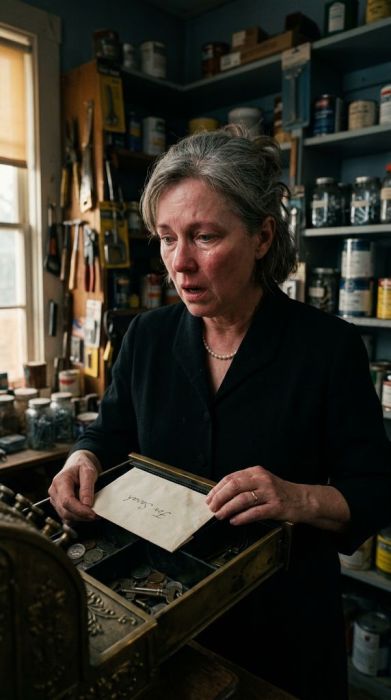
The day it all came apart was a Friday. I was at the bank, withdrawing the cash, exactly as Detective Webb had instructed, when the teller handed me a receipt I hadn't asked for — an old deposit slip that had fallen out of my own checkbook. I opened it to put it back, and I saw a name I had never expected to see: the name on the account where my first wire transfer had been sent. It was printed in plain black type, and the world tilted sideways.
P. Sorensen.
I stood there in the middle of the bank, holding that slip of paper, and every sweet moment of the past year rearranged itself in front of me like a deck of cards laid out by a cheat. The "friend of a friend" who had no face. The gifts that arrived at my door. The way Peggy had been there, always, to comfort me, to encourage me, to count my blessings for me. The way she'd asked, so casually, over coffee one afternoon, how Harold's insurance settlement had been handled, and whether I'd put it somewhere safe. I had told her everything.
Detective Webb's team traced the rest of it that same week. The shell accounts in faraway cities all fed, eventually, into a single personal account in Des Moines, Iowa — an account registered to Peggy Sorensen, the sweetest woman at St. Andrew's Widow's Circle. When the detective showed me the printout, my hands were shaking so badly I couldn't hold it. "She introduced us," I kept saying. "She held my hand at the funeral group. She brought me coffee. She was my friend."
"She was running you, Margaret," he said gently. "That's what she does. And she's going to do it to someone else if we don't catch her."
The trap was simple, and I have to say, in all the years since, I have never once felt guilty about it. I told Daniel I'd withdrawn the full fourteen thousand in cash, but that I was nervous carrying it around, and could his courier meet me somewhere safe? I suggested Martha's Diner on the south side, a place I'd never once mentioned to Peggy. Daniel was thrilled. He said his courier would be there at noon on Thursday. He said he loved me. He said soon, angel, soon.
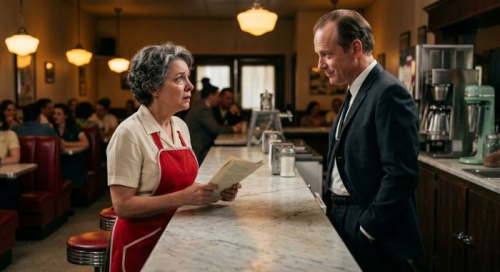
On Thursday, I sat in the back booth at Martha's Diner, a paper bag full of blank paper on the seat beside me, and I watched the door. Detective Webb and two of his officers were in the booth behind me. At noon, the door opened, and a woman walked in wearing a long raincoat and dark sunglasses, even though it was a clear September day. She scanned the diner, spotted me, and walked straight to my booth.
She sat down across from me. She took off the sunglasses.
"Daniel sent me, honey," Peggy Sorensen said, smiling her warm, crinkly-eyed smile. "He trusts me to bring the money to him. Isn't that wonderful?"
I looked at her for a long moment. Then I said, very quietly, "Peggy. I never told Daniel we were meeting at Martha's Diner."
Her smile didn't move. For one awful, perfect second, it just hung there, frozen on her face. Then it collapsed, and I watched sixty-seven years of being everybody's favorite person fall away, and underneath there was just a frightened woman who had bet everything on the hope that I would never look too close.
Detective Webb stood up behind her. "Peggy Sorensen," he said, "you're under arrest for wire fraud and exploitation of a vulnerable adult."
They took her out in handcuffs. The whole diner watched. I sat very still in my booth, my hands folded on the table, and I did not cry. I felt the strangest thing, a kind of terrible, quiet peace, like the moment after a fever breaks.
The Widow's Circle was shattered, of course. Half the women didn't want to come back — they couldn't believe they'd sat in a circle with a predator for years. The other half came back precisely because of that. I stood up at the next meeting, my hands still shaking, and I told them everything. I told them about Daniel, who never had a face. I told them about the roses, and the voice notes, and the four men I'd later learn Peggy had been running at the same time — widowers' money, all of it, flowing into her account while she baked us casseroles and called us sisters.
The bank recovered my money. Because I had reported the fraud within days of recognizing it, and because what Peggy had done to me fell squarely under the protections banks carry for older customers, every single wire transfer came back. Fifteen thousand dollars, returned to my account like it had never left. I sat in the bank manager's office and wept into my hands, and she didn't say a word, just pushed a box of tissues across the desk and let me.
Peggy's trial was quiet, the way small-city fraud trials are. A few of the women from the Circle came to the courthouse and sat in the back row. Peggy's own house, I learned, had been in foreclosure for a year. Her husband's illness had eaten their savings, and somewhere along the way, she had decided that other widows' grief was a resource she could mine. She got five years. I didn't celebrate. I didn't need to. Justice, I've learned, doesn't need applause to be real.
I still light a candle for Harold on Sundays. I still make his favorite pie on the first Sunday of the month. Elena calls me every Sunday night now, and Maya comes to stay once a month, and she taught me how to look at a photograph and know if it's real. I tell the women at the Circle about the red flags — the man who never shows his face, the emergencies that always need money, the friend who seems a little too eager for you to be happy. I say it the way Peggy said it to me, warm and kind, because I've learned that kindness is real, and so is the wolf that wears its face. The trick is knowing the difference. And now I do.