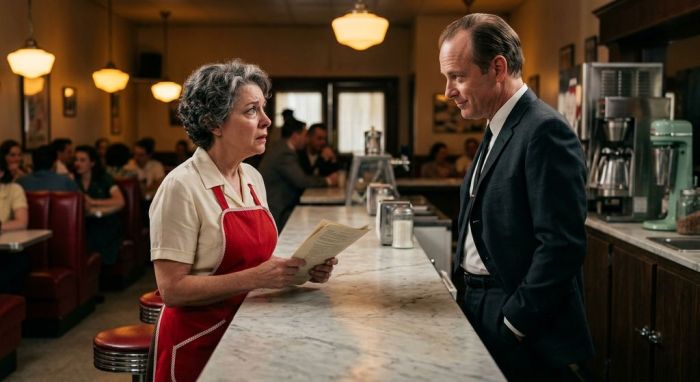
The day my brother stood in the middle of our grandfather's ice cream parlor and told me I had sixty days to get out, I was handing a little girl a vanilla cone with a cherry on top. Her name was Rosie Porter, and she came in every Tuesday with her grandmother and asked for the cherry even though she never ate it. I put the cherry on, handed her the cone, and looked up to find Ricky standing in the doorway in a suit. Behind him, on the sidewalk, a woman in a tailored blazer was studying the front of my building like it was a carcass.
"That's a lovely parlor, Dot," Ricky said, the way you'd compliment a car you planned to buy. "Shame it has to go."
I felt the eyes of the afternoon crowd on me. Mabel Hargrove from the bank. Old Tommy Novak, who had been coming here since he was a boy. Rosie's grandmother, who pulled her granddaughter a little closer to her hip.
"Whose offer?" I asked, surprised my voice came out steady.
Ricky smiled the way he smiled at funerals, all teeth and no warmth. "The Heinlein Group. They're taking the whole block. Retail on the bottom, condos up top. This place becomes a lobby and a coffee bar." He gestured at the red vinyl booths, the chrome stools, the marble counter that had stood there since 1952. "It's a good deal, Dot. A fair deal. Don't stand in the way of it over nostalgia."
"It's not nostalgia," I said. "It's our family. Papa Frank built this place with his own two hands and stood behind this counter for forty years."
"Papa Frank is dead, Dot." He said it flat, like he was correcting my arithmetic. "He's been dead for nine years. The building belongs to the family, and the family has decided. I hold power of attorney from Mom, and I'm telling you — sixty days."
Rosie's grandmother took her hand and left without buying anything. Tommy put down his coffee and followed. In thirty seconds the parlor emptied, and I stood alone behind the counter with the register open and Ricky's smile hanging in the air like smoke.
"You should have come to me first," I said quietly.
"I'm coming to you now." He laid a folded document on the marble. "Sixty days. That's generous. The new owners said they'd have given you two weeks." He turned and walked out, and through the window I watched him climb into a black car and shake the woman's hand like he'd just closed the deal of the century.
I stood there in the smell of vanilla and warm sugar and thought about the last time I had seen my brother look so pleased with himself. It had been at Papa Frank's funeral, nine years before. Ricky had stood at the graveside with his phone in his hand, and when the service ended, he walked straight to the lawyer and asked about the will. He was the same then as he was now. The only difference was that back then, I still believed family meant something.
I want to tell you about Papa Frank, because to understand what happened next, you have to understand him. Frank Delaney opened this parlor in 1952 with a loan from a barber and a handshake. He painted the sign himself, and for forty years he stood behind this counter in a white apron that always smelled faintly of butterscotch. He knew every family in town by name, and which kids were having a hard time at home and needed the extra scoop free of charge.
I started working for him when I was twelve. I wasn't tall enough to reach the syrup pumps, so Papa Frank built me a little wooden step and kept it behind the counter for years. "You're the best scoop girl in Hickory Falls," he'd say, "and don't you ever forget it."
Ricky never worked here. Not once. When we were kids, Papa Frank would hand him an apron and Ricky would let it drop to the floor. "I'm not going to be a soda jerk my whole life," he'd say, and Papa Frank would just laugh. "Nobody said anything about your whole life, Ricky. Just this afternoon." But Ricky never did it. He'd slip out the back door and come home at dinner with some story about a friend's boat, and I'd scoop another cone and try not to feel like the only one who cared.
Ricky went to college, then to the city, where he became a salesman, then a "property consultant," then a developer's right hand. He called home twice a year, and both calls were about him. He never came home for anything, until Papa Frank got sick.
That was the year I finally understood what my brother was. Papa Frank was dying — slow, the way old men who've worked too hard die — and I moved into the apartment above the parlor to take care of him. I fed him soup, read him the paper, and let him hold court from his armchair, telling the same stories about the summer of '54 and the year the football team drank every last drop of the chocolate shake mix. Ricky came home for one week. He sat at Papa Frank's bedside and asked about the deed, the mortgage, whether Papa Frank had "made arrangements." Papa Frank, who was not as sick as Ricky thought, opened one eye and said, "I made all my arrangements years ago, son. You worry about your own." Ricky left the next morning without saying goodbye.
Papa Frank died on a Tuesday in October, nine years ago. I was holding his hand. His last words to me were not about the parlor, or the money, or Ricky. He squeezed my fingers and said, "Dot. There's a key. Taped under the butterscotch card in the recipe box. You keep it until you need it, and you'll know when you need it." I thought he was confused. But he looked at me with those sharp old eyes and said, "I mean it, Dot. Don't let anyone take it from you."
I found the key the next day, taped to the back of the card for Papa Frank's Famous Butterscotch. I put it in my jewelry box and thought about the old safe behind the counter, the one nobody had opened since Papa Frank locked it in 1985 and lost the combination. Then I did what I always did when something frightened me. I put it out of my mind and went back to work.
At the reading of the will, Mr. Okafor — who had handled Papa Frank's affairs for thirty years — explained that Papa Frank had left the parlor "to the family," held in a trust controlled by our mother, Evelyn. Ricky stopped listening the moment he heard the word trust and started asking how soon it could be sold. Mr. Okafor looked at him the way you'd look at a dog that had just peed on a rug. "The trust is quite specific, Mr. Delaney," he said. "Your father was very careful." Ricky waved a hand. "Yeah, yeah. We'll sort it out later."
For nine years I ran the parlor. I got up at five in the morning and churned the base, made the waffle cones by hand, and knew every regular by name. I had my daughter Carrie, who taught English at the high school and came by every Sunday with her two boys. On the days when the loneliness got heavy, I'd look at the old safe and think about the key in my jewelry box, and I'd tell myself whatever was in there could wait. I believed the way you believe in weather that nothing could ever take the parlor from me.
Then Mom broke her hip, and Ricky came home. Not to help — to move Mom into the house on Cedar Lane so he could "take care of her." He took over her mail and her appointments. He started showing up at the parlor to stand in the middle of the room and say, "You know, this place is sitting on prime real estate, Dot." I'd hand him a cone and he'd eat it and never say thank you, and I'd wonder when my brother had stopped being a person I knew.
The day he brought the woman in the blazer, I felt it coming. Her name was Roz Whitfield, a project manager for the Heinlein Group. She stood on my sidewalk for twenty minutes photographing the building, the awning, the windows. I watched from behind the counter and felt a cold feeling in my stomach, like standing on a dock and watching a wave roll in from far away.
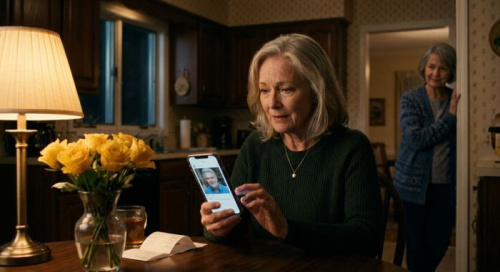
When Ricky told me about the offer and the sixty days, I thought about Mr. Okafor, about what Papa Frank had said on his deathbed, about the key in my jewelry box. I called Mr. Okafor that night.
"Dot," he said, "I've been waiting for this call for nine years."
He came to the parlor the next morning with a folder so old the paper had gone yellow. He told me, gently, that Papa Frank had deeded the building to me in October of 1998. Not to the family. Not to a trust. To me, Dorothy Delaney, outright. The deed had been recorded at the county courthouse, same as any deed. The trust Ricky was so proud of held the business — the name, the recipes, the goodwill. The building, the bricks and marble and red vinyl booths and the safe behind the counter, belonged to me, and had belonged to me for twenty-six years.
"Why didn't anyone tell me?" I whispered.
Mr. Okafor smiled. "Your grandfather asked me not to. He said you'd refuse to believe it, or feel guilty, or let your brother talk you out of it. He said, and I quote, 'Dot needs to believe she has nothing, so she'll fight for what she has.' He knew Ricky would come for this building eventually. He knew it before Ricky did."
I sat down on one of the chrome stools and cried, and laughed, and cried again. Papa Frank. That old fox. Even from the grave, he was taking care of me.
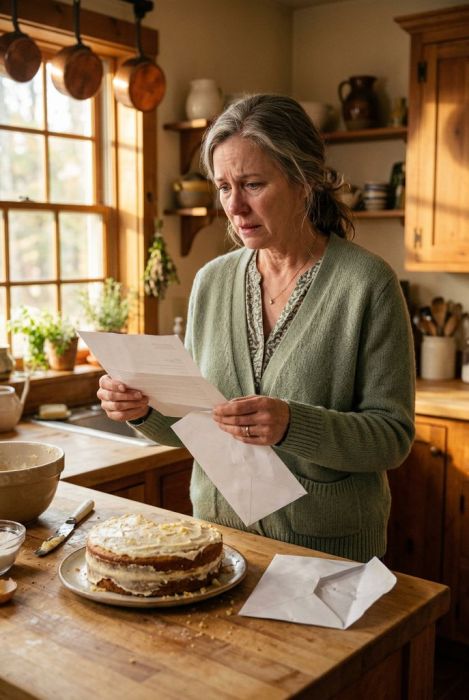
Mr. Okafor handed me a certified copy of the deed with the county seal, then slid a small envelope across the counter. "Your grandfather also asked me to give you this." Inside was a letter in Papa Frank's hand, dated two weeks before he died.
"Dot," it read, "if you're reading this, then Ricky has done something foolish, and I'm sorry. I should have told you years ago, but I was afraid you'd give it away out of love, the way you've always given everything away out of love. So I did it quietly, the way I did everything. The building is yours. The safe is yours. There is something in that safe that belongs to you and only you — the one thing I never found the nerve to say to your face. You'll know what I mean when you open it. Be brave, sweetheart. You were always the brave one. — Papa."
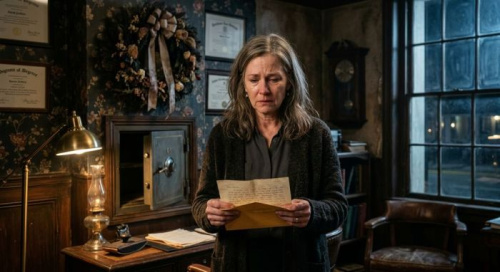
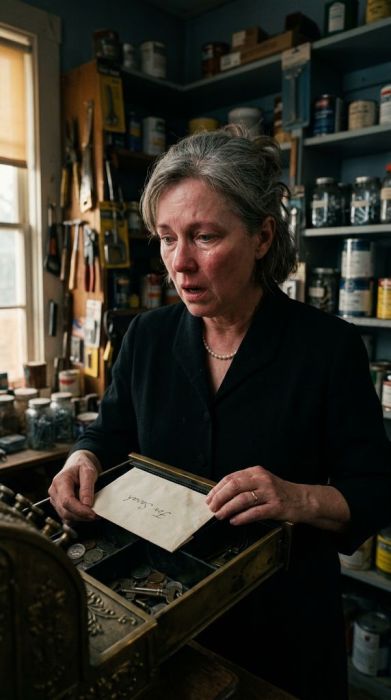
I folded the letter into my apron pocket, walked to the safe, and opened it with the key that had sat in my jewelry box for nine years. Inside was a small wooden box. Wrapped in a handkerchief was the original deed from 1998, and beneath it a photograph of Papa Frank and my mother when they were young. Tucked behind the photograph, in an envelope that had never been opened, was a letter addressed in Papa Frank's hand to one person only. Ricky.
I didn't open it. I didn't have to. I knew what Papa Frank had written in that envelope — he had seen his grandson clearly his whole life and knew exactly who would come knocking when he was gone. I took it to Mr. Okafor and told him to hold it until the moment it was needed.
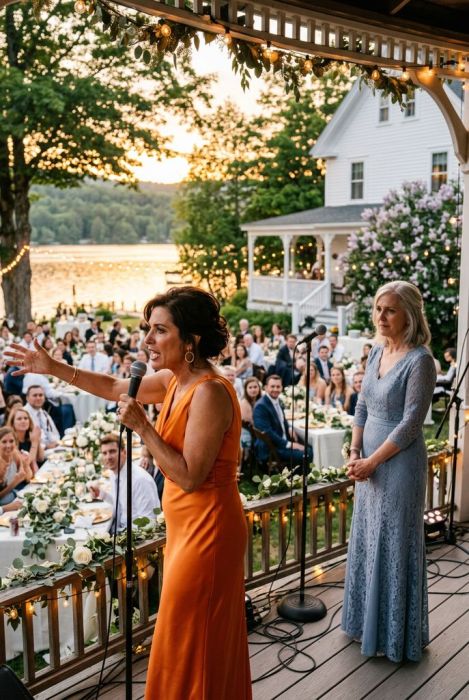
Ricky held the closing celebration at the parlor on the last Saturday of the month. He called it a "toast to the future." He had the champagne, the mayor, a photographer from the paper — and our mother in her wheelchair, parked beside the counter in a new blouse she didn't remember buying. He had told her, I would learn later, that she was signing a card for the family trust.
I walked in with Mr. Okafor and Carrie. In my hand, in a manila envelope, I carried the certified deed and a copy of Papa Frank's letter.
Ricky saw me and raised his glass. "Ah, there she is. The scoop girl, come to say goodbye. Let's give Dot a hand, folks. Fifty years behind the counter — that deserves a round of applause."
Nobody clapped. The room went quiet. "I'm not here to say goodbye, Ricky," I said.
I set the envelope on the marble counter and took out the deed, holding it up so the mayor could see the county seal. "This deed was recorded at the county courthouse in October of 1998. It transfers this building from Frank Delaney to Dorothy Delaney. That's me. This building has been mine for twenty-six years, and it has never once been Mom's to give you power of attorney over."
Ricky's smile faltered. "That's a forgery. Papa Frank put the parlor in a trust. Everyone knows that."
"The trust held the business," I said. "Not the building. Mr. Okafor drew up both documents himself. Ask him."
Mr. Okafor stepped forward and nodded. "It's true. The building has belonged to Dot since 1998."
And then, from the back of the room, a voice I didn't expect. Roz Whitfield stepped out of the crowd with her phone in her hand. "He's right," she said quietly. "My title team flagged this exact deed this morning. We found it in the county records two days ago. I was going to raise it tonight myself." She looked at Ricky with something cold in her eyes. "You told my company this property was clear to acquire, Mr. Delaney. It isn't. It's hers."
Ricky went pale. "This is a mistake. There's been a mistake."
"The only mistake," Mr. Okafor said, "was yours. The power of attorney your mother signed while she was medicated after surgery, without a single witness who knew her, has been revoked. Your mother signed it under false pretenses. That's elder financial exploitation, Ricky. The district attorney's office has already been informed."
The room erupted. The mayor stepped back from Ricky like he'd been burned. And Mom looked up at Ricky with an expression I will never forget. "You told me it was a card, Ricky," she said, her voice trembling. "You told me I was signing a card."
Ricky opened his mouth and nothing came out. For the first time in his life, my brother had nothing to say. He looked around the room — at the marble counter, the chrome stools, the safe, all the faces of the town that had watched him his whole life — and I watched the confidence drain out of him like water down a sink. A sheriff's deputy, who had been standing by the door because I had asked him to be there, stepped forward and asked Ricky to come with him. He didn't resist. He had nowhere left to run.
They took him out through the back, past the freezer case and the old cash register, and the whole town watched him go. The Heinlein Group pulled out the next week. Roz Whitfield called me herself and apologized. "The company doesn't do business with fraud," she said. "But you know, Dot — this place is a gem. If you ever want a partner to help you preserve it, my firm would be honored."
Mom moved in with me above the parlor. It took her a long time to understand what Ricky had done, and longer to forgive herself for trusting him. I told her a hundred times it wasn't her fault. He had been her son. She had loved him. That was never a crime.
We reopened the parlor on the seventy-second anniversary of the day Papa Frank poured his first scoop. The mayor came. The whole town came. Carrie brought her boys, and they stood on the little wooden step behind the counter — the one Papa Frank built for me, the one I had saved all these years — and scooped their own cones while their grandmother watched, tears streaming down her face.
The old safe sits open behind the counter now. People ask me what's in it, and I tell them the truth. A deed. A photograph. A key. And a whole lifetime of a man who loved me enough to make sure that, no matter what the world threw at me, I would always have a home.
Ricky's trial is coming up. I don't go. I don't need to. The district attorney tells me he'll face real time for what he did to Mom, and I believe it. But that's not why I sleep easy at night.
I sleep easy because every morning I walk downstairs and unlock the front door of Delaney's, and I stand behind the marble counter in the smell of vanilla and warm sugar, and I scoop a cone for a little girl who asks for a cherry she'll never eat. And I think about my grandfather, who knew, long before anyone else, that the best way to win a battle is to fight it quietly, years in advance, with nothing but love and a key taped to the back of a recipe card.
Papa Frank always said I was the brave one. The truth is, I was never brave. I was just loved. And love, it turns out, is the strongest thing in the world.