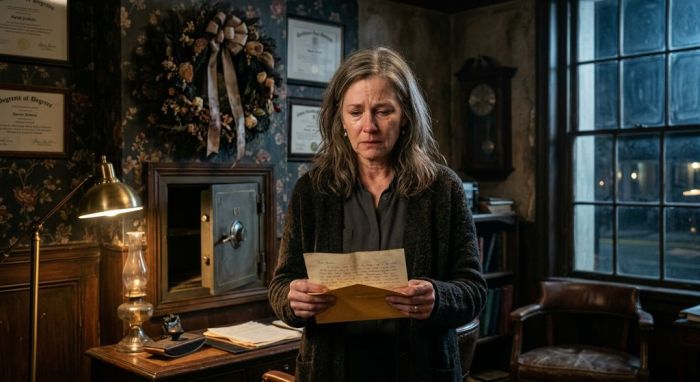
The morning after my mother's funeral, my sister Darlene stood in the doorway of Hollis Funeral Home wearing a black dress that cost more than my entire wardrobe, holding a folder like it was a holy book. "We'll take it from here, Maggie," she said, and her husband Victor stepped out from behind her with the keys to Mom's office already in his hand.
I hadn't slept. I'd spent the night in the parlor, organizing flowers, because that was what I always did — what Mom always did — when grief was too heavy to carry alone. Darlene, who had not set foot in this building for nine years except to collect a check, was smiling at me like she'd won a prize.
"What are you talking about?" I asked.
"Mom signed everything to us before she passed," Darlene said, opening the folder. "She wanted Victor to take over the business. She said you were too fragile, Maggie. Too sentimental. She wanted a fresh start."
My mother, Ruth Hollis, had spent fifty-two years building this place from a rented storefront into the most trusted funeral home in Erie, Pennsylvania. She had buried half the county's grandfathers and held the hands of a thousand widows. In her final weeks, when the cancer took her voice, I was the one beside her bed. Darlene visited exactly twice — once to take a photo for her social media and once to ask Mom where the deed was.
Mom couldn't speak on that last day. But she could still write. She gripped my hand and wrote four words on my palm with a shaking finger: "Lockbox. Wreath. Trust no one."
I thought it was the fever talking. I was wrong. On that first morning, I was just a woman in her sixties, exhausted and hollow, staring at her sister and wondering how a person could look so triumphant at a funeral.
"Mom never mentioned any of this to me, Darlene."
"Mom was protecting you." Darlene's voice was soft, almost kind, which was somehow worse than shouting. "You've given your whole life to this place, Maggie. You deserve rest. Victor has plans. Big plans."
Victor Mercer was a man who sold pre-owned cars before he married Darlene, then pre-owned boats, then "investment opportunities" that mysteriously never paid out. He was handsome in a slippery way, with a smile that arrived before the words and left before the consequences. He had never once in twenty years done an honest day's work, and now he was holding the keys to my mother's life's work.
I should have screamed. I should have called the police. Instead, I stood there in the smell of her candles and her furniture polish, and I let them walk past me. Because that is what happens when grief empties you out. You let people walk past you.
It took me three days to realize what they were actually doing.
The first sign was the sign itself. By noon on Thursday, the letters above the door read "HOLLIS LEGACY FUNERAL GROUP — SERVING FAMILIES FOR GENERATIONS." My mother's name, twisted into a marketing slogan. Mrs. Kowalski, the widow across the street who had known Mom since they were girls, came out and put her hand on my arm.
"Margaret," she said softly, "your mother would hate that."
"They fired Danny," I said. Danny was my assistant, a quiet young man who had helped Mom with the gardens and the paperwork for six years.
Mrs. Kowalski nodded slowly. "Victor hired his nephew. I saw him yesterday, wearing a suit that cost more than my house payment."
I laughed, because it was the only way to keep from crying. But Darlene and Victor weren't selling hearses. What they were doing was far, far worse.
It started with a flyer that appeared in every church in the county: "HOLLIS LEGACY LIFETIME CARE PRE-PAID PLAN — Lock in today's prices, protect your family, save up to 40%. Cash discount available."
I saw it first at St. Mary's, pinned to the bulletin board. My stomach dropped. My mother had spent her whole career telling families the same thing: never pay for a funeral in cash, never trust a stranger with your grief, always go through a licensed funeral director and a regulated trust. And her own daughter was now doing the opposite, with her name above the door.
I walked into the funeral home the next morning and found Victor at Mom's actual desk — her chair, her coffee cup — with a stack of contracts and a cash box the size of a shoebox.
"Margaret! Come in, come in." He stood up, all smiles, like I was a customer. "I'd love your input on the Lifetime Care program."
"Take my mother's cup off your desk, Victor."
He glanced at it, then at me, and slowly set the cup aside. "Of course. Sentimental value. I understand. Darlene says you're very attached to the past."
"The past is my mother's reputation, Victor. And you're using it to sell pre-paid plans to widows who trust this name."
"Not selling, Margaret. Helping. That's what a funeral home does, isn't it? Help families? I'm helping them save money."
I looked at the contract on his desk. It was glossy, professionally printed, with my mother's actual photograph — taken at her seventy-fifth birthday — right at the top, smiling, as if she endorsed it. The fine print said the money would be held in a "member benefits account" managed by a company called Crescent Ridge Holdings, LLC. Victor Mercer had incorporated a shell company. And he was feeding it with the savings of grieving old people who trusted my mother's name.
"You can't do this," I said.
"I have done it." He sat back down in Mom's chair and smiled at me, and for the first time I saw the real Victor Mercer — not the salesman, but the predator. "Now, here's what happens next. You're going to sign this agreement recognizing the transfer of management, and in exchange, we'll give you a comfortable severance. Darlene insisted. Family, you know."
I didn't sign. I didn't scream. I walked out, went home, and did the only thing that made sense: I started digging.
What I found over the next two weeks made my blood run cold.
First, Danny — yes, the fired Danny — called me one night, his voice low and shaken. "Miss Hollis, I'm sorry, I just… I kept copies. Of the books. Victor's been running the accounts through Crescent Ridge. The pre-paid money, it's all going to one place, and it's not a trust. It's his."
"How much, Danny?"
"Over the last month? I counted the receipts. Maybe three hundred thousand. Cash and checks. Mrs. Kowalski's church group alone…" He stopped. "Miss Hollis, they're doing it at funerals. At viewings. They're selling the plans to people standing next to open caskets."
I wanted to be sick. My mother's funeral home — her gentle, holy, careful funeral home — had become a toll booth for grief.
The second discovery came from the county recorder's office. The transfer papers Darlene waved at me? They were real, in the sense that a forgery is real. The signature date interested me: eighteen days before Mom died. Except on that date, Mom was in the hospital. I had signed her in myself at 9 a.m. She was in no condition to sign a notarized transfer that afternoon. And the notary? Victor's old friend from the car lot, a man who had lost his bond twice.
The third discovery was the hardest. Mrs. Kowalski's granddaughter, a paralegal in the county DA's office, pulled me aside after Mass one Sunday and told me her grandmother had written a check for twelve thousand dollars — her entire savings — for a Lifetime Care plan.
"For her and for me," the granddaughter said, her voice breaking. "She wanted us taken care of. She said your mother's name was on it, so it had to be safe."
I sat in my kitchen that night with the lights off, and I finally understood what Mom had written on my palm. "Lockbox. Wreath. Trust no one."
The viewing parlor had a memorial corner — a small wooden alcove where Mom kept a brass lamp, a Bible, and a large white wreath she had made herself when she first opened the doors. Every family that buried someone through Hollis got their name in a gilt-edged book that sat on a stand beneath that wreath. It was Mom's signature touch. No one ever touched the wreath. It had been hanging there for fifty years, ignored by everyone.
Everyone except me.
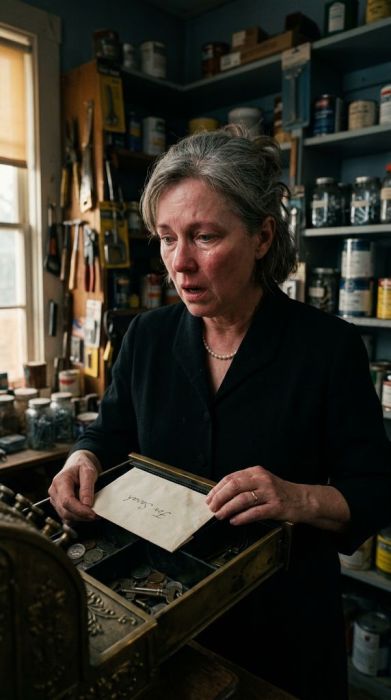
The night after my conversation with the DA's office, I let myself into the funeral home with the spare key Mom gave me on my twenty-fifth birthday. The building was dark. I went through the prep room, past the cold storage, and into the viewing parlor. The wreath was still there, pale in the moonlight.
I reached behind it, and my fingers found the seam in the wall that I hadn't touched in decades. Mom showed it to me when I was twelve: a small spring-loaded panel, hidden behind the flowers, the kind of hidey-hole that only made sense to a woman who had survived two marriages and one depression.
Inside was a lockbox. Plain, grey, unmarked. Inside the lockbox was everything.
There was the original 1998 partnership agreement between Ruth Hollis and Margaret Hollis — me. Fifty-one percent mine. My mother had made me her legal partner eleven years ago and never told Darlene, because Darlene had never once asked.
There was a handwritten letter, folded into a square, in Mom's loopy script.
It began: "My dearest Margaret. If you are reading this, I am gone, and someone has moved my cup. Your sister's husband has approached me three times about the business. He believes I am old and forgetful. I am neither. I want you to know: I never signed anything for him. Whatever papers he shows you, my darling, they are lies. The real deed to the funeral home is in the safe at First Trust, box 14, your name and mine. He has the appetite of a thief but not the patience. He will get impatient. That is his weakness. Use it. And whatever happens, Margaret — keep the wreath."
I read it three times. Then I sat on the floor of my mother's viewing parlor, in the dark, with the wreath in my arms, and I wept the way I hadn't let myself weep at her funeral.
The next part was simple. It had to be, because it was for Mrs. Kowalski, and Danny, and every old person who had handed Victor their savings because they saw my mother's face on a flyer. I called the DA's office. Then I called the state banking authority. Then I called a locksmith for safe-deposit box 14 at First Trust.
The morning of the discovery, Victor called a press conference. Not a small one — a real one, with two TV vans and a smiling Darlene in a burgundy suit, standing on the front steps beside a banner that read "HOLLIS LEGACY LIFECARE: SERVING ERIE WITH PRIDE."
"I'm proud to announce," Victor said into a forest of microphones, "that Hollis Legacy has acquired the property next door, and we're expanding our Lifetime Care program to serve even more families…"
That was when the first black car pulled up. Then the second. Then the county sheriff, two state banking investigators, and a very patient man from the attorney general's office got out.
Victor's smile vaporized. Darlene's did not, but I watched her hands begin to shake.
I stepped out from behind the crowd and walked up the steps to stand beside my sister. I had the lockbox in one hand and my mother's letter in the other. Behind us, on the wall, framed in gold, was the original founding license: RUTH HOLLIS, LICENSED FUNERAL DIRECTOR, 1971.
"Hello, Darlene," I said, loud enough for the cameras. "I brought Mom's book of names."
Victor tried to run, slipping sideways toward the side door — but Danny was standing there, holding a receipt box and smiling the way only a young man with nothing left to lose can smile.
"Looking for these, Mr. Mercer?" Danny said, holding up a folder.
They arrested Victor on the front steps of the funeral home my mother built, in full view of the TV cameras and half the neighborhood. The charges were long and ugly: theft by deception, forgery, financial exploitation of the elderly, and unlawful use of a license. The state froze Crescent Ridge Holdings the same afternoon.
Darlene was charged two days later, as an accomplice. I stood outside the courthouse and watched my sister — the golden child, the one who left, the one who came back to take — being led out in handcuffs, and I felt nothing but tired. She looked at me, and I looked through her.
"You'll be sorry," she called out. "You were always the favorite, and you'll be sorry anyway. Mom hated you, actually — she just felt guilty —"
"Mom left me the wreath, Darlene."
Darlene stopped walking.
"Eleven years ago," I said, "Mom and I signed a partnership agreement. Fifty-one percent me. She knew you'd come for this place the day she died. She knew what you were. She left the box behind the wreath so I could remember who to trust."
"You're lying."
"Mom kept your husband's first forged transfer," I said. "The one from 2019, when he tried to take the property before she got sick. She had the notary verify it. She forgave you then, because you begged her. But she documented it anyway. She said people don't change; they just get older and better at hiding what they are."
Darlene said nothing. For once in her life, she had nothing to say, and I think that was the moment it really landed. My mother had spent her final months not just dying, but preparing for the exact moment Darlene moved. And she'd chosen me, not because I was the favorite, but because I was the one who stayed.
The restitution took eight months. Mrs. Kowalski got her twelve thousand dollars back, and I personally signed her a letter on the original Hollis letterhead: "Your family will always be taken care of. — The Hollis family."
I re-opened the funeral home under the old sign — just "HOLLIS FUNERAL HOME," in the same gold lettering. Danny came back to work for me, full of quiet pride. The first funeral I directed was for Mrs. Kowalski's cousin, and I did it exactly the way Mom taught me: no plan, no upselling, no forms, just a hand held and a candle lit and flowers that cost what flowers should cost.
The wreath still hangs in the parlor. The lockbox went back behind it, empty now except for Mom's letter, which I read on hard days. On the first anniversary of her death, I hung a new brass plate under her photograph: "Ruth Hollis, Founder. Fearless. Forgiving. Watching."
Victor Mercer is serving eight years. Darlene got five, suspended after two, and she lives now in a small apartment in Ohio that no one visits. She writes to me sometimes — long, rambling letters full of blame and if-onlys. I read the first two, and then I stopped, because I finally understood something my mother understood all along.
Some people only show up for the property. The rest of us show up for the people.
And I have her wreath, her box, her book of names, and her funeral home. I have her blessing, written in her own hand, warning me about the world she knew was coming. And on the nights when the parlor is dark and quiet and the phone doesn't ring, I run my fingers along the words she left me, and I smile.
Trust no one, my darling. But keep the wreath. Some doors are only closed to the people who never earned the key.