The stranger appeared on a Tuesday afternoon, driving a dusty blue sedan with out-of-state plates. He parked in front of Mabel's Diner on Main Street and sat at the counter for nearly an hour, nursing a cup of coffee and asking quiet questions about the yellow house at the end of Maple Street.
Mabel herself brought him a second cup, free of charge. "You're not from around here," she said, sliding into the booth across from him. It wasn't a question, but he answered anyway.
"Oregon," he said. "I'm looking for information about a house. The one at the end of Maple. Yellow with white trim."
Mabel's hands stilled on the coffee pot. "That house has been empty for forty years, honey. What's your interest in it?"
The stranger smiled, but there was something careful in his eyes. "I think my grandfather built it. I'm trying to find out what happened to the people who lived there."
And just like that, Willow Creek, Georgia, population 847, had itself a mystery.
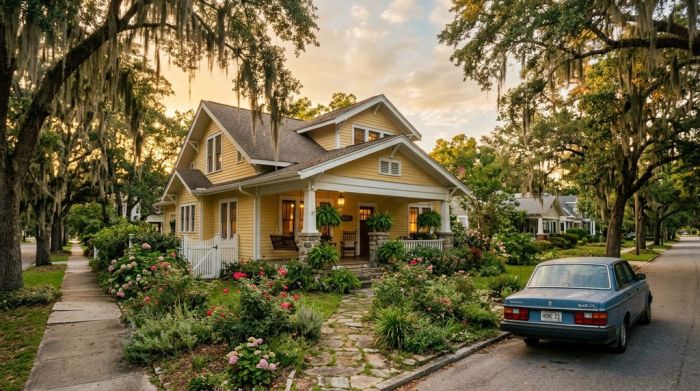
The town had always known the yellow house was special. It sat at the far end of Maple Street, where the pavement gave way to a dirt road that wound into the pine woods. The house itself was a beautiful two-story craftsman, built in 1950 by a young couple named Thomas and Eleanor Beckett. Everyone in Willow Creek remembered Eleanor — she had been the town librarian, a woman with an easy laugh and a gift for remembering which book each child would love. Thomas worked at the lumber mill and had carved the banister in the town hall by hand.
They had been happy together, as far as anyone knew. And then one day in 1964, Thomas Beckett vanished.
There were rumors, of course. Some said Thomas had run off with another woman. Others whispered that he'd gotten into debt and fled. The official story was that he'd died in a logging accident up in the mountains, his body never recovered. Eleanor had grieved for a year, maybe two, and then she'd simply gone on living. She stayed in the yellow house until her death in 1984, alone and faithful to a memory no one could quite verify. The house had been sealed ever since, passed down through some distant relative who never came to claim it.
Until now.
The stranger's name was Daniel Keller. He was forty-seven years old, an architect from Portland, and he had grown up believing his grandfather had died before he was born. It was only after his mother's passing the previous spring, while sorting through a box of her things, that he found a stack of letters addressed to Thomas Beckett in Willow Creek, Georgia.
"I never knew any of this," Daniel told the handful of regulars who had drifted over from their tables to listen. The afternoon crowd at Mabel's had grown to include Frank from the hardware store, old Mrs. Patterson who had been Eleanor's closest friend, and the mayor himself, a man named Roy Bennett who had been a boy when Thomas disappeared.
"Thomas was my grandfather," Daniel continued. "My mother never spoke of him. She was just a baby when he left. But these letters — they're from her. From Eleanor." He touched the worn envelope on the counter. "She wrote to him for years. And they were all returned unopened."
Mrs. Patterson wiped her eyes with a handkerchief. She was eighty-three now, her memory of those days as sharp as ever. "Eleanor never believed he was dead," she said softly. "She told me once that she felt him out there, somewhere. That love like theirs didn't just end without a goodbye."
"But why did he leave?" Daniel asked. "What happened?"
Mayor Bennett cleared his throat. "There's someone you should talk to. Martha Pendleton. She was Eleanor's best friend. If anyone knows the truth, it's Martha."
Martha Pendleton lived in a small white cottage three blocks from the diner. She was eighty-two now, a retired schoolteacher who had spent fifty years shaping the minds of Willow Creek's children. She answered the door in a flower-print dress with a cup of tea in her hand, as if she had been expecting company all along.
"I wondered when someone would come," she said, studying Daniel's face. "You have his eyes, you know. Thomas had kind eyes, and so do you."
She led him into her living room, where every surface was covered in photographs and books. On the coffee table sat a worn leather journal, its spine cracked with age.
"I've been keeping this for forty years," Martha said, sitting down heavily in her armchair. "Thomas asked me to hold onto it before he left. He said if he didn't come back, I was to give it to someone who needed to understand."
Daniel sat down across from her, his hands trembling slightly. "He knew he wasn't coming back?"
Martha shook her head slowly. "He knew he might not. There was an accident at the mill, Daniel. Not the one the town heard about. It happened in early 1964. A beam fell and crushed Thomas's spine. He survived, but the doctor told him he'd never walk again. Never work. Never be the husband Eleanor deserved."
"But Eleanor loved him," Daniel said. "She wouldn't have cared about any of that."
"No," Martha agreed. "She wouldn't have. And that was exactly the problem. Thomas couldn't bear the thought of being a burden. He loved her too much to watch her give up her life caring for him. So he made a decision. He let everyone believe he had died in a logging accident. He had a friend from out of town spread the story, and he slipped away to a veterans' hospital in Savannah."
"But he was alive the whole time," Daniel whispered.
"He was. And he wrote to her. Hundreds of letters over the years. But he never mailed a single one. He said it wouldn't be fair to disturb her peace." Martha opened the journal and pulled out a folded piece of paper, yellowed and brittle. "This is the last letter he wrote. It was found among his things when he passed away in 1998. He died in a nursing home in Savannah, alone, still in love with a woman he hadn't seen in thirty-four years."
Daniel took the letter with reverent hands. He unfolded it carefully, and the first words made his breath catch.
My dearest Eleanor,
I am sitting in a room with a window that faces east, and I like to think that if I look hard enough, I can see the yellow house in the morning light. I carved the banister there, you know. Every morning I ran my hand along it on my way down to make you coffee. I remember the feel of that wood. I remember everything.
I have been a coward, my love. I told myself I was being noble, but that is a lie. I was afraid. Afraid you would look at me and see a broken man instead of the one who promised you forever. But I have learned, too late, that forever doesn't require a man to walk. It only requires him to love.
I have loved you every single day. I have loved you from this chair. I have loved you in silence and in secret and in the quiet hours of the night when I close my eyes and pretend I am on Maple Street, and you are in the kitchen, and the world is whole again.
I am tired now. The doctors say I don't have long. And I find that I am no longer afraid. Because wherever I am going, I hope with all my heart that you will be there too, waiting for me, with that laugh that could light up the whole of Georgia.
Forever yours, Thomas
When Daniel finished reading, there was not a dry eye in the room. Martha was crying openly, and even Daniel, who had never known the man who wrote those words, felt a grief that belonged to someone else but settled in his chest like an old friend.
"There's more," Martha said, her voice thick with emotion. "After Eleanor passed, I found letters too. She wrote him as well. She never stopped believing he was out there. She kept a journal of her own, and in it she wrote about him every single day until she died."
Martha reached into her knitting bag and pulled out a second journal, bound in faded blue cloth. "I think you should take both of these, Daniel. You're the only family either of them has left. And I think they would want you to know that their love story didn't end in tragedy. It just continued. In different ways. In letters that were never sent. In a yellow house that waited. In a town that never forgot."
Daniel stayed in Willow Creek for a week. He visited the yellow house, which Mayor Bennett unlocked for him using a key that had been hanging in the town hall for four decades. The inside was frozen in time — Eleanor's books still on the shelves, her reading glasses on the nightstand, Thomas's hand-carved banister smooth and worn under his fingers.
He found something else too, tucked inside a copy of To Kill a Mockingbird on the nightstand: a photograph of Thomas and Eleanor on their wedding day, young and radiant and full of hope. On the back, in Eleanor's handwriting, were the words: "He promised me forever. I'm still waiting."
Daniel returned to Oregon with the journals, the letters, and a new understanding of what love really meant. But Willow Creek wasn't done with him yet.
Three months later, a letter arrived at his Portland office, forwarded from his old address. It was from a woman named Sarah Connors, a retired nurse who had read about the story in a local newspaper.
Dear Mr. Keller,
I worked at St. Mary's Hospital in Savannah in the 1970s. I remember your grandfather, Thomas. I took care of him for two years before he transferred to another facility. He spoke of Eleanor often, and of a daughter he left behind. I believe he also spoke of another child — a baby girl born shortly after he left Willow Creek.
Another child. A baby girl. Daniel spent the next six months searching, following paper trails and birth records and old hospital registries. And eventually, he found her.
Her name was Margaret Pendleton. She lived in Macon, Georgia, seventy miles from Willow Creek. She was sixty-two years old, a retired schoolteacher who had spent her entire life believing she had been adopted. Her birth certificate listed her mother as Eleanor Beckett and her father as unknown.
Daniel drove to Macon on a rainy Saturday in November. He stood on Margaret's porch with the photograph of Thomas and Eleanor in his hand and knocked on a door he had been waiting his whole life to open.
Margaret opened it cautiously. She had Eleanor's eyes, Daniel realized. The same warm brown, the same crinkle at the corners when she smiled.
"Can I help you?" she asked.
"Margaret," Daniel said, and his voice broke on the name. "I think I'm your brother."
They talked for hours that day, sitting on her porch swing as the rain fell softly around them. Daniel told her about the yellow house, about Thomas's letters, about Eleanor's journals. Margaret told him about her adopted family, a kind couple who had raised her with love but could never answer the questions she carried in her heart.
"It's funny," she said, wiping her eyes. "I became a teacher. Just like Mother."
The following spring, Daniel moved to Willow Creek. He bought a small house on the other side of town, and he and Margaret worked together to restore the yellow house. They painted the trim, replanted the garden with the same rosebushes Eleanor had tended, and refilled the bookshelves with new stories.
On the first anniversary of their reunion, the town held a dedication ceremony. The yellow house was officially reopened as the Eleanor and Thomas Beckett Community Library, a place where the children of Willow Creek could discover the magic of reading, just as Eleanor had helped generations of children do before them.
Daniel stood at the podium, looking out at the faces of the town that had welcomed him home. Margaret stood beside him, holding the photograph of their parents.
"They left behind a house full of silence," Daniel said, his voice carrying across the quiet crowd. "But they also left behind a love that never stopped writing letters, never stopped hoping, never stopped believing that somehow, some way, the people we love always find their way back to us."
Martha Pendleton, now eighty-five, sat in the front row. She was crying, but she was also smiling — the kind of smile that comes when a story that took too long finally reaches its ending.
That evening, after the ceremony, Daniel and Margaret walked home together under the soft glow of the streetlights on Maple Street. The yellow house stood restored and beautiful, lights shining from every window.
"I think they'd be proud," Margaret said quietly.
Daniel nodded. "I think they'd be happy."
And somewhere — in a place where love doesn't need letters or houses or time — two people who had been waiting for each other their whole lives finally, at long last, found their way home.