Eleanor Parker had been dreading this day for months. Cleaning out her grandmother's house was not something she had volunteered for, not something anyone in the family had wanted to think about. But the for-sale sign had gone up at the end of the driveway last Tuesday, and now here she was, standing in the doorway of the attic bedroom that had smelled of lavender and old paper for as long as she could remember.
Grandma Rose had passed quietly in her sleep at ninety-three, which everyone agreed was a good way to go. But goodbyes were still goodbyes, and Eleanor felt the weight of them pressing down on her chest as she pulled open the top drawer of the old oak dresser.
The sewing box was right where it had always been.
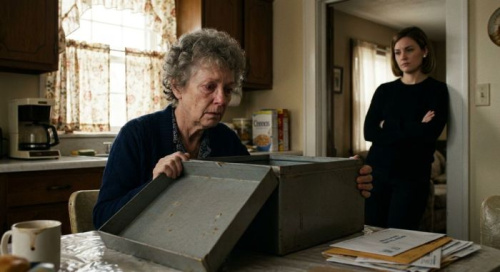
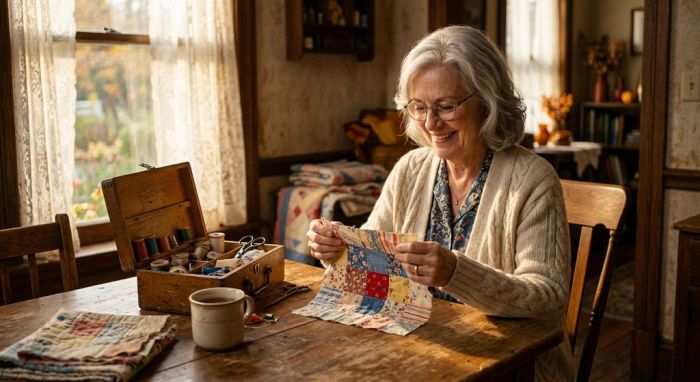
Eleanor lifted it carefully, surprised by how heavy it still was after all these years. The wood was worn smooth at the corners, the brass hinges tarnished to a soft green. She remembered sitting at her grandmother's feet as a little girl, watching those quick, capable hands turn scraps of fabric into something beautiful. Patchwork quilts, mostly. Grandma Rose had made one for every grandchild, each stitch a small act of love.
Eleanor set the box on the bed and lifted the lid.
The familiar smell of thread and lavender sachets rose up to meet her. There were the old wooden spools, the needle case shaped like a fish, the little silver thimble that had belonged to Grandma Rose's own mother. But tucked beneath the bottom tray, folded so neatly it barely made a bump, was something Eleanor had never seen before.
A piece of fabric. Soft, faded cotton, the color of buttermilk. She pulled it out and unfolded it carefully, and her breath caught in her throat.
It was the beginning of a quilt. Not a full quilt, but a single quilt block, perfectly sewn in a pattern she recognized as a classic wedding ring design. The stitching was exquisite, each tiny stitch even and precise, the way Grandma Rose had always done everything. But it was unfinished. Only one block had been completed, and the rest of the fabric pieces lay in a neat stack, pinned together with a note.
Eleanor's hands trembled as she unfolded the note. The paper was yellowed and brittle, the ink faded to a pale brown. But the handwriting was unmistakably her grandmother's.
For Margaret's girl. Due in May 1942. Never got to finish. If someone finds this, please see it through.
Eleanor read the note three times, her heart hammering against her ribs. Margaret's girl. She didn't know any Margaret. And 1942 was long before she was born, before her mother was even a thought. Grandma Rose would have been just a young woman then, newly married, building her life.
She sat down on the edge of the bed, the unfinished quilt block in her lap, and tried to make sense of what she was holding.
The rest of the attic could wait.
She drove home that evening with the sewing box on the passenger seat beside her, the quilt block and the note tucked inside her coat pocket. Her husband Tom was pulling a casserole out of the oven when she walked through the door, and he took one look at her face and set the dish down on the counter.
"You found something," he said. It wasn't a question.
Eleanor pulled out the quilt block and handed it to him. He turned it over in his hands, running his thumb over the stitches the way she had done.
"Wow," he said softly. "Your grandmother made this?"
"She started it. She never finished it." Eleanor handed him the note. "She wanted it to go to someone named Margaret's baby. Due in May 1942."
Tom read the note, then looked up at her. "Do you know who Margaret is?"
"I've never heard of her. None of the stories Grandma told me ever mentioned a Margaret."
Tom handed the quilt back to her. "Well, I guess you've got a mystery to solve."
Eleanor smiled for the first time all day. "I guess I do."
The next morning, she called her mother, hoping for answers. Her mother, Helen, was seventy-two now and lived in a retirement community in Florida. She had always been closer to Grandma Rose than anyone, the one who had stayed behind when all the other children moved away.
"Margaret?" Helen repeated, and Eleanor could hear the frown in her voice. "I don't recall Grandma ever mentioning a Margaret. But you know, your grandmother had a way of keeping things close to her chest. She never liked to burden anyone with her troubles."
"Do you think it could be someone from the church?" Eleanor asked. "Or a neighbor?"
"Could be anyone, sweetheart. Your grandmother knew everyone in that town. But the name Margaret doesn't ring a bell for me."
Eleanor hung up feeling more curious than ever. She spent the afternoon going through the rest of the things she had brought home from the attic, but there was nothing else that seemed related. No photographs, no letters, no other notes. Just the one unfinished block, the pinned fabric pieces, and the cryptic message.
She spread the pieces out on the dining room table and studied them. The wedding ring pattern was made up of small circles of fabric, pieced together to form interlocking rings. She could see that Grandma Rose had carefully chosen each fabric, some of them from old dresses and aprons, and one that looked like it might have been a flour sack. The colors were soft and faded now, but Eleanor could imagine how bright they must have been in the 1940s.
She picked up one of the unfinished ring pieces and noticed something she had missed before. On the back of the fabric, written in pencil, was a tiny annotation: M's dress, 1939.
M's dress. Margaret's dress?
Eleanor's heart began to race again. She looked at the other pieces, and sure enough, each one had a tiny pencil mark on the back. Church picnic, summer 1940. Annie's apron. From the garden party.
It was a quilt made of memories. A quilt made from the fabric of someone's life.
Over the next week, Eleanor became obsessed with the mystery. She called the town historical society, the local church, even the library. She posted in the town's Facebook group, asking if anyone remembered a woman named Margaret who might have been expecting a baby in the spring of 1942.
The responses came in slowly. Some people thought they remembered an older Margaret, but no one could place her. A few people suggested the name Margaret Thompson, but that turned out to be a dead end. Eleanor was starting to lose hope when she got a message from a woman named Betty Sue Watson, who had lived next door to Grandma Rose for forty years.
Betty Sue was eighty-six now and living with her daughter in Ohio, but she remembered the Margaret story well.
"Your grandmother never talked about it to anyone," Betty Sue wrote. "But I knew. I used to see her working on that quilt in the evenings, sitting on her porch with her needle and thread. She was making it for a girl named Maggie. Not Margaret — Maggie. Maggie Sullivan. She was just a teenager, maybe sixteen or seventeen, and she was in trouble."
Eleanor read the message with her heart in her throat. Maggie Sullivan. A teenager in trouble. In 1942, that could only mean one thing.
"She got sent away," Betty Sue continued. "That's what they did in those days. Her family was Catholic and very strict. They sent her to live with relatives in another state, somewhere out west, I think. Your grandmother was the only one who was kind to her. She was making that quilt as a gift for the baby. But Maggie left before it was finished, and your grandmother never got an address to send it to."
Eleanor sat back in her chair, her mind spinning. Grandma Rose had been a young woman in 1942, newly married to Eleanor's grandfather. She had befriended a scared, pregnant teenager in a town that had turned its back on her. And she had started making a quilt for the baby, a beautiful wedding ring quilt, as a symbol of hope and new beginnings.
But the baby had never received it.
Eleanor looked at the unfinished quilt block on her dining room table, and she felt a surge of determination. She was going to find Maggie Sullivan. Or rather, she was going to find the baby, who would be in his or her eighties by now.
The search took another three weeks. Eleanor scoured online records, old newspaper archives, and census data. She traced Maggie Sullivan to a small town in Oregon, where she had married a man named Harold Peterson in 1943. The baby, a girl, had been born in May 1942, just as Grandma Rose's note had said. Her name was Alice.
Eleanor found Alice Peterson living in a retirement community outside Portland, Oregon. She was eighty-two years old, a widow, a retired schoolteacher, and a grandmother of seven. Eleanor stared at the phone number on her screen for a long time before she worked up the courage to call.
"Hello?" The voice on the other end was warm and clear, with a slight Western drawl.
"Alice Peterson?" Eleanor said, her voice trembling. "My name is Eleanor Parker. I'm calling from Ridgeview, Ohio. I think... I think I have something that belongs to you."
There was a long pause on the other end of the line. Then Alice spoke, her voice soft and curious. "I haven't heard anyone mention Ridgeview, Ohio, in over sixty years. How did you find me?"
Eleanor took a deep breath and told her everything. About the sewing box, the unfinished quilt, the note, and the search that had led her across the country. When she finished, there was silence on the line for so long that Eleanor thought they had been disconnected.
"Alice? Are you still there?"
"I'm here," Alice said, and her voice was thick with emotion. "I just... I never knew. My mother never talked about Ohio. She never talked about anyone from her life before Oregon. I always thought she was born there, that she had no family back east."
"She had a friend," Eleanor said softly. "My grandmother. Rose Parker. She never forgot your mother, and she never finished that quilt. I think she was waiting for the right time, and the right time never came."
"I'd like to see it," Alice said. "The quilt, I mean. Would you... would you consider sending me a photograph? Or maybe..."
Eleanor didn't hesitate. "I'll bring it to you."
Two weeks later, Eleanor Parker stepped off a plane in Portland, Oregon, carrying the sewing box in her carry-on bag. She had booked a rental car and driven through the lush green hills, following her GPS to a small retirement community nestled among the pines.
Alice Peterson was waiting for her on the porch, a small woman with silver hair and kind eyes that crinkled when she smiled. She was wearing a pale blue cardigan, and around her neck hung a simple gold cross. Eleanor knew, somehow, that this was the moment Grandma Rose had been waiting for.
They sat on the porch together, and Eleanor opened the sewing box. She handed Alice the unfinished quilt block, and Alice held it in her hands the way you might hold a newborn baby, with awe and tenderness and a kind of reverence.
"My mother's dress," Alice whispered, touching the fabric. "I recognize this pattern. She had a dress like this in an old photograph. I never knew where it came from."
"It was from 1939," Eleanor said. "Your mother's dress. Your grandmother used pieces of fabric from your mother's life to make this quilt. She wanted it to be a record of who your mother was."
Alice's eyes filled with tears. "I never knew her. Not really. She died when I was twenty-five, and I feel like I've been searching for her ever since. This... this is like finding a piece of her that I never knew existed."
Eleanor reached into the box and pulled out the remaining fabric pieces, still pinned together. "I want to finish it," she said. "I want to finish the quilt my grandmother started. If you'll let me."
Alice looked at her with an expression of pure wonder. "You would do that?"
"I've been learning," Eleanor said, smiling. "I took a quilting class last week. I'm not half as good as my grandmother was, but I think she would want it completed. I think she would want it to be finished, finally, after all these years."
Alice reached out and took Eleanor's hand. "I don't even know how to thank you. You don't know what this means to me."
Eleanor squeezed her hand. "I think I do."
The quilt took Eleanor four months to finish. She worked on it every evening, sitting in her own living room with the sewing box open beside her, Grandma Rose's thimble on her finger. She made mistakes, plenty of them, and she had to unpick stitches and start over more times than she could count. But she kept going, because she could feel her grandmother's presence in every stitch, could almost hear her voice guiding her hands.
When it was finished, she packed it carefully in a box and drove to the post office. But at the counter, she hesitated. She couldn't just mail it. Not after everything.
She called Alice instead.
"Would you mind if I came to visit again?" Eleanor asked. "I'd like to deliver it in person."
Alice laughed, a warm, joyful sound. "I was hoping you'd say that. I've already told my daughter about you. She wants to meet the woman who found her grandmother's quilt."
So Eleanor flew back to Oregon, the finished quilt folded carefully in her suitcase. This time, Alice's entire family was there — her daughter, her son-in-law, and three of her grandchildren. They gathered in the living room of the retirement community, and Eleanor unwrapped the quilt and held it up for everyone to see.
It was beautiful. The interlocking rings were a riot of color, each one telling a story of a life. The fabric from Maggie's dress. The piece from the church picnic. The flour sack from the garden party. And in the center, a single piece of soft, buttermilk-colored cotton, embroidered with the words: For Maggie's girl. Finished at last.
Alice pressed her hand to her mouth, and her daughter wrapped an arm around her shoulders. The grandchildren gathered close, reaching out to touch the fabric, asking questions about the different pieces.
"Do you know what this fabric is from?" Eleanor asked, touching one of the squares. "It's from a dress my grandmother wore to a church picnic in the summer of 1940. She wrote it on the back."
Alice's daughter, a woman named Sarah, shook her head in wonder. "It's like a time capsule. A whole history sewn into a quilt."
Alice took the quilt into her arms and held it against her chest. "I never knew my mother's mother," she said softly. "I never knew anyone from that side of the family. But now I feel like I have a little piece of her. A little piece of where I came from."
Eleanor watched her, and she felt a warmth spread through her chest, a feeling of completeness. She had started this journey with a question, and she had ended it with a family. Not her own family, not by blood, but a family nonetheless.
"You know," Alice said, looking up at her with tears in her eyes, "I think your grandmother would be proud of you."
Eleanor smiled. "I think she would be too."
The quilt hung on Alice's wall from that day forward, a centerpiece of her living room, a conversation starter for every visitor who walked through the door. She told the story to anyone who would listen, the story of a young woman in 1942, a kind friend who never forgot her, and a stranger who traveled across the country to finish what love had started.
Eleanor and Alice stayed in touch, calling each other every week, exchanging photographs and stories. They became, in a quiet and unexpected way, like family. And every time Eleanor saw a photograph of the quilt, hanging on Alice's wall, she felt a pang of something that was almost like joy.
Grandma Rose had left behind more than a sewing box. She had left behind a reminder that the smallest acts of kindness ripple outward, touching lives long after we are gone. An unfinished quilt, a single note, a friendship that had spanned decades without either woman knowing it.
Eleanor took up quilting as a hobby after that, and she made a quilt for each of her own grandchildren, stitching them with the same care and patience her grandmother had always shown. She wrote notes and tucked them inside the fabric, just in case someone, someday, needed to find a story.
In the end, that was what Grandma Rose had left her. Not just a quilt, but a story. A story about a girl named Maggie, a baby named Alice, and a friendship that had never been forgotten, carried across the decades in a sewing box full of lavender and thread.