The first time Elliot asked me to marry him, we were sitting in the rose garden at Palm Cove Villas, on the same bench where we had shared coffee every morning for three months. He took my hand, pressed a solitaire into my palm that caught the Florida light like a dare, and said my name the way other men say prayers. "Barbara," he said, "I have waited sixty-seven years to feel this way. Please don't make me wait another minute."
I said yes before I could think, because thinking had become the enemy. Alan had been gone four years. Four years of microwaved dinners and muted television does something to a woman's spine — it bends it toward the first warm thing that says her name gently. Elliot was that warm thing. He smelled like sandalwood. He opened doors. He remembered that my mother's favorite flower had been the gardenia, and he had a pot of them delivered to my patio on the anniversary of her passing.
That night, my neighbor Margie cornered me by the punch bowl at the clubhouse social. She had lived at Palm Cove for nine years, and she had the squint of a woman who had seen every con that walks on two legs. "Barbara," she said, "that man moved in here six months ago. Nobody knows his family. Nobody knows his town. Do you know what he is? He's a mystery with a smile."
"Mysteries are just men who haven't told you everything yet," I said, and I believed it. I was sixty-three years old, a retired school librarian, and I had spent thirty-one years teaching children the difference between what is real and what only pretends to be real. I knew fiction when I read it. I was certain I would know it if it held my hand in the dark.
The ring, by the way, was perfect. He said it was a family stone, his mother's, reset just for me. I wore it to the bridge table and let the ladies gasp over it, and for a few weeks, being envied felt like being alive again. Then came the Thursday that split everything wide open.
We were at the hardware store, where he was helping me pick paint for my spare bedroom, and he got separated from me in the paint aisle. When he came back, he was tucking a wallet into his jacket, and the credit card that winked at me from his fingers said a name I had never heard: Linda M. Harlow.
"Who's Linda?" I asked, teasing, the way you do when you are not really asking yet.
He did not miss a beat. "My bookkeeper. I manage her investments. She gave me her card to pay for the paint — I left mine in the truck."
It made sense. Elliot was semi-retired from real estate, and men in semi-retirement are always handling somebody's money. So I let it go. I am ashamed of that part — I let it go because the alternative was admitting that a splinter had worked its way under a very new, very pretty bandage.
But I started watching. Not like a detective. Like a woman who had read a thousand mysteries and knew that details are the first things liars lose.
Elliot never took his phone into the bathroom. He turned it face-down on every table, even at cards. When I asked about his daughter in Phoenix — he had mentioned her once, twice — he said, "We're not close," and his eyes went somewhere flat, and I heard a door click shut behind them.
The second crack came a week later. He borrowed two thousand dollars for a bridge loan. "Just till the escrow closes on the Naples property, sweetheart," he said, and he wrote me a check from his own account that I never cashed, because I am not a fool. I am a woman who wanted very badly to believe. He paid me back in ten days, in cash, with a box of chocolates and an apology so smooth it felt rehearsed. Maybe it was. Maybe that is why the chocolate tasted like ash, even though it was perfectly good chocolate.
Then came the photograph. It slipped out of his jacket one evening when he hung it on my coat rack, and I picked it up without thinking: Elliot, maybe ten years younger, his arm around a dark-haired woman, two kids in front of them at what looked like Disney World. Happier. Realer. I felt my stomach drop two floors.
"That's my sister and her family," he said when I asked, and he took the photo from my hand like it was made of glass, and he put it in his pocket, and he did not mention it again. I wanted to believe him. I wanted it so hard I could feel the wanting in my teeth.
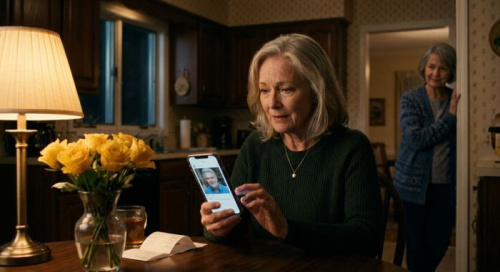
My granddaughter Emma saved me. She is twenty-two, finishing her last year of college, and she came down for a long weekend. Within an hour she had found him on the community Wi-Fi. "Nana," she said, holding up her phone with her eyebrows at her hairline, "why does this man have four different names in four different states?"
I looked at her screen. Harold Vess in Ohio. Erik Lunden in Arizona. Richard Coyle in Nevada. And Elliot Vance here in Florida. Four names. Four addresses. One face.
Emma wanted to call the police that second. "Nana," she said, "you have to."
"I will," I told her, and I meant it. "But not yet. I want to know exactly who he is and what he wants, so I can give it to him in front of everyone who ever believed him."
That is the part people don't understand about quiet women who read too much. We forgive slowly, but we plot beautifully.
The next morning, I called Frank Capaletti. Frank was a retired detective who had been Alan's poker buddy for thirty years. He came to my patio with a notebook and a look that said he already knew how this story ended. Ten days later, he came back with the whole ugly truth, spread across my kitchen table.
Elliot Vance was not a widower. He was not divorced. He was married — to Linda M. Harlow, née Lindgren, in a courthouse in Georgia, two years ago. The marriage was still legal and very much alive, as was his hobby of charming lonely women out of their nest eggs.
In Arizona, he was wanted on a warrant for grand theft from an elderly widow named Dorothy Shea. He had been her friendly neighbor for eight months, her handyman, her chauffeur to church. Then he had talked her into a $310,000 "investment" that vanished, along with her peace of mind. Charges had been filed. He had skipped state before the arrest.
In Ohio, he had drained the savings account of a retired nurse he dated for a year. In Nevada, there was a civil judgment against him for taking a deposit on a house he never owned. And somewhere along the way, he had picked up a habit of changing his name the way other men change their shirts.
I sat very still while Frank talked. Then I asked the only question that mattered. "What does he want from me, Frank?"
Frank closed the file. "Your house, Barbara. Your pension. You. He's already told three people at the club that after the wedding he plans to sell your place and move you both to a 'smaller, easier' condo. That smaller condo is his, and every cent comes out of you."
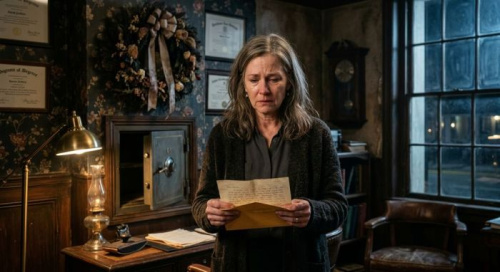
I thanked Frank, paid him, and walked to the kitchen window. My gardenias were blooming. Alan had planted them the spring before he died, and I had kept them alive out of pure stubbornness. I looked at them for a long time, and then I started planning.
I did not confront Elliot. That is what he expected — the tearful scene, the begging, the chance to slip away and start over with somebody else's sweetheart. Instead, I did the one thing no one ever does with a con man. I played along. I said yes to a birthday dinner at the Captain's Table, the fanciest restaurant on the bay. I said yes to champagne. I even practiced smiling at my own reflection until the smile looked brand new.
Three weeks later, on a Friday night in March, I walked into the Captain's Table on Elliot's arm, wearing a teal dress I had not worn since Alan's retirement party. Elliot had gone all out — a private table by the windows, a bottle of wine he ordered by pointing at the price, and a velvet box in his pocket that I could feel from across the table. He was going to propose again, publicly this time, so that the whole room would witness me say yes.
He never got the chance to ask.
Halfway through the appetizers, a woman stood up from a table two rows over. She was maybe fifty-fifty-five, sharp and beautiful, in a red dress and a look of stone. She walked straight to our table, put a folded document on the linen next to Elliot's bread plate, and said, in a voice that carried to every corner of the room, "You have to stop him. He did this to me, too. That's my marriage license, sweetheart — I'm his wife. He has been married to me for two years, and to about four other women before that. Did he show you the ring he gave me? Same one. He bought them in bulk."
The room went silent the way a room goes silent before a storm. Elliot's face did something I had never seen on a human face — it tried to be five different expressions at once and landed on nothing. "She's crazy," he said, and his voice cracked on the last word. "Barbara, this woman is a stalker. She's been folowing me for —"
"Folowing you?" Linda laughed, and it was not a kind laugh. "Baby, I have been married to you. I paid your car insurance. I bailed you out in Georgia when you got picked up for writing bad checks. Folowing you is what I get to do because I'm your wife."
I let the silence stretch. I let him sweat. Then I reached into my purse and brought out Frank's file, and I set it on the table next to the marriage license, and I opened it to the first page. "Elliot," I said, "or Harold, or Erik, or Richard — this is a warrant from the state of Arizona for grand theft from a seventy-two-year-old widow named Dorothy Shea. She trusted you the way I trusted you. You took her whole life's savings and told her the market was just slow." I turned a page. "And this is a photo of you walking out of the county courthouse in Georgia with Linda, last June. You married her two months after you proposed to Dorothy."
He stood up. The chair grated against the floor. "You set me up — "
"Yes," I said pleasantly. "I did. Because the detective who knew this case was sitting at the bar with a clear view, and he has been recording this table since we sat down."
I looked past Elliot, and Arthur Serrano — retired detective, now a private investigator himself, friend of Frank's — stood up from the bar, badge in one hand, phone in the other, already connected to the Sarasota County sheriff's dispatcher. And behind him, by the door, came two uniformed officers who had been having a quiet dinner at the booth in the corner.
"You want to do this here," Detective Serrano said to Elliot, "or you want to walk out quiet and let your wife keep her dignity?"
Elliot looked around the room. Every face was turned toward him. Somewhere a woman whispered, "That's the man from Palm Cove." Somebody's fork clattered. And Elliot Vance — Harold, Erik, Richard, whichever name he chose to wear that day — did the only thing he had left. He walked out between the two officers with his hands behind his back, and the last look he gave me was not rage. It was confusion. He genuinely could not understand how the quiet librarian had beaten him.
The trial was not dramatic. The evidence was boring and perfect, which is exactly how I like my justice. Arizona extradited him, and the judge there gave him nine years with full restitution — every penny of Dorothy Shea's money, plus interest, plus the two thousand dollars he had paid me back in cash that I had kept in an envelope, untouched, with the date written on it. Linda divorced him within the month. The Nevada judgment and the Ohio civil cases went in his file, waiting for the day he got out and tried again.
The part that surprised me was how the ending had nothing to do with Elliot at all.
After the news spread, Palm Cove did the thing the best small communities do: it wrapped around me. Margie confessed she had been praying for a disaster to happen because she was so sure the man was foul, and then she cried and apologized, and then she cried again and hugged me. The ladies at the bridge table stopped whispering about my ring and started playing cards with me at lunch. My daughter Brenna flew down for a whole week. My son Tim called every Sunday, unprompted, just to say hi.
And I started a coffee group. First Friday of every month, my patio, gardenias in bloom. We call it the Gardenia Club, and there are nine of us now — me, Margie, two widows from the retirement village up the road, a divorced teacher, a woman whose sister got catfished online, and new members every month. We do not sit around being afraid. We compare notes. We teach each other the signs: the fast proposal, the phone that never rings when you're in the room, the investments you should never ask about, the man who has a new name in every state.
And sometimes, when we have coffee and the light hits the bay just right, I think about the way people say con artists prey on the lonely, as if loneliness is a weakness. It's not. Loneliness is what's left when love is gone. It's the bravest thing there is, to keep your heart open after you've been burned. Elliot did not con me because I was lonely. He almost fooled me because I was brave enough to love again.
I look at my gardenias, and I think Alan would have laughed till he cried at the image of me and my friends running a school for scammers. Then he would have poured me a glass of wine and said what he always said when I finished a book: "That's my girl. She always gets the ending right."
The ring is in a drawer now. I keep it because I like the way it catches the light — one small, pretty thing that reminds me I can be fooled and still not be broken. And on the first Friday of every month, I pour an extra cup of coffee for whoever shows up, and I tell them the truth I finally believe myself.
It is not about the villain. It's about the people who show up with chairs when the storm passes. That is the whole secret. That is the ending I waited four years to find.