The night of the Majestic's centennial gala, my brother-in-law walked onto the stage and took the microphone right out of my hand. Two hundred people from Ashford and the three towns around it had come to honor the little theater Ray and I had kept alive for forty-three years. Instead, they watched Dale Barlow announce that the building was condemned, that the sale was already done, and that I was, in his words, "a sweet woman who simply hasn't been able to accept the truth."
I stood there in the deep blue dress Ray had always loved, and for one long moment I could feel the whole room holding its breath. Dale raised a sheet of paper over his head like a trophy. "It's all right here," he said. "A partnership agreement. Dated 1995. Signed by both of us. Ray and I were partners from day one, and partners have to make hard decisions."
He smiled his car-salesman smile and patted my shoulder the way you'd pat a dog that had learned a trick. I wanted to scream that it was a lie. But I had learned something in the sixty days since Ray died, something Dale had no idea I knew. So instead I smiled, the way Ray taught me to smile when a customer swore they'd already paid. "Well, Dale," I said. "I guess we'll see about that."
The truth is, nobody in that room knew the Majestic better than I did. I was the one who had stood outside in her coat selling tickets on frozen December nights in 1983 when Ray couldn't afford a second employee. I was the one who mopped the lobby after the high school kids spilled their sodas, who restocked the candy counter, who held Ray's hand in the projection booth during the first digital conversion, when we both thought we'd lose everything we had.
Ray and I met in that theater, underneath the marquee that Ray's father had built with his own hands. Ray was twenty-two and wore a bow tie that he'd never quite learned to straighten. I was nineteen and had lied on my application about having any experience at all. He hired me anyway. A year later, he proposed with a ring box that had once held projector bulbs, and we were married in the auditorium on a Tuesday morning, with my mother crying in aisle seven and his father pretending to check the fuse box so he could hide his own tears.
We built our whole life in that building. We slept in the office during the bad years. We raised our daughter, Ellie, on Saturday matinees and Sunday cartoons, and she learned to walk holding onto seat rows instead of furniture. When Ellie got married, she did it standing on that same stage, right where I was standing now, with the red curtain folded behind her like something from a wedding magazine.
Dale never understood any of it. Ray's little brother had left Ashford when he was nineteen and had spent forty years chasing get-rich schemes that never worked out. He sold used cars in Cincinnati. Then he sold timeshares in Florida. Then he sold "pre-owned luxury watches" out of a rented booth that folded within a year. Every time he came home, he showed up with a new company name printed on a new shirt, and every time he left, he borrowed money that he never quite paid back.
Ray always gave it to him. "He's my brother," Ray would say, rubbing his forehead the way he did when he was tired. "What am I supposed to do?" And I would watch Dale drive away in a rental car with better tires than ours, and I would say nothing, because that was the kind of wife I was.
When Ray died six months ago, it happened in the projection booth during the last reel of "It's a Wonderful Life." That was his tradition, every Christmas Eve — watch George Bailey learn that his life mattered. Ellie and I found him with his hand still resting on the changeover switch, and the screen behind him glowing with snow falling over Bedford Falls. The doctor said it was his heart, and that he wouldn't have felt anything. I have tried since then to believe that.
Dale showed up at the funeral in a black suit that looked like it had been pulled off a clearance rack, and he hugged me a second too long, and I felt his hand patting my back with a rhythm that didn't match grief. I should have known then. But grief is a fog, and I walked through the weeks after the funeral inside it, nodding at people who meant well, signing papers I barely read, leaning on the friends who brought casseroles and stayed to talk.
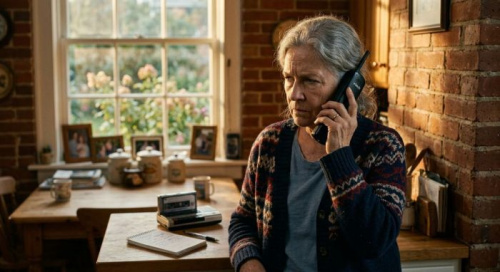
The first sign came in March, when I found the theater's water bill had been put on hold. Then the electricity company called about a "new account" that I didn't recognize. Then a man in a suit came by with a clipboard and asked to see "the current manager," and when I introduced myself, he looked at the floor and said he'd been told the property was in receivership.
That was when I went into the basement.
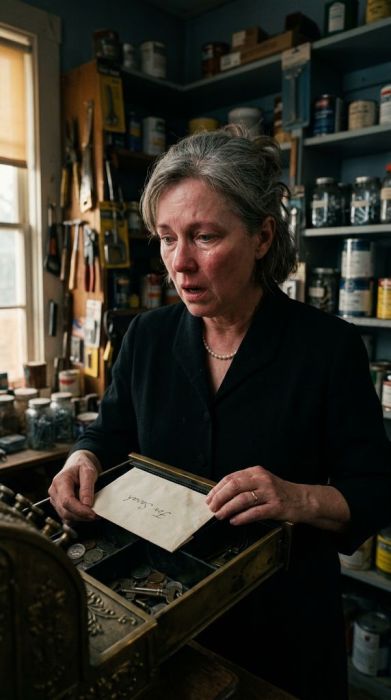
The Majestic has a basement nobody talks about, a damp little room under the stage where Ray's father kept the old carbon-arc projectors and where Ray kept everything he ever wanted to hide. There was a metal cabinet down there with a lock that had been rusted shut since before Ellie was born, and it took me an afternoon and a crowbar to get it open. Inside, wrapped in a wax-paper bundle that smelled like fifty years of dust, I found an envelope with my name on it, written in Ray's careful hand.
Carol, it said on the front. If anyone ever tries to take the Majestic, read this. And I'm sorry I couldn't tell you in person.
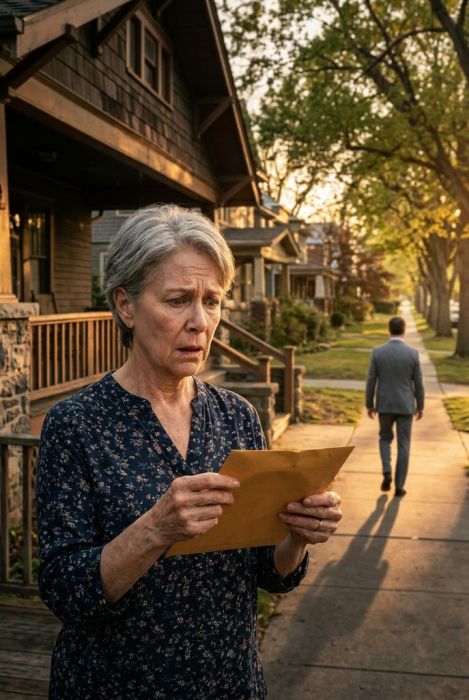
I sat on the basement stairs and read it three times before I could stand up. Inside was a copy of the original ground lease from 1926, when the town of Ashford leased the land under the theater to the Barlow family for ninety-nine years. The lease named the General Manager of the Majestic as the signatory, and Ray had made me General Manager the week after we were married. It also meant the building could not be sold, assigned, or demolished without my signature — and that when the lease expired, the land and everything on it reverted to the town.
There was more. Ray had registered the Majestic on the National Register of Historic Places two years before he died, and he'd kept the certificate in the same bundle, along with a letter from the state historic preservation office explaining that the demolition of a listed landmark without review was a violation of the law. And at the bottom of the envelope, in Ray's handwriting, one more note: Dale filed a partnership agreement in '95. I never signed it. I have the real file in my safe-deposit box, and the letter he wrote resigning from the theater the same year he took a five-thousand-dollar buyout. Keep it all. You'll know when you need it.
I sat on those basement stairs and cried until I thought I had nothing left. Not because of the papers. Because Ray had known. He had known his brother would come for the theater, and he had spent his last years building a wall of paper around it, because that was how he loved me — in action, in preparation, in the quiet things nobody ever saw.
Over the next two months, I did my homework. I found the file in Ray's safe-deposit box at the branch on Elm Street, exactly where he said it would be. I took the partnership agreement to a retired document examiner in Columbus, a patient old man with a magnifying glass who had testified in court forty times, and he told me what I already suspected: Ray's signature on the 1995 agreement had been traced from a 1978 check. The ink lay on top of the pencil guides. A child could see it under magnification.
I also hired Marvin Ellis, a retired structural engineer who had watched a movie at the Majestic every Friday night for thirty years. Marvin spent one afternoon walking the building, tapping walls, shining a flashlight into the joists, and he wrote me a report that made my knees weak with relief. The theater was sound. The so-called engineers Dale had hired had never opened a door. Their report was two pages long, printed on letterhead from a company that turned out to be a post office box and a cell phone number.
The man who signed that report was Mark Tolliver, who had gone to high school with Dale and had once been my dentist's receptionist's husband. When I called the number, he answered on the second ring, and I heard the guilt in his voice before I even said hello. Dale had paid him five hundred dollars cash to invent the condemnation. Tolliver started crying on the phone. He told me he'd done it because his own roof was leaking and his kids needed winter coats, and I believed him, and I also called the police.
That was how I spent the last three weeks before the gala. Every day, I practiced standing up straight. Every night, I rehearsed the words I would say. Ellie flew in from Denver and stayed at the house she had grown up in, and when I told her the plan, she didn't try to talk me out of it. She just looked at me with her father's eyes and said, "Mom. You've got this."
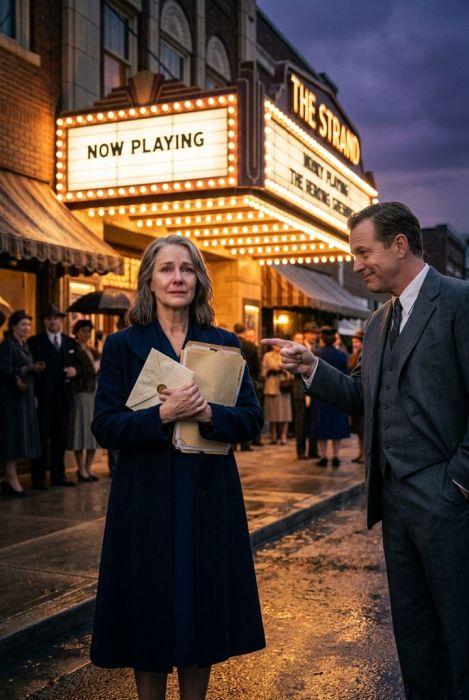
On the night of the gala, the marquee glowed red and gold over the whole block, and for two hours I let the town celebrate the theater exactly the way Ray would have wanted. The high school jazz band played in the corner. Old Mrs. Okafor cut the cake in the shape of a clapperboard. Marvin stood by the popcorn machine, telling anyone who would listen that the building could stand another hundred years. I was halfway through my toast — the one where I thanked Ashford for forty-three years of buying tickets and laughing at the same jokes — when Dale walked up the aisle and onto the stage, and took the microphone from my hand.
I let him have his moment. That was part of the plan, too.
"Our friend Carol has been through so much," Dale said to the crowd, holding up his fake agreement. "And that's why I want to make things easy for her. The theater is condemned. The developer is ready to build. All that's left is the paperwork, and I'm taking care of it."
The crowd stirred. I saw a man in the back stand up, and then another. Dale loved that. He thought they were on his side.
"Of course," he said, "there will be a small change of management. The new owners have asked me to stay on as a consultant." He laughed, and the laugh bounced off the old walls, and a few people laughed with him, because Dale had always been able to make people laugh when he wanted something.
That's when the wrecking crew arrived. I heard the truck before I saw it — the low grumble of a diesel engine idling out on Main Street, then the thump of the parking brake. Dale checked his watch. "Right on time," he said, loud enough for the front rows to hear.
He had told everyone that the demolition crew was coming to "secure" the condemned building. He had even handed out little cards with the developer's logo on them. What he hadn't counted on was that I had invited the entire town council to the gala, and the mayor was sitting in the third row with his wife, and Captain Reyes of the Ashford police was leaning against the back wall eating popcorn.
I walked to the edge of the stage and picked up the microphone Dale had set down when he finished his speech. "Before anybody tears down anything," I said, "I'd like to read you a letter."
Two hundred faces turned toward me. Dale's smile went stiff. I could see him working out whether to grab the microphone back or play it cool, and he chose cool, which was the worst mistake he could have made.
I read them Ray's letter first, the one from the basement. I read them the 1926 ground lease, holding up the yellowed pages so the front rows could see the town seal. I read them the National Register certificate, and then I introduced Marvin Ellis, who stood up and told the room that the theater's bones were better than most buildings constructed last year.
Then I looked at Dale, and I said the words I had practiced in my kitchen for three weeks. "You've been telling everybody this theater is condemned, Dale. But the only condemnation is the one you paid five hundred dollars for. The state's document examiner has already confirmed your so-called partnership agreement is a forgery, and the police have a confession from the man who wrote your fake engineering report."
The room erupted. I have never heard anything like it. Women in sequins were shouting. The high school band started playing the "Rocky" theme, because that's what teenagers do when they don't know what else to do. Dale turned white, then red, and he made the fatal mistake of grabbing my arm, right in front of Captain Reyes, who had started walking up the aisle the second the shouting began.
"Get your hands off her" is all Reyes said, and Dale's hand opened like a sprung trap. The police officers read him his rights in the lobby while the marquee still glowed behind them. The developer, who had driven down from Columbus expecting to shake hands, shook the mayor's hand instead and apologized three times, and I believe him, because he looked genuinely sick.
The wrecking crew loaded their equipment back onto the truck without touching a single brick. As they pulled away, the driver rolled down his window and yelled to me, "Sorry about this, ma'am. We were told it was abandoned." He had a daughter. Later, when they sent a flower arrangement to the theater, I put it in the lobby and didn't have the heart to throw it out.
The hearing came six weeks later, in the county courthouse downtown, and it was standing room only. Dale hired a lawyer who tried to argue that the forged agreement didn't matter because the real issue was the "valid transfer" of shares, at which point I presented the letter Dale had signed in 1995, the one where he resigned from the Majestic and accepted his five-thousand-dollar buyout. My lawyer asked him, very gently, to explain how a man could resign from a partnership he claimed never to have had. Dale said he didn't remember. Then the document examiner took the stand and the tracing guides were shown on the big screen, and the courtroom went so quiet you could hear the air conditioner.
Dale was charged with forgery, attempted fraud, and making a false report to authorities. The judge, a woman who had seen her first movie at the Majestic in 1974, looked at the papers for a long time and then looked at Dale. "I've seen a lot of families fight over a lot of things in this courtroom," she said. "But this is the first time I've seen a man try to demolish his own brother's memory to get paid." She sentenced him to probation, restitution, and a year of community service, which the town gleefully assigned to him picking up trash along Main Street, where the marquee glowed at him every single morning.
I don't tell people this, because it feels like bragging, but the town raised forty thousand dollars in a month to set up the Majestic as a community trust. The historic designation got the roof repaired through a preservation grant. The Friday night classic series is sold out six weeks in advance, and tickets are still five dollars, because that's what Ray would have wanted.
As for me, I turned seventy-one last fall, and I still walk the lobby every evening at six, turning on the marquee the way Ray used to. Some nights I stand in the projection booth and I can still feel him there, his hand resting on the changeover switch, watching the snow fall over Bedford Falls.
Last Friday, Marvin Ellis asked me if I wanted to see a movie with him. Not the classic series, just a regular one, and I said yes, and I let him buy the popcorn. I think Ray would have liked that. He always said the theater was a place where people should get second chances.
The Majestic will be here long after all of us. That was Ray's whole point, the one he spent his last years building a wall of paper to protect. Nobody dies and stays dead when there's still a seat in the dark waiting for them, and the lights still come up, and somebody still cares enough to turn them on.
I turn them on every single night. And as long as I do, Dale Barlow will drive past that glowing marquee on his way to pick up trash along Main Street, and he will know exactly who won. Not because I ever wanted to win anything — but because I was the one who kept the faith, and kept the papers, and kept the promise.