The night of my father's funeral, my brother Randy stood in Dad's kitchen with one hand already closed around Beau's collar, and I felt the floor tilt under me.
"Dad promised me the dog," he said.
He said it the way he said everything, with that easy smile that had talked Mom into every scheme he ever ran. It was the same smile he'd worn at fifteen when he "borrowed" Dad's Mustang, at twenty-two when he "invested" Mom's savings, and at fifty-eight, at our father's own wake, when he reached for the one living thing our father had loved most in this world.
"He never promised you anything," I said. My voice came out strangled. I'd been holding it together all day — the hymns, the awkward hugs, the casseroles piling up on the counter.
Randy shrugged. "He told me last Christmas. Said if anything ever happened to him, Beau should go with me and the kids."
It was a lie. I knew it was a lie because I had been there last Christmas, standing in this same kitchen in my mother's apron, when Dad raised his glass and said, plain as day, "When I go, Beau stays with Maggie. She's the one who feeds him when my back is bad." My aunt Irene heard it. My cousin Walter heard it. Even the dog seemed to hear it, thumping his tail against Dad's chair leg.
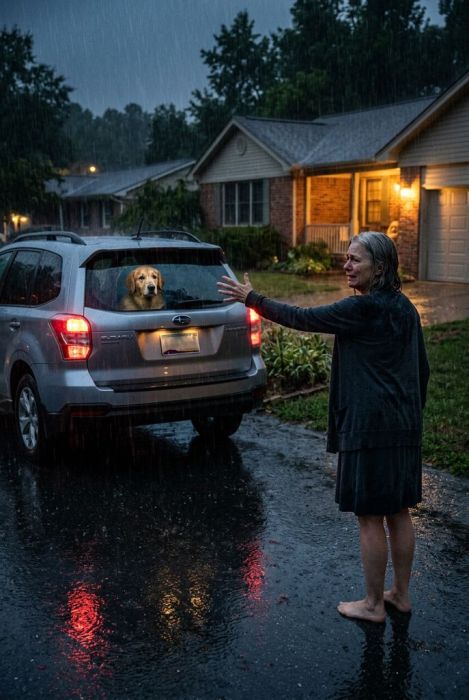
None of that mattered to Randy. Because Randy had the car, and the dog was in the car, and the car was already running in the driveway.
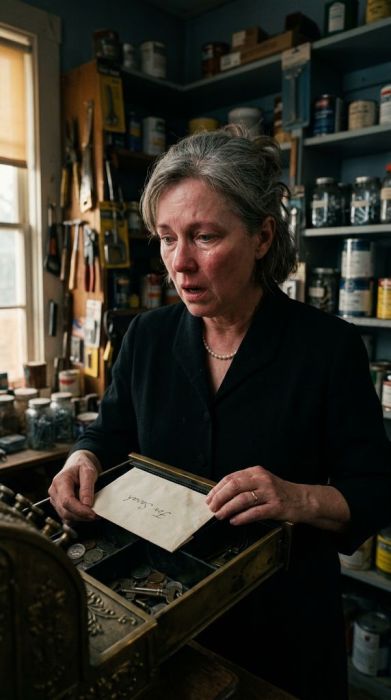
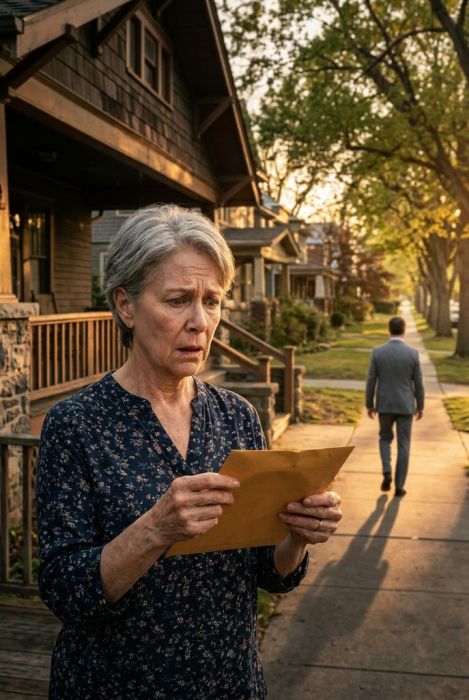
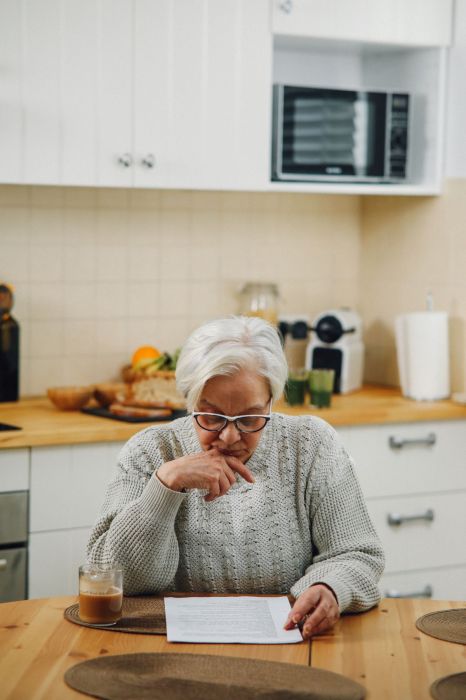
I want to be clear about who I am. I'm Maggie Vance. Sixty-three years old, retired school nurse, and I live alone in Millbrook, Pennsylvania, in the little house on Chestnut Lane that my parents bought in 1974. I buried my husband Frank eleven years ago. Cancer, real quick, real quiet. And when Mom went eight years back, it was just me and Dad and the dog, and I got used to being the one who showed up with soup.
Beau was the one thing that never let me feel like the leftover of a family. Dad brought him home as a puppy the spring after Mom died — a golden retriever the color of late honey, with paws too big for his body and a head that fit perfectly under Dad's palm. For eight years they were inseparable. Every morning at six-thirty, rain or snow, Dad and Beau did the loop around the park. Every afternoon Beau sat by the barbershop door across the street, waiting for the old men to toss him bits of their sandwiches. Every night he slept in the curl of Dad's legs, in that armchair by the window he'd owned since I was a girl.
The whole town knew that dog. That's what made Randy's theft so bold.
He'd driven up from Philadelphia in that leased SUV of his — "just for the day," he'd said, though he'd shown up an hour late and ten years too cheerful. Taylor was with him, his girlfriend, and her two kids, twins about eight years old. They stood in the church parking lot picking at their phones while the rest of us did the hard, human work of lowering my father into the ground.
I gave Randy the benefit of the doubt for exactly one week after the funeral. I called him every night. I called Taylor. I left messages that got progressively less polite. When he finally texted back, it was a photo of Beau lying on a rug I didn't recognize, with the caption: He's happy here with us. The kids love him.
I asked to come visit. No answer.
I asked — begged, really — for a video call, just to see his eyes. Randy texted: He's fine. Stop worrying.
So I drove the hour and a half to his place in Conshohocken. I won't ever forget what I saw through the fence. Beau was out back on a chain, on a patch of dirt that used to be grass. His ribs showed through his coat. His fur was matted. His water bowl was tipped on its side.
And around his neck, a thin raw line where the collar had rubbed him sore.
He saw me before Randy did. He came to the fence as fast as his legs would carry him, and he made that sound — that half-whine, half-yelp that Golden Retrievers make when they're so happy they forget their manners. I knelt down and put my fingers through the chain-link, and he pressed his big warm head into my hand.
That's how Randy found us. He came out in a sweatshirt with a beer in his hand and told me I was trespassing. Told me if I didn't leave he'd call the police. He said the kids had renamed the dog Rex, that the dog liked it better, that the chain was just "till he learns the yard."
I told him Beau was nine years old and arthritic and had never been on a chain in his life.
"You don't know anything about him," I said. "You never did."
I watched something in his face close up, like a door. And I drove home crying, with his taillights shrinking in my mirror and the whole drive replaying the look on that dog's face.
Two weeks later, Randy called me himself. Not to apologize. To ask for money.
"Beau's got a flea problem," he said. "The vet out here wants four hundred bucks just to look at him. And Taylor's kids have lost interest, and the landlord says no dogs, and honestly, Maggie, the dog is costing me."
I waited. I knew what was coming.
"So I'll tell you what," he said. "You send me fifteen hundred dollars for what I've spent on him, and I'll let you come get him."
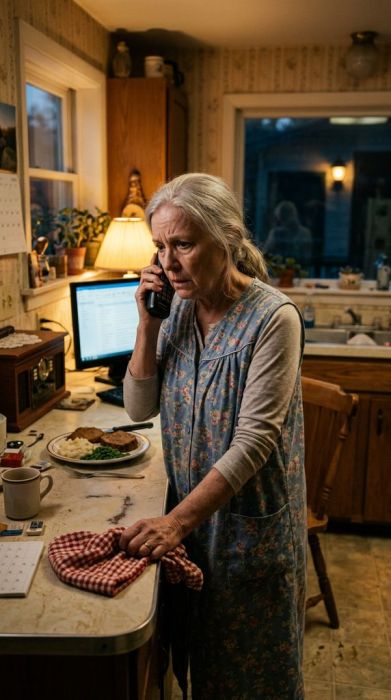
I didn't say yes. I also didn't say no. I said I'd think about it, and I hung up, and I sat in Dad's kitchen — my kitchen now; the will had given me the house, which had sent Randy into a rage all its own — and I thought about a dog on a chain with a raw neck and a brother who had turned him into a ransom note.
That's when I remembered the chip.
Two years back, when I'd driven Dad and Beau to Dr. Park's clinic for their checkup, Dad had said something I'd forgotten until now: "When I'm gone, the dog goes to Maggie. Make sure the paperwork says so." Dr. Park had laughed and said, "You want me to put that in the file?" And Dad had said, "Put it everywhere."
I called Dr. Grace Park the next morning. She'd known Dad for years — she'd treated Beau since he was a pup, and she'd treated half the old men on Chestnut Lane for everything from burrs in their ears to bad hearts. When I told her what Randy had done, she didn't even pause.
"I've got his whole file here, Maggie," she said. "And I've got something better."
She had a statement Dad had signed at his final checkup, the week before he died, right there in her office: I, Arthur Vance, declare that my dog Beau is to be given to my daughter Margaret Vance upon my death. Randy is not to have him. And beneath it sat the microchip registration, updated the same day, listing the contact owner as Margaret Vance of Chestnut Lane.
"You want the papers, they're yours," Dr. Park said. "You want me to testify, I'll testify."
Then the universe did the strangest thing. The very next week, I got a call from a woman named Emily, from animal control in Conshohocken. Beau had gotten loose. Someone had found him — a ten-year-old girl, as it turned out, who'd been feeding him her lunch for three days — and when animal control scanned the chip in his neck, my name and number came up first.
"We have your dog, ma'am," Emily said. "And I have to tell you, he's underweight. There's a collar sore on his neck that's been there a while. Whoever's been keeping him hasn't been doing much keeping."
I didn't tell Randy I knew. That was important. I let him think I was still deciding about the fifteen hundred dollars. I let him leave me three increasingly nasty voicemails about "how hard it is to have a dog." I let him dig every hole he could dig with his own two hands.
The trap came together at Aunt Irene's eighty-fifth birthday, the first Saturday in September.
It was the right place, because Aunt Irene was the one person Randy could never charm out of the truth. She was Dad's older sister, ninety pounds of Pennsylvania stubborn, and she'd been at that Christmas dinner too. I'd asked her quietly if she remembered what Dad had said about Beau. She'd looked at me like I'd asked if the sky was blue. "He said it right to Randy's face, Maggie. And Randy nodded and said, 'Yes sir, I heard you.' He knew."
The party was at the V.F.W. hall on Main Street, and everyone came — the cousins, the old barbershop crowd, Dr. Park, even Dad's bowling team. Randy showed up late, of course, with Taylor on his arm and a story about traffic, and he was two drinks in before the speeches started, which is exactly when I chose to stand up.
I didn't raise my voice. That's the thing about doing it right. You don't need to shout when you have the papers in your hand.
I said, "Aunt Irene, before we cut the cake, I want to give you your real gift." And I walked to the little podium and I told the room — the whole room, forty people, every one of them a witness — what Randy had done. I told them about the funeral, about the "promise" that had never happened, about the chain, about the raw ring around the dog's neck, about the fifteen hundred dollars.
Randy laughed. "She's making it up," he said, loud, red-faced, waving his beer. "She's just mad she didn't get the whole house."
That's when Emily stood up from the table near the door, in her uniform. "Sir," she said, quiet as anything, "I picked your dog up in Conshohocken last week. He'd been loose for three days. He was fourteen pounds underweight, and he had a collar sore that had been there for weeks."
And then Dr. Park stood up, and she read from the file. The signed statement. The date. The words: Randy is not to have him.
And then Aunt Irene stood up — that tiny old woman, my father's sister — and she said, "Arthur said it at Christmas, right in front of you, Randy. You looked him in the eye and agreed. You've been lying to this family since the day your father died."
I watched the color drain out of his face like water out of a sink.
Deputy Halverson had been Dad's bowling partner for twenty years. He'd come to the party like everyone else, in a golf shirt and khakis, and he was standing by the punch bowl with a paper plate when Randy started laughing. He didn't need to do much, as it turned out. He just asked Randy, in the mildest voice you ever heard, if he wanted to step outside and talk about the theft report we'd be filing in the morning — because under Pennsylvania law, a dog is property, and property worth more than a thousand dollars, with witnesses and paperwork and a microchip to prove it, is a thing the county takes seriously.
Taylor left before he did. I watched her gather the twins and walk out without a word, and I thought about how the kids had "lost interest" in Beau, and I hoped — I truly hoped — that wherever they went next, someone taught them that animals aren't toys you set down when they get heavy.
Randy tried to bluster. He tried to say he'd "been meaning to give the dog back." Then he tried to say the dog was "half dead anyway." Then he just stood there, in the middle of his father's sister's party, with every person in Millbrook who'd ever loved his father looking at him like he was a stranger.
They charged him. The theft was bad enough, but the county prosecutor took one look at the vet records — the underweight notes, the collar sore, the tipped-over water bowl in the photo I'd taken through the fence — and added animal neglect to the pile. Randy paid restitution, paid every cent of Beau's recovery bills, did eighty hours of community service at the shelter he'd sworn he'd never set foot in, and his boss at the dealership let him go when the news got around, because no dealership wanted a salesman who'd ransomed his own father's dog.
He's living with a cousin in Ohio now. Mom would have said it was a shame. Maybe it is. Maybe part of me will always feel that small, lonely pull toward the brother I had before he decided that everything with a heartbeat was a transaction.
But I didn't cry for him. I cried the morning Emily brought Beau home, and I cried again when Dr. Park hugged me in the parking lot, and I cried the first time I walked him back to the park — Dad's loop, six-thirty in the morning, the same bench where the old men used to sit — because he remembered the whole route. He pulled at the leash at every single corner, exactly like Dad had taught him, and when we got back to the house on Chestnut Lane he went straight to Dad's chair by the window, climbed into the curl that still smelled like him, and put his head down on the armrest.
He sleeps there every night now. I've stopped trying to get him to use his own bed. Some things you don't move.
The neighbors have been wonderful, the way small towns are when they decide to wrap their arms around you. Mrs. Kowalski knitted him a sweater for the winter. The barbershop men agreed to walk him any day my knees complain. The girl who fed him her lunch in Conshohocken — her mother calls me every Sunday, and I've promised them first pick of the litter the day I ever decide to let Beau have puppies, which won't be soon.
People ask me if I'm lonely in that big house with nothing but a dog. I tell them I'm the least lonely woman in Millbrook County.
Because here's the thing I learned standing in a V.F.W. hall with my father's sister holding my hand and forty witnesses behind me: blood isn't what makes you family. Showing up is. Feeding the dog when your father's back is bad. Walking the loop in the rain. Sitting in the quiet house at the end of the day and staying anyway.
Beau is old now — he'll be ten in the spring. He's slower than he was, his muzzle is white as December, and he sighs when he lies down, the way Dad used to. But every morning at six-thirty, he's at the end of the bed, waiting for the loop, and I get up.
Some people spend their whole lives looking for a sign that they did right by the ones they loved. I don't have to look far. Every day, the dog my father loved the most in this world puts his head in my lap and tells me I did.