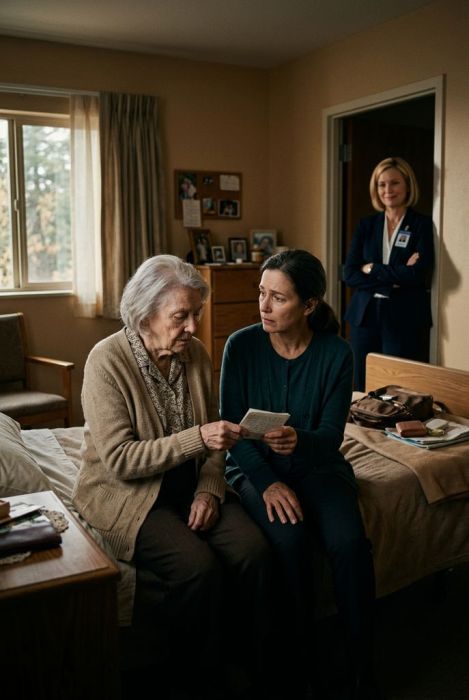
The first time I saw the notebook, I thought Mom was hiding something from me. She was sitting by the window of her room at Piedmont Gardens, and when I walked in, she slid it into the pocket of her nightgown so fast I almost didn't catch it. "What do you have there, Mom?" I asked, keeping my voice light. She looked at me with those clear blue eyes everyone said were going hazy, and she put a finger to her lips. "Evidence," she whispered. Then the administrator, Donna Voss, appeared in the doorway like she had been summoned, her perfume arriving a full second before she did. "Sunshine!" Donna sang, gliding to Mom's side. "How's my favorite girl today?" Mom smiled her sweetest smile, the one she used on difficult children in forty years of first grade, and Donna patted her arm like she was a good dog.
That was the first time I understood something was very, very wrong at Piedmont Gardens. It just took me nine more weeks, one terrifying phone call, and a green composition notebook to prove it.
Nine months earlier, we had buried my father, and something in Mom had quietly folded shut. She had been Dorothy to everyone, Dot to Dad, but after the stroke she became smaller, softer, slower. The doctors said it was early dementia, the kind that creeps in like fog. My sister Vanessa, who sells real estate and believes in expensive things, announced at a family dinner that she had found the perfect place. "Piedmont Gardens has won awards, Claire. Three counties. Mom will have crafts and bingo and someone to watch her around the clock." I said I thought Mom might do better at home with help, that she still made her own oatmeal, that she still knew every hymn she had ever taught. Vanessa rolled her eyes so hard I heard them click. "You can't just quit your life to babysit her, Claire. You're not a nurse."
I wasn't a nurse. I was a retired second-grade teacher and a widow myself, with a son in law school and a house full of silence. Maybe that's why I let them win. Maybe that's why, when Vanessa stood in the lobby of Piedmont Gardens holding the admission papers, I signed my name beside hers even though my stomach was telling me something was wrong. Donna Voss had shaken my hand with both of hers, looked me dead in the eye, and said, "We treat every resident like our own grandmother. You'll see." The way she said it, so warm and practiced, should have been my first warning. Genuine people do not need to announce how genuine they are.
For the first month, it seemed fine. Mom had a roommate named June, a tiny laughing woman from Kentucky who told me I had her mother's chin. They did arts and crafts. There were photos of Mom at a Halloween party wearing a cardboard crown, smiling, clutching a plastic pumpkin full of candy. I slept better. I told myself I had been a worrywart, exactly what Vanessa always said. And then, slowly, the phone calls started.
"Mom doesn't want to go to the dining hall anymore." "Mom says she's cold at night." "Mom had a fall, but it was minor, nothing to worry about." Each call came from the same pleasant voice, a nurse's aide named Tammy who always sounded like she was smiling through a closed door. I started driving over on my day off, unannounced, and that's when the small wrong things began to pile up. Mom's room was always immaculate, but her favorite lavender sweater was gone, and when I asked about it, Tammy said it must have been donated to the laundry pile by accident. The little framed photo of Dad had been moved from her nightstand to the top shelf of the closet, where she couldn't reach it. And Mom, who had never complained about anything in her life, started saying the same thing every time I left: "Don't let them take my notebook, Claire."
I asked Vanessa about the notebook. She laughed. "It's probably a crossword book, Claire. Mom's fine. Donna sends me pictures every day." Donna sent Vanessa pictures. That was the thing I only understood later — Donna had chosen Vanessa. She called Vanessa weekly, asked for her advice, complimented her earrings, and somehow always mentioned the new wellness wing they were building. Vanessa glowed under the attention the way people do when a predator picks them out of a crowd. "She's an angel, Claire. Honestly, we're so lucky." Meanwhile, I was the difficult daughter. The one who called too often. The one who asked too many questions.
The first big crack appeared on a Tuesday in February. I had driven through freezing rain to bring Mom her favorite soup, and I found her sitting in a cold room with the heat turned down, wearing two sweaters and her coat. The call button was on the floor. Her water glass was empty, and the tray from lunch was still on the table, untouched, the food congealed into something gray. "They forgot me today, Claire," Mom said, matter-of-factly, like she was telling me it had rained. "They forget me a lot." Something inside me turned over. I went to the nurse's station and asked, as pleasantly as I could manage, why my mother had been left alone for hours without food. The head nurse, a tired woman named Greta, looked at the schedule and said, "It says right here she was seen at noon. And one o'clock. And three." She pointed at a clipboard full of checkmarks. Every box was checked. Mom's tray was still sitting there, untouched.
That was the day I stopped asking questions and started looking. I went home and pulled Mom's bank statements out of the shoebox she kept in the hall closet, the one that still smelled like her rose-scented drawer liners. What I found turned my blood cold. Piedmont Gardens was billing Mom nine thousand dollars a month for a "Comprehensive Memory Care Package" that included daily physical therapy, evening music therapy, individualized nutrition planning, and something called "Sunset Concierge Services." Mom had not had physical therapy. Mom could not remember the last time anyone played her music. And on the statement from the month before, there was an additional charge, itemized in tiny gray print: "Specialized one-on-one care — seventeen days." Seventeen days of one-on-one care, adding more than four thousand dollars on top of the package. I called the billing office and asked to speak to someone. They transferred me three times, and then Donna came on the line, warm as caramel. "Oh, Claire, that's just the upgraded plan your sister approved. Vanessa signed the addendum last fall. Didn't she tell you?" I called Vanessa. Vanessa said, "I signed something about activities, I don't remember. Donna explained it to me on the phone. It sounded good." My sister had signed a four-thousand-dollar-a-month addendum because a woman with a kind voice explained it over the phone.
I did the math in my head. Mom's savings would be gone in eighteen months. And every night I lay awake thinking about the notebook.
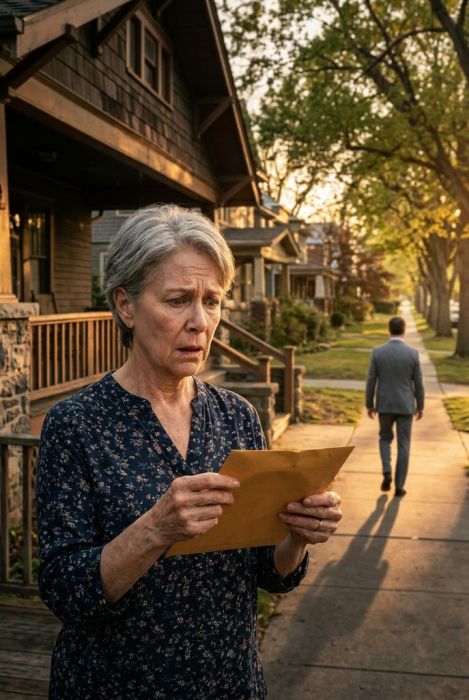
The notebook arrived in my mailbox on a gray Sunday afternoon, in a padded envelope with no return address. Inside, wrapped in a plastic bag, was the green composition notebook Mom had been hiding in her nightgown pocket, along with a letter in her careful first-grade-teacher handwriting. "Dear Claire," it read. "If you're reading this, I'm not as confused as they think. I started writing everything down the day I realized they mark things done that never happened. I know the days and the times. I know the van that comes at night. I know the sign-ins that are lies. I've been pretending, because pretending keeps me safe, and because nobody believes an old woman. But I believe you. Love, Mom."
The notebook was a diary of small betrayals, written in her neat looping cursive. "Jan 14 — left alone 2pm to 7pm. Called four times. Nobody came. Wrote it down." "Jan 22 — they say June fell, but I saw the aide push her. June cried. They wrote 'fall.'" "Feb 3 — the van with the blue stripe came again at nine. Donna was waiting at the door with the keys." "Feb 9 — Miss Donna had me sign a paper while I was eating. She said it was a birthday card for June. It was a care addendum. I saw the words after she left. $4,200. I signed in the wrong place, deliberately." Mom had signed the addendum wrong on purpose, which made it contestable. And she had noted every detail like she was still taking attendance: dates, times, names, license plates. The blue-striped van belonged to a company called Sunset Concierge Services — the same name on the phantom bill — a company Donna had incorporated herself, according to the state business registry I pulled up the next morning, using the facility's address and her own home address on the filing.
I stopped arguing with Vanessa. I stopped calling Donna. Instead, I called the state Long-Term Care Ombudsman, and then, because of the money moving in Mom's notebook, I called the county prosecutor's elder fraud unit. I also did something I had never done before: I talked to the other families. There was a small table in the visitors' lounge where I started saying hello, quietly, to the sons and daughters of other residents. One by one, they told me the same stories. Billing that made no sense. Loved ones who said they were forgotten. The same strange word, "fall," appearing over and over. A man whose father had paid for a private aide who never showed up. A woman whose mother had signed papers she couldn't read. I started a group chat. Nobody used the word "scheme" yet. But we were all looking at each other with the same dawning, sick understanding.
The trap snapped closed at the county board hearing, though Donna never saw it coming. She had submitted the facility's expansion plans for approval, and the hearing fell on the same week the prosecutor's warrant was being prepared. Donna walked in looking like a magazine cover, laughing, holding a rendering of the new wellness wing under her arm. I was in the third row, and I had Mom with me, which surprised everyone — especially Vanessa, who hadn't known I'd brought her from the facility that morning. When the floor opened for public comment, I stood up and asked Donna, in front of the whole room, to explain the $4,200 addendum my mother signed on February ninth while she was eating. Donna's smile flickered but held. "That was the upgraded memory care plan, fully explained to the family at the time." I held up the notebook. "This is the notebook my mother kept in her nightgown pocket. In it, she wrote down the date, the time, and that you told her it was a birthday card for her roommate. She signed it in the wrong place on purpose, because she knew it wasn't right." The room went quiet. I read a few entries aloud: the untouched trays, the blue-striped van, the checkmarks that were lies. And then I said the words I had rehearsed with the prosecutor's office: "There is a warrant being executed at this facility as we speak, and a second one at Sunset Concierge Services — the company my mother was billed four thousand dollars a month for. A company that lists the same address as your home."
I had expected a fight. I had expected lawyers. What I did not expect was for Donna Voss to look at her watch, smile at the audience, and say, "This is ridiculous," before walking toward the side exit — where two state troopers in plain clothes were already waiting for her. The meeting dissolved into chaos. People were on their phones. Vanessa was crying, grabbing my arm, saying "I'm so sorry, Claire, I'm so sorry" over and over. And Mom, who had been playing the confused old woman for nine months, sat perfectly straight in her chair, holding my hand, and said, quietly, "I told you. I wrote it all down." Then she let the tremble come back into her hand and the faraway look into her eyes, and I understood that she had been acting — that the fog had lifted for exactly as long as it needed to, and that the person who saved us all was a woman I had almost let them convince me was lost.
The investigation took nine months. Piedmont Gardens lost its license. The residents were moved to better facilities, and the families — all fourteen of us from the group chat — formed a little army of advocates that hounded the county until restitution checks started going out. Donna Voss was indicted on charges of elder exploitation and insurance fraud, along with two nurses who had falsified the checkmarks and a billing manager who had doctored ten months of statements. June, Mom's roommate, testified at the deposition about the fall that was written down as an accident. The blue-striped van turned out to belong to a scheme that had billed an additional half-million dollars across three facilities in two states. It was bigger than one greedy woman. It was a system — a machine built on the assumption that old people don't write things down and their children don't look.
Mom came home to live with me in March. We put her green notebook on the shelf beside Dad's photo, and she made oatmeal every morning, and within a week she had befriended every dog on the street. The dementia was real — it never stopped being real — but it was slower than they said, and kinder. Some days she knew me, and some days she called me by her sister's name, but every evening at six o'clock she would look at the shelf and say, "Has anyone touched my notebook?" and I would tell her no, and she would nod, satisfied, and drift off to sleep with her hand in mine. She passed eight months later, on a Tuesday, with the window open and the smell of roses coming in from the garden. The notebook was on the nightstand. Under it, I found a letter she had written the week she came home. "I never wanted to be brave, Claire. I just wanted someone to believe me. You did. That was everything."
I tell this story now because there are people out there right now, sitting in the same kind of room I sat in, holding the same kind of phone call. If your mother tells you they forgot her, ask to see the log. If the billing doesn't make sense, ask for the itemized line. If a woman with a warm voice and a fancy lobby calls your mother "Sunshine," look twice. And if your loved one keeps a notebook in their nightgown pocket, believe it. Because the people who built that machine counted on us not looking. My mother counted on me looking. And looking — that is the only thing that saved her.