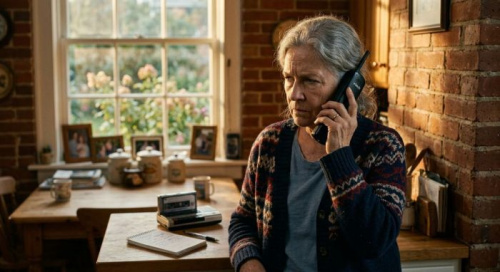
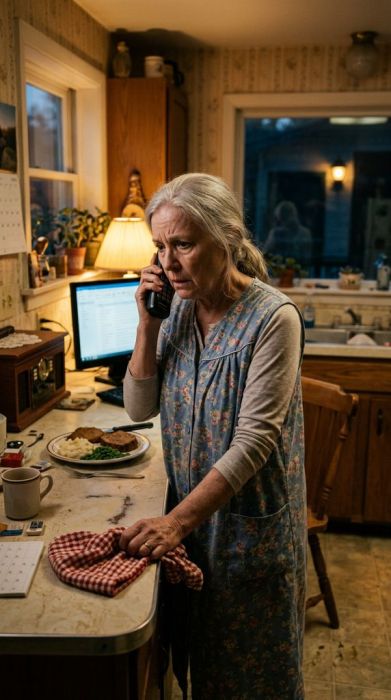
The call came at 2:17 on a Tuesday, right as the meatloaf went into the oven. I only picked up because the number on the screen belonged to the security company — the one whose little orange shield had lived in the corner of Roy's computer for twenty years. The young man introduced himself as Agent Torres, badge SRV-22917, and his voice had that practiced pleasantness you hear from people who read a script and mean every word of it.
"I'm showing a renewal charge of four hundred ninety-nine dollars and ninety-nine cents," he said, "against the card ending in 4-4-4-1. This is your final notice."
I told him there must be a mistake. Roy had been gone fourteen months now, and I had frozen every card we owned within a week of the funeral. I didn't even own a card ending in 4-4-4-1 anymore.
"Ma'am, I can see the charge right here on my screen," he said, and his voice went a little tighter. "If you don't want the service, I can process a refund today. But my system shows the charge is already going through, and if we don't handle it before five o'clock, it renews automatically for another year."
That was the hook. That was the little trap he set, and I walked into it with my eyes wide open, because I didn't know better yet. I asked him to please refund it, please cancel it, please don't let Roy's name sit on another bill. I told him Roy had died, and he said he was so sorry, ma'am, and then he kept right on selling. I was crying by the time I finished saying all of it. I keep Roy's dish towel folded on the counter where his coffee cup used to live, and I cried into it.
What happened next took my breath. He put me on hold, and when he came back his voice had dropped into something almost gentle. "Ma'am, my supervisor approved the refund, but I'm seeing I overpaid you. I sent back five thousand four hundred dollars instead of four ninety-nine. That was an error on our end, and if the bank catches it before it's corrected, they'll flag your account and you could be investigated for fraud."
My heart did something I'm not proud of. It froze. I'm seventy-one years old, and I've watched the same news everybody watches. I've seen the stories about people my age having their accounts frozen over mistakes smaller than that. He put a supervisor on the line — a woman named Harris with a voice like a closing door — and Supervisor Harris told me, flat out, that if I did not return the overpayment by gift card before the end of business, she would report me to the FBI herself.
"You have forty-five minutes," she said. "And we are trying to help you."
I hung up. I sat down at the kitchen table and cried into Roy's chair, the one I still can't move. Then I called my son.
Caleb is a deputy sheriff, and I love him more than my own life, but he has a sigh he saves specially for me. I heard it across the line before I even finished my sentence.
"Mom, it's a scam," he said. "It's the gift card thing. We had the training last month. Just don't buy the cards, don't give them the codes, and hang up."
"Caleb, they said the FBI—"
"Nobody's coming to arrest you, Mom. I promise."
He meant well. He's a good son; he brings me soup when I'm sick, and he changed every lock on the house after Roy passed. But I heard the edge under his patience, the same one I used to hear in my own voice when I was explaining long division to a child who had already decided he was bad at numbers. He thought I was being naive. He thought I was one of those old ladies who believes the letters with the clip-art eagles in the corner.
He was wrong. And the craziest part is, I didn't know I was going to prove it to him until about forty minutes after I hung up.
The second call came at 6:18 that evening, while I was washing the dish the meatloaf was supposed to be on. Supervisor Harris again, and she was angrier. "You haven't completed the return. Our system is still showing the overpayment on your card. This is now a theft matter. I'm going to have to escalate to our legal team."
That's when something in me straightened up. I spent forty years in a classroom, and I know a bluff when one gets bluffed at me. A real legal team does not tell you to go to the grocery store and buy gift cards to fix a banking error. Even I knew that. I had just been scared long enough not to say it out loud.
So I did a strange thing. I said I was sorry, and I asked her what kind of cards she preferred. She said Visa and Mastercard, and she told me to buy four thousand eight hundred dollars' worth, in denominations under five hundred, so the cashier wouldn't ask questions. She stayed on the line while I wrote it down, and at the end her voice went soft, the way the con man's always does right before he takes the whole pot.
"Cooperating is the smartest thing you can do, sweetheart."
I didn't buy four thousand eight hundred dollars' worth of cards. I bought one hundred dollars' worth, from the Safeway two blocks over, and I paid cash so it couldn't be traced to my account. Then I came home and called my granddaughter.
Maren is twenty-one, a computer science student at the University of Oregon, and she is the only person in this family who inherited my habit of writing things down. I told her everything — the phone calls, the badge numbers, the forty-five minutes, the gift cards. The whole time I talked, she typed on her laptop, and I could hear the little satisfied clicks when she found what she was looking for.
"Grandma, this is a refund scam," she said. "It's a whole industry. They call it the overpayment trick. The call center is overseas, the cards get cashed by local runners, and the only thing that keeps it alive is scared people who never tell anybody."
"Your father said the same thing."
"Dad thinks it's stupid," she said, and I heard the eye roll through the phone. "He thinks it's stupid until somebody does it to his mama. Then he'll want the badge numbers himself."
That was the moment the plan started. I can't tell you it was brave. It was more like the way a cat watches a bird through a window — patient, and already sure of how the story ends. I decided I was not going to be a body in somebody's ledger anymore. I was going to be the one who wrote the ledger.
Here is what I want you to understand about the people who do this. They are not sloppy on the phone. The scripts are rehearsed, the voices are trained, and they know exactly which button to push. But they are greedy, and greed has a schedule. Greed calls back. Greed sends somebody to your house.
Maren put me in touch with Detective Dana Okafor, who ran the county's elder fraud unit. Detective Okafor asked me one question I'll remember for the rest of my life: "Iris, are you scared of them, or are you angry at them?"
I thought about it for a long moment. "Angry," I said. "I'm angry they used Roy's name. I'm angry they made me cry into my dish towel."
"Good," she said. "Angry people remember every word."
We built the operation together. I would keep the line open, keep them happy, keep them believing. The one hundred dollars I'd already sent would be our proof that they were real; when they asked for the rest, we would be ready. Detective Okafor coached me through every call. She told me to be scared, to sound shaky, to ask the questions a scared woman would ask. I did. I'm old enough to remember when the telephone was the fastest thing in the house, and I can sound however I need to sound for the people I love.
"Four thousand eight hundred dollars," I whispered to Harris one Thursday, and I let my voice break on the number. "That's a lot of trips to the store."
"Take your time," she said. "But not too much. Once they're activated, we'll send a courier to collect them within the hour. It's for your safety, so the cards don't get lost in the mail."
That's how it works, you see. In the movies the villain creeps in through the dark. In real life, the villain knocks on your front door in the daylight, and you offer him iced tea.
The courier came on a Friday night. Our porch light — the one that had been out since July, the one Caleb kept promising to fix — Detective Okafor's team had replaced the Thursday before, and they'd hung a camera inside the little birdhouse Roy built, aimed at the porch steps at exactly the right angle.
When the silver car with the dented bumper pulled into my driveway, I was standing at the kitchen window with the phone pressed to my ear, playing my part. Harris was on the line walking me through the activation, and I said yes, yes, I'd found the number through the scratch-off, yes, it's going through now. What I didn't say was that the boy walking up my porch steps was Danny Kimball.
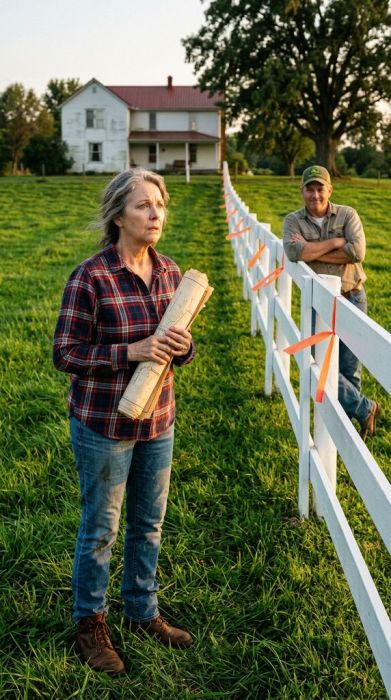
I had known Danny since he was eight years old. I taught him to feed the koi pond out back; he pulled weeds for two summers and mowed my lawn until he grew taller than the fence. My Roy taught him how to change a tire. I sat with his mother at the hospital the year his father left, and I was in the front row the day he graduated from high school in a cap that kept falling off. He delivered groceries for the market downtown now, and he always waved twice when he passed my house, even in the rain.
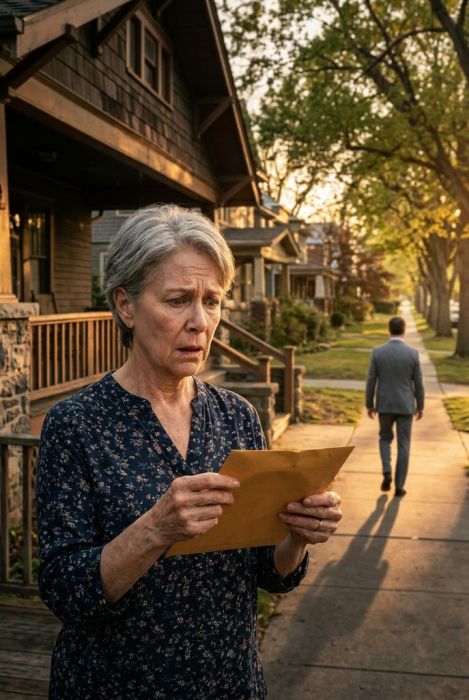
The envelope I'd left on the mat was not full of gift cards. It was full of expired loyalty cards from the bottom drawer of my kitchen — weighted with a scrap of wood from Roy's workshop, held together with a rubber band — and one real card that Detective Okafor's people had already flagged with the fraud desk, its serial number photographed and logged before I ever put it in the envelope.
Danny picked the package up without looking inside it. That was the part that hurt. He didn't even glance at the camera hanging two feet above his head, because crooks never look up. He tucked the envelope under his jacket, drove three blocks to the gas station, and walked in smiling.
They let him complete the whole exchange. That was the plan, and watching it happen through the live feed was the longest twenty minutes of my life. Detective Okafor's voice stayed soft in my ear: "Easy, Iris. Let him finish. Let him show us who's waiting."
The raid came at 8:47 that night. Danny and the man behind the counter at the gas station were arrested together, and the porch camera footage, the call recordings, and the flagged card gave the county everything it needed for the warrants. The man behind the counter had two phones and a ledger of his own, and that ledger had names that led to couriers in three states. The call center — the real one, with the real "Agent Torres" and "Supervisor Harris" — traced through the phone routing to a building Maren's lab had been watching for months. Federal agents took the case from there, and the line that had tormented me for eleven days went dead.
The part nobody prepares you for is the boy. Danny cried in the interview room. He cried the way he used to cry when he was nine and he'd scraped his knee, only bigger. He said a man at the market had recruited him, told him he'd be "moving packages," told him the old folks were covered by insurance anyway, so nobody really lost anything. He was twenty-two years old and he'd chosen to believe it, because believing it was easier than admitting what he was doing.
The judge didn't have much patience for it, and neither did I, when I was asked to speak. But I'll tell you the truth: part of me still saw the eight-year-old on my porch with the koi food in his fist. The part of me that mattered remembered that he was the only one of us who got arrested that night, and the people who actually built the machine — the voices on the phone, the men who wrote the scripts, the ones who taught a grocery boy to call old ladies "sweetheart" — were in another country, laughing at both of us. Danny gave them up, every name he had, and he pled guilty to elder exploitation just to keep his mother from sitting through a longer trial. The fences were charged. The ring collapsed. The restitution order was signed, and my one hundred dollars came back to me in a check I framed instead of cashing, because it felt like a trophy.
Caleb ran into me at the station a few weeks later. He stood there with his hat in his hands — grown man, forty-four years old, sheriff's department patch on his sleeve — and he said, "You were right, Mom. I'm sorry."
"You're going to have to do better than that," I told him, and I made him sit down and watch the porch camera footage twice. Then I made him bring me soup. It's a mother's right to be petty in her own kitchen.
I don't meet with detectives anymore. Now I run Scam Bingo at the senior center on the second Tuesday of every month. The cards aren't numbers — every square is a tactic. Urgent arrest threat. Gift cards at the grocery store. We've overpaid you. A card ending in four digits we don't own. A courier coming to your house. The first person to fill a row wins a five-dollar gift card donated by the Safeway, and the whole room groans and laughs, because we all know what a gift card means now.
And on the nights when the phone rings and I don't recognize the number, I let it ring. Pip, Roy's old cat, lifts his head from the armchair to give me a look, and I give him one back. Somebody else can answer it. I'm done being the body in somebody's ledger. I write my own books now, and the only numbers in them are the ones that add up.