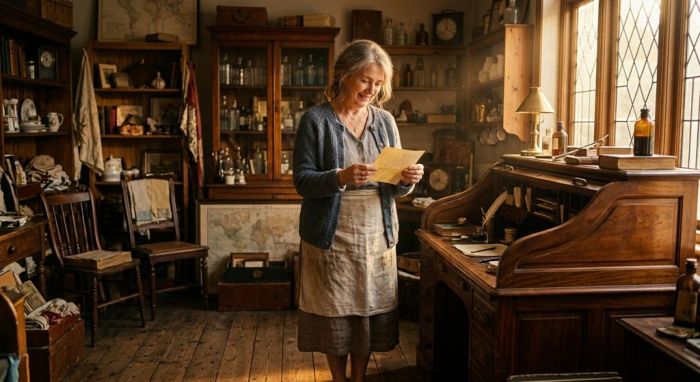
The morning light slanted through the front window of Eleanor's Antiques, catching dust motes in golden streams and warming the worn oak floors. Eleanor Pearce wiped her hands on her apron and surveyed the morning's work — a Victorian writing desk she'd picked up from the Henderson estate sale, its mahogany surface scratched but dignified, its brass handles tarnished with age.
She ran her fingers along the desktop. There was something about old furniture that spoke to her. Every scratch, every stain, every worn edge told a story. She'd learned that from her father, who had taught her to see the soul in a piece of wood long before she understood what he meant.
The bell above the door chimed, and Eleanor looked up to see Martha Gibbs, her neighbor and closest friend for thirty years, letting herself in with a paper bag in hand.
"Cinnamon roll from Dottie's," Martha announced, setting the bag on the counter. "And I brought coffee because I know you've been up since five."
Eleanor smiled. "Was it that obvious?"
"You always get that faraway look when you're working on something special." Martha peered at the desk. "Oh, this is beautiful. Victorian?"
"Circa 1880, I think. The Hendersons' great-grandmother brought it over from England." Eleanor walked over and pulled out one of the small side drawers. "I'm going to restore it, but something's stuck back here."
She reached her hand into the empty drawer cavity, feeling along the back panel. Her fingers brushed against something — not wood, but paper. She worked it loose carefully, and a folded, yellowed envelope fell into her palm.
Martha leaned in. "What's that?"
Eleanor turned it over. The front was blank. But as she unfolded the flap, she saw handwriting inside — delicate cursive, in faded blue ink. She pulled out a letter, so thin and fragile she was afraid it might tear just from her breath.
"My Dearest Thomas," she read aloud, her voice softening. "I am writing this on the eve of your departure, though I know I will never send it. A woman of my station cannot say these things aloud. But if you ever wonder, if the years grow long and you question whether you were loved — know this. You were. You were my heartbeat, my sunshine, my dearest friend."
Martha put her hand over her heart. "Oh, Ellie. That's beautiful."
Eleanor's eyes were fixed on the letter. " 'I will keep this here, in the desk my father gave me, hidden away like my heart. Perhaps one day, someone will find it and know that even the quietest lives hold the deepest loves. Yours always, Margaret.' "
"Margaret Henderson," Martha whispered. "Their great-grandmother. The one who never married."
Eleanor sank into the chair behind the counter, the letter trembling in her hands. "She loved someone. She loved someone her whole life, and she never told a soul."
It was the curiosity that kept Eleanor up that night. She lay in bed, the letter on her nightstand, wondering who Thomas was and what had become of him. Margaret Henderson had died at eighty-seven, a spinster schoolteacher who had lived in the same white house on Sycamore Street for seventy years. Everyone in Millbrook remembered her as a kind but private woman who gave piano lessons and grew prize-winning roses. But no one — not even her family — had known about Thomas.
Eleanor spent the next three days at the local historical society, combing through old newspapers and church records. She found a Thomas Whitaker who had lived in Millbrook until 1942, the year the letter was written. He had enlisted in the Army shortly after Pearl Harbor, shipped out to Europe, and never returned to Ohio. According to a brief obituary in the Millbrook Gazette, Thomas Whitaker had been killed in action in France in 1944. He was twenty-three years old. He had no surviving family listed. He was buried overseas and never came home.
Eleanor put down the microfilm reader and sat in the dark room, the hum of the machine the only sound. A young man who went to war and never came back. A woman who loved him in secret and never married. A letter hidden in a desk for over eighty years. The tragedy of it pressed against her chest. But there was also something beautiful — a love so true it had endured in silence for a lifetime.
It was Martha who suggested she look up the Henderson family descendants. Eleanor found a cousin, a woman named Carol Benson who lived in Columbus, and called her that evening. "Margaret's letter?" Carol said, her voice crackling with surprise over the phone. "Goodness, I never knew her to be the romantic type. She was so proper, so contained."
"She loved deeply," Eleanor said. "And I think she wanted someone to know."
Carol was quiet for a moment. "You know, there's a Henderson family reunion next Saturday at the old church on Maple. Margaret's great-nieces and nephews will be there. If you wanted to bring the letter..."
Eleanor hadn't planned on driving two hours to a family reunion for people she'd never met. But the next Saturday morning, she found herself packing the letter carefully into a plastic sleeve and getting into her car. The church was a white clapboard building with a small cemetery beside it. Eleanor walked past the headstones, reading the names — Whitaker, Henderson, Gibbs, Miller. Generations of Millbrook families, their stories carved in stone. She found Margaret's grave near an old oak tree. The headstone was simple, weathered by decades of Ohio winters.
Margaret Ellen Henderson. 1919–2006. Beloved Teacher. Faithful Friend.
And next to it, a smaller stone, barely visible beneath the grass.
Thomas James Whitaker. 1921–1944. Killed in France. Forever in Our Hearts.
Eleanor knelt down, her throat tightening. Someone had placed a stone for Thomas here, next to Margaret. Someone had known.
Inside the church hall, she was greeted warmly by Carol Benson, a cheerful woman in her sixties with Margaret's same gentle eyes. Carol introduced her to cousins and great-nieces, all of them curious about the stranger who had brought news of their great-aunt. Eleanor stood at the front of the room, the letter in her hands, and told them the story. She told them about the desk, about the hidden compartment, about the young man who went to war and the woman who loved him in silence.
When she read the letter aloud, the room fell completely still. She saw tears on faces young and old. She saw a teenage girl wipe her eyes. She saw an elderly man, Margaret's nephew, remove his glasses and press his handkerchief to his face.
When she finished, there was a long, full silence. Then Carol stood up slowly, her voice unsteady. "Margaret never married," Carol said. "We always thought she was... that she just never found the right person. But she did. She found him. And she lost him."
"Someone placed a stone for him next to her grave," Eleanor said. "Did you know about that?"
Carol shook her head slowly. "No. It wasn't any of us. But it must have been Margaret. She must have arranged it before she died. She wanted to be next to him, even in death."
The quiet that followed was not sad. It was sacred. The kind of silence that falls when people realize they have witnessed something holy.
Eleanor drove home that evening with the sunset painting the Ohio farmland gold and amber. She felt lighter than she had in months, as if she had been carrying some invisible weight and had finally set it down. She thought about her own life. She thought about her father, who had taught her to see the stories in old furniture. She thought about her mother, who had passed away five years ago. And then, unbidden, she thought about her brother.
Benjamin. Two years older. They hadn't spoken in over twenty years. The rift had started over their father's estate. Their father had left his antique shop to Eleanor, and Benjamin had taken it as a sign that their father loved her more. Letters had been exchanged. Words had been said. Benjamin had packed his family and moved to Seattle, and the silence had stretched from months to years to decades.
Eleanor had told herself she was fine. She had the shop. She had Martha. She had her life. She didn't need Benjamin. But watching the Henderson family gather — strangers who had wept together over a love story eighty years old — she felt something crack inside her.
She pulled over at a rest stop just outside of Dayton and sat in the car, staring at her phone. Benjamin's number was still in her contacts. She had never deleted it. She had looked at it a hundred times over the years, but she had never pressed call.
She pressed it now.
The phone rang four times. She was about to hang up when a voice answered — hesitant, familiar. "Ellie?"
Her name. Her childhood name. Her heart seized.
"Ben," she said, and her voice cracked. "Ben, it's me."
There was a long pause. She could hear him breathing. "I was just thinking about you," he said softly. "I was looking at an old photograph of Dad's shop. You were standing in the doorway, holding that little wooden horse he carved for you."
Eleanor's tears fell freely now. "I still have it. It's on my nightstand."
"I know," Benjamin said. "I remember the day he gave it to you. You were so happy."
They talked for an hour. They talked about the shop and about their parents and about the stupid argument that had kept them apart for twenty-three years. Benjamin admitted he had been jealous. Eleanor admitted she had been stubborn. They both admitted they had missed each other more than they had ever let themselves feel.
"Come visit," Eleanor finally said. "I'll make you Mom's pot roast. The one with the carrots."
"I'll be there next weekend," Benjamin said.
When Eleanor got home that night, she walked into her workshop and stood in front of the Victorian desk. It was half-restored now, the scratches sanded, the brass handles polished to a soft glow. She placed the letter back in its hiding spot for safekeeping. But before she closed the compartment, she took a small piece of paper from her pocket and tucked it in beside Margaret's letter.
On it, she had written two words:
He called.
Because some stories, she had learned, were not finished yet. And the quietest lives, it turned out, held the deepest loves — not just the romantic ones, but the ones between siblings, too. The ones that had been waiting all along to be found again.