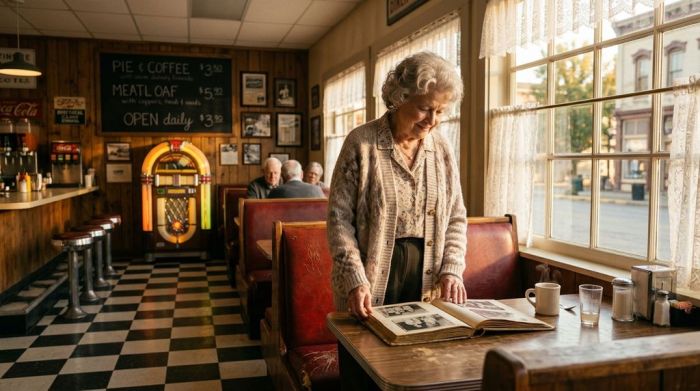
Eleanor Vance had been coming to the Corner Plate Diner every Tuesday morning for twenty-three years. She always sat in the same place — the last booth by the window, where the morning sun fell across the red vinyl in a way that reminded her of autumn leaves. She ordered the same thing every time: one scrambled egg, wheat toast, and a cup of black coffee with one sugar she never stirred all the way through. Frank, the owner, used to bring it to her without asking. He had known her order since before her husband passed, since before her hair turned silver, since before the diner became the only place that still felt like home.
That was six weeks ago. Now Frank was gone too.
The town of Millbrook, New Hampshire had buried Frank Morelli on a grey Tuesday in early October. The diner had closed the next day. A handwritten sign on the door said "Family Tragedy — Thank You for Fifty-Two Wonderful Years" in Frank's daughter's careful cursive. Eleanor had stood outside that morning and pressed her palm flat against the glass, the way she used to press it against her husband's chest in the hospital, as if she could hold on to something that was already slipping away.
Now, on the first Saturday of November, Eleanor stood inside the empty diner with a cardboard box in her arms, ready to help Frank's daughter, Claire, pack up fifty-two years of a small town's life.
Claire was a kind woman in her early forties with her father's tired eyes and none of his laugh. She had flown in from Seattle to handle the estate and was clearly overwhelmed by the weight of it all. Eleanor had offered to help without thinking — the way you offer to help a neighbor whose tree has fallen on their roof — and Claire had accepted with the grateful relief of someone drowning.
"I don't know what to do with any of it," Claire said, standing in the middle of the diner with her hands on her hips. Her voice echoed off the empty walls. "The kitchen equipment, the furniture, the storage room — Dad kept everything. I mean everything. There are boxes back there from 1987."
Eleanor smiled. "That was your father. He never threw anything away that might have a story attached to it."
"He never told me any of the stories," Claire said quietly, and Eleanor heard something fragile in her voice.
The storage room was smaller than Eleanor remembered — or perhaps it was just fuller. Boxes stacked to the ceiling. Old menus in plastic sleeves. A broken milkshake machine from a decade Eleanor couldn't name. Christmas decorations still in their 1990s wrapping paper. And in the far corner, buried under a pile of dusty tablecloths, a wooden crate marked simply: "BOOTH 7 — HANDLE WITH CARE."
Booth 7. That was Eleanor's booth. The last one by the window.
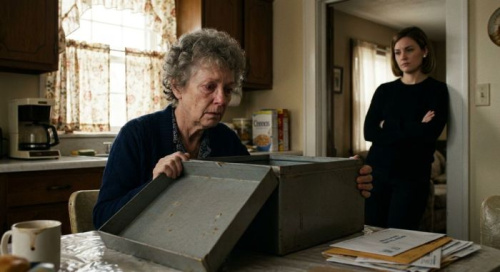
She pulled the crate into the light and pried open the lid with a butter knife from the kitchen. Inside, wrapped in kitchen towels so old they had faded from red to pink, were dozens of spiral notebooks. The oldest dated back to 1972.
Eleanor opened the first one carefully, the way you open something that might crumble if you breathe too hard. The pages were filled with handwriting she recognized instantly. Frank's. But the entries were not recipes or inventory lists. They were names. Dates. And amounts.
March 14, 1972 — Tommy Harrison's mother. Three weeks behind on rent. Left $45 in the register for her tab. Said she didn't order the meatloaf special but I know different.
September 2, 1976 — The Delgado family. Lost their house in the fire. Paid for their dinners every Friday for four months. Told them it was a church charity.
December 18, 1983 — Widow Kowalski. Three kids. Husband lost to cancer in July. She never knew I slipped the extra ham into her grocery bag every Thursday.
Eleanor's hand began to tremble.
She turned the page. And then another. And then another. Fifty-two years of entries. Fifty-two years of a man quietly, secretly, taking care of his town.
May 7, 1992 — Eleanor Vance. Just lost Richard. She comes in and sits at Booth 7 and doesn't eat much. I put extra scrambled eggs on her plate. She thinks I forgot her order. I'll never tell her.
Eleanor pressed a hand to her mouth. Tears blurred her vision.
There was more. Underneath the notebooks, Eleanor found envelopes tucked into the crate's false bottom — layers upon layers of photographs, letters, and receipts. Photographs of families at the diner on Christmas Eve. Receipts marked "PAID" in Frank's handwriting for meals that had never been charged. Letters of thanks that people had written but Frank had never shown anyone.
One envelope was thicker than the rest. Inside, Eleanor found a photograph of a young woman in a yellow dress, standing outside the diner in the summer of 1968. On the back, in careful cursive: Margaret — the one who got away. Opened the diner the week she left town. Named the Corner Plate after the place where we had our first date. She never knew.
Claire had come to the doorway. "What did you find?"
Eleanor looked up, tears streaming down her cheeks. "Your father," she whispered. "I found your father."
They spent the rest of the afternoon reading through the notebooks together. Claire learned that her father had paid for a little girl's piano lessons for seven years after her father lost his job. That he had secretly funded the town's summer picnic every single year since 1975. That he had hired a high school dropout named Danny Russo as a dishwasher in 1984 and quietly paid for his community college tuition — and Danny was now the owner of the largest hardware store in three counties.
But it was the last notebook that broke them both open.
The entries in the final notebook had all been written within the last three years. And Eleanor's name appeared in almost every one.
March 2021 — Eleanor. Booth 7. She's slowing down. Arthritis in her hands. She doesn't complain. Never does. I make sure her coffee cup is always full. I wish she'd let me drive her home when it snows.
January 2022 — Eleanor didn't come in for two weeks. Flu season. I called her every day just to hear her voice. Told her I was checking if she wanted her usual order. She laughed. That laugh is the only music this diner ever needed.
June 2023 — I'm sick. Doctor says it's bad. I keep thinking about Eleanor sitting at Booth 7. Who's going to bring her coffee when I'm gone? Who's going to make sure she eats?
The last entry was dated August 12, 2023.
August 12, 2023 — I asked Claire to promise me something. She didn't understand why. But I know what I know. If anything happens to me, I told her to give Eleanor the diner. The whole thing. The building, the land, the name. It's all paid for. I fixed it so no taxes will take it. Ellie needs a place to belong. She always has. I was too young and too scared to marry her in 1968, but I spent fifty-two years making sure she was never alone. This diner was never about me. It was always about her. It was always about the woman in Booth 7.
Eleanor closed the notebook. She couldn't speak. Claire was crying so hard she had to sit down on an overturned milk crate.
"He loved you," Claire managed. "All those years. He never said a word."
"I loved him too," Eleanor said, her voice barely a whisper. "I was too scared to say it after Richard. I thought it was too late. I thought... I thought we were just friends."
"You were his whole world," Claire said. "This diner. Booth 7. The extra eggs. He built his entire life around taking care of you. And he never needed you to know."
The story did not end there.
Word spread through Millbrook like warmth through a cold house. By the following Tuesday, the town had gathered outside the Corner Plate Diner — not to say goodbye, but to welcome it back. Someone had already cleaned the windows. Someone else had fixed the neon sign that had been flickering since 2019. Danny Russo from the hardware store had brought a crew to repair the back steps. The Delgado family — now three generations strong — had baked enough pies to fill the counter twice over.
Eleanor stood at the door of the diner, holding the key that Claire had given her. The key Frank had left for her in his will. The key to a place that had never been just a diner — it had been a love letter written in scrambled eggs and coffee cups, one day at a time, for fifty-two years.
"What do we call it now?" someone called from the crowd.
Eleanor looked at the sign above the door. The Corner Plate. She thought about the plate of eggs Frank had always brought her. The plate that held more than food — that held a lifetime of quiet, patient, unspoken love.
"The same name," she said. "Nothing changes."
She pushed open the door. The bells above it chimed the same way they had since 1971. The morning sun fell across Booth 7. And for the first time in six weeks, Eleanor sat down in her spot, and the diner felt like home again.
There was no grand announcement. No wedding bells. No dramatic reunion. Frank was gone, and that would always ache. But he had left her something more enduring than a love story: he had left her a purpose. A place. A town full of people who had been quietly cared for by the same gentle man, and who were ready now to care for her.
The Corner Plate Diner reopened the next morning. Eleanor was behind the counter by six, wearing one of Frank's old aprons, pouring coffee for the early crowd. She thought she might run the place for a few years, until it was time to pass it on to someone else. Maybe Danny Russo's granddaughter, who was fifteen and already made the best blueberry pancakes in Millbrook.
Because that was the thing about small towns. They took care of their own. They passed kindness down like heirlooms. And every once in a while, if you were lucky enough to sit in the last booth by the window, you discovered that the person you thought was just a friend had been loving you, in his own quiet way, for a lifetime.
Eleanor smiled and poured herself a cup of coffee. One sugar, not stirred all the way through.
Frank would have known.