The front door groaned open, and the smell hit Marguerite first — lemon verbena and old paper and a faint ghost of cinnamon. In that single breath, she was twelve again, perched on this porch step while Aunt Evelyn handed her a cold glass of iced tea with a thin slice of lemon bobbing on top. Thirty-one years had passed since she'd last stood on Willow Lane, and yet the place had not forgotten her, not even a little.
She'd come back to Pemberton for the practical reason that death notices and lawyer's letters inevitably demand: her aunt had left her the cottage, and somebody had to decide what to do with it. She was a physical therapist with a full schedule and a comfortable apartment in Columbus that had never once smelled like cinnamon. She told herself the trip was business, plain and simple. Three days, maybe four, long enough to sort through Evelyn's things, put a For Sale sign in the yard, and drive home before her weekend was gone.
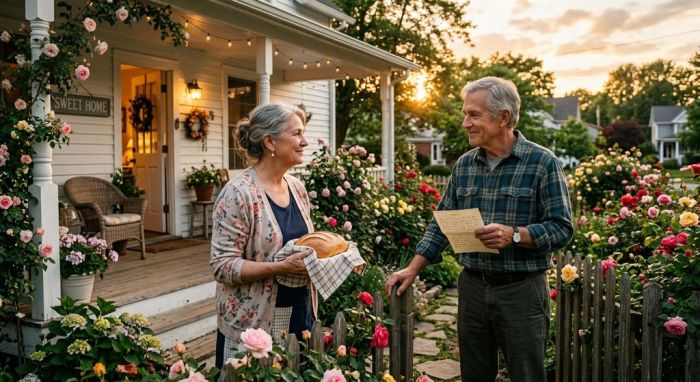
But the garden out front stopped her cold. It should have been a sad two-year tangle nobody had touched since Evelyn's final illness. Instead, roses climbed the fence in tidy loops, the hydrangeas sat fat and blue, and a fresh coat of white paint gleamed on the porch rails. The flowerbeds were weeded. The stones along the walk had been scrubbed.
On the porch step sat a loaf of bread wrapped in a clean dish towel, still warm to the touch.
Marguerite stood there a long moment, holding the bread in both hands, her heart doing something odd. Beside the loaf, weighted by a smooth river stone, lay a scrap of paper in an old-fashioned, tidy script. It read simply: "Welcome back to Willow Lane. — E."
Inside, the cottage was exactly as she remembered it, and that was its own kind of ache. The same lace curtains. The same blue-and-white china in the hutch. The same framed photograph of her aunt as a young woman standing in a garden that had not yet become this garden. Evelyn had raised Marguerite for a time, after her mother's death, and those years had left their mark on her forever — the way she took her tea, the way she folded towels, the quiet certainty that home was not a place so much as a person who made you feel safe.
She did not plan on finding a stranger's bread on her aunt's porch, and she certainly did not plan to find it again the next morning.
The neighbor to the right had a terrier that barked at the fence. The house to the left stood dark and quiet, its curtains drawn, though a single porch light burned through the afternoon like a patient eye. Every day for the next week, the bread appeared. Monday, sourdough. Wednesday, a braided loaf studded with rosemary. Friday, the warm cinnamon one that made Marguerite's throat tighten for reasons she couldn't name. By the end of the week she had stopped wondering who was leaving the loaves and simply started looking forward to them.
On Saturday, she finally knocked on the dark house's door.
An old man answered, gray-haired and slightly stooped, with flour still dusting the knuckles of his hands. He looked at her the way you'd look at a photograph you'd been waiting decades to see in person. "You must be Evelyn's girl," he said.
"Her niece," Marguerite corrected gently. "Marguerite."
"Ah." He nodded, as if settling something. "She always called you her girl. Come in. The coffee's fresh."
His name was Ellis Whitaker. He had lived on Willow Lane for fifty-one years, which made him, in the quiet arithmetic of small towns, the longest-standing resident on the street. His wife had passed a decade before. His daughter lived in Oregon and visited at Thanksgiving. And every morning, at a time when the rest of Pemberton was still asleep, Ellis Whitaker baked bread in his small, tidy kitchen and left it, warm, on the porch of the cottage next door.
"You don't have to keep doing that now," Marguerite said over coffee, watching the steam rise from her mug. "Evelyn's gone. It's just me here, and I'm only staying until the house sells."
Ellis set down his mug and looked at her with a gentleness that made her want to look away. "I've been leaving that bread for fifty years," he said simply. "I don't rightly know how to stop."
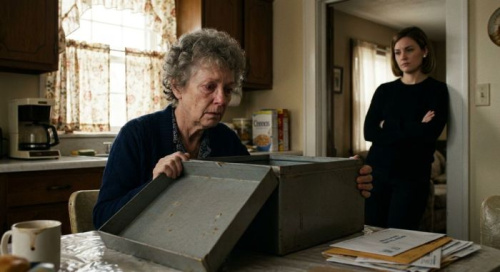
The letters were in a shoebox in Evelyn's spare bedroom, tucked beneath a stack of folded quilts. Marguerite found them on her fourth day, when the rain kept her indoors and the quiet of the cottage pressed in on her. She'd sat down to sort through old papers, the kind of chore she'd been avoiding, and the box simply fell open in her hands.
There were hundreds of them, bound in rubber bands, arranged by year. Letters on thin airmail paper. Letters on stationery with faded flowers. Letters addressed in two different hands — Evelyn's looping cursive, and a stranger's tidy, old-fashioned script that she now recognized at once.
Ellis.
Her hands trembled as she untied the first bundle. The letters spanned five decades. 1974. 1983. 1992. The handwriting loosened and slowed as the years passed, but the warmth never faded. They wrote about gardens and grandchildren and the weather. They wrote about bread — Evelyn begging for recipes, Ellis sending her handwritten ones. They wrote about their days, their disappointments, their small daily joys, the way you only write to the one person in the world who truly understands you.
And somewhere in the middle bundle, from 1987, she found Evelyn's letter that made her lower the page to her lap. "I don't know what I'd do without your letters, Ellis. They're the best part of my week. I only wish I'd met you years ago, in person, the way people should."
Marguerite read all afternoon, until the light through the window went gold and then gray, and then she read by lamplight, unable to stop. Her aunt, who had never married, whose life everyone assumed had been a quiet and solitary one, had been carrying on a love affair of the written word for half a century with the man who lived forty feet away.
The recognition landed in her chest like a small, warm stone. All those years Evelyn had sat in this cottage with her tea and her verbena, and thirty feet beyond the fence, her dearest friend had been baking her bread, and neither of them had ever once crossed the garden to say what the letters had said a hundred times. Two people so close they could finish each other's sentences on paper, and they had never once held a conversation in person.
That evening, Marguerite found Ellis in his yard, trimming roses with careful, practiced hands. She carried the shoebox, heavy, against her heart.
"I found your letters," she said. "All of them. She kept every single one."
Ellis set down his clippers slowly. For a long moment he didn't speak, and when he did, his voice had gone quiet and rough. "She wrote to me every week for fifty years," he said. "The only person who ever wrote me a letter in my whole life. When she got sick, the letters stopped, and I thought—" He stopped, swallowed. "I never knew if she got the last ones I sent."
"She got them," Marguerite said. "She kept them all in a box under her quilts, like they were treasure. Because they were."
They sat on the cottage steps together as the evening came down, and Marguerite read him one of the letters — the one where Evelyn described her dream of someday seeing Ellis's garden in full bloom. Ellis closed his eyes and listened, and his hands, so steady at the oven, shook a little as he held the page.
"She always said a garden is just a letter you write to the future," he said at last.
The harvest festival arrived a month later, as it always did in late September, and the whole of Pemberton gathered under strings of amber lights in the town square. Ellis had agreed, reluctantly at first, to enter his bread in the county bake-off, a thing he hadn't done since his wife was alive. Marguerite stood in the crowd near the judges' table with the shoebox under her arm, watching as a boy handed Ellis a blue ribbon he'd clearly earned many times over.
When the crowd applauded, Ellis searched the faces until he found her. And then, to the sound of her own heart beating too fast, Marguerite walked through the crowd and pressed the shoebox into his hands.
"I think you should have these," she said. "She'd want you to have them. She'd want you to know that she read every word."
Ellis held the box like it was made of glass. Somewhere behind them, the high school band struck up a tune, and a little girl in a yellow dress chased a balloon across the square, and all around them the town glowed with the particular golden warmth of people celebrating something they'd built together.
That night, Marguerite called her daughter back in Columbus and told her she was staying. She expected questions, but her daughter only laughed, the warm, knowing laugh of someone who had always suspected her mother belonged somewhere gentler. "Then stay, Mom," she said. "I'll come visit for Thanksgiving. I want to see this cottage of yours." Marguerite promised to save her a seat on the porch, and hung up smiling at the echo of her own words.
Marguerite did not put the For Sale sign in the yard. She did not go back to Columbus at the end of September, or October, or November. She rented a tiny office in town and started a small physical therapy practice, because Pemberton needed one, and because she needed, it turned out, a place that smelled like cinnamon.
On the first morning of spring, she found Ellis on her porch again, a fresh loaf in his hands and a folded letter tucked into his shirt pocket. She'd written him one that week, the first of what she knew would be many, about her new garden and the roses she was trying to coax along. He had written back within the day, in that same tidy script she had come to treasure.
"If you don't mind," he said, holding out the bread, "I'd like to keep doing this for a good long while."
Marguerite took the loaf, warm through the towel, and smiled at him the way her aunt had smiled at a hundred photographs she'd never shown anyone. "I'd like that too," she said. "I really, really would."
And in the cottage on Willow Lane, the scent of lemon verbena and old paper and fresh bread all drifted together through an open window, exactly the way a home should smell.