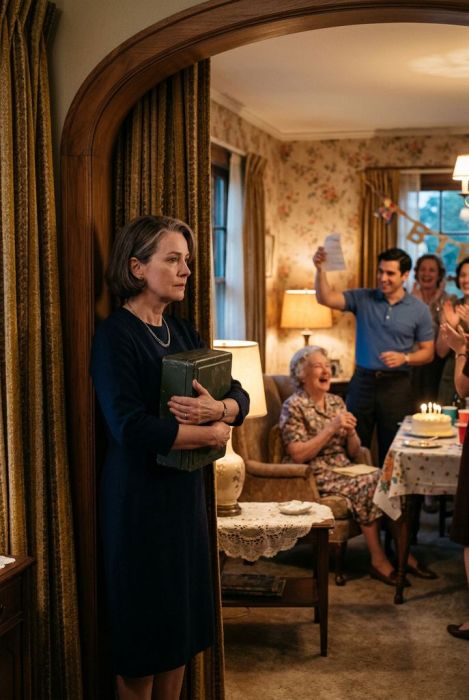
The day Arthur Voss walked through my mother's front door, I was still wearing the dress I'd worn to her funeral. That's the kind of detail you remember when someone takes advantage of you — the small, humiliating facts. The black dress with the tiny pearl buttons. The dust on the banister. The way the house smelled of lemon polish and loss.
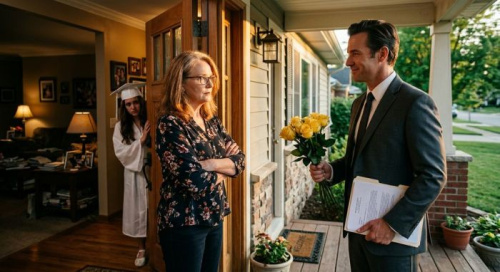
"Just let me take a look, Mrs. Bennett," he said, flashing a smile that had probably opened a hundred grieving doors. "I'll give you a fair price for what's worth selling. You can thank me later."
His card said Voss & Son Fine Antiques, Estates Appraised, Estates Purchased. I'd called him because the neighbor, Phyllis, swore he'd helped her sister "clear out" a farmhouse in two afternoons. Two afternoons. I should have heard the warning in that.
My mother, Eleanor Bennett, had taught first grade in Woodstock for thirty-one years and volunteered at the historical society for twenty of them. She collected the way she taught — with patience and a quiet belief that everything deserved a second look. Her house was a museum of other people's castoffs: milk glass, old postcards, a treadle sewing machine, and a dozen paintings that had hung on the same hooks since before I was born.
"It's all clutter," my brother Brian said on the phone from Phoenix. "Take the money. Get it done."
Brian had flown in for the funeral and flown out the same night. He hadn't asked about the house, or Mom's things, or me. He'd asked when the checks would clear. So I was alone when Voss climbed the attic stairs behind me, running his fingers along the rail like he was already counting his profit.
He moved through the house in a pattern I didn't recognize until later — fast past the good stuff, slow past the overlooked. He named prices quickly, dismissively. Fifty for the sewing machine. Forty for the milk glass collection. "The furniture's not worth much, I'm afraid. Nobody wants this style anymore."
Then he stopped in front of the painting above the fireplace.
The ugly painting. That's what I called it as a child, and Mom would laugh and say, "Be kind, Clara. That river has been good to our family." It was a dark, heavy landscape — a bend in a river at dusk, all muted browns and greens, with little white caps on the water and a sky the color of old pewter. It had hung over that fireplace my entire life. I'd studied it through every Christmas dinner and every quiet Sunday, and I'd never once thought it was anything but a faded reproduction from some department store.
Voss stood very still in front of it. Then he reached up, lifted it off its hook, and turned it over, checking the back with two fingers, the way a doctor checks a pulse. He set it on the hearth, knelt, and looked at the corner of the canvas. He was there for a long time.
"Everything all right?" I asked.
"Yes, yes," he said, too quickly. "Just checking for water damage. This one's got a tear in the canvas, see? Back here. Not worth restoring. I'll take it off your hands as part of the lot, if you like — I can use the frame for something."
Something cold settled in my stomach. I didn't know why. I'd never liked that painting. But the way he'd said it — smooth and heavy, like a lid being fitted onto a jar — made me want to know what was under it.
"I'll give you three hundred for everything," he said, standing and brushing off his knees. "Cash or check, your choice."
Three hundred dollars for my mother's life.
I should have said no. I should have looked at him the way Mom would have looked at him — the way she looked at a child who'd put a frog in someone's lunchbox, patient and knowing. But grief had made me hollow, and Brian's voice was still in my ear. Take the money. Get it done.
"Check," I said.
He wrote it at the kitchen table, his penmanship a florid, confident scrawl. Then he bent over the painting one more time — and I saw it. He pressed a small white price tag onto the lower corner of the frame, right at the edge of the canvas. Covering something.
I didn't say a word. I walked him to the door, took his smooth handshake, and watched his truck roll down the driveway with my mother's ugly painting propped in the passenger seat.
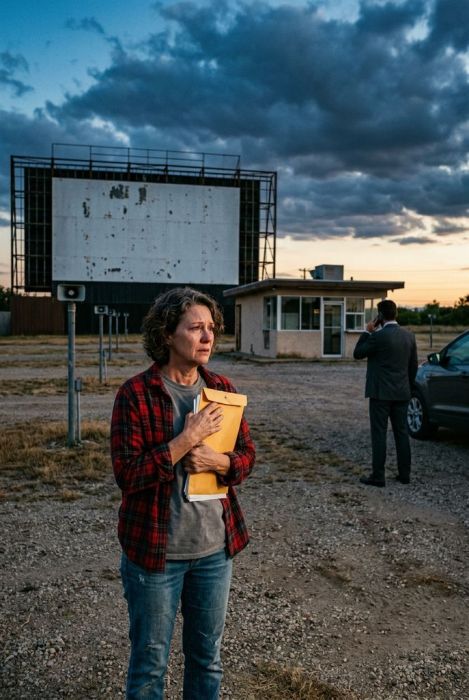
Then I went back inside, sat on the floor of the empty living room, and cried until the light changed.
Here's the part I'm not proud of: I almost let it go. I signed nothing that kept me up at night — it was a bill of sale, a check, a painting I'd never liked. For two weeks I tried to be like Brian. Take the money. Get it done.
But the house wouldn't stop talking to me. Every time I walked past the fireplace, I saw the lighter rectangle on the wallpaper where the painting had hung. I started looking at her things differently — reading the backs of frames, lifting the liners of drawers, checking the seams of old books. Mom had taught me to look twice at everything. It took losing her to actually do it.
I found the letter in a sewing box she'd kept beside her chair, underneath a tangle of embroidery floss, folded into a square so small it fit in the palm of my hand.
It was dated October 12, 1957, typed on paper that crackled like a dried leaf. It was from a man named Otis Fairweather, and it was addressed to my great-grandfather.
"My dear friend," it read. "The river at dusk has finally come home to me. I want you to hang it where you can see it every day, because that is what friends do for each other — they keep the good light burning. If you ever find yourself in difficulty, remember: it carries my name in the lower corner, and my word, and my love."
I remembered the price tag. The lower corner. His name.
I looked up Otis Fairweather that night on Brian's old laptop, my hands shaking over the keys. The search returned an auction record from four years earlier: "Otis Fairweather (Vermont, 1878–1961), 'The River at Dusk,' oil on canvas, 28 x 40 inches, sold for $212,000." There was a note in the listing: the painting had been missing from public record for fifty years. The auction house called it "the great lost Fairweather."
My mother's ugly painting. The one I'd handed to a stranger for three hundred dollars because my brother told me to take the money and get it done.
I didn't sleep that night. I sat in the empty living room with the lighter rectangle on the wallpaper and the letter on my lap, and I let myself feel the full, stupid, crushing weight of what I'd done. Then — somewhere around four in the morning — I got angry. Not at Brian. Not even at Voss, not yet. At myself, for letting grief make me small and obedient.
That's when I started making calls.
My daughter Maya is a paralegal in Montpelier. She didn't scold me. She said, "Mom, nobody gets to do that. We're going to fix it." And she put me in touch with a lawyer named Dennis Okafor, who specialized in art and estate fraud, and who listened to the whole story without interrupting once.
The second call was to Bob Kellerman. He was the retired art history professor who'd bought Mom's cookies at every church bazaar for twenty years, and he'd known the painting — he'd commented on it at every Christmas open house. "The Fairweather?" he said, when I described it. "Clara, I stood in your mother's living room for ten years wanting to ask about that painting. She always changed the subject. I assumed it was a family thing."
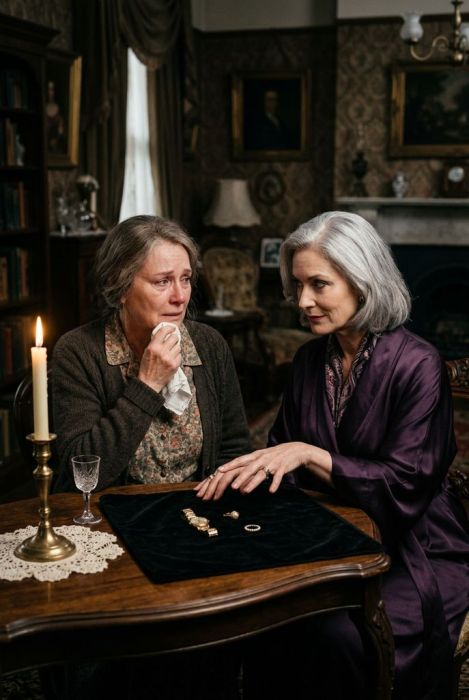
So Mom had known. Not the price — Mom didn't care about prices — but the worth. The worth of a friend's gift, a century of care, a family story. She'd kept the letter and the painting the way she kept everything: quietly, faithfully, waiting for the right moment to explain.
Meanwhile, Voss's shop had listed "the estate painting" for $4,500 — a decor piece, he said, a nice moody landscape for a cabin. I watched the listing the way you watch a fire. Then, a month later, it disappeared from his site. Maya's lawyer sent a letter requesting provenance documentation for any Fairweather items in his possession — a nudge, nothing more. Voss called the office, bluffing, and hung up when they mentioned the artist's name.
That's when I knew. He'd found the signature under his own price tag. And now he was trying to figure out how to sell a stolen painting without looking like a thief.
Here's the thing about people who cheat grieving families: they always think they're the smartest person in the room. And sometimes they just need help staying quiet long enough to hang themselves.
The County Historical Society held its annual fall fundraiser in November, and this year they'd convinced Voss & Son to donate an appraisal table. Free valuations, a little goodwill, a room full of potential consignments. I heard about it from Phyllis, who heard it from Voss's own ad in the paper. I called Dennis. Then I called Bob. Then I called State Police Investigator Dana Fields, a woman whose mother had been robbed the same way, by the same man, nine years earlier. Her file on Voss was thicker than her fist, and it had been growing for a decade.
We built the trap in a week. Bob wrote a short lecture on the Fairweathers — Otis and his brother, both Vermont painters, both forgotten until the market rediscovered them. Dennis had the letter notarized and copied. Investigator Fields got a warrant on new evidence. And I — I practiced being small and grateful, the way grief had taught me, because I needed Voss to believe I was still the woman who'd signed away her mother's life for three hundred dollars.
The day of the fundraiser was cold and bright, the kind of sharp New England afternoon that makes you believe in second chances. The town hall smelled of cider and pine. Voss stood behind his table in a tweed jacket, silver-haired and kindly, as the line of townspeople shuffled forward with their treasures. I waited at the back.
When my turn came, I set the frame on his table — the frame he'd sold me for three hundred dollars, which I'd bought back from his own storeroom for fifty, through a friend who asked no questions.
"Mr. Voss," I said, loud enough for the room to hear. "I believe you have something of mine."
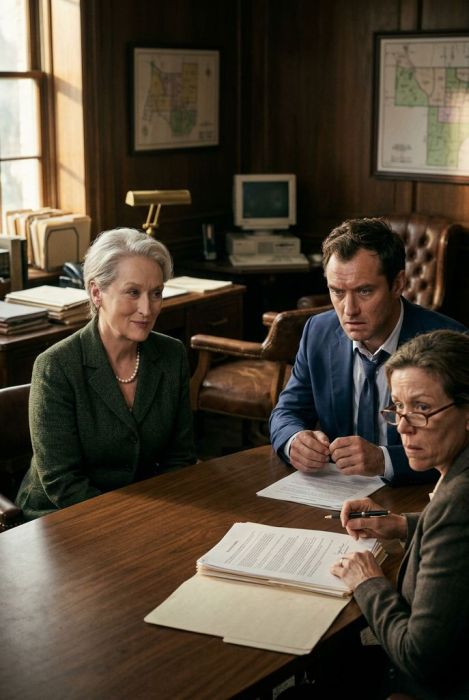
He looked at me, and for a second he didn't have a smile ready. He had no inventory of scripts for this. Somewhere behind him, Investigator Fields moved through the crowd. Bob Kellerman was already standing, already mounting the steps to the podium, already unfolding a photograph of the missing painting — the auction record, the price, the date.
"The great lost Fairweather," Bob said into the microphone, "hung in the home of Eleanor Bennett, a volunteer at this very society, for over sixty years. It was purchased from her grieving daughter for three hundred dollars by the man at this table, who believed he was concealing its signature under a price tag."
The room went quiet in that particular way — the way a crowd goes quiet when a story they thought was over suddenly opens again.
Voss laughed. That was his mistake. "This is ridiculous. That painting's long gone. This woman sold me a crate of junk —"
"You still have it," Dennis said, stepping forward. "We have your shop records. We have the courier receipt to New York. We have the consignment agreement with the auction house in Albany." He held up a folder. "And we have the letter in the sewing box, which establishes provenance and right of ownership, and which predates your misrepresentation."
Investigator Fields was beside him now. She said his name quietly, the way you call a dog you're about to confine, and the room stayed silent while she read him his rights in front of everyone who'd ever trusted him with their grandmother's china.
The painting came home four days later — flown back from Albany, insured for two hundred thousand dollars, in a crate that cost more than my first car. Voss had already sold the consignment interest to a collector named Wallace Pemberton, who turned out to be a perfectly decent man. When he learned the provenance, he tore up the contract himself. "I don't buy stolen light," he said, which is such a strange sentence that I've never forgotten it.
The district attorney charged Voss with obtaining property by false pretenses, and the restitution list ran to seven families — including the Kassels, whose Civil War diary he'd "appraised" in a driveway, and the Ferris sisters, whose mother's jewelry box he'd emptied during a "free cleanup." His license was revoked. His shop went dark by spring. I read in the paper that he'd moved to Florida, where I like to imagine the light is very bright and very honest.
Dennis handled the final sale of the Fairweather. The painting went to a private collector through a proper auction, and after fees and taxes, the proceeds came to just over a hundred and eighty-seven thousand dollars. I split it the only way that felt right: a third for Maya's children's college fund — my grandchildren, who will grow up knowing that their great-great-grandmother's friend painted the river at dusk; a third for the historical society, where Mom's name is now on a little brass plaque beside the painting's permanent reproduction; and a third for me, which I mostly have not touched.
People ask me if I'm angry. I'm not, not anymore. I'm grateful — grateful for the ugly painting that turned out to be the most beautiful thing we owned, grateful for a mother who taught me to look twice at everything, and grateful that I finally listened.
Brian called from Phoenix in March, all charm and curiosity about the money. I told him the house had been cleared out, the estate settled, the funds distributed to charity.
"All of it?" he said.
"All of it," I said. "Take the money. Get it done."
That spring, I planted peonies along the fence line — the ones Mom always wanted, the ones she said would outlive us all. I hung the reproduction of the river at dusk over my fireplace, in the same spot, at the same height. And every time I pass it, I think of Otis Fairweather's letter, and the sentence that saved me: keep the good light burning.
Somebody tried to steal my mother's light, and I got it back. That's the whole story. That's the only story that matters.