The letter arrived on a Tuesday in late August, stuffed into a cream-colored envelope with Carol Benson's name written in the familiar, slightly trembling cursive she would have recognized anywhere. Carol stood at the kitchen counter of her small Oregon bungalow, a mug of coffee cooling beside her, and read the first line three times before she allowed herself to believe it.
Dear Carol, I know it's been a long time. But this year is the 100th Founder's Day, and I could really use your help with the parade route. You always had a good eye for it.
Twelve years. That was how long it had been since Carol had set foot in Maple Grove, Ohio. Twelve years since her father's funeral, since she had stood in the cemetery under a gray November sky and watched them lower him into the ground. Twelve years since she and her mother had hugged goodbye at the front door, both of them dry-eyed and stiff, neither one knowing how to say the things that needed to be said.
They had spoken on the phone, of course. Birthdays and holidays. Short, careful conversations that never lasted more than fifteen minutes and always ended with Evelyn saying, "Well, I won't keep you," and Carol agreeing with too much relief. The distance between them had grown quietly, like a crack in a foundation that nobody wanted to acknowledge.
But this letter was different. It wasn't pleading or dramatic. It was practical. And there was something in the way her mother had written "You always had a good eye for it" that made Carol's throat tighten. Her mother remembered that. After all these years, she remembered that Carol used to walk the parade route with her as a teenager, pointing out where the floats should slow down and where the marching band should make its turn.
Carol called her principal that afternoon and requested two weeks of personal leave.
The drive from Portland to Maple Grove took three days when Carol took the scenic route through the Rockies and across the plains. She stayed at roadside motels and ate diner breakfasts and tried not to think about what she would say when she finally pulled into the driveway of the house on Sycamore Street.
When she got there, the house looked smaller than she remembered. The porch swing was still there, though the cushions were faded. The maple tree in the front yard had grown thick and full, its branches casting long shadows across the lawn. And there was her mother, standing on the front steps in a worn blue cardigan, one hand raised in a wave that seemed almost hesitant.
Carol parked the car and got out. For a moment, neither of them moved. Then Evelyn stepped forward and opened her arms, and Carol walked into them like she was fourteen years old again.
"You look thin," Evelyn said into her daughter's hair.
"You look exactly the same," Carol whispered, and it was true. Her mother was seventy-eight, but she still had the same sharp blue eyes, the same capable hands, the same way of standing with her chin lifted like she was ready for whatever life threw at her.
The first few days were tentative. Carol unpacked her suitcase in her old bedroom, which her mother had kept exactly as it was—the same quilt on the bed, the same books on the shelf, the same framed photograph of Carol's high school graduation on the nightstand. It was like stepping into a time capsule.
They fell into a quiet rhythm. Mornings were spent at the kitchen table with coffee and the local newspaper. Afternoons were devoted to Founder's Day preparations. Carol drove her mother to the town hall, where Evelyn presided over committee meetings with the quiet authority of someone who had been organizing this celebration for forty years.
The 100th Founder's Day was a big deal, and everyone in Maple Grove was invested. The town square was being decorated with string lights and bunting. The high school marching band was rehearsing a new arrangement. Local businesses were preparing floats and booths. And Evelyn Benson was at the center of it all, her notebook filled with lists and schedules and hand-drawn diagrams of the parade route.
Carol found herself enjoying the work more than she had expected. She helped coordinate with the volunteer firefighters about road closures. She worked with the owner of the local bakery to arrange the order of the floats. She even found herself laughing with old neighbors she hadn't seen in years, people who greeted her with warm hugs and the same question: "How long are you staying?"
But there was something Carol couldn't quite put her finger on. Her mother was keeping something from her. Evelyn spent hours in the garage workshop every evening, the door firmly closed. When Carol asked what she was working on, her mother would wave a dismissive hand and say, "Oh, just something for the parade. You'll see."
The night before the parade, Carol couldn't sleep. She padded downstairs in her bathrobe and saw a sliver of light under the garage door. She found her mother asleep in an old wooden chair, a half-finished project towering in front of her.
It was a float. But not just any float. It was a perfect wooden replica of the old town gazebo, the one that had stood in Maple Grove's square since 1924, when the town was first founded. Every detail was there—the scalloped roof, the wooden railing, the steps where generations of town residents had posed for wedding photographs and graduation pictures. Her mother had built it by hand, piece by piece, over the course of months.
Carol's eyes filled with tears. She knew how much this meant. The gazebo was where her parents had met in 1964. It was where Carol had learned to ride her bike, circling it again and again while her father cheered her on. It was the heart of the town, and her mother had recreated it with painstaking love.
But then Carol noticed something. A small hinged compartment tucked into the side of the gazebo, almost invisible against the wood grain. She opened it carefully.
Inside was a stack of letters. Dozens of them. All addressed to her father, Frank Benson, in Carol's own handwriting. Letters she had written during her first years away from Maple Grove—when she was finding her footing as a young teacher, when she was homesick and too proud to admit it, when she had news to share and people to tell about her new life.
Her father had never responded to those letters. She had assumed he was simply too busy, or that he didn't know what to say. Over time, she had stopped writing.
But here they were. Unopened.
Carol sat on the garage floor, the letters spread around her, and waited for her mother to wake up. When Evelyn opened her eyes and saw what Carol had found, her face went pale.
"I can explain," Evelyn said softly.
"Please do," Carol said, her voice trembling.
Evelyn took a long breath and sat down beside her daughter on the cold concrete floor. "Your father asked me to keep them from him," she said. "On his deathbed, he told me something I never expected to hear."
"What?"
"He said he couldn't bear to read your letters. Not because he didn't love you." Her mother's voice cracked. "Because he loved you too much. Reading about your life out there, knowing he couldn't be part of it—it broke his heart. He said it hurt less to imagine you happy than to know for certain that you were happy somewhere he couldn't reach you."
Carol stared at her mother. "But I thought... I thought he didn't care. I thought you didn't care. You never talked about my letters. You never mentioned them."
"Because I was keeping a promise to him," Evelyn said. "He wanted me to save them. He said maybe someday, when you came back, we could read them together. He wanted it to be something we shared. A way to bring you home."
Carol looked down at the letters in her lap. All those words she had written, all those pieces of her heart she had mailed across the country, thinking they had been received and ignored. But they had been kept. Treasured. Saved for a moment that her father had hoped would come.
"Why didn't you tell me?" Carol whispered.
"Because I was angry," Evelyn admitted. "I was angry at him for making me keep the secret. And I was angry at you for leaving." She paused, her eyes glistening. "But I was mostly angry at myself, because I didn't know how to fix any of it. So I just kept going. I kept busy. I kept planning this parade every year, because it was the one thing that made me feel connected to this town, to your father's memory, to you."
The next morning, Maple Grove held its 100th Founder's Day Parade, and it was the most beautiful thing Carol had ever seen.
The floats were colorful. The marching band played with youthful enthusiasm. Children waved paper flags from the curb. But the centerpiece of it all was the wooden gazebo float, pulled by a vintage tractor, with Evelyn Benson standing on it, waving to the crowd like a queen in her parade.
And there, tucked into Carol's hand as she walked beside the float, was one of the letters. The first one she had ever written to her father, thirty years ago. She had opened it that morning and read it for the first time—the words of a twenty-two-year-old who was scared and excited and desperately hoping her parents were proud of her.
She had cried reading it. And then she had shown it to her mother, who had cried too.
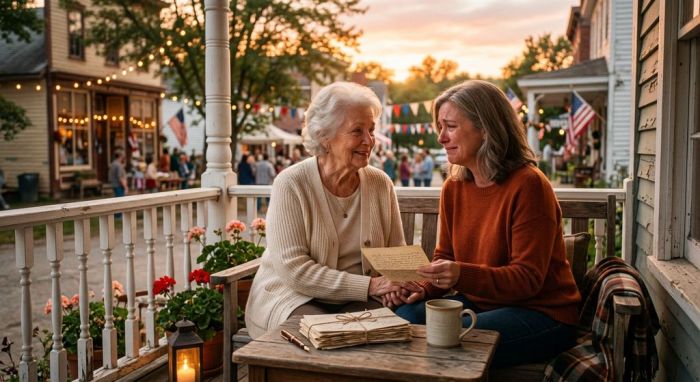
After the parade, when the townspeople had dispersed to the fairgrounds for the carnival, Carol and Evelyn sat on the front porch of the house on Sycamore Street. The evening air was cool and sweet, and the string lights from the square cast a warm glow down the block.
"I'm thinking of applying for a teaching position at the high school," Carol said quietly.
Evelyn turned to look at her, surprised. "Here? In Maple Grove?"
"I've been gone long enough," Carol said. "I think it's time I came home."
Her mother didn't say anything. She just reached over and took Carol's hand, holding it tightly, the way she used to when Carol was little and the world felt too big.
They sat like that for a long time, mother and daughter, on the porch where Carol had learned to tie her shoes and read books and believe in the goodness of small towns. The letters sat between them, a bridge across twelve years of silence, finally crossed.
And somewhere, Carol liked to think, her father was watching the parade from a good seat, finally at peace knowing that his plan had worked after all.
He had brought them home.