The first time Marcus Webb knocked on my door, I was still wearing the black dress from Hank's funeral. Six days. That was all I'd had. Six days to figure out how to start the push mower, six days to decide which of Hank's toolboxes I could bear to open, and six days before this man in a charcoal blazer stood on my porch holding a leather folder like he was bringing me answers I hadn't asked for.
"I'm so sorry for your loss, Mrs. Callahan," he said, and his voice had that practiced softness you hear on radio ads. "I know this is a difficult time. I just happened to be in the neighborhood, and I thought you might want to know what your property is worth."
I said I wasn't planning to sell. He nodded, smiled, and handed me his card — Webb & Associates Realty, Marcus Webb, Senior Listing Agent, with a little gold embossed house in the corner. "You don't have to decide anything tonight," he said. "But houses sit better when someone's thinking about the future. If you ever change your mind, I'll be here."
I thanked him and closed the door. I put the card in the junk drawer, next to the coupons Hank never let me throw away. I thought that would be the end of it. It wasn't. Nothing about Marcus Webb was ever the end of anything.
He came back four days later with muffins in a paper bag. "I was at the bakery," he said, "and I thought of you." The muffins were still warm, but I noticed the price sticker on the bag — four dollars and ninety-nine cents — and I wondered what kind of man buys sympathy for under five dollars. He stood on my porch and talked about the market for ten minutes. He mentioned the roof, which was two years old, and the furnace, which was older. "A house this size, a single woman on a fixed income — you want to think about lightening the load, Mrs. Callahan. I know people who pay cash."
That night I called June, my daughter, who works nights as an ER nurse up in Manchester. "Mom, you're not actually talking about selling the house," she said. "Dad redid the foundation piers himself three years ago. He'd roll over in his grave if you gave that place away."
"I'm not giving anything away," I told her. "I'm just listening."
"That's how it starts," she said.
Two weeks after the funeral, Marcus brought a buyer. A man named Lance, mid-forties, who wore a windbreaker with a logo I didn't recognize and kept his hands in his pockets while he walked through my house. He ran a finger along the grout in the kitchen. He squinted at a hairline crack in the mudroom ceiling that had been there since 1998. He stopped at the furnace, which huffed in the corner like an old dog, and said, "This is gonna be a problem for most buyers."
That weekend, Marcus came back alone. He lowered his voice like he was letting me in on a secret. "Mrs. Callahan, my buyers are prepared to make a serious offer. One-sixty-five, cash, close in fourteen days. No repairs, no inspections — well, one inspection, but that's just paperwork — and no commissions coming out of your end. You'd walk away with a check in your hand."
One hundred sixty-five thousand dollars. Hank and I had bought this house in 1988 for eighty-two. It felt like a fortune and a betrayal at the same time. I told Marcus I'd think about it.
He called me every other day for a week. Each call, the offer got smaller. One-fifty-five. One-fifty. "The buyers are getting cold feet," he said. "You want to strike while the iron's hot." Finally, on a Thursday night, he came to the house with the documents.
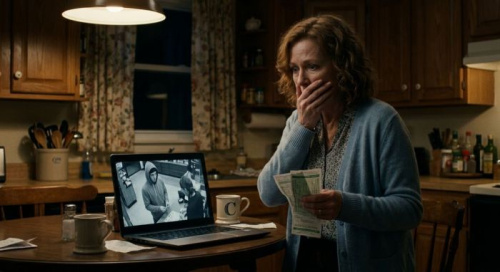
He spread the papers across my kitchen table — the purchase agreement, the deed transfer, a stack of pages held together with a binder clip. On top was a document that made my stomach turn: a home inspection report from a company called Precision Property Inspections. "$54,000 in estimated repairs," Marcus said, tapping the page with a manicured finger. "Water damage in the ceiling. Cracked tile in the hall bath. Sagging porch. I'm not going to lie to you, Mrs. Callahan — my buyers are offering one-forty, and that's generous, given what that report shows."
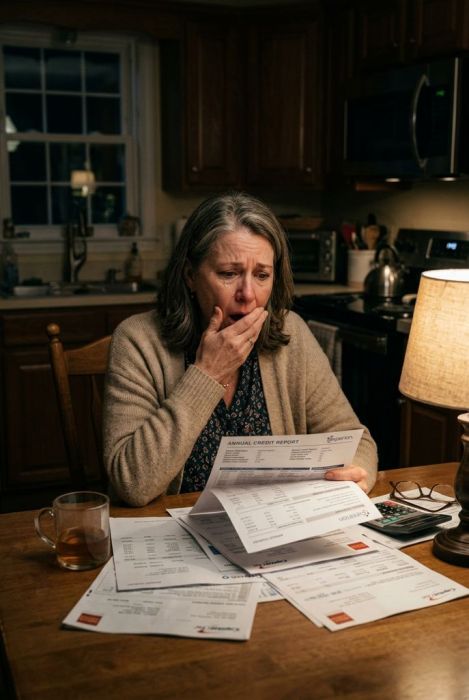
I couldn't breathe. Fifty-four thousand dollars in repairs. Our house. The house Hank and I had painted, replumbed, re-roofed, and loved for nearly forty years. I looked at the photo attached to the report — a water-stained ceiling, cracked tile, a sagging porch — and something in my chest went very cold.
Because the porch in that photo wasn't my porch.
Mine is white clapboard with a railing that Hank and I repainted every other spring. The porch in the photo was brick, with a black metal railing and a concrete step. I looked at the address block at the top of the report. Property Inspected: 18 Holly Street.
I live at 18 Holly Lane. I've written that address on a million birthday cards, a million tax forms, a thousand prescriptions. I know my own address the way I know my own name.
"Mrs. Callahan?" Marcus was watching me, his smile polite and patient. "Do you need a minute?"
"No," I said. My voice came out steadier than I felt. "I just want to read it all carefully. You understand — this is the biggest decision of my life." He nodded, satisfied, and I turned the pages slowly, buying time, while my mind raced. I asked a few questions I already knew the answers to. I said I wanted to sleep on it. I walked him to the door, and I kept the folder.
The next morning, I drove to 18 Holly Street.
It was three blocks away, on the other side of the elementary school. A brick ranch with black metal railings, just like the photo. It had been empty for a year — the windows were dark, and the grass was taller than Hank's ever was. I parked across the street and stared at it for a long time, and I felt something I hadn't felt since the funeral: not grief, but clarity.
Over the next week, I did things I'd never done before. I went to the county clerk's office downtown and asked for the records on something called Bright Nest Investments, LLC. Brenda, the clerk, knew me from church — she knew Hank too, from when he helped her mother with her porch. She pulled up the file and then went quiet.
"Dottie," she said slowly, "are you sure you want to sell to these people?"
"Why?"
She turned the screen toward me. Bright Nest Investments had been registered last spring. The registered agent's address was 4 Sycamore Court — and I knew that address. Marcus Webb lived at 4 Sycamore Court. His wife's maiden name was Morrow. On the filing, in neat black letters, was the name Beth Morrow Webb.
The buyer wasn't Lance. The buyer was Marcus. He had been the buyer all along.
That same week, Ruth Okafor handed me a cup of tea at the garden club and asked how I was doing. I told her about Marcus Webb. She set her teacup down so fast it rattled. Her daughter Tara had been a real estate agent for eleven years, and Tara had told her about the exact same man. "He did this to Estelle Kowalski last fall," Ruth said. "Down the street. Her husband had been dead three weeks when he knocked on her door with that same folder. He told her the house needed fifty thousand in repairs. She almost signed — her son stopped it just in time."
Estelle Kowalski. She lived two doors down. I'd known her for thirty years, and I'd been so wrapped up in my own grief that I hadn't even thought to ask how she was holding up.
I asked Tara to run an honest market analysis on my house. She did it for free, and the number she came up with made me sit down. Three-ninety, she said, and probably four hundred on a good week. The house two streets over — same square footage, no new roof, no redone foundation — had gone for three-seventy in June.
Marcus Webb's buyers were paying me one hundred forty thousand dollars for a house worth four hundred thousand, and the buyer was him.
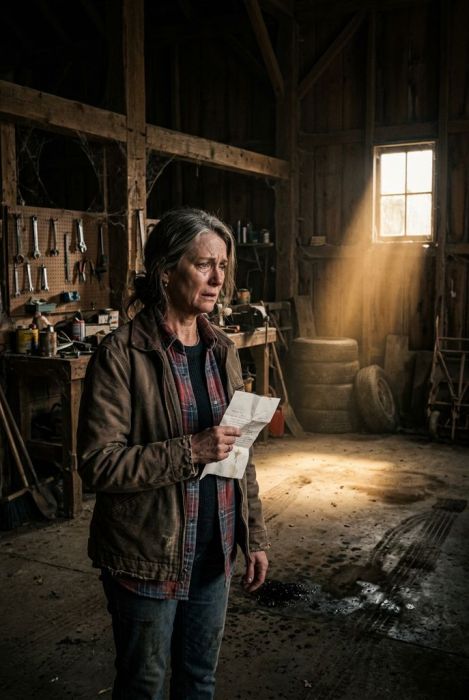
I paid for a full independent appraisal. Four hundred and fifty dollars, which my daughter called the best money I'd ever spent. The appraiser, a quiet woman named Dr. Ellison, took three hours and came back with a report that said three hundred ninety-eight thousand. I kept both reports in Hank's old workshop, inside the steel toolbox he'd locked before he died and I'd never had the heart to open. It felt right that the truth should come out of his toolbox.
Then I called the county prosecutor's office. The woman who answered, an investigator named Detective Ortiz, listened to my story without interrupting once. When I finished, she said, "Ma'am, you're the third person this year to describe Marcus Webb to me. The first two didn't have the paperwork."
"I have the paperwork," I said.
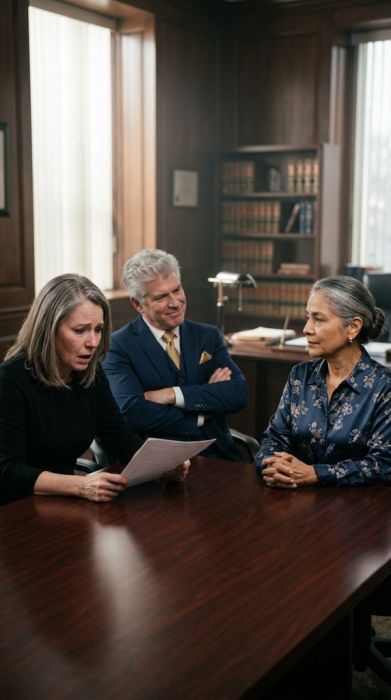
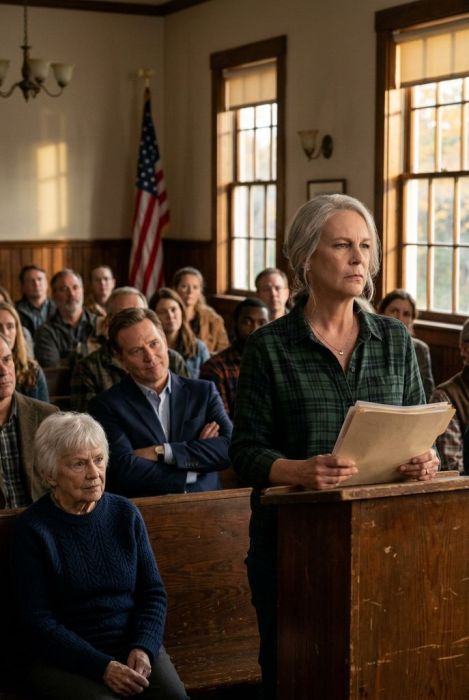
The closing was set for the following Friday, at a title company on Main Street. Marcus had picked the place. He'd picked the notary too, a man named Gerald who stamped everything Marcus put in front of him without reading it. I arrived ten minutes early, wearing the blue dress I'd worn to my thirty-fifth wedding anniversary, and I carried Hank's toolbox like a purse.
Marcus was glowing. He shook Lance's hand, straightened his tie, and pulled out a gold pen he'd clearly bought for the occasion. "Mrs. Callahan," he said, "this is the start of a wonderful new chapter for you."
"It certainly is," I said, and I set the toolbox on the table with a thunk.
The notary smiled. The closing agent, a young woman I didn't know, started arranging the documents. Marcus uncapped his pen. "If you'll just sign here —"
"Marcus." I didn't raise my voice. "I want you to look at the top of that inspection report you gave me. The one that said my house needs fifty-four thousand dollars in repairs."
He blinked. "It's in the folder—"
"No, it's not in the folder," I said. "I kept it. And it says Property Inspected: 18 Holly Street. I live at 18 Holly Lane. I drove past 18 Holly Street on Tuesday morning — it's a brick ranch, three blocks over, and it's been empty for a year." I took the report out of the toolbox and laid it flat on the table. "That's not my porch in the photo. My porch has white rails. It's the porch my husband and I painted together for thirty years."
Marcus's smile stayed frozen on his face for about two full seconds. Then it cracked.
"I also have this," I said, and I took out the appraisal. "An independent appraisal from Dr. Ellison. Three hundred ninety-eight thousand dollars. Your buyers — the ones who offered me one-forty — are you sure you want me to finish the story, or should I just hand this folder to the deputy who's parked outside?"
The closing agent's head came up. "Deputy?"
I put the county filing on top of the appraisal. Bright Nest Investments, LLC, registered to Beth Morrow Webb, whose husband lives at 4 Sycamore Court. "The buyer isn't Lance," I said gently. "The buyer has been you this whole time, Marcus. You tried to buy my house for a quarter of what it's worth, through your own LLC, using a forged inspection report for a house that isn't even mine. There's a prosecutor named Ortiz who's been waiting to meet you for eleven months."
Lance stood up so fast his chair scraped the floor. "What?" He looked at Marcus, then at me, then back at Marcus. "What is she talking about?"
"Don't listen to her, she's confused—"
"Estelle Kowalski," I said, "two doors down. Her husband died last fall. You handed her the exact same line. Her son has your business card in a drawer with your phone number written on it in his mother's handwriting."
The door opened. Two deputies came in, and Detective Ortiz behind them, in plain clothes with a badge on her belt. Marcus's hand was still frozen around the gold pen. He looked at the door, looked at me, and for one beautiful, terrible moment, he understood that the folder he'd been carrying for months was no longer a plan — it was a confession.
I did not sign.
Detective Ortiz read Marcus his rights right there in the title office, while the closing agent quietly recorded the whole thing on her phone and Gerald the notary turned the color of a strawberry. They walked him out through the back parking lot, and I stood at the window and watched them put him in the car. Lance stayed behind. It turned out he was Marcus's brother-in-law — Beth's brother — and he'd believed, up until the deputies arrived, that he was buying a fixer-upper with his sister's husband for a fair price. He'd never seen the real comps. He'd never seen the appraisal. He'd signed whatever Marcus put in front of him, and I watched the shame wash over him like a wave, and I almost felt sorry for him.
Almost.
The charges came down over the following weeks. Fraudulent business practices, attempted theft by deception, forgery — the inspection report, it turned out, was for a house Marcus's brother was helping him flip on Holly Street, recycled to scare me. The state licensing board suspended his license the week after the closing that never happened. The local paper ran the story on the front page, and three more widows came forward with their own folders, their own muffins, their own slow-dripping offers that got smaller the longer they said no. Marcus Webb's brokerage closed in March. Last I heard, he was facing felony charges and Estelle Kowalski was the lead witness, and she was looking better than she had in years.
I sold the house myself, with Tara handling the listing, eleven days after I put the sign in the yard. A young couple bought it — she teaches third grade at the elementary school, he's a mechanic who restores old trucks — and they're expecting their first baby in the spring. They stood on the back porch, the one with the white railings, and the wife said, "We're going to paint a nursery in the room above the garage," and I thought about Hank, who always said that room would make the perfect nursery one day.
I cried in the car, but they were good tears.
I gave twenty-five thousand dollars to the community garden in Hank's name, and I bought a little condo two blocks from June and my granddaughter. I set up my garden in a sunny corner of the complex, and the first thing I planted was tomatoes, because Hank always said a garden isn't a home until it has tomatoes. Estelle Kowalski comes over every Sunday for coffee, and we talk about our husbands, and about the men who tried to take our houses, and about how we should have known better — except we didn't do anything wrong. That's what I finally understood. Grief makes you soft. Decent people count on the softness of the grieving to get what they want.
But Hank taught me one thing in forty years of fixing things together. "If somebody rushes you, Dottie," he used to say, "it's because they're hiding something. Good work doesn't need to be rushed."
Marcus Webb rushed me. He rushed Estelle. He rushed every widow he could find. And in the end, the only thing he rushed was his own downfall.
I still have the gold pen, by the way. I found it on the title office table after they took him away, and I keep it in the junk drawer, right next to the card he handed me on my front porch. Not to remember him — to remind me that sometimes the worst people hand you the evidence against themselves, if you're patient enough to read the fine print.
And the house? It's thriving. The third-grade teacher plants marigolds along the walk, and the mechanic fixed the furnace the week they moved in, and last I heard, they painted that nursery butter yellow. Somewhere out there, Hank is smiling, because that house was never really for sale.
It was just waiting for the right people.