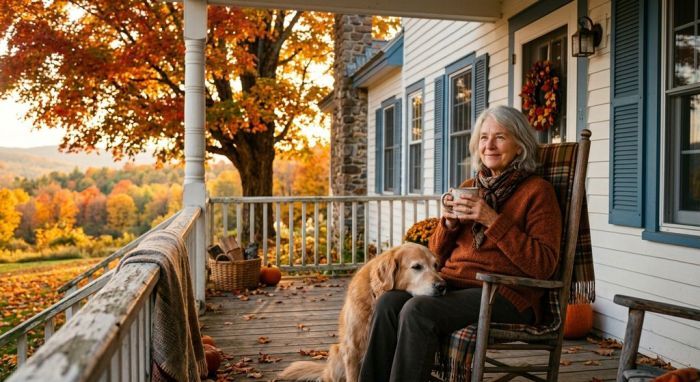
Margaret Bellamy was not the kind of woman who expected surprises.
At sixty-eight, she had her routines. Breakfast at seven-thirty, a walk along Elm Street at nine, lunch with the Tuesday book club, and a crossword puzzle before bed. Her life in the small town of Oak Hollow, Vermont, was exactly the way she liked it — predictable, quiet, and full of the simple comforts she had built for herself after thirty-eight years of teaching high school English.
So when the email arrived on a rainy Tuesday afternoon in October, she almost deleted it without opening it.
The subject line read: "New DNA Relative Match — Estimated Relationship: Half-Sibling."
Margaret stared at the screen for a full minute, her reading glasses perched halfway down her nose. She had taken the ancestry DNA test six months ago on a whim, after Ellen from the book club had done it and discovered she was twelve percent Scandinavian. Margaret had thought it might be fun to learn something about her Irish grandmother or her father's English roots.
She had never expected this.
She clicked the message open slowly, as if the computer might bite her. The notification was straightforward. A man named Thomas Grady, age sixty-six, living in Millbrook, Vermont, shared enough DNA with her to be her half-brother. The system calculated a ninety-nine percent probability.
Millbrook was eighteen miles away.
Margaret closed her laptop, walked to the kitchen, and made herself a cup of tea. She sat at the small wooden table by the window, watching the rain streak down the glass, and tried to make sense of what she had just read.
She was an only child. She had always been an only child. Her mother, Eleanor, had passed away twelve years ago, and her father, Frank, had died when she was just twenty-three. They had never mentioned another child. Not once.
Margaret spent the rest of the afternoon doing what any retired English teacher would do — she researched. She looked at Thomas Grady's limited public profile. He had also taken the ancestry test. His listed hometown was Millbrook. His profile picture showed a man with silver-gray hair and kind eyes, sitting on a porch with a golden retriever at his feet.
He looked like someone she might pass on the street and never think twice about. But there was something in his face that made her pause. Something familiar that she could not quite name.
The next morning, Margaret called her childhood friend Diane, who had known her family since they were both six years old.
"That's impossible," Diane said flatly. "Your mother would have told you."
"You would think so."
"We were at your house every single day, Marge. I would have known if there was a baby. You know your mother — she couldn't keep a secret about a birthday cake, let alone a whole child."
Margaret had to admit this was true. Her mother had been many wonderful things — warm, generous, a spectacular baker — but discreet had never been one of them.
"Maybe he's not really related," Diane offered. "Don't those tests get things wrong sometimes?"
"They said ninety-nine percent probability."
Diane was quiet for a moment. "What are you going to do?"
"I don't know yet."
But she already knew what she was going to do.
Three days later, Margaret sat in her parked car on Maple Street in Millbrook, Vermont, staring at a modest white house with blue shutters. A wooden sign by the front door read "Grady" in neatly painted letters.
She had not called ahead. She had not written a letter. She had simply driven the eighteen miles on impulse, telling herself she was just going to look. Just to see the house. Just to satisfy her own curiosity.
Then the front door opened.
The man from the profile picture stepped out onto the porch, a coffee mug in his hand. He was taller than she had imagined, with broad shoulders and the same silver-gray hair. His golden retriever followed him out and immediately spotted her car. The dog wagged its tail.
Thomas Grady looked at her car. He looked at her. And then, inexplicably, he smiled.
Margaret's heart pounded so hard she could feel it in her ears. She watched as he set down his coffee mug, said something to the dog, and began walking toward her car.
She had two choices. Start the engine and drive away. Or roll down the window.
She rolled down the window.
"Can I help you?" he asked. His voice was warm, with a slight rasp.
Margaret opened her mouth, but no words came out. She had prepared an entire speech on the drive over, and now every word of it had vanished from her memory.
"Are you lost?" he asked gently.
"No," she managed. "I'm... I'm Margaret Bellamy."
He tilted his head slightly, as if the name meant something to him but he could not place it.
"I'm from Oak Hollow," she added. "I took an ancestry DNA test."
The change in his face was immediate. His eyes widened slightly, and he took a small step back. Then he let out a breath that seemed to carry the weight of many years.
"You found me," he said quietly.
"I found you."
He gestured toward the house. "Would you like to come in?"
The inside of Thomas Grady's home was warm and lived-in. A fire crackled in the stone fireplace. Bookshelves lined the living room walls, packed with novels and history books. A pair of reading glasses sat on the end table beside a half-finished crossword puzzle.
Margaret noticed the puzzle immediately. It was the same newspaper syndicate she did every night.
"I need to explain some things," Thomas said, motioning for her to sit on the sofa. He sat across from her in a worn leather armchair, his dog settling at his feet.
"You knew about me?" she asked.
"I've known about you for a long time." He paused. "My mother — our mother — she told me everything before she passed. She made me promise I would never reach out. She said it would only cause pain."
"Our mother," Margaret repeated. The words felt strange on her tongue. "So she was... she was my mother too?"
Thomas nodded slowly. "Her name was Eleanor. She was my mother too."
Margaret shook her head. "That can't be. I grew up with Eleanor Bellamy. She was my mother. She never mentioned another child. She never..."
She stopped, because a memory was pushing its way to the surface. A memory she had not thought about in decades. When she was about seven years old, she had found a photograph tucked inside one of her mother's books. It showed a young woman — her mother — holding a baby. A baby girl. Margaret had asked who the baby was, and her mother had taken the photograph from her hands so quickly it had startled her.
"That's nobody," her mother had said, her voice tight. "A friend's baby. I was just helping."
Margaret had never thought about that moment again. Until now.
"She gave me up," Thomas said gently, as if reading her thoughts. "Or rather, she gave me to my father's sister to raise. It was 1958. She was unmarried. Her family was strict Catholic. She didn't have a choice."
"Where was I?"
"You were born two years later. By then, she had married your father. She was in a position to keep you."
Margaret felt tears prick her eyes. She blinked them back. "She never told me."
"She never told anyone, as far as I know. When my aunt passed away, I found letters. Dozens of them." He stood and walked to a small wooden box on the mantelpiece. He brought it back and handed it to her.
The box was old, the wood worn smooth at the corners. Margaret lifted the lid with trembling hands. Inside were letters, tied with a faded blue ribbon. She recognized the handwriting immediately. It was her mother's.
Margaret spent the next hour reading the letters in silence while Thomas sat nearby, giving her space.
They were letters her mother had written to Thomas's aunt over the years. Short, careful notes at first, then longer, more personal ones as time passed. Her mother had asked for updates — about school, about health, about whether he was happy. She had sent money when she could, always cash, always in secret.
The last letter was dated 2008, two years before her mother's death.
"I think about him every day," her mother had written. "I pray he knows I loved him. I pray he knows I never wanted to let him go."
Margaret folded the letter carefully and placed it back in the box.
"I never knew," she whispered. "She carried this her whole life, and I never knew."
"She wanted to protect you," Thomas said. "And she wanted to protect me. She thought if we never knew about each other, neither of us would have to carry the weight of her decision."
"But that's not fair to either of us."
"No," Thomas agreed quietly. "It's not. But she did what she thought was best. She was young, and she was scared, and she didn't have anyone to tell her different."
Margaret looked at him — really looked at him. The curve of his jaw, the color of his eyes, the way he held his coffee cup with both hands. It was like looking into a mirror that reflected a slightly different version of herself.
"You're my brother," she said.
"I'm your brother," he confirmed.
And then, for the first time in twelve years — since her mother had died — Margaret Bellamy let herself cry.
They talked for hours.
Thomas had grown up in Millbrook, raised by his aunt Clara, who had loved him fiercely and never kept the truth from him. He had known about his birth mother from the age of sixteen. He had wanted to reach out many times, but Clara had advised against it, warning him that the truth might hurt more people than it helped.
He had married young, divorced amicably, and spent thirty-two years as a high school history teacher. He had a son in Connecticut and a daughter in Oregon, both of whom knew about their father's complicated family history.
"I told them about Eleanor," he said. "And about the possibility that I might have a half-sibling out there somewhere. They've been encouraging me to take the DNA test for years."
"Why did you finally do it?"
He smiled. "I turned sixty-six last March. I realized I didn't want to go to my grave wondering."
Margaret understood that better than she could explain.
"I always wanted a sibling," she said. "When I was a little girl, I used to pray for one. I thought God just wasn't listening."
"Maybe He was just taking the long way around."
She let out a small laugh. "You sound like me. I say things like that."
"It must run in the family."
That was three weeks ago.
Now, on a chilly Saturday morning in November, Margaret pulled into Thomas's driveway again — only this time, she was not a stranger in a car, afraid to knock. She was family.
Thomas met her at the door with two cups of coffee and a grin. "You're late."
"I'm exactly on time," she said, taking the coffee. "You're just early."
They sat on his porch, wrapped in jackets, watching the last of the autumn leaves drift down from the maple trees. His golden retriever, Millie, rested her head on Margaret's knee.
"I've been thinking," Thomas said. "Thanksgiving is next week. I usually go to my son's place in Connecticut, but I was thinking maybe this year I'd stay here."
Margaret felt her heart lift. "I was going to say the same thing. I always spend Thanksgiving alone. Diane invites me, but I never want to intrude on her family."
"You wouldn't be intruding. You'd be the guest of honor."
She smiled. "Then it's settled. We'll have Thanksgiving here. Together."
"Together," he repeated, testing the word. "I like the sound of that."
They sat in comfortable silence for a while, watching the sun climb higher over the hills. Millie snored softly at their feet.
"I found more letters," Margaret said after a while. "After I got home that first day. I went through my mother's old things, the ones I'd stored in the attic after she passed. I found a box I had never opened."
"What was in it?"
"Photographs. Baby clothes. A christening gown." She paused. "They were yours. She kept everything."
Thomas set down his coffee cup. His eyes glistened, but he did not look away. "She did?"
"She never forgot you. Not for a single day." Margaret reached into her bag and pulled out a small, faded photograph. It showed a young Eleanor Bellamy, barely twenty years old, holding a newborn wrapped in a blue blanket. Her mother was smiling — a soft, hopeful smile Margaret had never seen in any other photograph.
Thomas took the picture in his hands. He looked at it for a long time.
"I think," he said finally, his voice rough with emotion, "I think she would have wanted us to find each other. In the end."
Margaret nodded. "I think so too."
The story she told her book club the following Tuesday was not the full truth — not yet. That would take time. But she told them enough.
"I found out I have a brother," she said, and the entire room fell silent.
Ellen dropped her knitting. "You what?"
"He lives in Millbrook. He's a retired history teacher. He has a golden retriever and he does the same crossword puzzle I do every night."
"Marge," Diane said slowly, "are you telling me you have a sibling you never knew about?"
"I'm telling you I have a brother. And I'm spending Thanksgiving with him."
The room erupted in questions and exclamations. Margaret answered as many as she could, but her mind was elsewhere — on the letters, on the photograph, on the way Thomas had looked at her mother's picture.
She thought about all the Thanksgiving dinners they had both spent alone, all the birthdays and Christmases and ordinary Tuesdays that they had missed. She thought about the eighteen miles that had separated them for sixty-six years.
And she thought about the next sixty-six years — the ones they would not miss.
On Thanksgiving morning, Margaret arrived at Thomas's house with a pumpkin pie, a sweet potato casserole, and a frame containing the photograph of their mother holding him as a baby.
Thomas had set the table with his best china. A beautiful turkey was roasting in the oven. Millie wore a little bandana with pumpkins on it.
"This is the best Thanksgiving I've had in years," Margaret said as she set the pie on the counter.
"Decades," Thomas corrected.
"Decades," she agreed.
They sat down to eat at two o'clock, the autumn sun casting a golden light through the windows. Thomas said grace — a simple, heartfelt prayer of thanks for family, for second chances, and for the unexpected gifts that life sometimes delivered when you least expected them.
After dinner, they sat on the porch again, two cups of coffee in hand, Millie curled between them.
"What happens now?" Margaret asked.
"Now?" Thomas looked out at the hills, the bare trees, the quiet street of a small Vermont town. "Now we make up for lost time. Sunday dinners. Phone calls. Maybe a trip to the coast in the spring."
"I'd like that."
"So would I."
Margaret looked at her brother — her real, living, breathing brother — and felt something she had not felt in a very long time.
She felt complete.
She was not an only child anymore. She never had been. Somewhere out there, for sixty-six years, her brother had been living his life, and she had been living hers, and the thread that connected them had never broken.
It had just taken a while to find its way home.