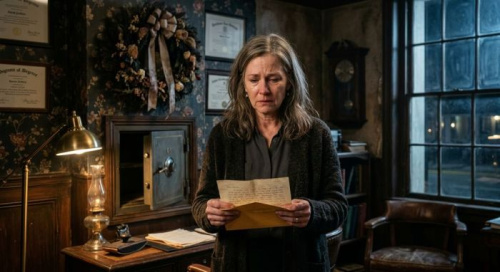

The first time the floor dropped out from under me, it wasn't at a doctor's office or a funeral. It was at my wife's sixtieth birthday party, in my own backyard, with forty of our friends standing around the grill.
Joanne looked radiant that afternoon. She always did. She wore the blue sundress I'd bought her in Savannah ten years ago, the one that made her laugh because it had pockets. She was laughing with her sisters, holding a glass of sweet tea, and I remember thinking that after thirty-seven years of marriage, she was still the most beautiful woman I'd ever seen.
Then Patty walked through the gate.
Patty is Joanne's younger sister. For the past year, my wife had been driving forty minutes to Greenfield every single Thursday to take care of Patty, who she said was battling a terrible illness. Cancer scares. Doctor visits. Chemo rounds she described in detail at the dinner table. I'd cooked casseroles, signed cards, sent flowers to a hospital room I'd never once visited.
But the woman who walked through the gate looked like she'd just come back from a vacation. She was tanned. She was glowing. She hugged everyone and laughed that loud, wonderful Patty laugh, the one that always filled a room.
"Ray!" she called, spotting me by the grill. "You look like you've seen a ghost."
I set down the tongs. "Patty," I said slowly, "how are you feeling? I mean, with the treatments and everything."
She looked at me like I'd spoken in a foreign language. "Treatments? Ray, what are you talking about?"
"The chemo. The appointments. Joanne's been driving down to Greenfield every Thursday for a year to sit with you."
Patty's smile faded. "Joanne hasn't been to Greenfield in six months. I'm not sick. I never was. Who told you that?"
I could feel the sweat on the back of my neck. I scanned the yard for Joanne, but she was suddenly gone from the cluster of sisters, gone from the buffet table, gone entirely.
"Joanne drives off every Thursday morning," I said, hearing how small my voice had become. "She says she's with you."
Patty grabbed my arm. "Ray, I'm not trying to upset you, but I haven't seen my sister in almost a year. She stopped answering my calls. She said she was too busy with you and the house. I figured you two were just living your lives."
We stood there in the July heat, and the whole backyard seemed to tilt. Forty people. A birthday cake. A wife who had disappeared into thin air the moment her sister arrived.
I did not make a scene. That was never my way. I told Patty I needed some air, and I walked into the house through the kitchen door, and I stood in the dark hallway with my hand on the wall, trying to remember how to breathe.
Thirty-seven years. I met Joanne when I was twenty-five, a young electrician with a toolbox and a beat-up Ford. She was a cashier at the hardware store on Main, and she smiled at me over the register like she already knew something I didn't. We married nine months later. We built a life. Two kids, now grown and scattered. A house on Maple Street that I'd paid off with twenty-three years of overtime and call-outs. A quiet, honest existence that I thought was the envy of everyone we knew.
And now she had been lying to me for a year.
I waited until the party ended and the last car pulled away. Joanne came inside around nine, heels in her hand, humming. She looked at me standing in the living room and smiled.
"Did you have a good time, sweetheart?" she asked.
"Where were you, Joanne?"
"Where was I? At my own party, Ray. Where were you?"
"Patty says she hasn't seen you in six months."
She went still. For a single heartbeat, her face did something I'd never seen before — a flicker, like a mask slipping. Then the smile came back, brighter than before.
"Patty's confused, Ray. You know how she is. The medication, the pain pills — it mixes her up."
"Patty isn't on pain pills, Joanne. Patty isn't sick. She told me herself. She looks better than I do."
"She's lying," Joanne said flatly. "She's always been jealous of us. You know that. She'd say anything to drive a wedge between us."
I should have let it go. That's what I'd done for years. I was the kind of husband who trusted his wife, who signed the checks without reading them, who believed that after three decades, you didn't need to look for signs.
But I had seen the mask slip. And I couldn't unsee it.
The following Thursday, I called in sick to a small job I'd taken on the other side of town, and I waited. At 7:45 in the morning, Joanne kissed my forehead, told me she'd be at Patty's until late, and drove off in her Camry. I waited ten minutes, then got in my truck and followed her.
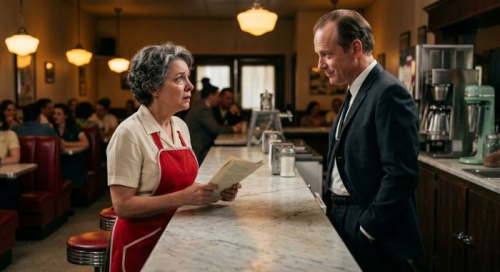
She didn't turn toward Greenfield. She turned toward the interstate, heading north, past three exits, all the way to a town I'd never once visited with her. She pulled into the parking lot of a diner called The Blue Plate, and she got out, and she walked over to a man leaning against a black truck.
I knew that man. His name was Vince Delgado. He was the HVAC contractor who had replaced our furnace three years ago. He'd been young and eager, and I'd taken a liking to him, helped him with a few jobs, taught him things I'd learned over a lifetime of wiring houses. We'd treated him like a nephew. Joanne had always been warm to him — too warm, I realized now, remembering how she'd laughed at his jokes, touched his arm at the kitchen table.
From across the parking lot, I watched my wife of thirty-seven years kiss another man. Not a peck on the cheek. A real kiss, the kind that belongs behind a closed door. And then she got into his truck, and they drove off together toward a motel on the highway, and I sat in my own truck with my hands shaking on the wheel, and I cried for the first time since my father died.
I did not confront her that day. That was my mistake, or maybe it was my saving grace. Instead, I went home, and I made a pot of coffee, and I started to think.
I am not a clever man. I'm an electrician. I understand wires and currents and what happens when you cross the wrong two. But I understand people, too, and I understood one thing with absolute clarity: Joanne was not going to admit to anything. If I confronted her with what I'd seen, she would cry, she would deny, she would twist it until I was the one apologizing. That had been the pattern of our whole marriage, and I was done with it.
So I did the one thing I knew how to do. I started checking the current.
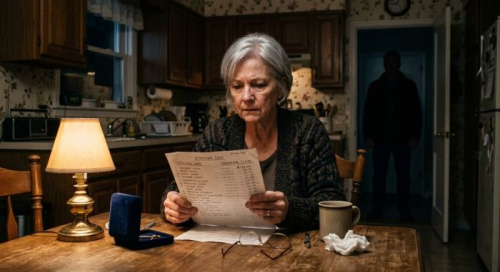
Our finances had always been hers. She balanced the checkbook, paid the bills, filed the taxes. I gave her my paycheck and trusted her. Now, on a Tuesday when she was at her "sister's," I went to the bank and asked for statements going back three years.
The teller looked nervous. I looked worse, I'm sure.
What I found made my stomach turn. For two years, there had been withdrawals I'd never approved — small ones at first, two hundred here, three hundred there, always in cash. Then they got bigger. Five thousand. Seven thousand. A transfer of twenty thousand dollars to an account in a bank I'd never heard of. And a mortgage statement, folded into a drawer at home, for a property I'd never seen.
I drove to that address on a Saturday, pretending I was lost, and I found a small two-bedroom condo at the edge of town. The lawn was new. The curtains were drawn. A black truck sat in the driveway.
Vince Delgado had a new home. And my wife had paid for it.
I should have gone to the police right then. But I wanted the truth on the table, in front of everyone, the way it had been served to me. I wanted her family to see it. I wanted the whole town to see it. So I called the only person I trusted — Patty, who I'd known for thirty-five years and who was, it turned out, the only sister on my side.
"Ray," she said when I told her everything, "I knew something was wrong. She's been different for two years. Cold. Distracted. I just didn't want to believe my own sister was capable of this."
"Will you help me?"
"Help you what?"
"Set the trap."
The plan came together over the next month, quietly, the way I'd learned to work — one wire at a time, never crossing the wrong two. I hired a private investigator with money from a separate account I'd opened years ago without telling her, the way old men sometimes do, just in case. He confirmed everything I'd found and more: Vince was in debt up to his eyeballs, had a history of charming older women out of their savings, and had done this before — a woman in Ohio, a woman in Pennsylvania, both of whom had lost everything and been too ashamed to press charges.
I asked Patty to play her part. On the morning of my wife's party, she was supposed to call Joanne to cancel, to see what she'd say. But we decided to go further. We decided Patty would show up in person.
And that is how, on a sweltering Saturday in July, with forty people in the backyard, the truth walked through my gate in the form of a healthy, furious sister.
The confrontation happened in front of everyone. When Joanne finally emerged from the house — she'd been hiding in the bathroom, I learned later — Patty was waiting for her by the cake. The party went silent.
"Thursday," Patty said, loud and clear. "You want to tell everyone about Thursday, Jo?"
Joanne laughed, but it was hollow. "Patty, sweetie, you're confused—"
"I'm not confused." Patty pulled out her phone and played a voicemail — Joanne's own voice, from three months ago, telling Patty she was too sick to visit, that the chemo was wiping her out. "That's you. I have twelve of these. I'm not sick, Jo. I've never been sick. You've been lying for a year, and I want to know why."
The party was frozen. The grill was smoking. Someone's kid was crying. And my wife of thirty-seven years stood there, mouth open, looking at her sister like she'd never seen her before.
That was my cue. I stepped forward, and I pulled the folder out of my jacket.
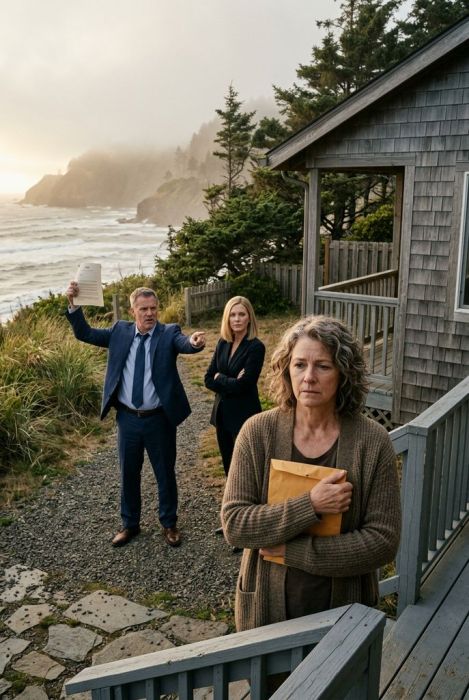
"Because of him," I said, and I held up a photograph the investigator had taken — Joanne getting into Vince Delgado's truck outside the Blue Plate Diner. "And because of this."
I spread the bank statements on the table beside the cake. People leaned in. Gasps went around the yard like a wave. Joanne's own brother picked up a statement, read it, and looked at her like she was a stranger.
"This is fraud," her brother said quietly. "This is theft. Ray, this is your money."
The police arrived forty minutes later. I hadn't called them — someone else had, one of our neighbors, or maybe Patty. They took statements. They took the folder. They took Joanne, gently but firmly, and she went without a single word to me. Not an apology. Not a goodbye. She walked through the gate of our house for the last time, and I let her go.
Vince Delgado was arrested the same week, at the condo my money had paid for. The charges against him spanned three states. The county district attorney called me personally to thank me — my quiet folder, it turned out, had cracked open a case that had been running for a decade.
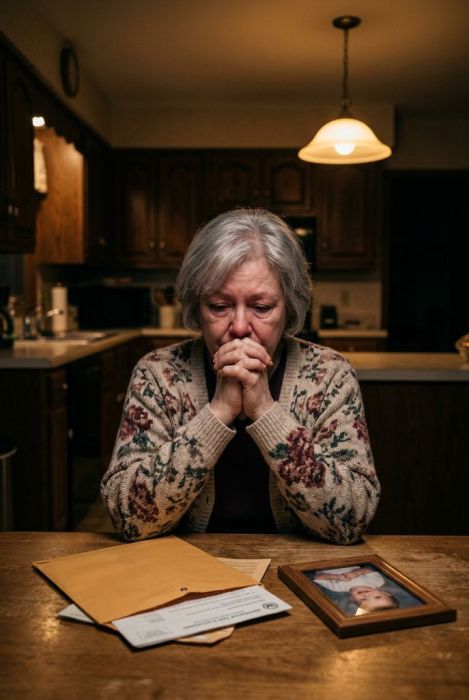
I lost a wife that summer. I won't pretend otherwise, and I won't pretend it didn't hurt. Some nights I woke up reaching for her side of the bed and found it empty, and I cried into my pillow like a fool.
But here is what I found in the wreckage: I found my home, still mine, because the deed had always been in my name. I found my savings, still mine, because I'd kept a separate account the way my own father taught me. I found my sister-in-law, who showed up at my door with a casserole and stayed for dinner every Sunday for a year, until I finally learned to laugh again.
And I found myself. At sixty-two, I started going to the community center. I took a woodworking class. I made a rocking chair for Patty's first grandchild, and when I delivered it, I met a woman at her daughter's house — a widow named June who had the kindest eyes and the same quiet way of moving through the world that I'd always had.
We started having coffee on Thursdays.
I know what you're thinking. And no, I don't mind that it's Thursday. The day doesn't belong to Joanne anymore. It belongs to me now — to the man who finally learned to read the signs, who trusted his gut, who stood in his own backyard and let the truth land where it was owed.
Some people said I should have fought harder for the marriage. Maybe. But I'd spent thirty-seven years fighting for it alone, and I was done. There is a peace that comes when you stop carrying the weight of someone else's lies, and I found it in a woodshop, in a rocking chair, in a cup of coffee with a kind woman who had no secrets.
Karma has a way of settling accounts. Joanne lost the house she'd schemed for, the man she'd stolen for, and the family that had watched her fall. Vince lost his freedom and his fake life. And I — I lost nothing that was ever truly mine to begin with.
I kept the house. I kept my peace. And on Thursday mornings now, I wake up early, and I make two cups of coffee, and I smile.
That's the whole story. The one that started with a birthday cake and ended with a rocking chair. And if you ever meet a man sitting on his porch on a summer evening, watching the light go soft over the maple trees, well — that's probably me. I'm the one who's finally at peace.