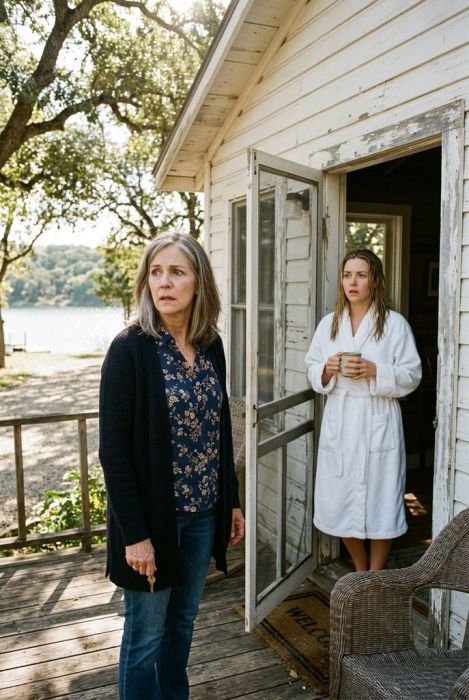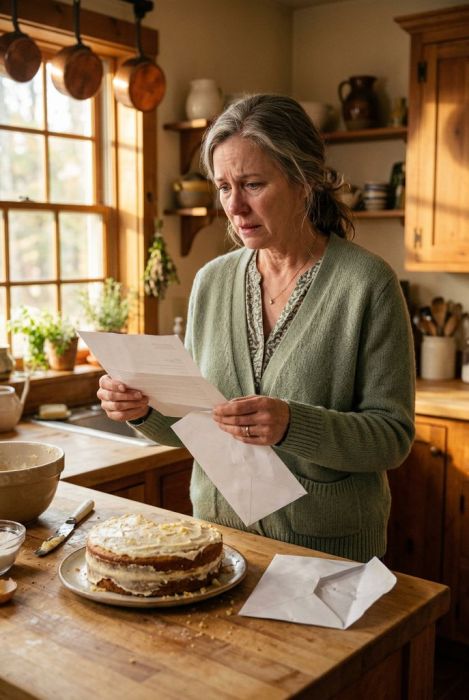
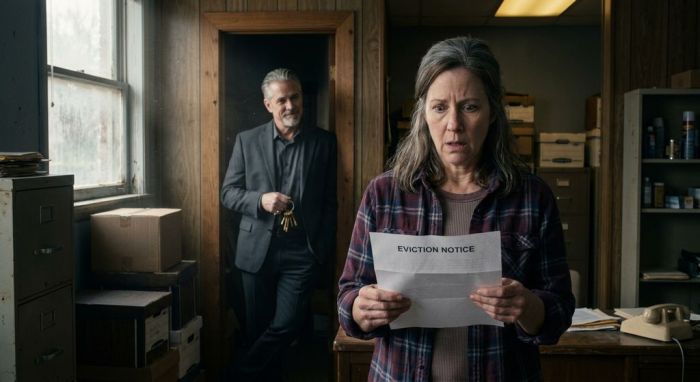
The eviction notice came to me at my father's wake, between the ham sandwiches and the sympathy cards. Uncle Carl didn't wait for the last guest to leave. He just laid the folded paper on the kitchen table where Dad had eaten breakfast for fifty years and said, "Thirty days, Nora. I'm being generous."
I remember staring at his cufflinks because I couldn't look at his face. They were new, gold, catching the kitchen light like a warning. My father had been dead for nine days. The funeral flowers were still drooping in the living room, and his younger brother was asking me to pack my life into boxes.
My father, Walt Bennett, built Bennett Storage with his own hands in 1979. Back then it was just a tin shed and two gravel lots on the edge of Hudson Falls, New York, where the old mill road meets the river. He poured concrete pads on weekends, welded the roof trusses himself, and spent every winter painting the units so the rust wouldn't win. By the time I was twelve, he had forty climate-controlled bays, a proper office, and a sign that said "Bennett Storage — Where Your Memories Stay Safe."
My mother died when I was nine, so it was always just Dad and me. He taught me how to balance the books, how to warm up the big chain locks on freezing mornings, and how to tell a customer's story from the things they stored. He was a quiet man, my father, the kind who showed love through repaired porch steps and full gas tanks. When my husband Dan passed five years ago, it was Dad who drove two hundred miles to sit with me in my empty kitchen. He never said much. He just stayed, and that was everything.
Uncle Carl was the opposite. Eight years younger than Dad and twice as loud, he'd spent his whole life with his hand out. He borrowed money for schemes that never worked, missed every family gathering that didn't involve a meal, and showed up at Dad's door every few years to argue about "what was coming to him." Dad always forgave him, said Carl never got over being the overlooked one. I forgave him too, because that's what you do for family.
The funeral was beautiful, in the plain way of small towns. The church was full, the casserole dishes piled up, and the pastor said Dad had "built more than buildings." I thought that was the end of it, that I could grieve in peace and figure out what to do with the business. I'd run the office for twenty-three years. I knew every key, every tenant, every invoice. I never once imagined the building would be taken from me.
"We had a deal," Carl said at the wake, tapping the paper with one manicured finger. "Walt sold me the property six weeks before he died. Fifty thousand dollars, cash, plus I take over the business and look after you. That's what he wanted."
I read the paper twice because I didn't believe it the first time. It was a quitclaim deed, signed with my father's shaky hospital signature, dated the week Dad was in for gallbladder surgery. He'd been on heavy painkillers then, drifting in and out, and I'd sat by his bed every night. Not once did he mention selling anything.
"That's not possible," I said. "Dad would have told me."
Carl's smile was small and patient, the smile of a man who has already won. "He was protecting you, Nora. He knew you'd take it hard. He put everything in my name so I could handle it — the building, the accounts, the lot. You're just the bookkeeper now. Thirty days to clear out the office."
I didn't scream. I didn't even cry. I just stood there in my father's kitchen, holding the deed that said the only home I had left belonged to a man who'd never once lifted a hammer on that property, and I felt something cold settle in my chest. That was the first time I understood that grief and betrayal can arrive in the same envelope.
The next weeks were a slow unraveling. Carl had the locks changed on the office while I was at my son's college orientation. He told the tenants their leases were void and new terms were coming. He put up a sign from Stoddard Development, a company I'd never heard of, announcing "Future Site of Riverbend Plaza." And he called a family meeting at my cousin's house where he told everyone I was "too emotional to handle the transition," and that he was "letting me keep the apartment above the office out of kindness."
My son Jake called me every night, furious on my behalf. "Mom, that's not legal. He can't just take it. Why won't you fight?" I wanted to fight. But Carl had the paper, and I had nothing but twenty-three years of my life and a box of receipts.
Then the utilities got shut off. I came back from the grocery store to find a notice taped to the office door saying the power had been disconnected at the owner's request. Carl had requested it. He was emptying the building, forcing the tenants out one by one, making the property worthless so Stoddard could buy it cheap. And every time I tried to see him about it, he had his lawyer call mine.
I didn't have a lawyer. I had a mortgage on my own small house, a son in college, and a savings account that was nearly gone after the funeral. I sat on the floor of the darkened office one night, surrounded by my father's filing cabinets, and I let myself feel the full weight of it. I was fifty-two years old, and I was about to lose everything my father had given me.
That's when I remembered the spring.
About fourteen months before Dad died, he'd come home from town in an odd, light mood. He'd told me he'd gone to the county courthouse to "renew the business license," which he'd never once needed to do before, and he'd laughed at some joke I didn't understand. That night, as I was leaving, he'd said something strange. "Nora, if Carl ever comes around with papers, don't argue with him. Just go see the clerk at the courthouse. The clerk will tell you the truth."
I'd chalked it up to a tired old man being sentimental. But now, kneeling on that cold office floor, I heard his voice the way you hear a song that suddenly makes sense. And in the morning, I did exactly what he'd said.
The county clerk's office in Hudson Falls is a small, quiet room with high windows and the smell of old paper. A woman named Patricia at the front desk asked how she could help, and I told her I needed to look at the records for a piece of property on Mill Road. She walked me to the big leather books, the kind my father had always called "the grown-up truth," and she helped me find the index.
It took me twenty minutes to find it. And when I did, I had to sit down.
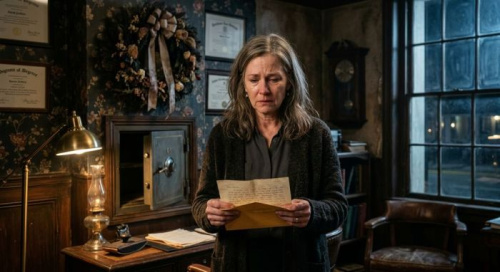
There it was, in black ink, recorded fourteen months before my father died: a warranty deed transferring the property known as Bennett Storage from Walter R. Bennett to Nora E. Bennett, daughter, "for love and affection, reserving a life estate to the grantor." My father had signed the building over to me the spring before his surgery. He'd paid cash for the recording, done it quietly, and never said a word.
I cried in that records room the way I hadn't been able to cry at the funeral. I cried for the tin shed he'd built with his own hands, and for the secret he'd kept to protect me, and for the beautiful, stubborn way he'd arranged his love so that no one could take it. And then I asked Patricia for one more look — this time at the deed Carl had filed after the funeral.
His quitclaim deed was there too, recorded just three weeks ago. And on the bottom, under my father's shaky signature, there was a notary stamp belonging to June Albright.
I knew June Albright. She was a retired notary who'd lived three streets over my whole life. She'd had a stroke in 2018 and moved to Florida to live with her daughter. Her stamp had been reported missing years ago, before she left, and she hadn't notarized a thing since.
I drove straight to the office of Ed Kowalski, the lawyer who'd handled Dad's will, and I walked in with the two papers in my hands. Ed was a big, slow man who'd known my father for forty years. He read the warranty deed, then the quitclaim, then the notary line, and when he looked up, his eyes were wet.
"Your father came to see me that same spring," he said quietly. "Paid in cash. Asked me to keep it quiet. He said — I remember his exact words — 'Carl's going to try something when I'm gone. I want her to have it clean.'"
Ed made two calls that afternoon. The first was to June Albright's daughter in Florida, who confirmed her mother had never notarized anything after her stroke and had reported the stamp stolen in 2018. The second was to the title company handling the Stoddard deal, because Carl had already taken a sixty-thousand-dollar advance and promised to deliver the property "vacant and clear" by Friday. Ed told the title attorney there might be a recording conflict that needed to be resolved in person.
I won't pretend I wasn't afraid. Carl was a man who fed on other people's fear, and I'd spent a month swallowing mine in the dark. But my father had left me one last lesson, and it was this: when a thief sells what isn't his, the whole town eventually hears about it.
Friday came cold and bright. I put on my best dress, the navy one from Jake's graduation, and I drove to the Stoddard Development offices on the other side of town. The conference room had a long glass table and a view of the river, and everyone was already there — Ray Stoddard, his lawyer, a young title attorney with a stack of files, and Carl, polished and smug in that same gold-cufflink confidence.
I sat down without being asked. Carl's smile flickered. "Nora," he said, "this is a private business meeting."
"Actually," the title attorney said, flipping open the file, "Mr. Bennett, there's a problem with the chain of title. This property was conveyed to Nora Bennett fourteen months ago. There's a recorded warranty deed, and her ownership is clean. Your quitclaim deed is void — you never had anything to sell."
You could have heard a pin drop. Carl's face went through several colors before it settled on a blotchy red. "That's a mistake. My brother — Walt and I had an agreement — he signed it before he died —"
"Walt didn't own it anymore," Ed said calmly. "He made sure of that before his surgery, Mr. Bennett. And there's the matter of your notary stamp. June Albright retired to Florida four years ago. She never notarized that document. My office has her written statement, and the handwriting comparison has already been requested by the district attorney."
Carl stood up so fast his chair scraped the floor. He pointed at me, his voice shaking. "You put her up to this. You always were a sneaky little —"
"Mr. Bennett," Ray Stoddard's lawyer said, holding up a hand, "I'd strongly suggest you sit down and stop talking. My client is prepared to exercise his contractual remedies regarding the advance you received."
It was over in about fifteen minutes. Stoddard's team pulled the contract, the title attorney stamped the file "unmarketable," and two men in suits walked Carl out through the back door. As he passed me, he stopped long enough to hiss that I'd regret it, that no one in the family would ever speak to me again. I didn't answer him. I just looked at the river through the big glass window and thought about my father pouring concrete on a summer day in 1979, whistling off-key, building something that would outlast him.
The rest of the story happened the way these things usually do, offstage and quietly. The district attorney opened an investigation into attempted grand larceny and forgery. Carl's lawyer worked out a plea deal — probation, restitution, community service — and Carl moved to Florida to live with friends who'd stopped answering his calls by Christmas. Most of the family, it turned out, had already suspected him. The ones who sided with him at the meeting never quite looked me in the eye again, and I found I could live with that.
I kept the warehouse. I couldn't imagine not keeping it. I reopened the office, turned the power back on, and called every tenant Carl had pushed out to tell them their spaces were waiting. Mrs. Hale's sailboat went back into unit twelve. Old Mr. Kowalski's records and furniture came home to unit four. By spring, Bennett Storage was fuller than it had been in years, and I'd added a little coffee corner by the front window where people could sit and talk, the way Dad would have wanted.
Jake came home for the summer and never really left. He's got my father's hands, steady and sure, and he's teaching himself the business the way I did — one frozen lock, one crooked sign, one kind favor at a time. Last September, we modernized the front gate and repainted the sign. It still says "Bennett Storage — Where Your Memories Stay Safe." Some things don't need to change.
On the first anniversary of Dad's death, Jake and I planted a red maple by the entrance, right where Dad used to park his old pickup. We didn't say much. We didn't have to. I stood there with dirt on my hands and my son beside me, and I thought about everything that had been taken and everything that had been given back.
My father gave me that building twice, really. Once, quietly, in a county clerk's office, fourteen months before he died. And once when I was a girl of twelve, standing beside him in a tin shed, watching him bolt a sign to the wall with his big, careful hands. He taught me that the world will sometimes hand you a paper that says a lie, and that the truth is usually written down somewhere else, in ink, waiting for you to come and look.
These days, when anyone asks how I came to own the place, I tell them the truth. My father gave it to me, I say, and I look them right in the eye when I do. He gave it to me the way he gave me everything — quietly, completely, and long before I ever knew I needed it.