The first time I heard my husband's brother lie, I was standing beside Ben's coffin in Grace Chapel, holding a white rose I never got to put down. It was a Thursday afternoon in April, and the whole of Cedar Hollow had packed itself into the pews — every row full, people lined along the walls, the way a small town shows up when a good man dies. Ben Hart had run the family hardware store for forty-one years, and half of Main Street owed him a first toolbox or a porch-light fixture or a knot in a knotty pine board. We were all grieving. Then Russell stood up.
I thought he was going to say something about Ben. They were brothers, after all, and family is family, even when it bleeds. Instead he cleared his throat and pulled a folded paper from the inside pocket of his jacket.
"It's no secret Ben and I had our differences," Russell said. "But we had an agreement, too. A handshake, the way our daddy did things. The store was to come to me." He lifted the paper into the air. "I've got it right here. Ben signed it the year after Dad passed away. It's all there."
The chapel went quiet in a way that takes the air out of a room. Somewhere behind me a woman whispered, "Oh, the poor thing." I looked at Anna, our daughter, and I saw my own shock staring back at me from her face. Ben and I had been married thirty-five years. He told me everything — except, it seemed, the things that would hurt most to know.
People were kind afterward, the way people are at funerals. They squeezed my hands and told me Ben was in a better place, and I nodded and thanked them. But I felt the question underneath every hug, the same one I could hear in the whispers that followed me down the street: Did Ben promise Russell the store? Why would he do that behind my back? By the time I reached home, the whispers had become a low hum that lived in my chest.
Ben had died six days before, his heart giving out in the back room of the store with a box of hinge screws still in his hands. Everyone said it was the way he'd have wanted it, which was probably true, but it left me no time to ask him the things I suddenly needed to ask. I didn't even know what those things were yet.
Russell was four years younger than Ben, and those four years were the only thing my husband ever had that his brother didn't resent. Warren Hart built the store in 1958 with a loan, a prayer, and a used brass cash register he polished every Sunday. When Warren got too old to run it, he gave it to Ben — not because he loved Ben more, but because Russell couldn't hold a job for more than eleven months, and Warren was too tired to keep paying for the messes. Russell carried that choice in his chest for the rest of his life, the way other men carry a bad knee.
I met Ben when I was nineteen, standing behind that same register, and I never really left. I stocked shelves when the stock boy quit, ran the books when the accountant retired, and learned the difference between a lag bolt and a carriage bolt before I could drive a stick shift. For thirty-five years I was Hart's Hardware every bit as much as Ben was. When the delivery truck broke down, I drove the parts out to the job sites myself. Russell, meanwhile, drifted through our lives like weather — holidays, bail money, one more chance.
The last chance he got was twelve years ago, and I wish I could say it went well. Ben put him on the delivery route, a decent job with a decent check, because their mother had begged him to look after your brother with tears in her eyes. We'd installed a small security camera that spring after a break-in, and that camera was what showed me the truth. Russell wasn't stealing much at first — a few dollars here, an undelivered package there. But it added up, and it broke something in Ben that never quite healed.
Ben let him go quietly, in the back office, and he never told a soul except me and Margaret Voss, our lawyer, who had been his friend since the seventh grade. "He's my brother, Evelyn," Ben said that night, sitting on the edge of the bed with his head in his hands. "I don't want him to go to jail. I just want him to go." I held him, and I didn't say that I thought Russell would never forgive us. I was wrong. He never forgave Ben. And he never once stopped believing that store was his by rights.
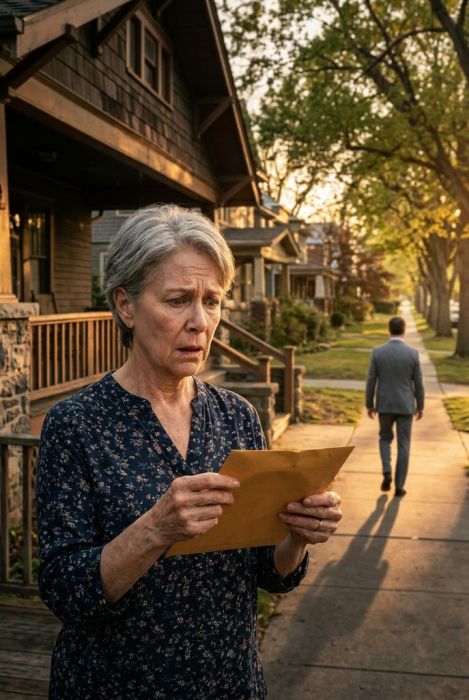
A week after the memorial, a letter arrived on the letterhead of a lawyer from the county seat, a man named Preston I had never met. It informed me that Russell Hart, as surviving co-owner of Hart's Hardware by virtue of a written agreement dated August 1999, was requesting full access to the store's records, inventory, and keys pending resolution of the estate. I read it three times. Then I laughed, because what else do you do when the world turns absurd. Then I cried, because it wasn't absurd at all. It was real, and it was coming for me.
Two days later, Russell changed the locks on the store. He told George the plumber, from next door, that he was protecting the inventory until everything got sorted out. He moved what little he owned into the apartment above the showroom, the one we'd used for storage since Anna was small. When I drove past that afternoon, I saw him standing behind my counter, answering my phone, the phone that was still in Ben's name on my bill.
Main Street divided down the middle, the way small towns do. Some people believed me because they'd known me for thirty-five years. Others believed Russell because they'd known the Hart brothers their whole lives, and everyone knows there's usually blame on both sides. Dottie Fenwick, who ran the dress shop and presided over the Cedar Hollow Merchant Association, gave Russell the floor at the monthly meeting so everyone could hear it straight from the family. I went. I don't know why, except that somebody had to.
Russell stood at the front of the meeting hall in a suit that looked like it had slept in a car, and he announced, to my face, with forty neighbors watching, that he had signed a letter of intent with Lakemont Home Centers. "They're going to buy the building and the business," he said. "The estate needs the money, and frankly, Evelyn can't run the store alone." A few people actually nodded at that. I sat very still and very straight, the way you do when you're drowning and don't want anyone to see you splash. Afterward George caught my elbow and said, "Evelyn, they always say there's two sides to every story." I wanted to scream that there was only one side — Ben's side — and Ben was dead. Instead I said, "Thank you, George," and drove home, where Anna was waiting on the porch.
"We're going to fight this, Mom," she said. "Dad would never have left us like this." "I know," I told her. "I know. He'd start with the paperwork." I remembered, then, the way Ben used to say it whenever anything went wrong: "Don't panic, Evelyn. Margaret knows everything."
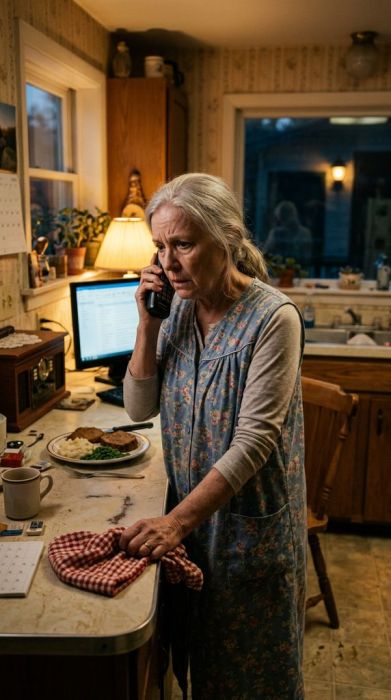
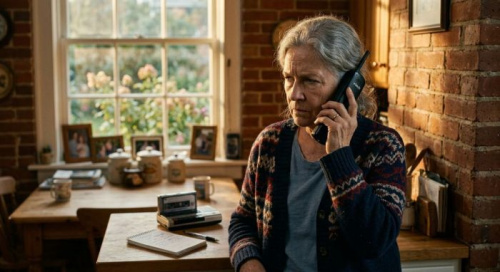
So I called Margaret Voss, and I will never forget the sound of her voice when she said my name. "Evelyn," she said, slow and warm and careful, the way you talk to someone who has just been through something terrible. "I've been waiting for this call for twelve years. I think you should come to the store tonight. There's something you need to see first — something Ben wanted you to find yourself."
That evening, after closing, Margaret met Anna and me at the back door with her spare key, and we let ourselves in. The store smelled like Ben: sawdust and WD-40 and the faint ghost of the coffee he always burned in the morning. The shelves were ransacked where Russell had been organizing. The good power tools were already gone, sold, I would later learn, to a man with a truck from out of town. And the old cash register was sitting right where it had always sat, on the shelf above the workbench in the back office.
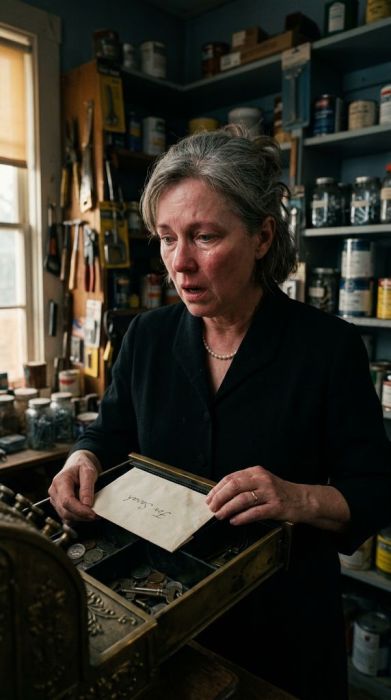
Ben kept that register there because it was the first thing his father ever bought for the store, and because the drawer always stuck, and because he swore it brought luck. Russell, who only ever saw things by their price tag, had decided it was junk and left it alone. Anna lifted it down, and the drawer slid open on its own — it always did, if you knew the trick — and inside, sitting on the green felt where Warren Hart once kept nickels for the newspaper boys, was a thick white envelope sealed with tape. On it, in Ben's handwriting, the handwriting I'd ignored a thousand times on sticky notes by the phone: "For Evelyn — if something happens to me."
I opened it with shaking hands. Inside was a copy of an operating agreement for Hart's Hardware, LLC — stamped, notarized, dated twelve years back. And under it, a letter. Three pages, cramped, in Ben's hand.
"Evelyn," it began. "If you're reading this, it means I'm gone, and it means Russell did exactly what I was afraid he'd do. Listen to me. The store is yours. I made sure of it the year I had to let him go, and keeping that secret was one of the hardest things I ever did, because I was raised to believe blood means everything. But blood is what Russell stole from this family for thirty years, a little at a time, until there was nothing left to forgive."
"You built this store beside me. You're the one who knows where the good brass fittings live and which customers are just lonely. You're the one the town will call when they need to know if their floor joist will take the weight. Don't argue with Russell. Don't let him take one more thing. Call Margaret. Show them the paper. And when it's over, put this letter back in the register, because it's ours."
I read it until the words went blurry. Anna read it over my shoulder, and we leaned against the workbench and cried without saying a word. Then Anna wiped her face with the back of her hand and said, "Tomorrow, Mom. We show them tomorrow."
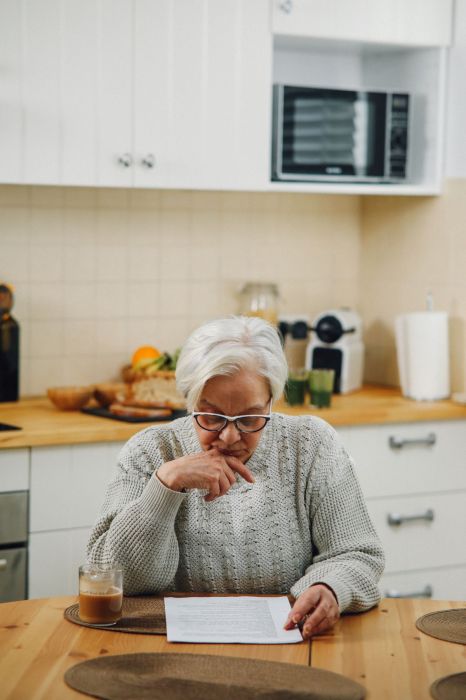
In the morning, Margaret laid it all out for us at her office, point by point. The year after the security camera caught Russell, Ben had converted the store from a sole proprietorship into a limited liability company and put my name on every document: fifty percent Ben, fifty percent me, with a survivorship clause that passed his share to me the moment he died. The store never went through probate. There was nothing to inherit, nothing to contest, and Russell knew it — which was precisely why he'd invented a thirty-year-old handshake and a paper to back it up.
"That paper of his is a fake, Evelyn," Margaret said. "I had a forensic document examiner look at it. The ink and the paper are both years younger than the date on the document. His own lawyer is going to drop him the second he learns that. Ben signed one thing in his life where Russell was concerned, and it was the paperwork that took Russell's name off the business for good."
I signed that stack of papers myself, the summer before Anna's wedding, when Ben told me it was insurance and my head was full of flowers and seating charts. I never read a word of it. It was the last time in my life I would ever sign anything without reading it, but I don't regret it, because it was the best document I ever didn't read.
The next afternoon, Lakemont's regional manager came to town with a notary and a contract, and Russell had set up chairs on the sidewalk and told everyone who would listen that history was being made. Half the town showed up, mostly to watch. He stood on the loading dock with his chest out, retelling the story of the handshake that never happened, while my store — mine — sat behind him like a hostage.
Then my car pulled up. Then Margaret's. I walked past Russell without a word, into the store, with Anna behind me, and I came back out carrying the old cash register, the way you'd carry a Bible into court. I set it on the loading dock and opened the drawer, and I took out the envelope, and I read Ben's letter out loud to the whole street.
I got through about three sentences before the crowd went dead silent. Russell's face did something complicated. His lawyer, Preston, had gone the color of old wallpaper. By the time I finished, Margaret was handing the Lakemont manager a copy of the operating agreement and the county's business filings, and she said, in a voice that carried, "This store has been owned by Evelyn Hart, outright, since 2013. Mr. Hart has never owned a single bolt. The agreement he presented to you is a fabrication, and the paper it's printed on is younger than my car."
The Lakemont men exchanged a look and left without another word — no contract, no handshake, nothing. A county deputy had pulled up at the curb, because Margaret had filed a complaint that morning over the stolen inventory and the false instrument. Russell tried to bluster. "This is between brothers," he said, and I heard the exact words leave his mouth, and I said the thing I'd been saving: "Ben isn't here to defend himself, Russell. But I am."
Russell didn't go to jail, and I'm not sorry to say that, because his mother's ghost would have haunted me. He made restitution for the tools, pleaded to a misdemeanor, paid a fine, and took the first greyhound out of Cedar Hollow a few weeks later. The Lakemont deal collapsed the minute their managers saw the news spread. His gambling debts, it turned out, were the reason he'd needed the store sold fast — Ben had never known how close the wolf was, and I like to think it stayed that way.
The store never closed. Anna took a leave from teaching and ran the counter beside me for a season, and the town came out of the woodwork to support us, the way it does when it finally understands who was telling the truth. In the fall, I hung a new sign over the door: Hart's Hardware, Est. 1958 — Reopened with Love. I put the old cash register on the front counter, next to the jar of pencils, and every morning I tap the drawer and say a small good morning to Ben, because it made him laugh when I did that, and because some habits are worth keeping.
Some days I still hear his boots on the floorboards and turn around expecting to see him. But I don't feel like a widow being pushed out of her life anymore. I feel like the owner of my own name, standing in a store that belongs to me. Russell wanted the store because he thought it was the biggest thing Ben ever had. He never understood that the biggest thing Ben ever had was the woman standing at the counter beside him. And I'm still here, one receipt at a time.