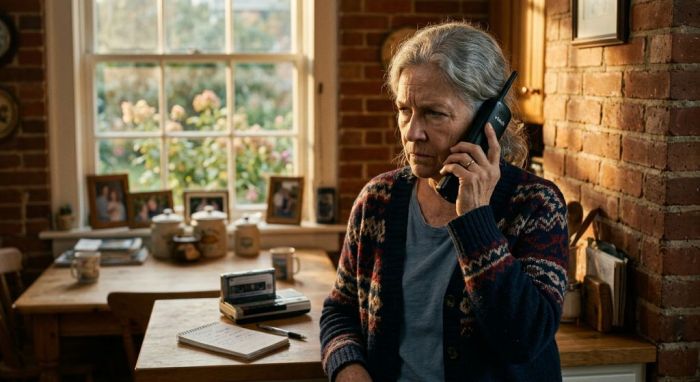
When the phone rang that first Tuesday at two o'clock, I almost let it go to the machine. I was out back with the tomatoes, my hands dirty to the wrists, and the cordless was sitting on the kitchen counter where it had sat for thirty years. Then a man said my full name — the one that only ever appears on insurance papers and tax forms — and asked, very politely, if I had a few minutes to protect my benefits.
I should have hung up. I knew better. I had read the brochures at the senior center, the ones with the cartoon of the elderly lady and the smiling crook holding a telephone. But here is what those brochures never tell you: the crook on the phone already knew my husband's name. He knew I'd had a hip replaced in 2016. He knew my birthday, my address, and the week my Medicare card had been issued. When a stranger knows those things, your brain does not say "scam." Your brain says "they must really be from the government."
That first day, Kevin did not ask for anything. He just walked me through my "new card," asked if I'd noticed any strange charges, and told me I was a smart lady for catching it early. He said he would call back tomorrow to check on me. And he did. At two o'clock on the dot, every single day, like a grandfather clock.
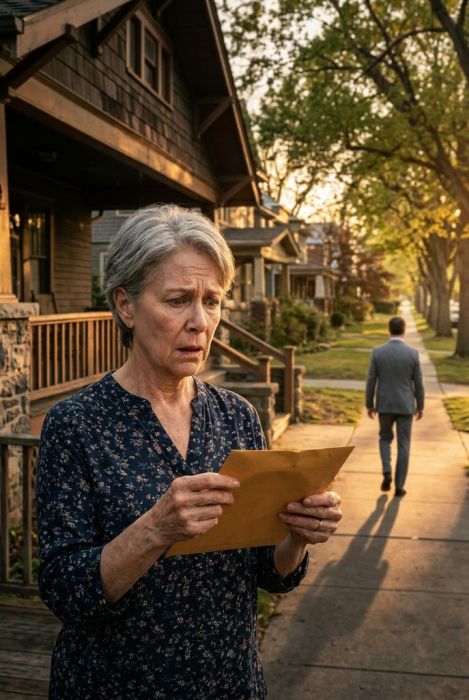
I am Ruth Callahan. I am seventy-three, a retired nurse, and a widow of nine years. I live alone in the brick house on Holland Street that Tom and I bought in 1984. My son Daniel works in airport logistics in Phoenix, and my grandson Collin is in the Navy, stationed somewhere he cannot tell me about. People assume that being alone means being lonely, and mostly they are right. But I have my garden — the roses, the tomatoes, the hummingbirds that come back every April. I have my bridge club on Thursdays. I have my memories.
What I did not have, until Kevin, was someone who called to ask how I was really doing.
He asked about the garden. He asked about Collin. He told me his own father had been a nurse, which I admit got to me — that was a low, cruel touch, because it was a lie, but I only learned that later. He laughed at my story about the squirrel that raided the bird feeder. He said, "Ruthie, you're the only person I know who can make a story about a squirrel interesting."
Ruthie.
Only family ever called me that. And I can tell you the exact moment my blood went cold: it was the third week, and I was telling him about my roses, and he said, "Don't you worry, Ruthie. God's honest truth, this is the real Medicare, and I'm going to fix this for you."
God's honest truth.
That was my brother Frank's saying. Frank said it at every dinner and every fishing trip. He said it to me the night he died, holding my hand in the hospital, and he said it to his son a hundred times a day. Raymond was twelve when he lost his father, and he picked that phrase up like a birthmark. He said it when he borrowed the car. He said it when he was lying.
I had not heard Raymond's voice in eight years. He left Erie after his mother passed, took a "job in hospitality" in Las Vegas, sent postcards for a year, and then went quiet. The last I heard, he owed somebody money and was working graveyard at a casino. I cried over that boy. I helped raise him after Frank died — Donna worked double shifts as a cashier, so Raymond ate at my table three nights a week, did his homework on my kitchen counter, and mowed my lawn for ten dollars. When he was sixteen and got caught stealing from the corner store, I was the one who talked the owner out of pressing charges. I loved him like my own.
And in that single cold moment, I knew that the warm, patient Medicare man was Raymond — using my brother's saying, my private name, and my own faithful heart as weapons against me.
I did not scream. I did not call him out. A nurse learns to stay calm in a crisis. I let my voice wobble a little and asked him to repeat what I needed to do. When we hung up, I sat at the kitchen table and looked at the old tape recorder on the shelf — the one Tom used to record our daughter's school concerts — and I started planning.
First, I called the number printed on my real Medicare card. A woman named Angela told me, in the kindest possible way, that Medicare does not call people, does not know their birthdays, and never asks for gift cards. She transferred me to the fraud line, and that is how I met Agent Monica Velez of the Office of Inspector General.
Agent Velez was patient and sharp. She asked me to keep notes on every call, every time, every word Kevin used. She told me my case matched a pattern — a mobile gift card redemption ring operating out of the Las Vegas area that had already emptied the accounts of eleven seniors in three states. Then she asked if I would be willing to help them build the case.
I said yes before she finished the sentence. I said yes because I was angry. Not just at being cheated — I had handed Kevin three hundred dollars in gift cards by then, and I was sick about it, though I never told him. I was angry because he had used my dead brother's words. He had used the door to my kitchen. He had taken the place where this family keeps its sorrows safe and turned it into a weapon pointed at me.
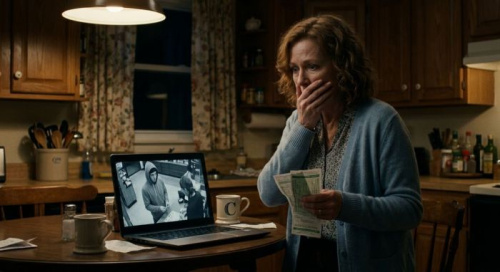
For the next three weeks, I played the most convincing role of my life. I am a little proud of that, even now. Kevin asked for more money — a security deposit to unlock my new card, a reversal fee, and finally a rescue amount to stop a phantom charge of nine thousand dollars. I hemmed and hawed. I pretended to be confused by my own checkbook. I told him the bank needed my signature in person, which made him panic in a very satisfying way. And every call, I recorded on Tom's old tape recorder, hidden in the bread box next to the flour.
I kept him talking. And slowly, so did his own greed.
The call that broke it came on a Thursday. Kevin was walking me through that nine-thousand-dollar wire transfer, being very smooth about it, when he said, "Ruthie, I know this is a lot. But you always did love that garden of yours, and I would hate to see you lose it over a misunderstanding."
There it was.
I had never mentioned the garden on any of those calls. The garden was mine — not in the phone book, not in my Medicare file, not in anything a stranger could look up. Only someone who had stood in my yard knew about that garden. Only someone who had mowed it for ten dollars.
I reported the phrase to Agent Velez at our next check-in. Within forty-eight hours, they had matched the voice. Raymond Hartley, forty-one, of Henderson, Nevada. Two prior fraud convictions in Clark County. And the ring behind him: three associates, a discount travel storefront, and a stack of victims as thick as a phone book.
That is when Agent Velez asked the question that changed everything. "Ruth, do you think you could get him to come to you?"
The plan was elegant, and I am not ashamed to say I loved it. Kevin had been pushing for one last in-person verification — for any amount over ten thousand, he claimed, Medicare required a certified courier to collect the payment personally. That was his greed talking: a courier could walk away with cash and leave no trail. I told him my bank could not process a wire, that I was so foolish, that I needed help, and could his courier please come on Thursday?
"Thursday it is, Ruthie. I'll make sure they take good care of you."
I called Daniel that night. I had not told him anything until then because I did not want the fuss, but a woman knows when she needs her son. He flew in the next morning. When he walked into the kitchen and saw the tape recorder in the bread box, he sat down, put his head in his hands, and said, "Mom, I'm sorry. I should have called more."
I told him it was not his fault. It was not. Loneliness does not announce itself. It just sits in the chair across from you, wearing the voice of a kind man, until one day you realize you have been having long conversations with an empty room.
Thursday came. Agent Velez and two federal agents were parked across the street in an unmarked sedan. At three-oh-five, a silver rental pulled into my driveway, and a man got out wearing aviator sunglasses and a collared shirt with the word "VOLUNTEER" stitched on the pocket.
Raymond.
He had put on some weight and lost most of his hair. He looked tired, the way people look when they have been running for eight years. He came up the walk carrying a clipboard, and when I opened the door, he said, "Ruth Callahan? I'm here from Medicare, ma'am, to help you with your card."
He did not recognize me. He was looking at a mark, not at his aunt.
Then Daniel stepped out from behind the kitchen door, and Raymond's face went the color of old dishwater.
"Ray." Daniel said just his name.
Raymond looked from Daniel to me, and the sunglasses came off, and I watched the mask fall apart. "Aunt Ruthie — listen. This is not what it looks like. I can explain. There are people —"
"The people in the car across the street," I said, "are federal agents, Raymond. And they've been listening to your voice for four weeks."
He turned to run. He made it two steps down the porch before two more agents came around the side of the house and he folded like a card table. The whole thing took about nine seconds. They walked him past me in handcuffs, and he looked at me, and he said, "God's honest truth, Ruthie. I never meant for it to be you."
I almost felt sorry for him. Almost. Then I remembered the eleven other seniors in three states, and the way he had practiced my brother's saying until it sounded like love, and I said, "I know, Raymond. That is what makes it so much worse. You chose me on purpose, because I was the easy one."
He pleaded guilty to wire fraud and identity theft in the federal building downtown. He got four years. The judge ordered restitution for every victim in the ring's files, and I got my three hundred dollars back in a check that I did not deposit for a week, because I kept taking it out of the envelope to look at it.
The ring collapsed. The Henderson storefront was raided, and eleven seniors in three states got their money back. I received a letter from the Department of Health and Human Services thanking me for my cooperation, and I keep it in the same drawer as Tom's tape recorder, right next to the good scissors.
Six months have passed. Daniel calls every Sunday at two o'clock now — the same hour Kevin used to call — and he talks to me about the garden. Collin sends pictures of ships I cannot pronounce. I started a small coffee hour at the senior center, though I do not lecture anyone about scams. I just bring cookies and my old flip phone, and I let people ask questions if they want to. Some of them cry. Some of them laugh. Most of them go home and change their passwords.
And the landline — the one that rang at two o'clock every day for a year — still rings sometimes. I let it ring. I pour myself some tea and I watch the cardinal land on the birdbath Tom set up before he died. I am not waiting for anyone's call anymore. I answer the phone when I want to, and not a second before.
That, I have decided, is what quiet triumph sounds like when nobody is clapping.