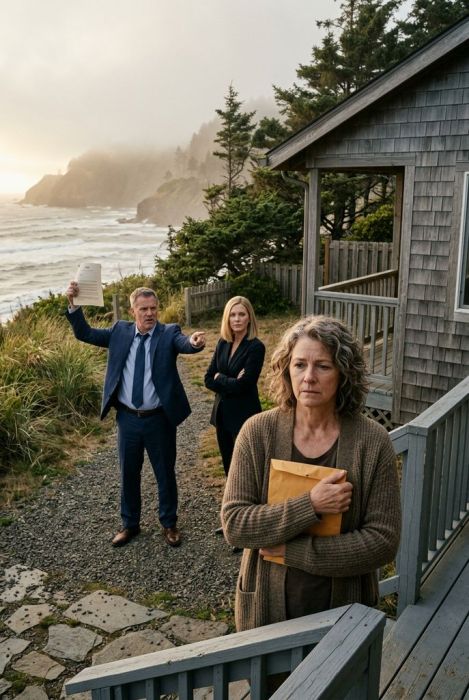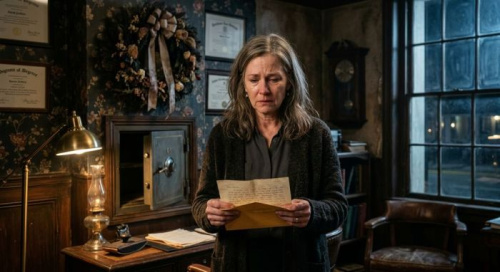
The day after my husband Harold was lowered into the ground, his three grown children stood on my porch with a locksmith and a smugness I will never forget. My stepdaughter Meredith held out a folded piece of paper like a queen offering a verdict.
"This is still his house," she said, "and it's going on the market next week. You have three days to collect your things."
I clutched the screen door and felt the cold air rush past me. Five years I had lived in that house with Harold. Five years of Sunday pancakes, of him humming old Sinatra songs while I watered his roses, of us talking late into the night on the porch swing he had built with his own hands. And now his children were treating me like a stranger, like a thief who had slipped into their father's life.
"You can't do this," I whispered. "We were married. This house is half mine."
Meredith laughed, a short, sharp sound. "Half yours? Honey, you walked in here with nothing but a suitcase and a dead-end job at the school. You married Dad for this house, and we all know it. Now the rightful family is taking it back."
Behind her, her brothers Marcus and Dean shifted their weight, looking anywhere but at me. That was the part that hurt the most. They had hugged me at the funeral. They had called me Lorraine and thanked me for taking care of him. And now, forty-eight hours later, they were evicting me from my own home.
I should have fought right then. I should have screamed about my rights as a widow. But grief does strange things to a person. Harold's death had hollowed me out, and I had spent the last two days moving through the house like a ghost, touching his shirts in the closet, breathing in the last of his scent on the pillow. I had no fight left in me.
So I did what they asked. I packed.
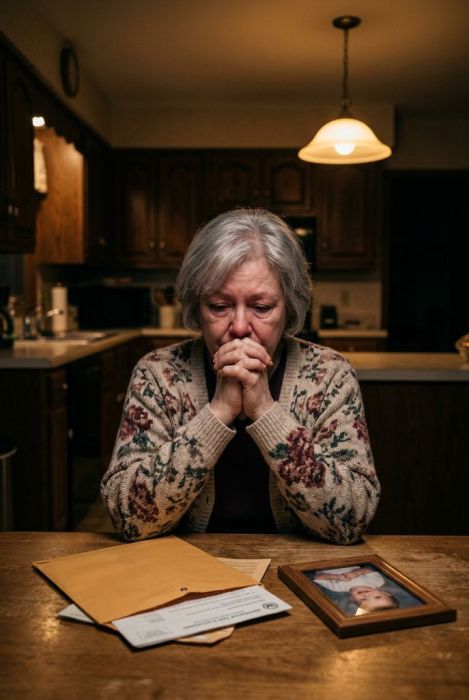
The first night I stayed at my sister's house in the next town, staring at the ceiling of her spare bedroom and listening to the hum of the old furnace. My sister Pat brought me tea and held my hand and said all the right things. But even she could not understand the betrayal I felt. Harold had been the best thing that ever happened to me. I had married him at fifty-three, after a lifetime of loneliness and a marriage that had ended quietly and painfully. With Harold, I had finally felt safe. And now his own children had decided I was nothing but a gold digger.
By the third morning, the anger started to wake up inside me, slow and hot like embers catching. I began to remember things. Small things I had pushed aside in my grief.
I remembered how Meredith had called Harold's lawyer the week before the funeral, asking about the house. I remembered how Marcus had shown up at the hospital the day Harold died and asked me, in the same breath as his condolences, whether Harold had signed any "new documents" lately. And I remembered the will.
Harold had made a will, of course. We had gone together, laughing, to a lawyer named Mr. Ellison, and we had both signed our names in his quiet office. In that will, everything was to go to me, and then to his children after I was gone. I had thought it was simple. I had trusted it.
But at the reading, Meredith had produced a different document. A "later" will, she claimed, one Harold had signed just two months before he died, cutting me out entirely and leaving everything to his three children. The lawyer who read it was not Mr. Ellison. It was some young man from a firm I had never heard of, and he had read it in a bored voice, as if he were announcing the weather.
I had been too stunned to challenge it. Too broken to ask the obvious questions. But now, sitting in Pat's spare bedroom with my grief slowly turning to rage, I began to ask them.
When did Harold sign this will? Why would he have changed it without telling me? And why had the signature looked slightly different from the one I had seen him make a hundred times on birthday cards and grocery receipts?
I called Mr. Ellison the next morning. His assistant put me through quickly, and when he heard my voice, there was a long pause on the other end of the line.
"Lorraine," he said carefully, "I've been expecting your call."
Something cold ran down my spine. "Why? What do you know, Bob?"
"I'm going to tell you something, and I need you to sit down," he said. "But first, I want you to go back to the house. Alone. Before the children sell it. There's something Harold wanted you to find."
I almost laughed. "They changed the locks, Bob. I can't get in."
"Harold gave me a spare key years ago," he said. "I kept it in my safe, because he told me there might come a day when his children did something like this. He knew them better than anyone, Lorraine. He knew exactly who he was dealing with."
My hands were shaking when I hung up. I drove back to the house that afternoon with Mr. Ellison's key warm in my palm. The For Sale sign was already up in the yard, stabbed into the grass like a flag of surrender. I walked up the porch steps, unlocked the door, and stepped into the quiet.
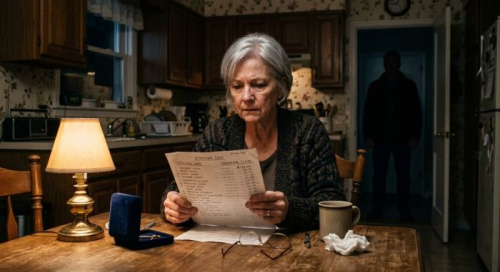
Everything was still there. Harold's reading glasses on the end table. The stack of newspapers he never finished. The faint smell of his cologne and the roses he had cut the morning he died. I stood in the living room and let the tears come, because it was the last time I would ever stand there as his wife.
Then I remembered what Mr. Ellison had said. Harold wanted me to find something.
I looked around the room. The bookshelves. The fireplace. The old china cabinet. And then my eyes landed on the piano.
Harold had loved that piano. It had been his mother's, a beautiful upright with worn ivory keys, and he had played it badly but happily, stumbling through old show tunes while I sang along. Every evening, before bed, he would run his hand over the top of it, almost like a blessing. I had never understood why he touched it so often.
Now I did.
I walked over and lifted the lid of the piano bench. Inside, beneath a stack of yellowed sheet music, there was a thick manila envelope with my name written across the front in Harold's familiar, looping handwriting.
I sat on the floor and opened it, my hands shaking so badly I could barely tear the seal.
Inside was a second will. Dated six months before the one Meredith had produced. And in it, Harold had left me everything: the house, the savings, his mother's jewelry. He had written a note to me, tucked in the envelope, that I read through tears.
"Lorraine, my love. If you're reading this, I'm gone, and I'm sorry I couldn't protect you while I was here. My children have a way of rewriting history when it suits them. I've seen them do it. So I made sure the truth was hidden somewhere they would never think to look: in the place where I always found peace. Take this to Bob Ellison. He has the rest. I love you more than I ever knew how to say. — Harold"
I must have sat on that floor for an hour, holding the will to my chest, crying and laughing at the same time. Harold had known. All along, he had known what his children were capable of. And he had loved me enough to plan for the day I might need to be saved.
I drove straight to Mr. Ellison's office. And that was when the full truth began to unfold.
It turned out that Mr. Ellison had more than a spare key. He had Harold's original will, the one we had signed together, safely filed. He had a letter from Harold's cardiologist confirming Harold had been in the hospital the very week the "new" will was supposedly signed — physically unable to visit a lawyer's office, let alone sign documents. And he had a handwriting analyst's report, commissioned quietly by Harold himself years earlier, which proved the signature on Meredith's "new" will had been traced from an old check.
Meredith and her brothers had not just tried to steal my home. They had committed forgery.
Mr. Ellison laid it all out on his desk, and I stared at the papers, trying to understand the depth of what Harold's children had done. They had found some friend of a friend who wrote wills on the side. They had paid him to draft a document cutting me out. And they had forged their own father's signature, all while their father's body was still warm in the ground.
"I'll be honest with you, Lorraine," Mr. Ellison said. "We could handle this quietly. I can file a caveat, the will gets set aside, you keep the house, and the children never see a cent. It would be clean and simple."
I thought about it. I thought about the funeral, where Meredith had cried real tears while I stood beside her. I thought about Marcus hugging me and promising to call. I thought about how they had looked at me on the porch that morning, like I was nothing.
"No," I said quietly. "I want to do this the way Harold would have wanted. In the open."
The confrontation happened six weeks later, in Mr. Ellison's conference room, with the entire family gathered. Meredith walked in wearing a black dress and a look of pure triumph, certain she was about to watch me be pushed out of the family for good. Marcus and Dean sat on either side of her, smug and confident.
Meredith spoke first, in that sweet, condescending voice she had mastered. "Lorraine, we've agreed to be generous. If you sign a document renouncing any claim to the house, we'll give you ten thousand dollars and let you take the piano."
I smiled. "The piano? That's very kind, Meredith. But I'd like to read something first."
I pulled the manila envelope from my bag and set it on the table. I watched their faces as I slid out Harold's will, as I read his note aloud, as the color slowly drained from Meredith's cheeks.
"That's... that's not real," she stammered. "Dad signed a new will. We have it. It's legal."
"You have a forgery," I said. "Mr. Ellison?"
Bob stood and, in the calm, patient voice of a man who had seen everything, laid out the evidence. The original will. The hospital records. The handwriting analyst's report. He even had the name of the man who had drafted their fake document, a desperate paralegal who had already confessed to everything when confronted with the evidence.
By the time he finished, Marcus and Dean were staring at the table, unable to meet anyone's eyes. Only Meredith tried to fight. She stood up, pointed at me, and called me every name she could think of. A liar. A manipulator. A conniving old woman.
And then Mr. Ellison's assistant opened the door, and two men in plain clothes stepped inside. Forgery of a legal document is a serious crime in this state, and Meredith's name was now on a police report that included her brothers' names as well.
I watched them be escorted out of the office. I watched Meredith turn at the door and look back at me with something I had never seen in her eyes before: genuine fear.
I didn't gloat. I didn't cheer. I just sat there in the quiet room, and I felt something I hadn't felt since the day Harold died: peace.
The house stayed mine. The will was upheld. Meredith, Marcus, and Dean were charged with forgery and attempted fraud, and their own greed became the thing that ruined them. Marcus lost his job at the county office when the news spread through town. Dean's wife left him, unable to stomach what he had done to his father's memory. And Meredith, the ringleader, spent months entangled in a legal battle she could not win.
As for me, I did something that surprised everyone, including myself. I sold the house.
Not because I didn't love it. I did. It held every memory of my life with Harold, and for a long time I wasn't sure I could let it go. But as I stood in the empty living room one last time, looking at the outline on the wall where the piano used to be, I realized that Harold had given me something more valuable than a house. He had given me proof that I was loved, truly and completely.
I took the money from the sale and bought a small cottage by the lake, the kind of place Harold and I used to drive past and dream about on Sunday afternoons. I planted roses in the front yard, just like the ones he had grown. I put his old Sinatra records on the shelf and his reading glasses on the table by the window, where the morning light could find them.
And on the first anniversary of his death, I went to the high school where I had worked for thirty years and handed them a check. I told them it was for a scholarship fund in Harold's name, for nursing students who couldn't afford school, because he had always believed that kindness was the only thing worth leaving behind.
The children never got a single thing from their father. Not the house. Not the savings. Not the jewelry. They got only what they had earned: the cold, hard weight of their own choices.
Some people might call what I did revenge. I don't think of it that way. I think of it as honoring a man who loved me enough to hide a will inside a piano bench, because he knew his children would try to erase me the moment he was gone.
On my porch by the lake, I have a bench now, a small one, built to remind me of the swing Harold made with his own hands. Every evening, as the sun goes down over the water, I sit there and I run my hand over the wood, the way Harold used to run his hand over the piano.
He knew. He always knew. And in the end, love was the only inheritance that mattered.