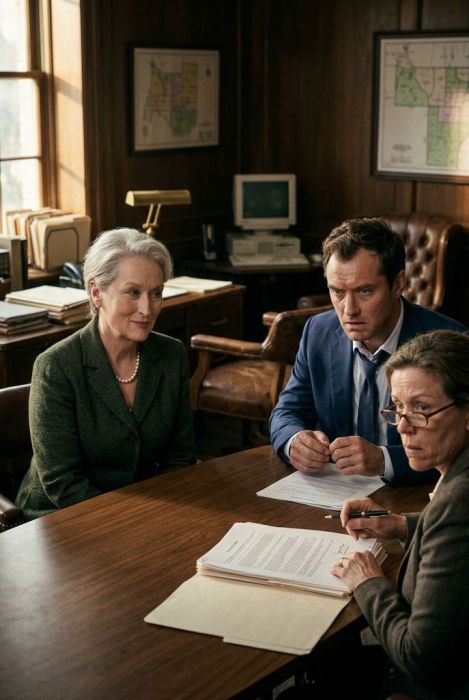
The moment Tom Callahan's pen stopped moving, I knew something was wrong. Tom had been my husband Frank's best friend for fifty years — he'd notarized our marriage license, our first mortgage, and the birth records of both our daughters. He could read a signature the way other people read the morning paper. So when he stared at the stack of documents my son-in-law had slid across the title company's walnut table, and his hand hovered above the line without touching it, my stomach turned to ice.
"Something the matter?" Derek asked, and his voice had an edge I'd never heard before. "It's a standard refinance closing. Helen told you what this is about."
Tom didn't answer him. He looked at me over the top of his reading glasses, and in that look I saw the same man who had held me at Frank's funeral and whispered I would never be alone. "Helen," he said slowly, "could I speak with you for a moment? Alone?"
Derek laughed, but it wasn't a happy laugh. "Come on, Tom. Let's just get this done. Helen wants the money in her account before the weekend."
"The money," Tom repeated, and he set the pen down flat. "Yes. That's what I'd like to talk to her about."
That was the moment my son-in-law's smile finally slipped. And in the quiet that followed, I started to remember everything I had chosen not to see for three years — every photocopy of my signature, every paper he'd told me was "just a form," every time he'd called me "Mom" with his hand already reaching for my purse.
Frank died on a Tuesday in late October, three years ago. A heart attack in the garden he'd spent forty years tending, his pruning shears still in his hand. The funeral was a blur of casseroles and sympathy cards, and in the middle of it all, my son-in-law Derek was a rock. He handled the calls, talked to the funeral home, held Amy when she couldn't stop crying, and looked after the grandchildren so I could sit in the quiet and breathe.
He was so good in those first weeks — that's the part I have to be honest about. He came every weekend, brought the kids, brought groceries, and fixed the kitchen faucet that had been dripping for a year. "You're family now," he said, more than once, with his hand over his heart. "Where would we all be without you, Mom?"
And I believed him, because why wouldn't I? He was a successful real estate agent who'd built himself up with his own two hands, and I applauded the story like everyone else.
The first little thing happened about six months after the funeral. Derek offered to "take over" the household accounts, since Frank had always handled them and I was "still grieving." Grieving — yes, I was. But I wasn't dead. Still, I let him help, and he looked so proud of himself that I didn't have the heart to tell him Frank and I had paid every bill by hand for forty-two years.
Then came the photocopies. Derek had a habit I noticed early on — whenever he came to the house, he'd find a reason to borrow my signature. A form for the grandchildren's school. An insurance questionnaire. "Just confirming the beneficiaries on your policy, Mom. Standard stuff." And each time, he'd ask me to sign and then, without asking, photocopy the page and slip both into his briefcase.
The first time I saw him do it, something pinched in my chest. The second time, I told myself I was paranoid — grief makes you suspicious of shadows. The third time, I started keeping a folder of my own: papers he gave me, copies he forgot to take, dates scribbled in the margins in my shaky handwriting.
Frank used to say, "Helen, you have the memory of a champion and the instincts of a farm cat. Never talk yourself out of a feeling." And by the second year, my feeling about Derek was that of a small animal in a room with a closing door.
It was Derek who put the idea of the refinance in my head, using my daughter's voice. "You're sitting on a goldmine, Mom," he said one Sunday, after he'd grilled steaks in the backyard. "This house is worth six hundred thousand dollars, easy. You're living on Social Security and Frank's pension. That's not right. Not for a woman who worked her whole life."
He leaned forward, elbows on the table, sincerity leaking from his eyes. "What if I told you I could get you a hundred and fifty thousand dollars, tax-free, in your checking account by the end of the month? No payments. No risk. You'd have money to travel, to spoil the grandkids, to fix up the place." He lowered his voice. "It's called a cash-out refinance, Mom. Completely normal. People do it all the time."
I didn't understand it, and I said so. Derek pulled out a folder — he always had a folder — and walked me through it. Payments, interest, terms — language that tied itself into knots the more I tried to follow it. But one thing stuck with me. "The house is free and clear, Mom. That's why this works so well. You're not borrowing against anything — you're just unlocking value that's already yours."
Something about that didn't sit right. I'd been debt-free since 1998, the year Frank and I burned the mortgage on the barbecue grill and danced in the kitchen. Now my son-in-law wanted me to take a mortgage out on that same house, on purpose, and call it freedom.
I said I'd think about it. And that night, I did something that would end up saving my whole life. I called the bank.
Our bank is a small-town branch on Main Street, the kind where the tellers know your dog's name and the manager, Rosa Delgado, has been a friend of mine since the church craft fair in 2004. When I told Rosa what Derek was proposing, she didn't laugh it off. She listened with her head tilted, the way she did when a customer came in with a fishy check.
"Helen," she said, "if you're going to do this, I want to put a verbal password on your accounts. That way, nobody — and I mean nobody, not even family — can move money without telling the teller the password. It's a small thing, but it's a wall." She looked at me. "Frank would want you to have a wall."
Frank. I still measured everything by what Frank would want — the man who drilled it into me that when people are too nice about your money, they're usually not nice about you, and who made me promise, the week before he died, never to sign anything without my lawyer reading it first.
So I told Rosa: give me the password. And the password I chose was the name of the beach where Frank and I had spent our honeymoon — a word I'd never written down, never told another living soul, and would never tell a man who photocopied my signature. I also called Edward Finch, our lawyer since 1985, and I called Tom Callahan. I told them both the same thing: my son-in-law wants to refinance my house, and I don't know what I don't know. Would they look at the papers before I signed anything?
"I'll look at them," Tom said. "And if your name is on them, Helen, I'll be the one to notarize it. I want to see this with my own two eyes."
That's how, three weeks later, I ended up at the walnut table in the title company office, with Derek beaming across at me and Tom's pen frozen in the air above the notary line.
"Mrs. Hartley," the closing agent said, "this document is not a refinance application."
I'd known it the second Tom's hand stopped, but hearing it said out loud, with Derek's face draining of color like someone had pulled a plug, was something else entirely. The agent turned the paper toward me. "This is a quitclaim deed, transferring the property at 44 Magnolia Lane to Silverline Properties, LLC. If you sign this, Mrs. Hartley, you're giving the house away. There's no mortgage. There's no loan. There's no hundred and fifty thousand dollars."
Derek was on his feet. "That's a clerical error," he said, his voice too loud, too fast. "The title company mixed up the documents. Mom, it's nothing, it's just paperwork, these things happen—"
"Then there's been a second clerical error," Tom said quietly, "because I checked, Derek. The registered address of Silverline Properties is a P.O. box in Newark, and the agent of record is your mother's sister, Cora. Care to explain that?" Silence. The kind of silence that has weight, that presses down on a room until somebody breaks. And Derek broke.
"This is nothing," he said, forcing a laugh. "Clerical errors happen. Mom, let's go home — we'll find a different notary, someone who knows how to run a closing. You and me, Mom. We'll take care of it." But the smile didn't work anymore. It had a crack running straight through it.
And that's when I said the words I'd been rehearsing in my bathroom mirror for three weeks. "I'm not your mom, Derek. I'm the woman whose signature you've been photocopying for two years."
I want to say I was brave. The truth is, I was terrified — my hands were shaking, and my heart was hammering so hard I could hear it in my ears. But I was also done. I'd been done since the night I called Rosa, and since the day I found the copy of the power-of-attorney form in Derek's briefcase when he left it open on my kitchen counter — the form with my name on it, in handwriting that wasn't mine, assigning my financial affairs to my son-in-law.
I'd photographed that form with my old flip phone and shown it to Edward Finch, who had nearly gone through the roof. He called the county recorder's office, the bank's fraud department, and the state attorney general's elder-abuse unit. All of them had been waiting for the moment Derek showed his hand.
So when Derek turned on his heel and stormed out of the title office, cursing under his breath, I didn't chase him. I sat back down in the walnut chair, let Tom pour me a cup of water from the cooler, and waited. Because I knew what was coming next.
Derek's backup plan, as Edward had predicted, was the forged power of attorney. The next morning, he walked into my bank branch with the forged document in his hand and asked to move my savings into an account in his name. "It's for her care," he told the teller, all charm and concern. "My mother-in-law is getting older. The family's taking over her finances now."
The teller, a young woman named Priya who'd once helped me pick out a birthday card for Amy, smiled and asked him for one small thing. The password.
"The password?" Derek said.
"On Mrs. Hartley's accounts, there's a verbal password, sir. It's standard security. She should have given it to you."
Derek laughed. "She's confused, she doesn't remember a password." Priya's smile never wavered. "I'm sorry, sir. Without the password, we can't process this request. Policy."
Then Derek made his worst mistake. He leaned across the counter, voice dropping to a growl, loud enough for the security camera and branch manager to hear — "Listen to me, sweetheart. I have legal documents. I have power of attorney. You're going to do what I say, or I'll have your job."
And Rosa, watching from her office the whole time, opened her door. "Actually, Derek, we have something for you."
The police arrived at the bank eleven minutes later. I know because I was sitting in the parking lot across the street in my old Buick, watching the dash clock, Amy in the passenger seat beside me. She'd called me that morning, crying, because Derek had told her I was "losing it" and needed a care facility, and she hadn't known whether to believe him. So I'd told her to come and see. To listen. And to keep her phone on speaker.
We heard Derek threaten Priya. We heard Rosa explain that the bank had flagged his account, that the power of attorney had been reported as a suspected forgery, and that the county recorder had placed a fraud alert on my property. We heard Derek insist it was all a misunderstanding, that his wife's mother was senile and greedy and had turned the whole town against him.
And then we heard him get arrested. Elder financial exploitation, attempted grand larceny by deception, forgery — they read the charges through the open door of the patrol car, and Derek's voice got very small, and then it stopped altogether. Amy didn't say anything for a long time. She just sat in the passenger seat, staring through the windshield, tears rolling down her cheeks without a sound.
Finally, she said, "He told me you were confused. He said you were giving everything away to strangers. He said I had to check his phone, had to hide my purse." She turned to look at me. "Mama, I'm so sorry. I believed him. For two years, I believed him."
"Sweetheart," I said, "so did I. That's what he was good at."
The fallout was fast. Derek's real estate license was suspended within the week and revoked by winter. Silverline Properties turned out to be nothing but a shell, and when the title companies in three counties caught word, every pending deal he had fell through like dominoes. His partners, his clients, his corner office — gone, because a man who forges his mother-in-law's signature doesn't have many friends left when the story gets out. And small towns, thank God, tell stories well.
Amy divorced him before the first snow and moved back into the house on Magnolia Lane, into the bedroom that had been hers since she was nine, with the two grandchildren and a cat Derek had never liked. For a while, nobody said much. We just existed in the same rooms, cooking together, learning to breathe again.
The house is mine. It was always mine. Frank had made sure of that — right of survivorship, paid in full, the deed clean as a whistle. Derek's quitclaim deed was void the moment Tom refused to notarize it, and the fraud alert meant even a lifetime of forged documents couldn't have moved an inch of that ground. Edward Finch sent me a letter that winter, stamped and notarized, which I keep in the drawer where I used to keep Frank's favorite photograph: "The property at 44 Magnolia Lane remains vested in Helen Hartley, free and clear, subject to no liens, encumbrances, or claims."
The money in my bank account? Untouched. Rosa made sure of that. And a year later, when I took out a small home-equity line — my own decision, my own lawyer, my own pace — I used it to build a ramp on the back porch and take the grandchildren to the beach where Frank and I had spent our honeymoon. I told Amy the password there, standing in the sand. A word I'd never written down. A word that had saved my life.
Derek, I hear, is awaiting trial. He's out on bail in another state, working construction under the table, living in his mother's basement. Some people would call that justice enough. Me, I call it a start. Because every time the story gets told at the diner and the post office, I remember the look on his face when the handcuffs went on. And I think about what Frank would say, standing in his garden, watching his son-in-law's world come apart because of a little piece of paper and a password.
I think he'd say, "That's my girl."