The first time my son looked at me like I was already gone was the Tuesday morning a process server handed me a folder at my own front door.
"Margaret Hollis?" the young man asked, not quite meeting my eyes. I nodded, a garden trowel still in my hand, and he pushed the papers toward me like they were nothing. "Consider yourself served."
I read the first line under the bright June sun, and the whole world went quiet. Petition for Appointment of Guardian of an Incapacitated Person. My name. My address. My son's signature on the last page.
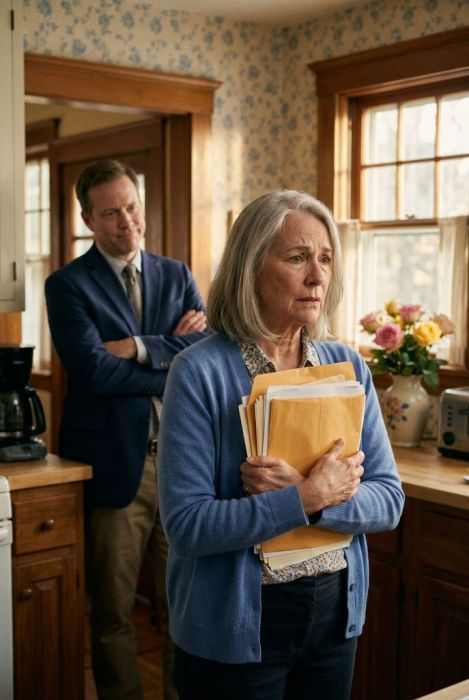
And when I looked up, Brent was there, standing on my porch in the navy suit he saved for closings and funerals, arms folded like he'd already won.
"It's for your own good, Mom," he said, in the same soft voice he'd used the time he hid my car keys as a child to keep me home. Only this time he wasn't seven years old and scared. He was forty-four, wearing a platinum watch, and holding a petition that said I was no longer fit to manage my own life.
The document claimed I'd been found wandering the neighborhood in my nightgown, unable to remember my own address. It claimed I'd left the stove on, forgotten my own grandson's name, become a danger to myself and others. It asked the court to give Brent complete authority over my body, my money, and my home.
Not one word of it was true. I was sixty-seven years old, sharp as a tack, and I'd balanced the books for the school district for thirty-one years. I still played bridge every Thursday. I still ran the church bazaar's budget in my head while I shelled peas.
But Brent knew how to tell a lie with a kind face. He'd learned it from his father's charm and his own bottomless need, and he'd gotten very, very good at it.
"You've been so confused lately," he said, stepping past me into the house like he owned it. "I just want to take care of you."
I didn't answer. I was too busy reading the second page, where the petition mentioned a doctor's evaluation. A Dr. Edmund Pryce of Boston, who had allegedly examined me five weeks earlier. Except I had never met Dr. Pryce in my life.
I felt the folder grow heavy in my hands, and something cold settle behind my ribs. Brent wasn't taking care of me. He was taking me apart.
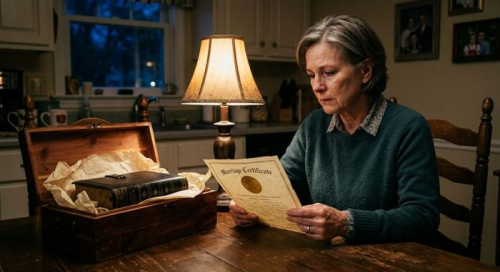
Three years earlier, my Hank had died of a heart attack in the garden, kneeling among his tomatoes, the way he'd always wanted to go — outside, doing something he loved. Brent had flown in for the funeral, stayed exactly two days, and spent most of it on the phone.
"Too big for one woman, Mom," he'd said then, looking up at the old craftsman house Hank and I had paid off in 1998. "You should sell. Downsize. Lock in the equity."
I'd laughed him off. The house was more than wood and plaster. It was every birthday candle, every scraped knee, every Christmas morning of his childhood. I wasn't selling my life so he could have a commission check.
But in the months after Hank died, Brent's calls became... interested. He asked about the deed. The title insurance. Whether Hank had kept a safety deposit box. He'd mention the market, the prices flippers were getting in our neighborhood, the developer who'd been sniffing around the block.
To anyone else, it sounded like a son looking out for his widowed mother. To me, it sounded like a man measuring the drapes.
So I did what I'd always done. I kept records. I went to Hank's brother, Raymond, a retired attorney who still kept an office above the old bank in Bangor, and I told him everything.
"You're thinking someone's coming for your house," Ray said over his reading glasses.
"I'm not thinking. I'm sure."
He studied me for a long moment, then nodded. "Then we beat them to it."
That's when the house went into the Hollis Family Trust, with Ray as trustee and my niece Dana, his paralegal, watching every move. I signed the papers on a Thursday. Brent came to dinner the following Sunday, and while I served his mother's meatloaf recipe, he asked, "So, Mom — you ever think about updating your will?"
I smiled, passed him the gravy, and said I was thinking about it. I didn't tell him about Ray. And I didn't tell him about the little silver recorder I'd bought at the electronics store, the one that fit in my cardigan pocket like a secret.
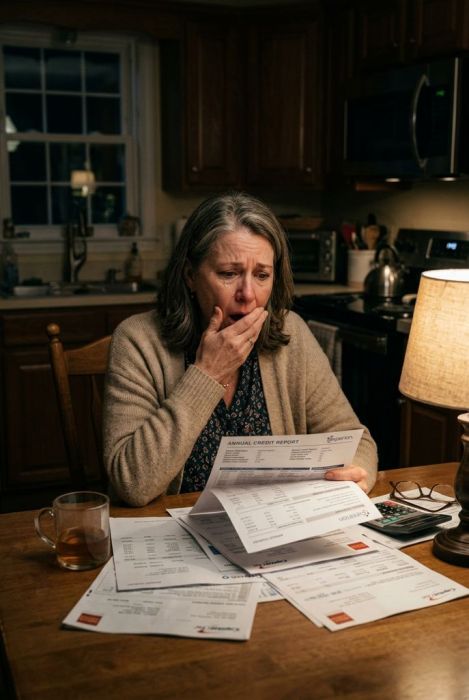
Sixty-seven years of balancing other people's books had taught me one thing: when someone tells you they're going to take everything, you keep a receipt.
The emergency hearing was a travesty. A judge I'd never seen signed the temporary order based on Dr. Pryce's letter — no appearance from me, no lawyer present, nothing but Brent's clean suit and a signature bought with cash.
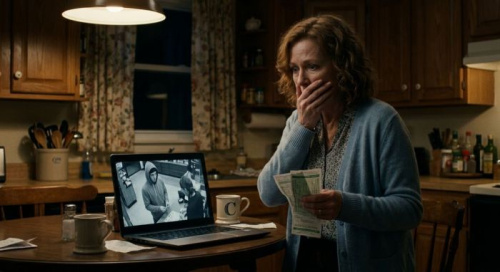
Within a week, Brent moved in. He took my car keys "for safekeeping." He took my checkbook, my credit cards, my phone — "to protect you from scammers, Mom." Lana, his wife, stood in my bedroom doorway that first evening and said, "We'll have this repainted by Friday. You'll love it."
They put me in the guest room, the one with the single bed and the thin blanket. My own house. My own bed. And I lay awake that night listening to them plan, in low voices, what to do with "the proceeds."
The aide came the next morning. Tammy. Twenty-something, bright smile, oozing warmth. She was supposed to keep an eye on me, she said, make sure I took my pills, didn't wander off.
I played the part of the frail old woman with a smile that fooled no one but her. I let her think she was smart. I let her think I was slipping.
Because the first smart thing I did was find Brent's briefcase, left open in the dining room like a door I was never meant to walk through.
Inside, under a stack of listings, was the original evaluation. The letterhead said a clinic in Boston. The signature was a hurried scrawl. And the date, I noticed with a small, cold thrill, was last March — two months before that clinic had closed its doors.
That afternoon, while Tammy was "on break" outside with her phone, I borrowed Dorothy's phone — my neighbor, my bridge partner, the only one Brent had forgotten to cut off — and we looked up Dr. Edmund Pryce together.
The first result made Dorothy gasp. The second made her grip my arm so hard it bruised.
Dr. Pryce had lost his medical license in Massachusetts four years earlier. Not for incompetence. For selling competency evaluations. A dozen of them, for cash, to families who wanted their elderly relatives declared incapable. Stripped of everything.
And now, apparently, he was back in business. My son's business.
I started recording everything after that. It was easy — Brent was arrogant, and arrogant men talk.
"Once the final hearing's over, it's all mine," I heard him tell Lana in the kitchen, through the crack in my bedroom door, the little silver recorder warm in my hand. "The house, the accounts, everything. The trust she thinks she's hiding? Guy's a retired paper pusher. I'll find a way around it. Mom's too far gone to remember she signed anything."
Too far gone. That's what he called me, after forty-four years of dinners and birthdays and love that I'd poured into him like water into sand.
I pressed stop. I counted to ten. And I smiled, because he had no idea that Ray had already sent me a copy of everything, and no idea that Dana had already filed a motion to intervene in the guardianship case, and no idea that the man he'd hired to destroy me had a paper trail a mile long.
The night before the final hearing, Brent sat across from me at the kitchen table — the one where he'd done his homework, where Hank had taught him to tie his shoes, where we'd celebrated every one of his birthdays — and patted my hand like I was a child.
"Don't worry, Mom. I'll handle everything from here."
"I know you will, sweetheart," I said. "That's exactly what I'm counting on."
He thought I was being agreeable. He thought the fight had gone out of me. He'd already told Tammy to pack my clothes — I'd be moving to a "care residence" he'd found, a place that smelled like bleach and despair, where the state would pay him to keep me quiet.
What he didn't know was that Dana had subpoenaed Dr. Pryce. What he didn't know was that Judge Margaret Ellison — the new judge on the docket, a no-nonsense woman with a civil rights background — had read the motion to intervene twice.
And what he really, truly didn't know, was the last recording I'd made, the one where he told the developer, in the parking lot of the diner, that his mother was "a dried-up old bat who wouldn't last six months in a home" and that the house could be broken down into two lots by spring.
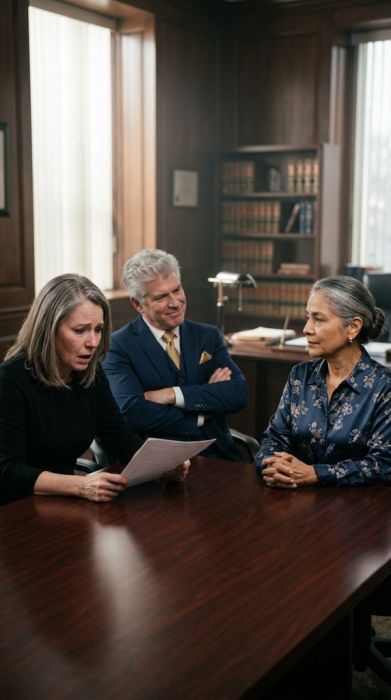
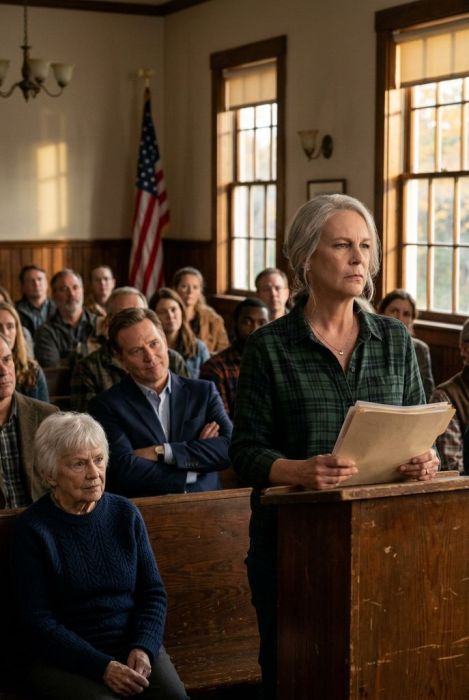
The courtroom was standing-room-only, which surprised me. Dorothy had brought half the bridge club. Ray sat beside me with Dana, his files so thick they made a thump when he set them on the table. Brent wore his navy suit and a smile that kept flickering like a bad bulb.
Dr. Pryce took the stand first. He looked five years older than his photo, wearing glasses that kept slipping, and he swore to tell the truth, the whole truth, and nothing but the truth — right before Ray asked him, gently, about the Massachusetts Board of Registration in Medicine.
"Sir, are you currently licensed to practice medicine in any state?"
Pryce's mouth opened. Closed. Opened again, like a fish in a shrinking pond. "I— I'm retired—"
"You were revoked," Ray said, and the word landed like a stone in a still lake. "Four years ago. For selling fraudulent competency evaluations to families seeking guardianship of elderly relatives. Isn't that right?"
The courtroom went dead silent. Brent's face went a color I'd never seen on a man who wasn't having a heart attack.
"What does that have to do with anything?" Brent jumped up. "Your Honor, this is harassment —"
"Sit down, Mr. Hollis," Judge Ellison said, in a voice that could frost a window, "or I'll have you removed."
Pryce crumbled. It took him less than three minutes to admit that Brent had paid him two thousand dollars in cash to sign the evaluation without ever examining me. That it wasn't the first time. That they'd done this before, in another state, and that Brent had promised him it would be "easier this time, the old lady's nobody."
I sat very still. Ray put a hand on my arm. Dana slid the trust documents across the table.
And then the judge asked to see Brent's bank records.
This was my part. I reached into my cardigan — the cardigan with the big pocket, the one Brent had never thought to search — and I pulled out the little silver recorder.
"Your Honor," I said, and my voice came out stronger than I felt, "I have something you should hear."
Brent started laughing. "That's adorable. My mother thinks she's a detective."
"Play it," Judge Ellison said.
I pressed the button, and the courtroom heard my son — my beautiful, greedy son — tell a total stranger in a diner parking lot that his mother was a dried-up old bat who wouldn't last six months in a home, that her house was already as good as two building lots, that all he had to do was keep smiling until the paperwork went through.
The laughter stopped. The color drained from Brent's face like water from a tub.
"I can explain —" he started.
"You can explain it to the district attorney," Judge Ellison said, and she didn't even look up when she said it.
The bailiff opened the door, and two officers came in. Brent didn't resist. He just looked at me, his eyes wet and wild, and said, "Mom. Mom, this isn't — you can't do this to your own son."
I looked at him — forty-four years of my life, standing there in handcuffs — and I felt something go quiet inside me. Not anger. Not grief. Something closer to peace.
"I loved you," I said, because it was true, and because I wanted him to remember it when the cell door closed. "You'll have a long time to think about what you did with that."
They took him out. In the hallway, I heard Lana screaming at the officers about her rights. I heard a door slam. And then, for the first time in three months, I heard nothing at all but my own heartbeat, and it sounded like the house breathing again.
It took the courts six months to untangle everything. Dr. Pryce's license was gone for good, and he went back to Boston to face new charges. Brent was convicted of attempted exploitation of a vulnerable adult, forgery, and elder abuse. He lost his real estate license, his marriage, and — as the restitution order read — a hundred and four thousand dollars he no longer had.
Lana moved back in with her sister. The developer lost interest the moment the trust made clear the house could never be sold out from under me.
And me? I sold the house anyway.
On my own terms, to the young couple next door — the Hendersons, who'd just had their second baby and who fell in love with the hydrangeas the way I had, forty years earlier. I helped them move in. I showed them where the water heater liked to complain, and which roses needed the most sun, and I told them the kitchen window was the best place in the world to watch the first snow.
Then I packed my books and my bridge trophies and my father's watch, and I moved to a little gray cottage in Cape Elizabeth, two streets from the ocean, where the light comes in sideways and the mornings taste like salt.
I volunteer at the library now, restoring old books, and I have a standing bridge game on Thursdays with a group of women who don't ask questions when I order the crab cakes. Dorothy visits every month, and we sit on my porch and watch the ferries cross the bay, and she always says the same thing: "You really got him, Peg."
"I didn't get him," I tell her. "He got himself. I just kept the receipts."
I still keep a recorder in my cardigan. Old habits — sixty-seven years of balancing books will do that to a woman. But these days, the only thing it ever picks up is the sound of the tide, rolling in and out, patient as a promise, and the new house settling around me like it's been waiting for me all along.