The voice on the other end of the line was cheerful and robotic at the same time. A young woman from something called Regional Credit Services introduced herself and then told me, very politely, that I was three months behind on a furniture loan for eleven thousand four hundred dollars at a store called Ashley & Sloan. I laughed and told her she had the wrong number. I had not set foot in any store called Ashley & Sloan in nineteen years, and I pay my bills on the first of the month, like clockwork.
She read my address back to me. My full name. My date of birth. And I felt the floor tilt under my kitchen chair.
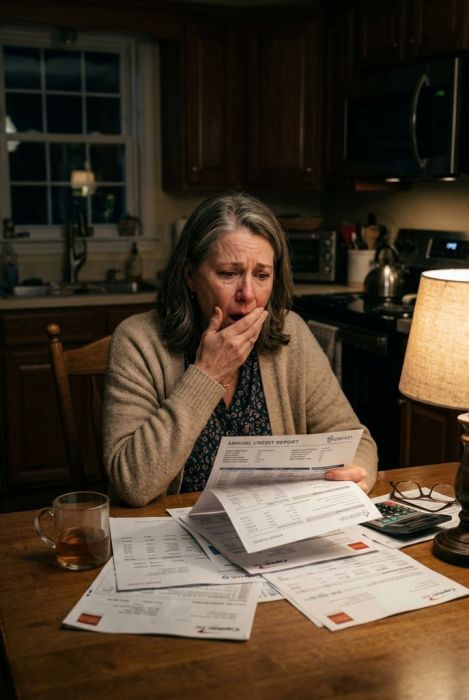
I hung up, assuming it was a scam. But they called again the next day, and the day after that. Finally, I drove to my bank and asked them to print my credit report, because I am old enough to know that numbers do not lie even when people do. I sat in the car in the parking lot of the Bank of Nebraska branch on Dodge Street and read it three times, and on the third time I started shaking.
Thirteen new accounts in the last fourteen months. Two department store cards. A line of credit. A payday loan for four thousand dollars. A car loan through a dealership across town. And a pending mortgage application at a credit union on the other side of Omaha for two hundred sixty-eight thousand dollars, in my name, at an address that was not mine.
Every account pointed to one person: my sister Pam. This was years in the making, and looking back, I can see every breadcrumb she left.
Pam is five years younger than me. We grew up in the same little house on Farnam Street, shared a bedroom, shared our mother's stubborn chin and our father's habit of whistling when he was nervous. But somewhere along the way we grew into different women. I married Frank, a mail carrier who fixed things with his hands and kept a ledger of every dollar we spent. I worked as a school nurse for thirty-one years, gave Frank a daughter named Emily, and paid off our little ranch house on time, every time. Boring, Pam called it. Careful. A life with no spice.
Pam married Rick, who sold timeshares and then vacuum cleaners and then a "revolutionary" vitamin line that was going to make them millionaires. They bought a boat and sold it at a loss. They bought a cabin in a falling market and lost it to foreclosure. They moved rentals every year or two, always chasing a bigger kitchen, always one payment behind, always with a smile that said none of it was their fault.
And yet I loved her. She was my sister. When Rick lost his job, I handed her an envelope with two thousand dollars and told her not to mention it again. When her daughter Krista needed braces, I paid the orthodontist and let Pam thank me in tears. Frank used to say I had a soft spot the size of Nebraska when it came to her, and he was right. I thought generosity was the same thing as love, and I thought she knew it.
Frank died six years ago. A Tuesday in June, out in the garden, right between the tomato rows. He left me the house free and clear, a small pension, and twelve thousand dollars in savings he insisted on calling our rainy day fund. I kept the ledger he kept, and I balanced it every Sunday. It made me feel close to him, running my finger down the columns he had written in his careful hand.
I think that is why, when Pam came over last spring to help me with my taxes, something in me should have paid attention. She brought a bottle of wine and a folder and said the state offered seniors a property tax discount, but the paperwork needed copies of my driver's license and social security card. She asked me to hold them up to the kitchen light while she took pictures with her phone. Just to be safe, she said. You keep the originals. I'll file everything online.
I made her spaghetti that night. We laughed about old boyfriends. At the door I told her I loved her, and she told me she loved me too, and I believed her. I always believed her.
So when I saw those thirteen accounts on that credit report, I did not want to believe what I was seeing. The bills all carried my name and my social security number, but the phone numbers were Pam's. The email addresses were Pam's. The addresses were the rental house on Blondo Street where she and Rick had been living for two years. I sat in that car until the parking lot lights came on, then drove home and called my sister.
She laughed. She laughed the way she laughed at my garden, at my ledger, at my life without spice. "Joan, that's ridiculous," she said. "Have you been reading those scam emails again? Someone's using your identity, that's all. You're the careful one. Why would I need your stupid credit? Rick and I are about to close on a house. We don't need your help."
I almost believed her. I wanted to believe her. But I had worked as a nurse, and I had learned that the patients who protest the loudest are usually the ones hiding the worst symptoms.
Two days later, Rick called me, and he was not laughing. "You better fix this, Joan," he said. "Pam's losing her mind. There's some nonsense about a police report, and we have a closing next week. If that falls through because of your little drama, I swear—"
"Because of my little drama," I repeated.
He went quiet for one second too long.
I hung up and called the credit bureaus that same afternoon. I froze my credit. I filed a report with the Omaha Police Department's financial crimes unit, and I was lucky enough to be handed over to a detective named Roy Ellison, who listened to my story with his elbows on his desk and a look on his face that I would later recognize as patience. He told me I had done everything right, which was more than I expected from a man young enough to be my grandson.
Then he told me something I did not expect at all.
The mortgage application in my name was real, he said. A local credit union had actually approved it in principle, because the fake Joan Whitfield on the paperwork had a beautiful credit score — the one I had spent forty years building. The house was a fixer-upper on Arbor Street, and the closing was scheduled for the following Thursday. And Pam thought she was walking into that closing to sign my name on the dotted line and take ownership of her forever home.
When Roy's team totaled every account, the number wore a comma: seventy-four thousand dollars and change, all spent on a life my sister could never have afforded on her own — the couch, the recliner, the car in the driveway of a house she had not bought yet.
Detective Ellison had a plan. He needed me to be brave, he said. He needed me not to confront her, not to warn her, not to cry on the phone with her. He needed Pam to show up at that closing believing she had won.
The hardest thing I have ever done was not screaming at my sister. It was not even filing the police report. It was sitting at my kitchen table every night for the next six days, looking at the folder of evidence Roy had helped me assemble — forty-three pages of it, every account, every statement, every forged signature, every receipt from the stores where she had spent my name like confetti — and doing nothing. Just waiting.
The stores had cameras, and the stores had been happy to cooperate. There was footage of Pam buying the sectional couch and the leather recliner with my name on the receipt. There was a payday loan signed in her own handwriting, the same hand that had signed my name ten times over. I pressed my fingers to those pages and thought about Frank's ledger, and about how she had taken pictures of my social security card while I made her spaghetti.
Krista called me that Sunday, my niece, crying. She said her mother had been acting strange, secretive, and could I please talk to her. I told her I loved her, and I did not tell her what Thursday would bring. Roy had told me the best way to protect everyone was to let the storm finish building, and I trusted him.
The closing was scheduled for ten o'clock Thursday morning at a title company on Farnam Street — the same street where we grew up, which I have always thought is the kind of detail God writes into stories to make them hurt more.
I arrived early. Roy had me wait in a small office off the lobby, behind a window of one-way glass, with Emily at my side. My daughter had driven four hours from Des Moines the night before, and she held my hand and did not ask questions. At ten o'clock, the front door opened, and Pam walked in.
She looked beautiful. She always looks beautiful when she is about to get what she wants. She was wearing a cream-colored dress and carrying a leather folder, and Rick was behind her in a suit that did not fit, and she was smiling at the closing agent like they were old friends.
The closing agent was not a closing agent. The man in the reading glasses, the one who offered her coffee with a warm professional smile, was Detective Roy Ellison. He shook her hand, asked to see her identification, and she produced my driver's license without a flicker of hesitation. She produced a power of attorney document that I had never signed. And then she signed my name on the loan documents with a little flourish, the way she signed birthday cards.
And Roy took off the glasses, stood up, and said in a voice that carried to every corner of that small room, "Pamela June Hargrove, you are under arrest for identity theft, forgery, and criminal impersonation."
For one full second, nobody moved. Rick's coffee cup hovered halfway to his mouth. The real loan officer, who had been in on it, quietly stepped out into the lobby. And Pam looked at Roy, then at the door, then at me — because I had opened the door from the little office, Emily was holding my arm, and I was holding Frank's old leather folder with the forty-three pages inside.
"Joan," Pam whispered. Her face went the color of the cream dress. "Joan, I can explain. I was going to pay it all back. That's the thing. Once we had the house, the value would go up, and I was going to pay every penny. You were always so careful, you'd never even miss it."
I did not say anything. There was nothing to say that forty-three pages had not already said better.
Rick tried to run. He made it two steps before a uniformed officer stepped out of a door he had not noticed, and Rick stopped and raised his hands like a man who had been through this before. Then he looked at Pam and said, quietly, "I want a divorce," and I watched my sister's face crumble in a way I had never seen it crumble, not even at Dad's funeral.
Roy read the charges in a calm voice. Thirteen counts, from the payday lender to the dealership to the credit union, all of it prepared with the county prosecutor. Pam stood there shaking, repeating her rights back at the officer who read them to her, and for a moment I almost felt sorry for her.
Then I remembered the way she had laughed when I called her. And the feeling passed.
They took her out through the front door in handcuffs, and I stood at that one-way glass and watched because I owed it to myself to watch. Emily squeezed my hand. Roy came back in and told me I had been the bravest witness he had ever had, and I smiled at him with a face I did not recognize as my own.
The house on Arbor Street went back on the market. The credit union, which had been burned but not badly because Roy's team had flagged the file, quietly withdrew its approval, and the seller kept the earnest money. The dealership took back the car. The stores accepted returns with a copy of the police report. And over the next ninety days, one by one, every single fraudulent account disappeared from my credit file like they had never existed.
The bureaus sent me letters. The credit union sent me a check for the fees. And my credit score, that careful forty-year construction of mine, came back higher than it had ever been. Eight hundred and twelve. Frank would have whistled.
Pam pled to a reduced charge, because the prosecutor had plenty of papers of her own. She got a hundred and twenty days in county jail and five years of probation, with restitution set at every dollar she had stolen in my name. She was also, by court order, banned from handling anyone else's finances in the state of Nebraska, which considering she once helped our elderly aunt Dorie with her checkbook, probably saved Aunt Dorie a world of trouble.
Rick did not wait for the divorce. He moved out the weekend she was arrested and took the boat with him. I have never asked where he landed, because I do not care. The last time I heard his name, it was attached to a bankruptcy filing in another state, and I felt nothing at all.
My niece Krista came to my house a month later and cried into my shoulder. She told me she was ashamed, and that she understood if I never wanted to see her again. I made her tea, the way my mother taught me, and I told her that the bills were paid, the debt was gone, and the only thing she owed me was an honest life. She calls me every Sunday now. Darren, my nephew, drove up from Kansas City last fall to paint the porch Frank never got to finish. He told me his mother was learning to knit in a halfway house, of all things.
I kept the forty-three pages. They live in Frank's leather folder on the shelf above my desk, right next to the last ledger he ever kept. I do not open it often. I do not need to. I know what it says. It says that numbers do not lie, that paper outlasts apologies, and that being called boring and careful by people who are neither is the highest compliment a person can receive.
On the anniversary of that Thursday, I sat with Emily on my new porch and we shared a bottle of the same wine Pam had brought that night last spring. We did not talk about her. We talked about Frank, and about the tomatoes, and about how strange it is that a woman can spend her whole life trying to protect her sister and end up having to protect herself from her instead.
I am sixty-three years old. I have a paid-off house, a ledger that balances, a daughter who believes in me, and a credit score of eight hundred and twelve. The next time someone tells me I should be less careful, I will smile, and I will think of my sister standing in that title office in her cream-colored dress, and I will know that careful was the best thing I ever was.