The day my mother signed the house over to my sister, I held her hand and said nothing. I didn't scream. I didn't argue. I didn't grab the paper and rip it in half, the way every instinct told me to. I just smoothed the blanket across her knees and told her I loved her, because I had learned long ago that some battles are won by staying very, very quiet.
I am Callie Hart, fifty-eight years old. For the last nine years, since Daddy passed, I had been the one living in the old family house on Sycamore Lane in Millbrook, Ohio. I was the one who left my own little apartment in Columbus, the one who sold my furniture, the one who took the night shift at the hospital so I could be home by morning to make Mother her oatmeal. Brenda, my younger sister, lived three states away in Indianapolis with her husband Doug. She sent flowers on birthdays and called at Christmas, and that was the shape of her devotion.
When Mother's heart began to fail last spring, Brenda arrived like a saint. She flew in with matching luggage and a rent-a-car and announced she was taking over. She cooked, though Mother barely ate. She rearranged the medicine cabinet. She sat in the parlor with the real estate brochures fanned out, sighing about how much the market was paying for property on this street.
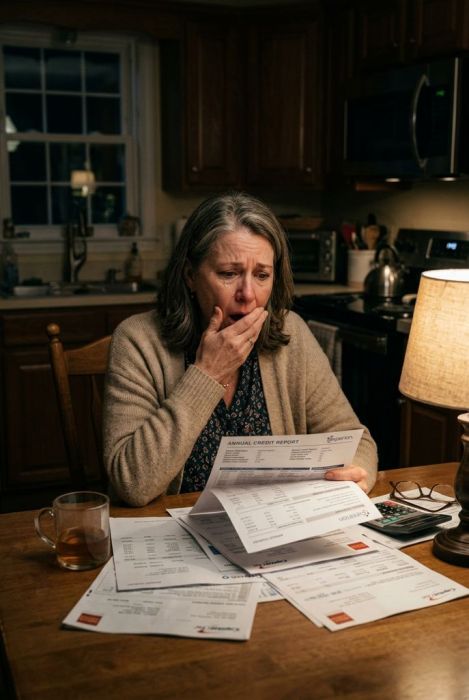
I was tired. That is the truth no one writes on the sympathy cards. I was bone-tired from nine years of urine-soaked sheets and midnight panics and doctors who spoke past me as though I did not exist because I was the daughter, the fixture, the one who changed the dressings. So when Brenda said sweetly, "Sister, why don't you go get some rest, I've got this," I let myself believe her. For three days, I slept. It was the most expensive sleep of my life.
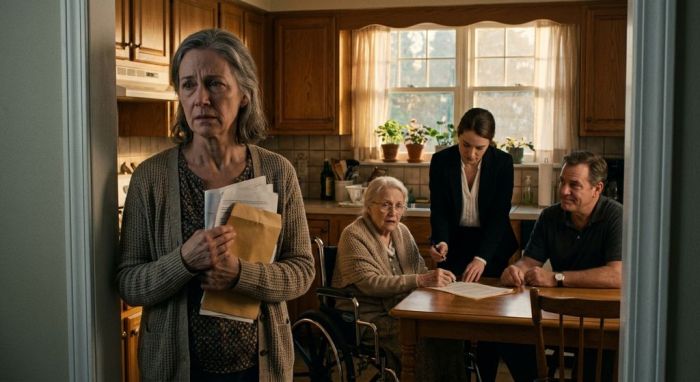
The papers were on the kitchen table when I came down on a Thursday morning. Mother was in her chair by the window, and a notary I had never seen was packing up her stamp. Brenda stood behind Mother with both hands on her shoulders, beaming like she had just won a game show.
"There you are," Brenda chirped. "We're all finished. Mother wanted me to take care of everything so you wouldn't have to worry."
The word that bothered me was "everything." I knelt beside Mother and took her hands. Her eyes were foggy, the way they got on her bad days, the days when she called me by Daddy's mother's name. "Mother," I said gently, "do you know what you signed?"
Brenda laughed, a bright, brittle sound. "Callie, don't do this. It's just paperwork so I can manage her affairs. Power of attorney. You'd have had a fit about the bank." The notary nodded, already halfway out the door, and I let her go. I was too tired to chase her, too trusting to understand what my own sister was capable of.
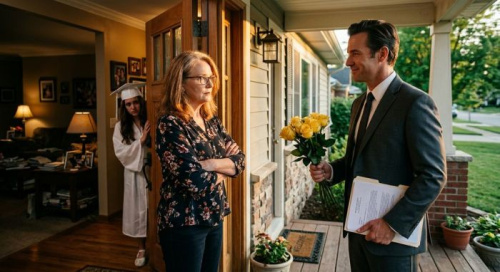
It was Doug who finally broke me. He came by two weeks later, not Brenda, and he stood on my porch in the rain with a folded envelope in his hand. "We need you out in thirty days," he said, as casual as a man ordering coffee. "Brenda owns the house now. It's in her name. Clean and legal."
I stared at him. "Mother deeded your wife my home?"
"Brenda convinced Mother that you had been skimming her savings," Doug said, and he almost smiled. "Mother decided she only trusts her real family. So. Thirty days."
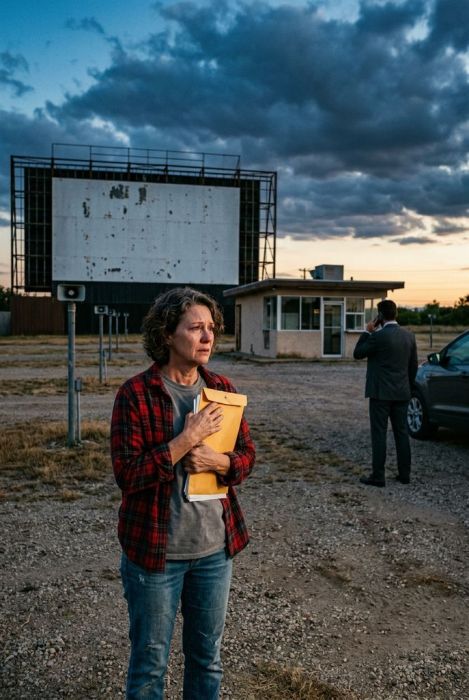
That was when the quiet began to leave me. I felt it drain away like water from a cracked pitcher, leaving something cold and hard behind. I did not cry in front of him. I shut the door and stood in the hallway, and I breathed, and I remembered a rainy afternoon twenty-two years ago when my father had sat me down in this very hallway with a heavy manila envelope.
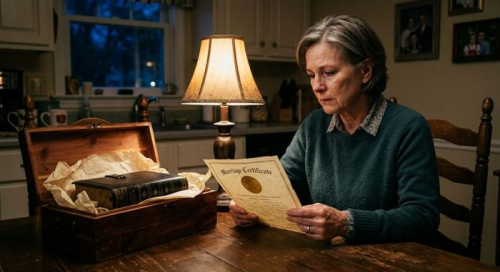
Daddy had always been a cautious, secretive man. He had grown up poor and become a small-town contractor, and he had never fully trusted banks or lawyers or anyone else to protect what he built with his own hands. "Callie, girl," he said to me that day, "your mother and I put this house in a trust years ago, with a rider that muddies the title something fierce. It's got two pages, and most people only ever look at the first. I'm telling you now, so that when the time comes, you'll know to look at the second."
I had nodded and patted his hand and thought he was just being old and worried. I had put the envelope in the metal box in the basement with the birth certificates and the war medals, and I had forgotten it the way you forget a promise you never thought you'd have to keep.
Now, standing in that hallway with my world collapsing, I remembered every word.
I didn't tell Brenda. I didn't tell anyone. I drove to the old County Records office in town, and I pulled the file on the house at 214 Sycamore Lane, and I sat in a plastic chair with the fluorescent lights humming overhead while a clerk with kind eyes helped me untangle the title history. What I found made my hands shake.
The trust my father had set up was real. The first page of the deed was ordinary — the kind of thing Brenda's notary would have yanked out of a stack and shoved in front of a confused old woman. But the second page, the one nobody ever reads, contained the rider. And in that rider, my father had signed his interest in the house over to me, his elder daughter, as joint tenant with right of survivorship, with one explicit line in black ink: "This property shall not be sold, transferred, or encumbered without the written consent of Callie Hart."
Mother had signed the house to Brenda. But Mother had never owned the house alone. She owned her share, and I owned mine, and no quitclaim deed signed by a confused woman in a fog could dissolve a joint tenancy that my father had protected with a clause Brenda had never once read.
I sat in that Records office and wept out loud, right there in the fluorescent light, because it was done. All of it. I was not homeless. I was not a thief's victim. I had been given a weapon by a father who had loved me enough to plan for the day I might need one.
Brenda, of course, grew bolder. She had the locks changed while I was at the hospital with Mother. She had my clothes bagged and stacked on the curb in garbage sacks, and when the neighbors stared, she waved and called out, "She's moving on! So exciting!" Mother was too far gone to understand, blinking at me from the window, and I blew her a kiss and did not scream.
My lawyer, a fierce little woman named Rosa Delgado who Daddy had once done a plumbing job for, wrote Brenda a letter. She sent it registered mail. She attached a copy of the second page and a copy of the trust, and she asked Brenda, very politely, to vacate the premises and return the keys before she found herself in a courtroom explaining why she had forged a joint deed.
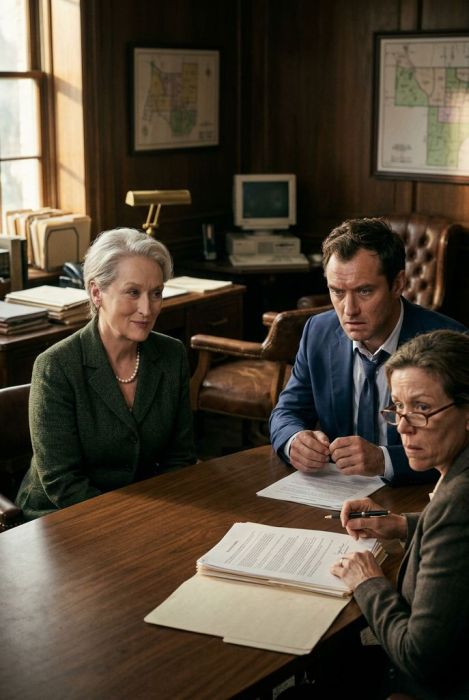
But Brenda did not take the exit I offered her. That is the thing about people like my sister — they cannot conceive of being beaten, so they mistake a warning for a bluff. She marched into court with Doug and her smug smile and her expensive lawyer, and she tried to evict me and claim the house, and Rosa stood up and showed the judge the second page and the trust and the clause, and the judge's eyebrows went up in a way that made me want to applaud.
Then the real accounting began. Because once a magistrate starts pulling at the thread of a fraudulent elder conveyance, the whole sweater unravels. The notary Brenda had used was a woman Doug did accounting for, a friend who had not actually witnessed Mother sign anything that day — she had stamped the form in her car an hour later. Mother's bank records showed money moved out of her accounts into Brenda's name, money to "cover funeral costs" that had not been spent. The real estate office had emails from Doug's account, discussing which county would be fastest to slip a quitclaim through.
The town of Millbrook does not like fraud against the elderly, and it likes it even less when the fraudster is the one sister who never stayed to wipe her mother's brow. The news traveled from the courthouse to the diner to the church in a single evening.
On the day of the final hearing, Brenda stood in the well of the courtroom in a pale pink suit, and she looked at me with those eyes, the ones that had always said I was the dull one, the martyr, the one who would never have anything of her own. "You think you're so clever, holding onto that house," she hissed low, so the reporter by the door couldn't hear. "You'll be old and alone and I'll have the last laugh."
And I looked at her, and I felt nothing but a tired, quiet peace, and I said, "Brenda, I've been caring for our mother while you've been planning her funeral. I think I already won."
The judge ruled against her on every point. The deed was void. The transfer was rescinded. And because the state had opened a file on elder financial exploitation, the question of whether Brenda had knowingly preyed on an incapacitated woman did not end at the civil bench. Three weeks later, I read in the paper that she and Doug had been indicted. They lost their house in Indianapolis to the legal fees. They lost their friends, who found the whole business unsavory. And in the end, they lost each other — Doug left her for a younger paralegal the day after the arraignment.
The house on Sycamore Lane is mine. Mine, and Mother's, for as long as she needs it.
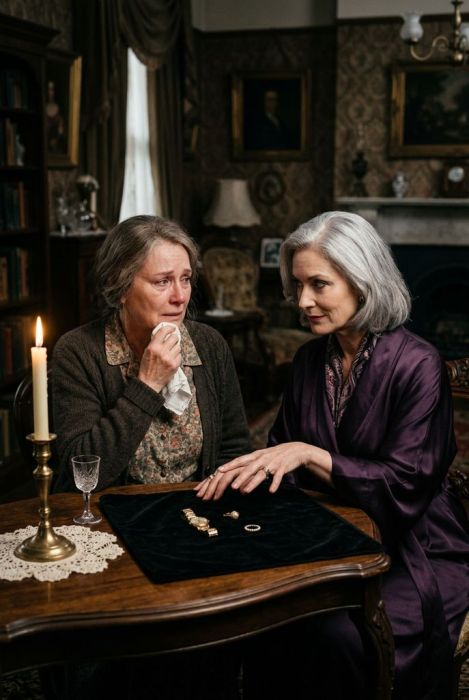
That autumn, I sat with Mother in the parlor with the big windows, and she had one of her clear days. She looked at me with eyes that were suddenly, heartbreakingly sharp. "Callie," she said, "I'm sorry. I think I signed something I shouldn't have."
I took her hand. "It's all right, Mother. Daddy fixed it a long time ago."
"He always did look out for you," she whispered, and she smiled, and I knew she remembered more than she let on, and that was enough.
I did not press charges personally against Brenda, though the state did not ask my permission. I did not gloat. I did not dance on her grave. I let the law do its work, and I let the town do its whispering, and I went back to the only thing I had ever really wanted — a quiet life, a garden I tended with my own hands, and the sound of my mother's breathing in the next room.
People ask me now, in the diner, how I stayed so calm through all of it. They want to hear that I had some brilliant plan, some dramatic revenge. But the truth is simpler. My father had loved me well enough to leave me one second page, and I had loved him well enough to remember it. That is not revenge. That is inheritance.
Brenda wrote me once, from a small apartment in Reno where she had gone to disappear. The letter was full of blame and fury and all the old accusations — I was the favorite, I was the martyr, I was the reason she had become who she was. I read it, and I folded it neatly, and I set it in the drawer with the war medals and the birth certificates and the manila envelope that had saved my life.
Some people spend their whole lives looking for the one who wronged them. I spent mine looking at the one who let me stay.
And that is the only revenge worth having.