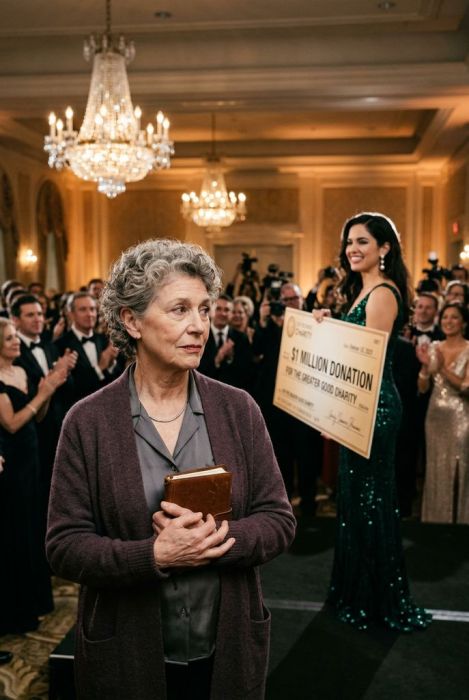
The emcee held up the enormous check with both hands, and the whole ballroom erupted. Nine hundred people rose to their feet, clapping until their palms stung. I stood at the back of the room, behind the champagne tower, and I clapped along with everyone else, because that was what was expected of me. I was the executive director of the Chestnut Hills Senior Center, the charity we had gathered to save, and the woman in the center of all that applause was not me.
She was my sister-in-law, Deirdre Mayhew, and she looked radiant under the chandeliers.
She had done this so well, and that was the part that made my stomach turn. Deirdre had swept into the center nine months earlier with her silk scarves and her boardroom smile, volunteering to chair the annual gala because, in her words, "someone with real connections ought to run it for once." She had meant me. She had meant that I, the woman who spent twenty years building this place beside my mother, was not enough.
The newspaper said we raised one point six million dollars that night. The quiet voice inside me, the one I had learned to trust over fifty-eight years of life, said we had actually raised nearly three million. And I was the only person in that ballroom who knew why.
I am not a foolish woman. I am not naive. I had simply been raised by a mother who believed the best in people, and I had let that kindness cost me. My mother built the Chestnut Hills Senior Center with her own two hands forty years ago, turning an old Methodist church into a place where aging neighbors could gather, eat warm meals, and never feel alone. She ran it until the day she died, and on her deathbed, she made me promise to carry it forward.
I carried that promise every single day for twenty years. I knew every name on the lunch list, every widower who needed a check-in call. The center was my life's work. In time, it became my identity.
Deirdre married my younger brother, Roger, eighteen years ago, and from the very first Sunday dinner she treated me with the particular warmth of a woman who believes she has married above the family. It lived in the way she praised my "charming little profession," the way she corrected my table manners, and the way she was always the loudest voice in the room.
When Mom died, Deirdre was all comfort. "Now, Mary," she said, squeezing my hand, "let me help you. You can't carry this burden alone." And because grief had hollowed me out, I believed her. I handed her the keys.
That was my first mistake. It would not be my last.
Deirdre did not take over the center's daily work. That would have required her to actually care. Instead, she took over the fundraisers, the donors, the grants, the accounts that came with the big money. She made sure the board saw her as the future and me as a relic of a bygone era. And because I was busy feeding and warming lonely people, I let her.
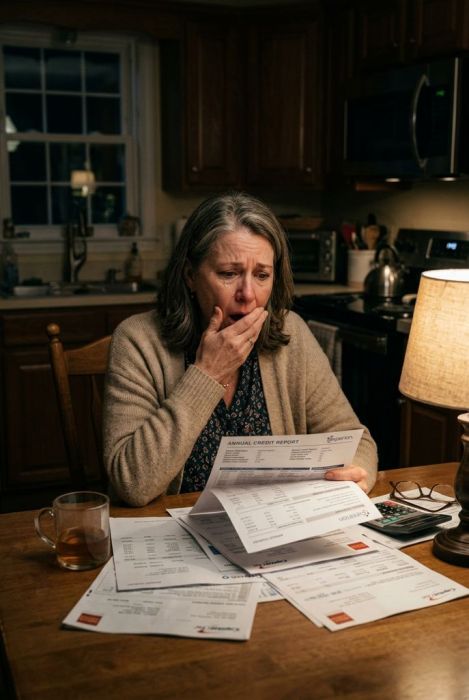
The first sign of trouble came in March, when I noticed a small discrepancy in the catering invoices for the spring luncheon. Mom had taught me the old way of keeping books, pen and paper, every dollar tracked, and I kept that discipline even after the center moved to software. Deirdre ran the official accounts. But I kept a private ledger, written in a shorthand Mom and I had invented, recording every figure I could verify myself. A strange habit for a charity director, I know. But my mother had grown up poor, and she taught me that you never fully trust anyone with the story of your money but yourself.
The discrepancy was small, eight hundred dollars more than the meal count could possibly explain. I told myself it was an error. I told myself I was being paranoid, the way aging women are so often accused of being. I put it in my ledger and said nothing.
The second sign came in June, at the summer donor event. I watched Deirdre accept a sealed envelope from a stranger, a man with a heavy gold watch and eyes that never quite settled. She slid it into her purse like a magician. When I asked who he was, she smiled and said, "Just a new friend of the center, darling. Don't worry your head." I wrote it all down in my shorthand that night and went to sleep telling myself the center was fine.
Oh, I wanted to believe it. You have to understand how desperately a good person wants to believe in other good people. The thought that my own brother's wife was stealing from my mother's legacy was too ugly to hold in my head for long. So I pushed it down. I kept my little ledger. I kept smiling.
Then came the gala.
Deirdre spent months building it into the social event of the season, with a caterer from Columbus, a florist who charged more than my mother's car had cost, and a silent auction stocked by senators and football greats. On the night, she was flawless, gliding through the ballroom in an emerald gown, kissing cheeks, accepting praise, while I worked quietly in the kitchen so the older volunteers didn't collapse.
I noticed, with a stone in my chest, that the printed honor roll was missing generous donors. The Winters family, who gave five thousand every single year, were gone. Tommy Delgado, who pledged ten thousand, was nowhere. I excused myself to the washroom and called the bank.
The manager was hesitant, because I was no longer on the signature line. But my mother's old account held a kind of trust with the people in that town, and she remembered me.
"Mary," she lowered her voice, "they've been making weekly transfers out of the gala account. Large ones. To a private holding account opened four months ago. I thought you knew."
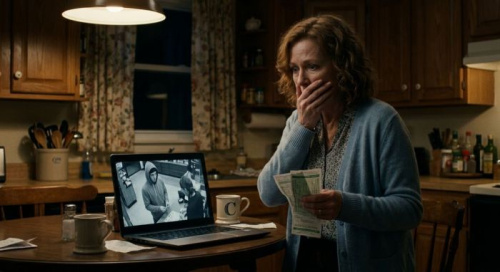
My hand shook when I hung up. Outside, a thousand people celebrated a beautiful, hollow lie, and I understood on my bones what Deirdre intended next. She was going to use the missing money to blame me.
Two days later, my brother arrived with pity on his face as a disguise. He sat me in his study and told me Deirdre had discovered "serious irregularities," that the board had to put me on administrative leave while a forensic accountant sorted it out. And he was so sorry.
I did not cry. I looked at Mom's photograph and felt a strange, quiet calm.
"Roger," I said, "I never expected this from you."
He had the decency to look away.
For four weeks, I was a ghost in my own town. People I had fed and sheltered for twenty years looked at me with pity and suspicion. I lost friends. I lost my sleep. But I did not lose my ledger. And I did not stop moving.
That was my hidden card, the thing Deirdre never understood. I had been invisible in plain sight all those years, a quiet woman who kept her own counsel, and she mistook my quiet for weakness, my kindness for stupidity. She built an entire scheme on the belief that I would sit down and disappear.
She never understood that a woman who keeps a ledger in her mother's own shorthand is a woman who knows how to prepare for the worst.
The forensic report was due at an emergency board meeting in October. Deirdre had arranged everything. She had convinced the board that I mismanaged the funds, and she claimed to own photographs of me accepting envelopes from donors. She did not bother to explain they were made of shadows. She had a helper, the man with the gold watch, and he was very skilled.
The night before the meeting, I did the last thing she expected. I went to see Sylvia, my mother's oldest friend, ninety-one years old and sharp as a tack. She had kept every bank statement the center had ever produced and lived in the small apartment above it, rent free, as my mother promised, watching the whole sad parade with the eyes of a woman who had seen every fortune hunter in town come and go for seventy years.
"I've been waiting for you, Mary," she said, and she opened the bottom drawer of her dresser.
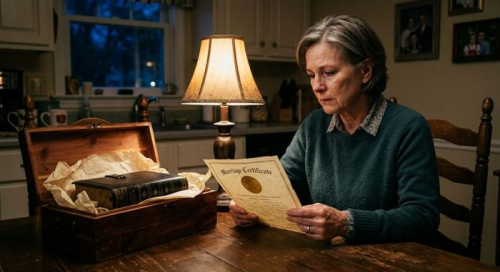
Inside was a second ledger. Sylvia had kept it faithfully, in the same shorthand I learned, because she and Mom had invented that code together before I was born. Every transfer Deirdre made, every forged signature, Sylvia had quietly recorded and saved.
"I knew the moment she walked in," Sylvia said. "I knew what she was. I just had to wait for you to be ready."
I wept in that room and felt the glorious relief of being seen and remembered and loved.
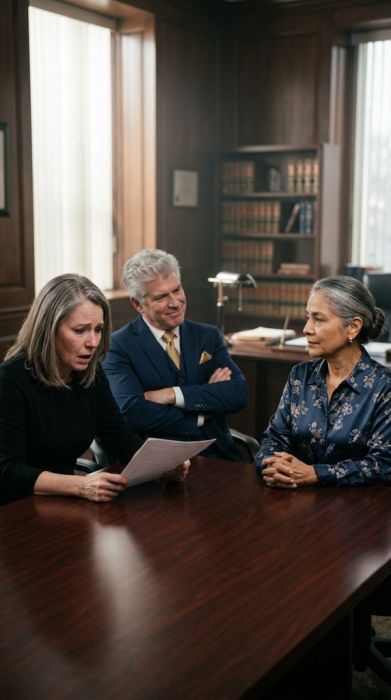
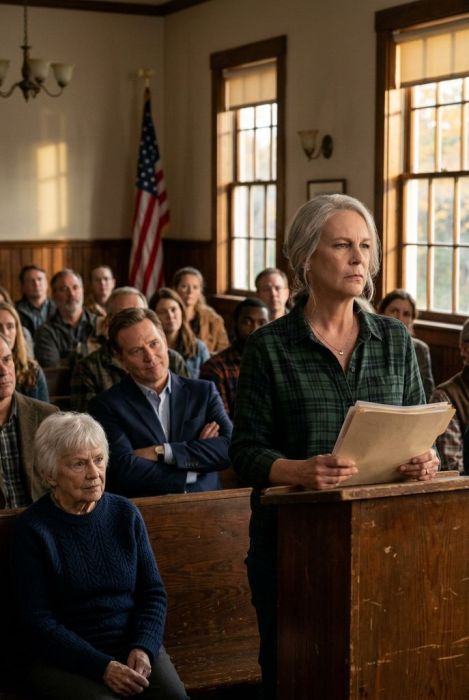
The meeting was held in the center, old and full. Deirdre arrived in elegance, escorted by my brother. The forensic accountant, Mr. Okafor, stood at the front with a binder of papers. I sat in the back, next to Sylvia, holding an old cloth bag on my lap like a woman carrying her Sunday shoes.
Deirdre spoke first. She smoothed her pearls and gave a performance worthy of the stage, about honor and trust and disappointment. She produced "evidence," and the gold-watch man handed out folders of what I knew were clever fakes.
I waited until her silence hung heavy in the air, and I stood.
"Deirdre," I said, my voice clear, "I want to show you the others."
I opened my bag. I had brought my ledger, and Sylvia had brought hers. Together, they told the story in code, and I had brought the truth in plain words too; the bank records, the caterer's true invoices, and the photograph of her hand reaching for that envelope.
The accountant read the pages, and his face changed.
The man with the gold watch exited quickly; two officers fell in step behind him. He had been wanted in three states, and the moment our police recognized him, they knew him.
And Deirdre, the queen of the gala, watched her world collapse. Roger rose slowly, the truth finally breaking on his face, the terrible knowledge that the woman he had defended was the thief he had carried home.
The police took Deirdre before the meeting broke. She was charged, and later convicted, of embezzlement and fraud. She had taken nearly a million dollars from a charity built to feed lonely old people, spent on cars and trips and gowns, and she tried to hang the weight around my neck. The court took what she had. My brother divorced her that year. And Deirdre got six years in federal prison, a sentence everyone in town called much too generous.
I do not take joy in that. But I cannot deny a deep, intact quiet satisfaction in the justice. The woman who tried to break me broke herself, with all her own greed and her own dark.
The center survived. When word got out, the community gave more than it ever had. Because generosity is a muscle that grows when it senses an injustice. The money she hid came back with interest, and the center is stronger than ever.
The board asked me to return, and I did, this time without compromise. I know now what my mother spent her life teaching me: kindness is not weakness, but a wise woman never hands all her cards away.
I am sixty years old, and every night I cook the same stew my mother made, and I help hungry people and frightened people feel like they have somewhere to go, and I keep my books, my ledgers, my quiet truth.
They always underestimated the quiet ones.
The doors are open still, as they have been for forty years. The stew breathes steam into the cold, the kitchen light follows the snow, and somewhere a woman taught by her own greed is learning that the things she tried to take cannot be taken. Not the love of a town, not the trust my mother passed to me, not the truth of a quiet woman who kept the only book that ever mattered.