The morning my sister changed the locks on the vineyard, I was standing in row fourteen with my pruning shears, doing the one thing I had sworn I would never do. I was talking to the vines.
They were bare and sleeping under a cold gray November sky, and I was telling them that Jack was gone, as if they didn't already know. He had dropped dead among these rows at sixty-one, pruning shears still in his hand, and the paramedics said he probably never felt a thing. I took some small comfort in that, and then I took none, because comfort was a luxury I no longer had.
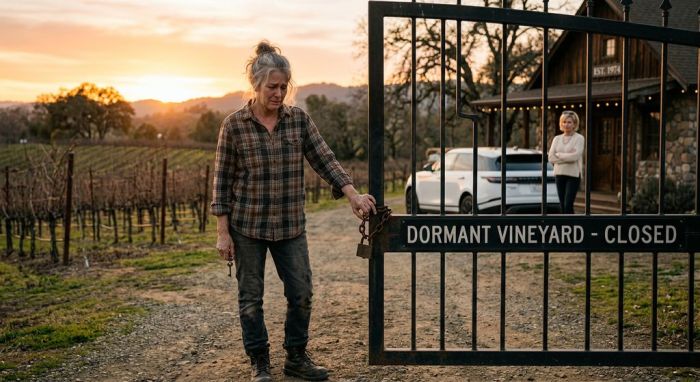
Glenda pulled up in her white Escalade and parked on the crushed rock in front of the tasting room. She didn't wave. She walked up the porch steps, slipped a key into the brand-new deadbolt she'd installed the week before, and let herself into my home like she owned it.
When I reached the porch, she was already behind the bar, pouring herself a glass of the 2019 reserve, the last vintage Jack ever made.
"New locks," I said.
"Security upgrade," she said, not quite looking at me. "Derek's cousin knows a guy. Can't be too careful with all these tastings."
I hadn't hosted a tasting in four months. But arguing with Glenda was like arguing with weather — it never changed anything; it only wore you out.
"Where's Pete?" I asked.
"Pete who?" She smiled that bright, careful smile she'd been wearing since the funeral.
"Pete Alvarez. My foreman. He's been here twenty-five years."
"Oh, Pete." She waved a hand. "I let him go this morning. The vineyard doesn't need three people standing around watching grapes not grow. We're cutting costs while we figure out your future."
"My future," I repeated.
"You've been through something terrible," Glenda said, taking my hands. "But you can't run a business on heartbreak. That's why Derek and I moved down from Fresno."
She had moved into the guest cottage four days after the funeral, and I had been too hollowed out to say no.
"You're not running anything," I said. "This is my vineyard."
"Mmm." She picked up her glass again. "We should talk about that."
That was the moment I should have called my daughter Mara, who had warned me from day one. "Aunt Glenda didn't come to help you, Mom," she'd said from Portland, where she worked as a sommelier. "She came because she smells money."
I had told Mara she was cynical. Now I finally understood that she had been right.
Over the next two weeks, Glenda dismantled my life with the cheerful efficiency of a woman rearranging furniture. She fired Rosa, the college girl who worked weekends. She canceled the wine club shipments. She put a lock on the cellar door, and when I asked for the key, she patted my arm and told me to rest.
Then, on a Tuesday, she brought papers.
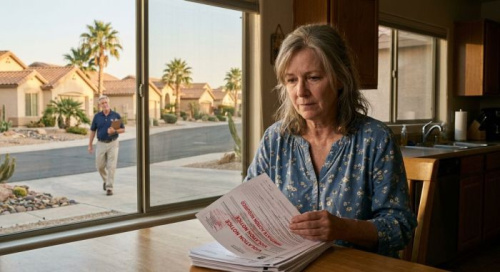
They were thick, and she laid them out on the kitchen table between us like a hand of cards I was supposed to lose.
"Just estate stuff," she said. "The bank needs signatures. The insurance company needs signatures. Sign here, here, and here. Derek will handle the rest."
I was exhausted. I hadn't slept through the night since Jack died. The words all blurred together, and I signed because she was my sister and I was too tired to read.
I never did read them. I will carry that failure for the rest of my life.
Mara drove down from Portland the next morning, six hours without stopping. She read everything on her phone while Glenda was out running errands.
"Mom," she said, her voice shaking, "do you know what you signed? This is a management agreement. It transfers operating control of Carmichael Vineyards LLC to Glenda Whitfield. It says you've been temporarily incapacitated by grief — her exact words — and that she's been appointed manager with full authority to sell, lease, or encumber business assets without your approval."
My heart stopped. "She can't sell my vineyard."
Mara looked at me. "Mom, she already listed it."
The for-sale sign went up the next day, and Hal Mercer, a developer who had been buying up vineyard land for years, came to walk the property with Glenda at his side. "The good news," she announced that night at dinner, "is that we have a serious offer. Four point two million. Hal wants to turn the whole valley into an event venue for tech weddings."
"It's not for sale," I said. "I never agreed to any of this."
"Sweetheart." She set down her fork. "You signed the papers. That's the agreement. And what they say is that I'm in charge until you get better. It's for your own good, Nora. You can't even water the plants without crying."
I couldn't answer, because it was true that I cried at everything.
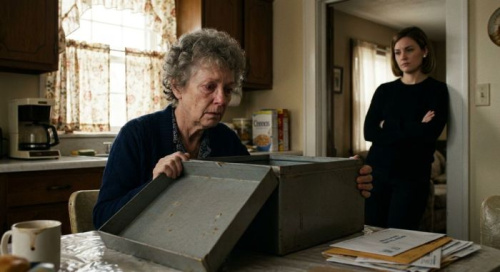
That night, after they'd gone to bed, I walked down to the old cellar office with a flashlight and went to Jack's safe. He'd shown it to me once, tucked behind a false panel of the wine rack. The combination was our anniversary — October 12, 1988. I turned the dial with shaking fingers, and the door opened with a soft click.
Inside there wasn't much. A few thousand dollars in cash. Jack's father's watch. And three envelopes, each in Jack's handwriting, each bearing my name.
The first two were letters he'd written but never given me, about the baby we lost in '91 and about the year the frost took everything. I read them crying against the wine rack, and I felt him so close I could almost smell the oak chips and the cigarettes he'd quit twenty years before.
The third envelope was different. It was sealed with tape, and on the front Jack had written: FOR NORA. OPEN ONLY IF I'M GONE.
Inside there was a document from the county recorder's office, dated eighteen months earlier, transferring the well-water permit for the property into my name alone. There was another document transferring the trademark for the label — the little gold finch on every bottle — into my name as well. And there was a note in Jack's hurried hand:
"Nora, if you're reading this, I'm gone, and I'm sorry. I know what my sister-in-law is. She came to me twice asking to be put on the paperwork. I told her no. These papers are yours, legally yours, no matter what Glenda says. And if she brings you documents, don't sign anything. Call Arthur. I love you. — J"
I read the note three times. Then I reached into the safe again, because a careful man leaves a trail, and taped to the underside of the roof was a USB drive.
I didn't watch it that night. I was too raw. But I took it, and I took the papers, and I did the first clear-headed thing I'd done in four months. I called Arthur Eastman, the lawyer who had handled every legal matter for Carmichael Vineyards since before Mara was born.
"Nora," Arthur said, after I told him everything, "Jack came to see me eighteen months ago. He made me promise that if anything ever happened to him, I'd have a folder ready the moment you called. I've been waiting for this phone call."
The next morning I drove to his dusty office above the hardware store in Healdsburg, and he unlocked a file cabinet with my name on the tab. Inside was a copy of every document I'd found in the safe, plus one I hadn't: a signed and notarized statement from Jack, dated the same week, declaring that he had never authorized my sister or her husband to hold any interest in the business, and that any document purporting to give them control should be treated as a forgery.
"There's more," Arthur said, sliding a second folder across the desk. "Your sister's management agreement was notarized by a woman named Brenda Kilpatrick. I looked her up. She's Derek's cousin. She notarized four documents last year. Three of them are under investigation by the county."
The closing was scheduled for the first Saturday in December, and Glenda decided to make a day of it. She invited the whole town to the tasting room for mimosas and a celebration of the vineyard's new chapter — a chance to say goodbye to the old farm and hello to the future.
I let her plan it. I let her believe she had won.
It was the hardest thing I have ever done, smiling while my sister told the Felice sisters from the feed store that I was doing so much better now. Mara stood beside me, holding my hand so hard my knuckles went white. Pete Alvarez was in the back with his cap in his hands. I'd found him the week before and asked him to come. "You'll want to see this," I'd said.
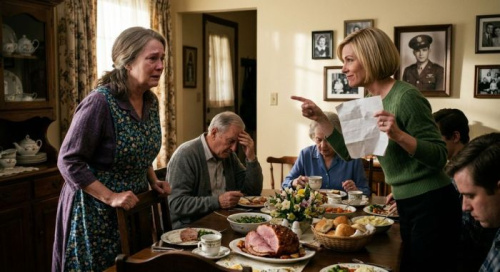
At noon, Hal Mercer arrived with his lawyers, and the room went quiet. Glenda launched into a speech about vision and legacy, and I let her get all the way to the part where she raised her glass to new beginnings before I stood up.
"Actually," I said, "before you toast, I want to show everyone something."
Glenda's glass froze halfway to her lips. "Nora, this isn't the time—"
"It's exactly the time." I held up the county document. "This is a well-water permit for this property, signed over to me eighteen months before Jack died. Without water, this vineyard is a pile of dirt. And the permit isn't in the name of the LLC, and it isn't in yours."
Glenda's smile flickered. "That's a technicality—"
"And this," I said, holding up the trademark registration, "is the label. The little gold finch. That's mine too, personally. You can't bottle a drop of this wine legally without my signature, and I'm not signing anything for Hal Mercer."
Hal Mercer had stopped smiling. He was looking at his lawyers the way men look at life rafts.
"There's more." I held up the notarized statement. "This is my husband's sworn declaration, dated, saying that no one but me was ever authorized to control this business. And this — this is what Jack wanted you all to see."
Mara plugged the USB into the speaker system, and Jack's face filled the big screen above the bar. He was thinner than I remembered, and the tape was grainy, and he was wearing the flannel shirt I'd fished out of the trash because I couldn't part with it.
"If you're watching this, Nora, I'm gone, and I'm sorry," he said. "But I need everyone in that room to know something. My sister-in-law Glenda has asked me twice to put her in the family business. Twice I said no. If she ever tells you I wanted her in charge, she's lying. The vineyard belongs to Nora. Everything belongs to Nora. And anyone who tries to take it from her is a thief, and they'll answer to God and the county prosecutor."
For a long moment, nobody moved.
Then Hal Mercer stood up, straightened his jacket, and said, "I think we're done here." He and his lawyers were out the door in under a minute, and the room was silent except for Glenda, who was still standing at the front with her glass in her hand.
"No, Glenda," I said. "It was never your vineyard. And it's not for sale."
Derek was at the door by then, on the phone, arguing about the bridge loan he'd taken out against the business — the one he'd told the bank he could secure with collateral he didn't own. He didn't get very far. Two deputies came through the door at three in the afternoon, and they didn't leave.
It turned out Brenda Kilpatrick, the cousin-notary, had already confessed when the county started asking questions. Derek had paid her two hundred dollars to stamp the management agreement, and she'd kept the payment record. The district attorney had enough for forgery and attempted grand theft before the mimosas even went flat.
They arrested Glenda and Derek right there, in front of half the valley. Glenda looked at me as they cuffed her, and for one second I thought she might say something real. Instead she said, "You'll regret this, Nora."
I didn't answer. There was nothing to answer. She had spent four months trying to take the one thing Jack and I had built with our hands, and in the end, all it had cost me was paperwork and heartbreak, and all it had cost her was everything.
I sold the Escalade she'd left in the driveway and put the money into Rosa's college fund. It felt like the closest thing to justice I could hand out with a clear conscience.
The charges stuck. The management agreement was voided because of the fraudulent notarization, the sale collapsed, and the bank came after the house in Fresno that Derek had used as collateral. By spring, Glenda and Derek were living with his mother in Bakersfield, and her name had become a cautionary tale in Dry Creek Valley.
We harvested that fall, Pete and Mara and I, with half the town turning out to help, and the grapes were the best since Jack's last year. I renamed the reserve wine "Jack's Last Vintage," and beneath the little gold finch on the label I added a line: "The vineyard belongs to those who tend it."
Mara moved home in July, not because she had to, but because she wanted to, and she talks about taking over the tasting room when I'm ready to hand it over — which, I've learned, is the only way to give anything away. Freely, with both eyes open, to someone who loves it.
Sometimes, on cold November mornings, I still go out to row fourteen with my pruning shears. And yes, I still talk to the vines. I tell them about Mara, and about the harvest, and about the strange, bright fact that I am still here, and the vineyard is still here, and Jack's last vintage sold out in eleven days.
I think he would have liked that. I think he would have laughed and said, "That's my girl."
He was a careful man. And he left me the only thing that mattered: a way to win without ever becoming like them.