The Sunday service had barely reached the announcements when Pastor Grant Hollis set down his sermon notes and looked out at the congregation with a face I had never seen in three years. "The Lord's work is missing eighteen thousand dollars," he said, "and it grieves me to tell you I know exactly who took it." The church went quiet enough to hear a page turn. Then every head in the room swung toward the second row, where I sat with a crayon drawing of a sun in my lap. He didn't call my name. He didn't have to.
My name is Ruth Calloway. I am sixty-three years old, and for thirty-one years I kept the books for the little food pantry my husband Earl built behind the church with lumber we bought on sale. Earl was a plumber with calloused hands and a kind heart, and the pantry was his whole life after he retired. When he passed four years ago, the pantry became the only thing that still felt like him. Pastor Hollis arrived about a year after the funeral, young and polished and full of ideas, and he told me he wanted to carry on Earl's legacy with every bit of his heart.
For a long time, I trusted him completely. When he said the pantry should be folded into the church's general account so it could grow under one roof, I agreed, even though it meant giving up the little blue checkbook room Earl and I had guarded for decades. When he suggested the board hire his brother-in-law, a man named Kyle from Tulsa, as an "operations consultant," I told myself it was generous of him to help family. I was lonely in my widowhood, and Grant was kind in a way that filled the empty chair across from me at dinner. He remembered Earl with a reverence that made me cry into my napkin. He brought me a casserole and a stack of get-well cards after my hip surgery, and I wept over the crust.
The first knot in my stomach came on a Tuesday in October. A woman from the Methodist church down the street delivered a check for two thousand dollars made out to "Earl's Pantry," the way it had always been written since 1994. I made a copy in my old red receipt book, the way Earl taught me, and placed the original in the deposit basket. A month later, I asked Grant about it, and he smiled at me with that warm fatherly patience and said the money had been diverted to an emergency fund for a family whose house had burned down. He said he had meant to tell me, but the family had needed it quietly. It was such a good, Christian excuse that I felt ashamed for asking a second question.
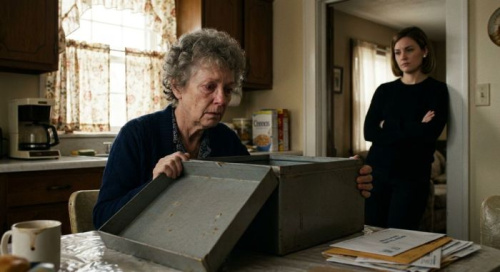
The second knot came in January, when the Deacon Board voted to move me out of the treasurer's seat into a role Grant called "pantry associate," a title that meant I still did all the work but no longer touched the books. Brenda, the church secretary, took over the ledgers with a cheerful, nervous energy I now recognize as fear that had been there all along. Earl's red receipt book went into a cardboard box in my hall closet. I couldn't bring myself to throw it away.
That spring, everything came apart. A big donor from Lufkin called the church office to ask why his five-thousand-dollar check had never been cashed. Grant told me, gently, that the man was getting older and had probably imagined the whole thing. I drove to the man's farm myself, forty miles of cracked highway, and watched him pull the very check from his own desk drawer, unmailed, because Pastor Hollis had told him the pantry no longer needed checks and cash would be better from now on. My hands shook on the steering wheel all the way home.
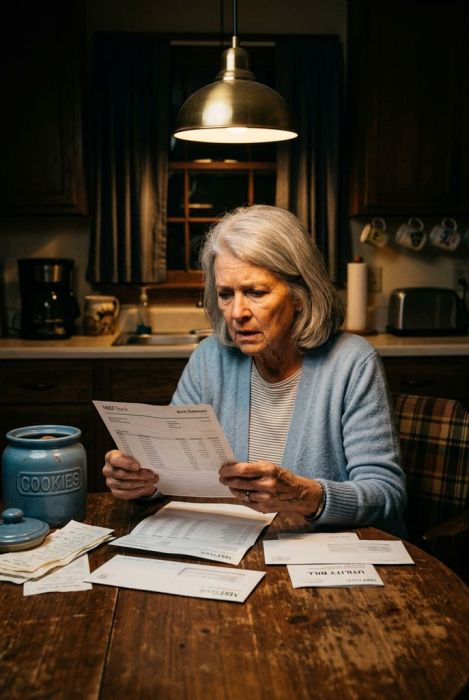
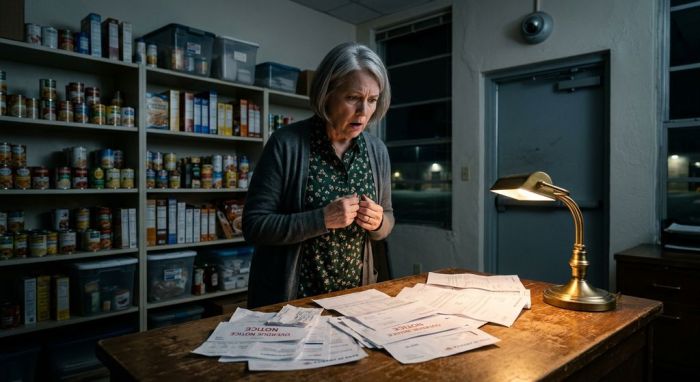
I started quietly comparing records that night. The church's new computer software showed seventeen thousand dollars in pantry donations for the year. My old red receipt book, the one nobody ever looked at, showed thirty-five. Eighteen thousand dollars had vanished somewhere between my copies and the official books. I sat at my kitchen table until two in the morning with those receipts spread out like a losing hand of cards, and I cried harder than I had at Earl's funeral, because I finally understood what was happening and I was the only one who could see it.
The framing came fast after that. Brenda found a manila envelope stuffed with cash in my desk drawer in the pantry office, cash I had never laid eyes on, and she carried it to the board in tears. Grant called a special meeting and suggested, in his kindest voice, that perhaps grief had caused me to mix up funds, that maybe I had taken money without meaning to. My own deacons, men I had broken bread with for three decades, looked at the floor. Nobody called me a thief to my face that night. They simply voted to let Pastor Hollis handle the matter quietly.
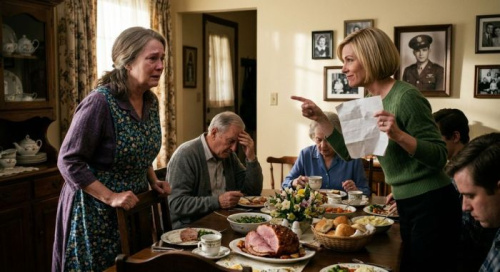
Then came the Sunday I will count for the rest of my life. Grant stood in the pulpit, opened his Bible, and preached a long sermon about the servant who betrayed his master, winding his way slowly toward the announcement that the church's audit had uncovered a serious problem that he had bravely uncovered. His voice cracked with practiced humility. He painted himself as the shepherd who had tracked down the wolf in his own flock. By the time he spoke my name, half the congregation was already looking at me like I had cursed their children. My son Troy sat beside me, white as chalk, gripping the pew in front of him. In the parking lot afterward, an old friend of Earl's crossed the street to avoid my eyes.
I knew then that I had two choices. I could fade away quietly, the way they all expected, and let Earl's pantry die with my name on it. Or I could remember the second thing Earl had installed after the pantry break-in of 2008: a small, ugly security camera bolted to the wall above the back door, its wires running down into the boiler room, where the old DVR recorder had sat on a metal shelf collecting dust for a decade. Everybody in the church had forgotten it by 2015. The new alarm company had even written it off as dead in their inspection report.
Earl had shown me how to work that camera once, laughing that his wife ought to know how the little eye worked in case she ever needed to. I let myself into the church that night with my own key, the one Earl had given me in 1987 when he and I were the only two people who opened the pantry before sunrise. The DVR was still on that shelf. Still plugged in. Still recording, night after night, year after year. I did not sleep for the next four nights. I sat in front of the little gray screen and fast-forwarded through years of dust and moths until I found what I needed: Kyle, unlocking the pantry safe at 11:47 on a Tuesday with a key nobody had ever given him. Grant, holding the Sunday collection bag while Kyle counted bills in the light of the utility sink. And the sweetest footage of all, Grant himself, alone, tucking envelopes into a black gym bag and driving off toward the bank on the edge of town.
I did not storm anywhere with it. I am sixty-three years old, and I have learned that the best revenge is a paper trail. I pulled the drive from that old DVR, transferred everything to my laptop, and made four copies. One went into my safety deposit box at the Cypress Bend Savings Bank. One went to Detective Anna Reyes of the Cypress Bend Police Department, a patient woman who listened to me with the hungry look of somebody who had been waiting years for a man like Grant to slip. One went to the district attorney's office. And the fourth I kept in my purse, right beside my lipstick, where I could feel the corner of it every time I left the house.
Grant knew none of this when he called a special family meeting of the church to formally remove me as pantry associate and announce the launch of his new Family Life Center, a building project he said the restored funds would finally make possible. He stood at the front of the fellowship hall in his best suit, Kyle at his elbow, and asked the congregation to join him in a prayer of thanksgiving before the vote. I stood up in the second row, the exact place where I had been sitting when he ruined me, and I said, "Before we pray, Pastor, I think the board should watch something first."
Brenda tried to stop me. My son Troy grabbed my sleeve and whispered, "Mom, please, not here." But Detective Reyes was already walking in through the fellowship hall's back door, and behind her came two patrol officers and a white-haired bank investigator all the way from Tulsa. I plugged my laptop into the old projector the youth group used for movie nights. The room went dark. Then the whole church, every deacon, every widow, every man who had studied the floor during my humiliation, watched Grant Hollis count hundreds on his brother-in-law's kitchen table while the date and time scrolled across the bottom of the screen.
The silence that followed was the loudest thing I have ever heard in my life. Grant's face went the color of graham crackers. Kyle bolted for the side door and ran straight into an officer who had been waiting there the whole time. Brenda burst into tears and confessed that Grant had told her exactly which drawer to put the envelope in, and that her reward was a promise that God would bless her loyalty. Detective Reyes read Grant his rights in the middle of the fellowship hall while the deacons stood around him looking like men who had just bitten into spoiled milk.
The money, as it turned out, had never really left town. Half of it sat in a brand-new account under a company called Grace Fields LLC, and Grace Fields had already put a down payment on the twenty acres where the Family Life Center was supposed to rise. The other half was in Tulsa, tangled in Kyle's name and a very interesting tower of gift cards. The district attorney charged them both with theft, fraud, and falsifying business records. The state pastors' board revoked Grant's credentials. And his previous church in Oklahoma, the one that had quietly let him go so he could pursue a new calling, reopened its own audit the following week and found forty thousand dollars in missing building funds, which they cheerfully said they would be forwarding to our district attorney as well.
The church did not die, the way I had feared it would. It did something braver. The board met, and then the congregation met, and they voted, all of them, to ask me to lead the pantry again, this time with my name on the checks instead of my grief. An old carpenter from the Men's Bible Study put a new roof on the pantry that summer and refused to take a dime. The woman from the Methodist church, the one whose two-thousand-dollar check had disappeared, drove over with five thousand dollars in Earl's name. And my son Troy, who had begged me to keep quiet to save myself, came to my kitchen one Saturday with his own grown children and helped me relabel every shelf in the place.
They asked me, at the end of it all, what I wanted to do with the little brass plaque that had come loose from the pantry door during the chaos. I had it re-machined to read exactly what it read when Earl hung it in 1994. And above the door, where the old gray camera still hangs, I had a brand-new one installed, small and white and modern, with a little blue light that blinks at night. Most of the deacons thought it was for security, and it is. But Earl would have understood the other reason. Cameras don't lie. And neither, finally, did I.