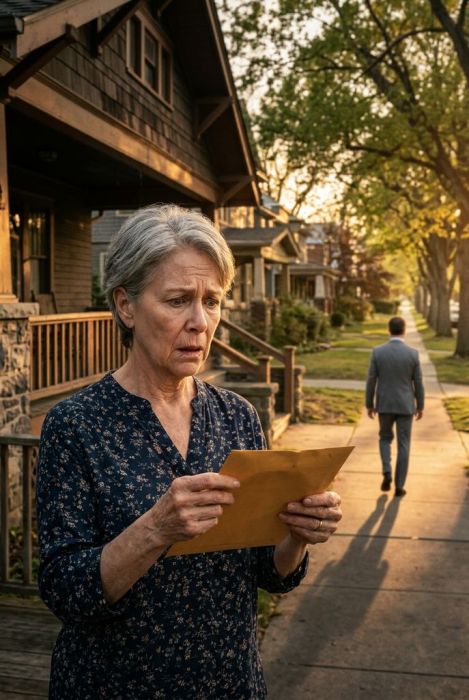
The envelope was the kind that makes your stomach drop before you even open it. Thin. Official. Polk County seal printed in the corner. I was sorting store coupons at the kitchen table, the way I did every Tuesday morning, when the mail slid through the slot and landed on the mat with a soft thud. Inside was one page that turned my whole world upside down: a recorded quitclaim deed, transferring 2124 Elm Street from Margaret R. Calloway to something called Creekside Development LLC, for ten dollars and other good and valuable consideration.
I read it three times. Then a fourth. My hands shook so bad I had to set the paper down on the table and press my palms flat. I had never signed anything. I had never sold my house. And yet there it was, stamped and time-dated by the recorder's office, as official as a birth certificate.
That house was my whole life. Jack and I bought it from my parents in 1979, the year our first daughter was born. My folks had bought it in 1962 with nothing but grit and a VA loan, and they raised five kids in three small bedrooms. Jack and I raised two more. Same creaky stairs. Same oak tree out front that dropped enough leaves to fill a pickup truck every autumn. When Jack died five years ago — a heart attack at his desk at the bank, just like that — the house was what kept me standing. It was the last place I could still hear his voice, see his hand on the banister, feel him in the warmth of the radiator in the hallway. I told my kids more than once: they would carry me out of 2124 Elm before I would ever leave on my own.
The trouble started last spring, when a man named Curtis Boone started buying up properties in my neighborhood. He was one of those smooth-talking investors in expensive shoes who parks his silver car two blocks away so nobody sees him coming. He knocked on my door in April and introduced himself with a smile full of teeth, and he offered me two hundred and ten thousand dollars for the house. I thanked him and said no. He came back in June with two-forty. I said no again. He came back in September with two-seventy-five and a story about a once-in-a-lifetime opportunity, and how I should be thinking about my golden years.
I told him my golden years were just fine right where I was.
He smiled at me then — that smile I had come to dislike — and said, "There's always another way, Mrs. Calloway. Always." I figured he meant he would keep raising his offer, or maybe he would find another house on the block. I did not figure he meant a forged deed with a fake notary stamp.
The first real sign should have been the For Sale sign. But it did not have my address on it. It was two streets over, on the corner of a weedy lot Curtis had bought, and I remember thinking, well, at least he found somewhere else to put his money. What I did not notice was the man with the clipboard who stood across the street from my house one Tuesday afternoon, taking pictures of the porch, the windows, the garage. I did not notice because I was busy pulling weeds in the garden, same as always. My eyesight is not what it used to be.
I only found out the truth because of a tax bill. A letter came from the county assessor addressed to Creekside Development LLC, care of a post office box in West Des Moines, asking why the property taxes on 2124 Elm had not been paid. Property taxes. On my house. That I had been paying for forty-three years.
The morning after that letter, I called the Polk County Recorder's office and got a woman named Gloria. I expected her to say there had been a mistake, a clerical error, something fixable with a phone call. Instead, she went quiet for a long moment, and when she spoke again, her voice had that careful, gentle tone people use when they are about to tell you something awful.
"Mrs. Calloway," she said, "the deed was recorded seven days ago. It's stamped, indexed, and filed. It lists you as the grantor."
"Then it's a forgery," I said. "Because I was at the St. Ambrose annual bazaar that day. I spent eight hours in the pie booth. Forty women saw me there."
Gloria let out a breath. "That's going to help you more than you know, ma'am. This is deed fraud. It happens more than people think — they lift your name off the county website, forge the signature, get a crooked notary to stamp it, and file it before you even look at your mail."
She gave me the name of the notary. Doreen Platt. A name I had never heard. She gave me the name of an attorney who handled title fraud cases pro bono for seniors. And she told me to keep every piece of paper, lock every door, and not to be surprised if the people behind the deed came knocking.
They did. Three days later.
It was not Curtis Boone who knocked, not at first. It was a young man in a polo shirt who said he represented Creekside Development and that they were prepared to be generous. He handed me a typed letter offering me thirty days to vacate the premises and five thousand dollars in relocation assistance if I signed their paperwork quietly. Five thousand dollars. For a house I had lived in for forty-three years. I told him to get off my porch, and I said it in the voice my fourth-grade students knew very well.
Then, that evening, Curtis Boone himself came by. He stood on my porch in the rain without an umbrella, and he looked almost sorry. Almost.
"See, Mrs. Calloway," he said, "this is why I keep telling you there's always a way. Now you can take the five grand and leave with some dignity, or you can fight me in court and lose your house and your savings on lawyers. Your choice."
I closed the door in his face. Then I called my daughter Carol.
Carol is a real estate paralegal in West Des Moines. She works with deeds and titles all day, and she is sharp as a tack. She was at my kitchen table within the hour with her laptop and a stack of files, and she did what nobody from the county had done yet: she ran the full chain of title on 2124 Elm.
That is when the pieces started to fall into place. First, Carol found the homestead affidavit my husband Jack had recorded back in 1987 — a single page in the miscellaneous records stating that 2124 Elm Street was the primary, continuous residence of Jack and Margaret Calloway. "Dad was a banker," Carol said. "He knew how easy it is to steal a house with a forged signature. He filed this the year the state passed the new homestead laws. It's a public declaration — any title company that does a proper search would have tripped right over it."
Second, she pulled up our original purchase papers from 1979. Jack, being who he was, had paid extra for an owner's title insurance policy with extended coverage — the kind that includes fraud protection. "This policy is still in force," Carol said, reading the fine print with a smile I had not seen on her face in years. "The title company is on the hook. And more than that — it means the title company is going to be very, very motivated to investigate who did this."
And third, the one that made us both start laughing — laughing, of all things. Carol pulled up the forged deed on the county website and zoomed in on the signature line. It read, in a careful, flowing script: Margaret Calloway.
"My whole life," I said, "my husband made me sign as M. R. Calloway. Every deed, every mortgage, every tax form, every bank document for forty-three years. He said initials looked more dignified on a banker's wife."
"Internet crooks copy what they see online," Carol said. "And there is not a single public document in this county with your full name on it. He signed your name the way a stranger would, not the way you have signed it forty years running."
Doreen Platt, the notary, had stamped the forgery on a Tuesday at 2:15 in the afternoon — the exact hour I was standing in the St. Ambrose parish hall, up to my elbows in pie crust, surrounded by forty women who would swear to it in any court in Iowa.
Carol called the title company the next morning. Within a week, a fraud investigator named Rick Harmon was sitting in my living room with a recorder and a notepad, and within a month, the Polk County Sheriff's Office had opened a case. They did not tell me everything, but they told me enough: Curtis Boone had done this before. At least two houses in Ankeny, one in Grimes. He would forge the deed, file it, sell the property to a shell company he controlled, then approach the real owner with a cash-for-keys letter, betting they would rather take a few thousand dollars than fight a legal battle. Most people folded. He was a professional at preying on the exhausted.
The arrest happened at a title company office on the west side of Des Moines on a gray November morning. I was not supposed to be there, but Rick Harmon said I should be. "You deserve to see it," he said, and he was right.
Curtis Boone walked in at ten o'clock wearing a nice dark suit, ready to sign the final assignment of 2124 Elm to a buyer — a buyer who turned out to be an undercover investigator with a briefcase wired for sound. Curtis was all charm, shaking hands, telling jokes, explaining how he had helped an elderly lady out of a burdensome property. And then the conference room door opened, and two detectives walked in, and Doreen Platt — the notary who had stamped his forgeries — was standing in the hallway in handcuffs, crying.
"She already told us everything," one of the detectives said. "So you can save us both the paperwork."
I will never forget the look on Curtis Boone's face. It was not rage. It was pure, blank surprise — the surprise of a man who had gotten away with something for so long that he had stopped believing he could ever be caught. He looked at me, sitting in the corner in my good coat, and for one second, that smile of his flickered and died.
"Hello, Curtis," I said. "I told you there's always a way."
He pleaded guilty six weeks later to felony forgery, identity theft, and first-degree theft by deception. The judge gave him ten years, with a recommendation that he serve most of it. Doreen Platt lost her notary license and took a plea deal that put her on probation for five years — she will be paying restitution to her victims for the rest of her working life. The fraudulent deed on my house was voided by court order at a hearing that lasted exactly eleven minutes. The judge apologized to me for the trouble. I told him it was not his fault — that kind of trouble finds you whether you are looking for it or not.
What surprised me was not the conviction. It was the other victims. Three families — two in Ankeny and one in Grimes — came forward after Curtis's arrest made the news. They had each been cheated out of their homes the same way, worn down by a system that makes fighting a forgery harder than falling for one. They formed a little support group, and now they call me the general. We meet once a month at the library to talk about title fraud, mortgage scams, notary tricks. The county even asked me to speak at a senior safety seminar.
The neighbors got together the Saturday after the hearing and threw me a block party. For Sale signs do not scare us anymore. We made a neighborhood watch that actually watches, and Gloria from the recorder's office came with a stack of pamphlets about how to file your own homestead affidavit — free, twenty minutes, and it puts a brick wall between your front door and the forgers.
I am still at 2124 Elm Street. I sit on the porch most evenings with a glass of iced tea, watching the oak tree drop its leaves, and I think about Jack. For forty-three years, I thought his insistence on M. R. was just an old banker's quirk — something to roll my eyes at when I filled out a form. I never imagined that quirk was the thing that saved me. That the name a stranger wrote on a forged deed — Margaret, in full, pretty and wrong — would be the detail that unmade him.
People ask me if I am angry. I am not. Anger is heavy, and I have lived long enough to know you do not carry what you do not have to. I am grateful, mostly. Grateful for a husband who filed paperwork nobody reads. Grateful for a daughter who knows where to look. Grateful for forty women in a pie booth who will swear until their dying day that I was there.
The house is mine. Nobody gets to take that from me again. And if you own your home outright and you have not filed your homestead affidavit yet — do it this week. It takes twenty minutes. It could save you forty-three years of memories.