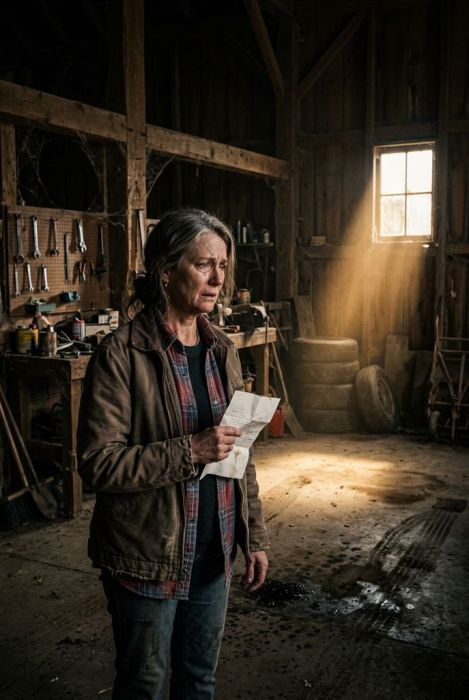
The first time I walked into Dad's barn after the funeral, I counted the cars the way a mother counts her children. Six of them. The '57 Chevy Bel Air under the tarp. The '67 Mustang fastback by the window, the one Dad had been saving for Danny. The old C-10 pickup nobody wanted. Three others I barely knew by name.
Eight months later, I counted again. Four.
"Relax, Aunt Ruth," Brandon said, wiping grease off his hands like he owned the place. "I've been keeping an eye on things for you. Battery tenders, tires, all that."
I should have asked where the other two went right then. I didn't. That's the part that still keeps me up some nights — how easy it is to trust the people you love, even when your gut is screaming.
Dad built the barn with his own hands in 1974. I grew up with the smell of motor oil and the sound of him whistling off-key while he worked. He was a mechanic's mechanic, the kind of man who could hear a bad bearing from across the street.
But his real heart was in the cars. He bought the Mustang in 1986 from a widow who didn't know what she had, paid her twelve hundred dollars, and handed her two thousand instead because "that's what it's worth, ma'am." He bought the Chevy in 1992 at an auction in Cincinnati, outbid three dealers, and drove it home grinning.
"These cars are going to be something," he used to tell me. "They're going to put Danny through college, or buy him a house someday. You mark my words, Ruthie."
Danny was nine then. He'd sit on a milk crate in the barn while Dad handed him a wrench and told him the story of every bolt. I think that barn raised him almost as much as I did.
Mom passed ten years ago, and Dad changed after that. He kept the shop open and kept restoring cars, but he talked less. He started writing everything down. "A man's word is only as good as his paper," he'd say, tapping his temple. "That's why I put things in writing."
I found a box of those notes after he died. Grocery lists. Oil change schedules. A letter he never sent to his brother in Arizona. And under all of it, a folded piece of paper: "If anything happens to me — barn, cars, tools, all of it — Ruthie. She knows what to do."
She knows what to do. I held that note at his funeral while Diane sobbed into a handkerchief that cost more than my whole dress, and I thought: what a strange thing for a father to leave his daughter. Not the cars. Not the money. A responsibility.
Brandon is Diane's boy. He was nineteen when Dad died, and he'd spent every summer of his life in that barn, sweeping floors, fetching tools, being the grandson Dad never had in Danny. Danny was gone so much with the Navy that Brandon filled the space. I loved him for it. I think we all did.
So when Brandon said he'd "look after" the barn, I said thank you. When he said he'd sell a few tools to cover the property taxes, I said sure. When he said the '68 Firebird had been sold years ago while Dad was sick, I believed him. Dad's memory had been slipping at the end. It was easier to believe that than the alternative.
The first crack came in April, at Kowalski's Auto Parts. Old Mr. Kowalski — Dad's best friend since high school — pulled me aside by the spark plugs.
"Ruthie," he said, "I don't mean to poke my nose in your business. But I saw something last week on one of those car auction websites. A '67 Mustang fastback, silver-blue. Looked an awful lot like your daddy's car."
"Dad's car is in the barn," I said. "Probably. Brandon was there Sunday."
Mr. Kowalski looked at me funny. "Honey, I've been in this business since 1961. I know that car. I know the dent in the rear quarter panel from where your mama backed into the fence post in '87. That car's been listed for two weeks. Two hundred and forty thousand dollars."
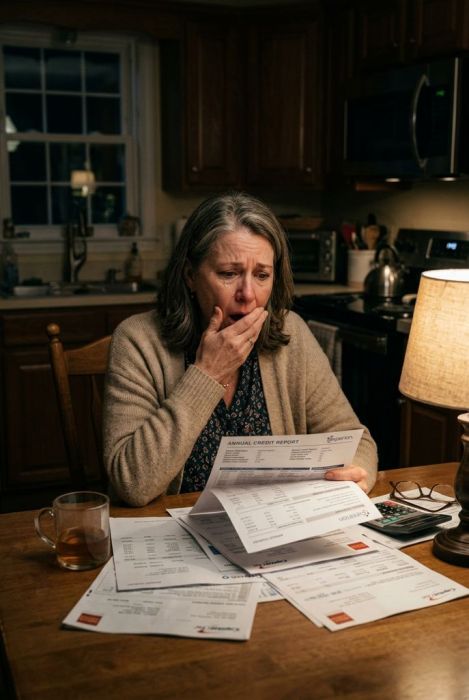
I didn't sleep that night. I kept thinking about the way Brandon smiled when I thanked him for watching the barn. I kept thinking about a receipt I'd found in the shop office — three thousand dollars for a "detailing setup," dated a month after Dad's funeral.
I drove out to the barn the next morning without calling anyone. The door was padlocked — Brandon had added a lock "for security," he'd said. He had a key. I never asked for one.
I should have asked for a key.
I crawled through the side window, the one Dad never fixed, the one with a squirrel's nest in the frame. The air was cold and stale. I did the count again, slower this time.
Four cars left. The Mustang was gone. The Chevy was gone. And the C-10, Dad's old workhorse that nobody ever wanted, was sitting exactly where it had always been, dusty, sagging, ignored. The tarp over it was new. Brandon had put a new tarp on the one car he didn't bother to sell.
That's what broke something open in me. A new tarp on the junk truck. He'd spent money to protect the one thing that meant nothing, so nobody would notice the two cars that meant everything.
I found the listings on my phone right there in the barn, kneeling on the cold concrete. The Mustang, listed by a dealer in Columbus called "Classic Dreams Ohio." The Chevy, listed two weeks later by the same man: "Barn find, no title, sold as-is." Sold as-is. The words looked like they were written in blood.
No title. No title at all. Dad told me a hundred times: a man's word is only as good as his paper. And Brandon had sold Dad's cars with no paper. Which meant somewhere — somewhere in this barn — the paper still existed.
Dad was paranoid about titles. He kept them in a fireproof box in the shop office, but the box was gone, emptied by someone. So I started looking the way Dad would have looked. Under the workbench. Behind the pegboard. In the coffee can of old bolts. In the doors of the cars themselves — Dad loved hiding things in door panels, once finding a thousand dollars in a '52 Packard he bought for scrap.
I checked the station wagon. The pickup. And I checked the C-10 last, because it was the least likely. The bench seat was torn, foam pushing through the vinyl like stuffing in a worn doll. I ran my hand along the frame under the seat. And I felt it.
A manila envelope, taped to the seat springs. Yellowed tape, the kind Dad used for everything. My hands were shaking so badly I almost couldn't get it open.
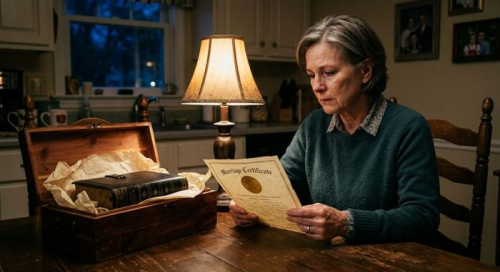
Inside: two titles. The Mustang, clean and clear, dated two years before Dad died. The owner box had my name on it. Ruth Anne Hartley. Dad had registered the Mustang to me quietly, legally, with a notary's stamp — and never told a soul.
Under it, a letter in Dad's careful handwriting: "Ruthie. If you're reading this, I'm gone, and I'm sorry I made you find it this way. The Mustang is yours. It always was. I signed it over the day I heard the cancer was back, because I didn't want lawyers or anyone else in my girls' business. Danny gets the Chevy when he comes home. The title's with the Harley-Davidson stuff in the garage. Don't let anybody tell you different. You know what to do. You always did. — Dad"
I sat on the floor of that barn and cried like a child. Not for the money. Not even for the cars. For the terrible unfairness that the last thing my father left me was a problem he trusted me to fix — and that the fix would break his other grandchild in half.
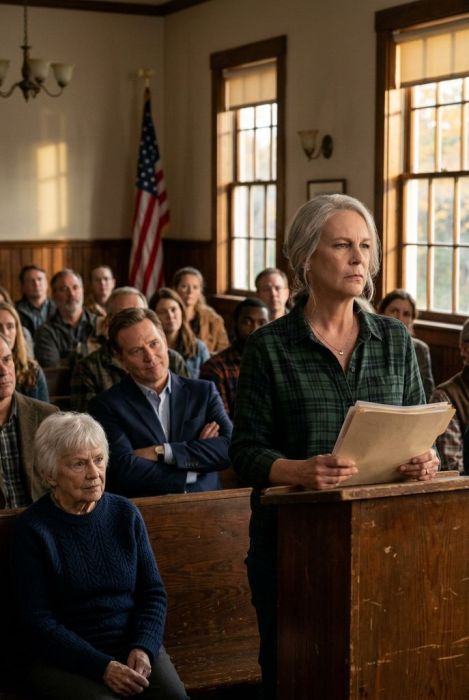
I went to Mr. Kowalski first. Then I went to the county recorder's office and paid forty dollars for title records dating back a decade. Then I called a lawyer, and then, because I was raised to believe the truth will out, I called the sheriff's office. A deputy named Frank Osgood listened to me talk for thirty minutes without interrupting once.
What happened next took weeks. Kowalski helped me find the dealer, a man named Mike Salazar who ran Classic Dreams Ohio out of a showroom in Columbus. And this is where the story turns, because Mike Salazar turned out to be an honest man in a crooked trade.
"I bought that Mustang in good faith," he told me when I showed up with the title and Dad's letter. "Cash. No questions. The kid sold it to me for sixty-five grand with a story about his grandmother needing surgery." He studied the title, then studied me. "Sixty-five thousand. For a car like that. I knew it was too cheap. I knew it."
The Chevy had been spotted at a classic-car auction in Indianapolis. Brandon had been selling it off in pieces — engine, transmission, interior — before a collector who'd bought the shell put two and two together after Kowalski called him. The internet is a small town when it wants to be.
But I didn't have proof that Brandon had lied to me. I had proof about the cars, but not about the boy. And that's where the barn itself finally spoke up.
Deputy Osgood asked me to leave everything in place and let the barn sit untouched. A week later, I got a call. "Mrs. Hartley," he said, "you need to come out here. And maybe bring a friend."
The barn was full of deputies. Brandon was there, hands cuffed behind his back, his face white as paper. On the workbench lay the fireproof box — the one I thought was gone — its lid open, its lock popped. Inside, next to a stack of bills he'd meant to hide, was everything he'd been hunting for and never found: Dad's original notarized bill of sale for the Chevy, made out to Danny Hartley, signed and dated three years before Dad got sick. And a second letter, tucked in the same envelope Dad had labeled "Harley stuff."
Brandon, it turned out, had panicked when he heard I was asking questions. He'd come to the barn to find the titles himself — to destroy them before anyone could. He'd pulled the box from its hiding spot behind the pegboard, dumped it open, and was standing there holding the proof of his own lie when the sheriff's department arrived.
"Set it down slowly, son," Deputy Osgood said on the recording later. "You did enough damage."
The charges were grand theft and forgery. The crumpled notes Brandon had shown me, the ones claiming Dad "gave" him the cars, had been typed on Dad's old letterhead and signed with a hand-copied signature. The county prosecutor called it the cleanest paper trail a family member had dug up in twenty years.
Diane's phone call came the night of the arrest. She screamed at me for twenty minutes, called me every name a sister can call a sister, told me I'd ruined her son over "a couple of old cars." I let her finish. Then I told her about the letter in the envelope, the one Dad wrote for Danny, the one that said the Chevy was waiting for him to come home.
"He wasn't stealing from me, Diane," I said. "He was stealing from a boy who never once missed a summer on a milk crate in that barn. He was stealing from Dad's word. And a man's word is only as good as his paper."
The dealership gave back the Mustang without a fight. Mike Salazar even covered the delivery trucking cost and drove it down himself, and I'll never forget the look on his face when he handed me the keys: not a salesman's look. A witness's.
The Chevy took longer. Seventy percent of it came home in boxes, crated by collectors who'd heard the story and wanted no part of a stolen car. Danny's Chevy, they called it. The rest came home in pieces, one crate at a time.
Danny came home in August. He hugged me at the airport, then drove straight to the barn in the same beat-up rental car, walked past the C-10, and stood in front of the bare space where the Mustang used to be. He didn't say anything for a long time.
"My granddad," he finally said, "was the smartest man I ever knew."
Brandon took a plea deal. Five years suspended with probation, plus restitution — the full appraised value of the cars, determined by an appraiser who choked up describing Dad's work. He'll be paying for his grandmother's "surgery" a long, long time. Diane stopped speaking to me. That still hurts, and I'm honest enough to say so. But my father's word meant more than her silence.
The barn got a new sign last fall: "Hartley's Garage — Est. 1974." Danny quit the fleet, moved home, and took over the restoration work. We spent the winter rebuilding the Chevy's interior from the boxes that came home, him telling me stories about ships and ports while I handed him wrenches in the same cold air my father loved.
The Mustang — mine, Dad's, ours — starts on the first try every time. Sometimes, late in the evening, I sit in the driver's seat with the garage door open and the engine idling, and I swear I can hear him: off-key whistling, a hand tapping the fender, a voice saying, "You know what to do. You always did."
He was right. I did. And I'd do it again, for Danny, for the barn, for every boy who comes home to find that the people he trusted with his legacy weren't worthy of it — because the people who were worthy are still standing there, keys in hand, ready to start the engine.