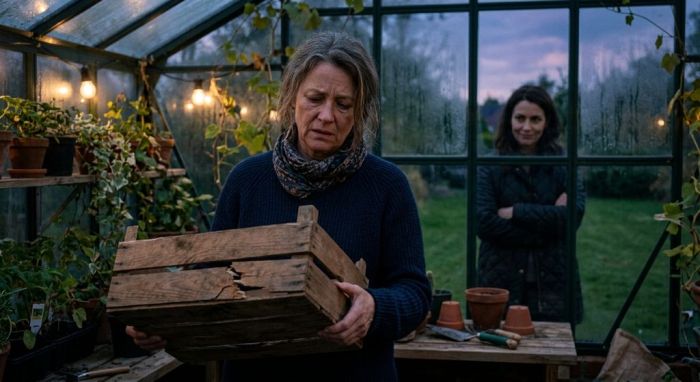
The first time I noticed something was wrong, I blamed the weather.
One morning in early May, I walked out to the greenhouse that sat at the back of my property and found the sprinkler line slashed. Water was still gushing into the gravel, pooling around my most precious rows of peonies, the ones I had babied for three years until their buds were fat as my fist. I knelt there in my oldest sweater, my knees sinking into the mud, and I told myself a raccoon had done it. A hungry raccoon, frustrated and determined. It had to be.
I have run Halloway Blooms out of my home for fourteen years. It is a small thing, a flower shop that lives inside a converted garage and spills out into that greenhouse and two tidy rows of raised beds. I grow exotic varieties you cannot find at the grocery store. Freckled lisianthus, coral-peach garden roses, peonies in shades of blush that brides drive two counties to see. It keeps the lights on since my Joe passed four years ago. More than that, it keeps me going. Every order feels like proof that I still have something to offer the world, even now.
So I fixed the sprinkler line with my own hands, the way I fix most things now. I vacuumed the flooded gravel, tightened the fittings, and I did not think about it again until the following Tuesday.
That was when the health inspector knocked on my door.
She introduced herself as a cheerful young woman with a clipboard and a badge, and she apologized the whole time she walked my rows. "I'm sorry to do this, ma'am, but we had a complaint," she said. "Someone says you've been storing chemicals near your cut-flower prep area. Improper labeling, that kind of thing."
I nearly laughed. "I don't use chemicals," I told her. "I haven't sprayed anything stronger than neem oil in eight years. You're welcome to look at every single one of my labels."
She looked. She found nothing, of course, because there was nothing to find. My shed was tidy, my labels were clear, and my shop had passed every inspection I had ever had. She scribbled a note, apologized again, and told me these anonymous complaints were common and usually nothing.
"Usually nothing," she said. And she drove away, and I almost let it go.
But I have learned, in fifty-six years on this earth, that instinct is rarely wrong. So the night after that inspector left, I stood at my kitchen window with a cup of cold coffee and I watched the house next door.
Marsha Whitfield. She had moved in two years ago with her husband, a quiet accountant named Ray who waved at me every morning and never learned my name. Marsha was a different kind of neighbor. She was brisk and polished, with sharp eyes that lingered a beat too long on my greenhouse, on the wedding flowers I hauled down my driveway, on the steady parade of customers who kept my little business alive.
It had been Marsha who, six months in, had come over with a plate of store-bought cookies and asked, "So you just sell flowers from your home? Is that really enough to live on?" There was something in the way she said it, something that was not quite a compliment.
And now, standing at my window, I watched her step out onto her back porch in that beige cardigan she always wore, phone pressed to her ear, pacing the edge of the fence line. I could not hear the words. But I saw her look directly at my greenhouse. I saw her smile a thin, satisfied smile. And I knew, the way you know when a shadow passes over the sun, that something had begun.
The complaints did not stop.
A week later the city zoning officer came by to say there had been a report that I was running an unlicensed commercial operation, that my garage conversion was not up to code. I pulled out every permit I had ever filed, fourteen years of paperwork in a worn folder, and he nodded and apologized and left.
The week after that, one of my biggest regular customers, the manager of the Rosedale Country Club, called to cancel a standing order for two hundred stems every Friday. "I heard you had a health violation," he said, embarrassed. "I can't take the risk, Halloway. I'm sorry."
I had not had a health violation. But somebody had made sure he thought I had.
The worst part was how much I loved those people. My customers were not numbers. They were the grandmother who ordered a single white rose every year on the anniversary of losing her son. They were the young couple who came back every spring for the same peonies they had carried on their wedding day. When orders started to thin out, when the phone rang a little less, it felt like losing friends one by one.
I told myself to keep my head down. To be patient. To trust that the truth would win in the end.
But Marsha was not patient, and she was not done.
The first real sabotage came on a Friday night in July. I had spent all day cutting and arranging a large order, dozens of boxes of the most delicate blooms, hyacinths and sweet peas and ruffled anemones, each one too fragile to survive a bruise. I set the boxes in neat rows on my loading bench and went inside to rest, planning to load the van at dawn.
At six in the morning I found the boxes tipped over. The blooms were crushed, the stems snapped, the petals smeared flat into the concrete. It was not weather. It was not an animal. It was a deliberate, brutal act, and it had cost me four hundred dollars and three hours of my best work.
I stood in the middle of that ruin and I wanted to cry. Instead I did what quiet people do when the world pushes them. I started paying attention.
I remembered that I had installed three small wildlife cameras years ago, back when something had been digging under my greenhouse foundation. I had pointed them at the beds and the fence line mostly, to catch whatever was tearing up my bulbs. I had not looked at the footage in a long time. But the cameras had kept recording, day and night, on little memory cards I replaced every month.
That evening I pulled the cards, plugged them into my laptop, and poured myself a glass of the good wine I usually saved for company.
I did not drink it.
Because there she was, clear as daylight, in a clip from two nights before. Marsha Whitfield, in that beige cardigan, stepping over the low fence in the dark. She crouched beside my rose beds. She sprayed something from a small bottle onto the leaves, then hurried back across the lawn to her own kitchen door, glancing over her shoulder the whole way.
I rewound it. I watched it again. And again.
I slept very little that night. In the morning I went out and inspected the roses she had sprayed. The leaves were curling at the edges, wilting in a way that was too fast, too even, to be natural. I pulled off a leaf, sniffed it, and the faint, sharp smell of herbicide hung in the air. Roundup, most likely, poured straight onto the roots, enough to kill any plant slowly and surely.
She was not just filing complaints. She was poisoning my garden.
I could have gone to the police right then. I could have marched next door and confronted her, demanded to know what she had against me. Part of me wanted to. But I had learned something in my years of dealing with difficult people, with my own late husband's family, with the petty cruelties of small towns. When you show your hand too early, you give the other person time to slip away and deny everything.
So I did nothing. I waited.
I did not water those roses. I harvested one of them, pressed it carefully between sheets of wax paper, and put it in the freezer. Then I called a woman I knew, a former county extension agent named Dottie who had a little testing lab in her barn. I asked her to test the residual herbicide on that one leaf, and to keep it between us.
"I can do that," Dottie said. "But you want to tell me why?"
"Just a feeling," I said. "A feeling that something's about to bloom."
It was almost a month later when the worst of it happened, and it happened at the biggest event of my year.
Every August I supplied all the flowers for the Founders' Day celebration down at the town square. It was a hundred and fifty years of tradition, and the committee had hired me for the past six years straight. It was my biggest check of the season, and it was a matter of real pride. That year I had grown something special, a cascade of rare white gardenias and pale blue delphiniums that the committee chair had already gushed over on the phone.
The morning of the setup, I loaded everything into my van with the help of my friend Sarah. We arrived at the square, unloaded the first cart, and there, pinned to the trellis where the flowers would go, was a formal letter from the city, dated the day before.
It stated that my business license was suspended pending an investigation into a pattern of health and safety violations, and that I was prohibited from operating, selling, or delivering flowers until further notice. It referenced complaints I had never seen, inspections I had never been told about.
The committee chair came rushing over, her face flushed. "Halloway, what is this? We've got three hundred people coming tonight. You can't do this to us."
"I didn't," I said, my voice shaking. "I swear, I didn't do anything."
But the damage was done. In front of half the town, I had to load my flowers back into the van, my ruined season made public, my name dragged through the mud. Sarah hugged me in the parking lot while I cried, and I cried not for the money, which I knew I would survive, but for the years of goodwill I had built and watched collapse in a single terrible morning.
That was the moment I stopped being afraid of Marsha Whitfield.
I drove straight to the police station. I did not go in shouting. I went in with a folder.
"Officer," I said, "I'd like to file a report. And I'd like to show you some video."
The officer who took my report was a patient woman named Detective Cole. She watched the footage of Marsha spraying my roses. She read the letter from the city with the date line, and the forged signature of an administrator I knew had been on vacation that week. She looked at the lab results from Dottie, confirming the herbicide that matched the exact brand I had found half-empty in Marsha's garage, visible through her kitchen window in one of the clips.
"This is coercion and criminal mischief at minimum," Detective Cole said slowly. "And this letter, if it's forged, is fraud. What do you want to do?"
"I want to finish her," I said. And I meant it.
I gave the town committee a copy of everything. I gave the city administrator a copy too. And I gave one more thing to Marsha Whitfield herself: an invitation.
Two weeks later, the city called a special public meeting to address the complaints against my business and clear my name. The town square was packed. Everyone who had heard the rumors, everyone who had pulled their orders, everyone who had whispered about me at the grocery store was there. Marsha sat in the front row, beaming, her hands folded primly in her lap, certain that this was the night she finally finished me off.
I waited until the administrator called my name. Then I walked to the front, and I pressed a button on a laptop, and the projector lit up the wall.
I did not say a word. I let the footage speak.
There was Marsha, clear as daylight, climbing over my fence in the dark. There was Marsha spraying herbicide onto my roses. There was Marsha, on another night, and another, and another, pouring something into my irrigation line by the fence, the same line that had fed my most expensive blooms. There was Marsha at the mailbox of the Rosedale Country Club manager, slipping what turned out to be a forged document between the slats.
The room went very, very quiet.
Someone in the back gasped. Marsha's face went from pink to white to a mottled, blotchy red, and she half-rose from her chair, her mouth opening and closing like a landed fish.
"That's– that's doctored," she managed. "That's fake. She's always been after me. Everyone here knows she's unstable, everyone–"
But Detective Cole was already standing at the doors of the community hall, two uniformed officers beside her. She held up the evidence bag with the empty Roundup bottle. She held up the lab report. She held up the letter, and the real administrator, back from vacation, stepped forward and said in a clear voice, "I never signed that. I was in Florida."
Marsha Whitfield was arrested that night for vandalism, criminal mischief, and attempted fraud. It turned out, when Ray finally spoke to the police in the kitchen of their own quiet house, that she had been doing this sort of thing for years. There had been a bakery she had ruined two towns over, a home daycare she had run out of business, a string of neighbors she had decided, for reasons that were probably not even about me, to slowly destroy. She had a pattern. She was very, very good at it, right up until she wasn't.
The city reinstated my license and issued a formal, public apology. The Rosedale Country Club restored my standing order and added a bonus they did not have to. My customers came back, and they brought their friends, and for a while I could not walk down the main street without someone stopping me to say they were sorry for doubting me, that they should have known better.
I told them it was all right. And it was.
What I did not tell them was what I did in the weeks after Marsha left. I drove out to Dottie's barn and thanked her for the lab work. I stood in my greenhouse among the roses she had tried so hard to kill, and I watched new buds unfurl on the stems she had poisoned, because peonies are stubborn, and so am I.
I sold the house to a sweet young couple with a baby on the way, and I bought a small cottage out by the lake with a big sunny kitchen and a plot of land that had never known Marsha Whitfield. I still grow flowers. I still take the wedding orders, the sad little orders for white roses, the happy ones full of peonies. But now I grow them for joy, not for survival. For the first time in years, the money is not what keeps me up at night.
Sometimes, when I am out in the garden at dusk, I think about her, sitting in that cell in some county facility, and about the rows of blooms she will never see again. I do not feel triumphant. Getting justice, I have learned, is not the same as getting your time back. But I feel light. I feel free. And every spring, when my garden comes up strong and green and covered in blossoms, I think that is its own quiet kind of victory.
The bird cameras over my exotic blooms had watched everything, from the very first slashed sprinkler line to the forged letter that was supposed to be my end. They never miss much, those little lenses. And neither, in the end, did I.