
The night Evelyn Calloway wheeled her suitcase into my guest room, she paused in the doorway and smiled at me the way a general smiles at a map of land she intends to conquer. "Just for a few weeks, Maggie," she said, patting my arm as though I were a child who needed comforting. "The doctor says my blood pressure needs watching, and Bill insisted."
Bill had insisted, all right. That had been the sum of our conversation for a month — his mother, her health, her loneliness. I loved Bill. Thirty-four years of marriage, a daughter married in Minnesota, a farmhouse that had been in my family for a hundred years. I knew when to hold my tongue, and I knew when my husband's worry had curdled into something that crowded out everything else. I told myself it would pass. I told myself Evelyn was just an old woman who wanted her son's attention.
I was wrong. And by the time I understood how wrong, she was already carving out the space where our life used to be.
It started small. The jars of preserves I'd put up in August vanished from the pantry, replaced by an order of her "special supplements" that cost more than our entire grocery budget. My quilted runner came off the dining table so she could lay out her photographs — dozens of them, all of Bill as a boy, none of me. When our daughter Emily called on Sunday, Evelyn held the phone for most of the hour, telling Bill's stories back to us like she was the curator of a museum where I was merely a visitor.
"Momma knew you when you were the light of my life, didn't she, Em?" Evelyn would say, and Emily would laugh politely, and I would stand in the kitchen stacking dishes and feeling the temperature of my own home drop by a degree.
Then came the humiliations, done so softly no one could call them cruel. The night of our anniversary, Evelyn announced she'd "forgotten" the reservation I'd made weeks earlier, so we sat in the living room eating defrosted lasagna while she told us, in exhausting detail, about the trip she and Bill's late father had taken to Italy in 1979. Bill's face softened into that particular fondness he saved for her, and I watched him forget that the anniversary was ours.
"Don't mind me, dear," she'd say whenever I tried to speak. "I'm just an old woman. You young people go on." But she never let us go on. She was a velvet lock on every conversation, every plan, every quiet hour Bill and I had once shared.
I started to feel like a stranger in my own marriage. Bill looked at me differently — a small confusion in his eyes, as if he'd been told something about me that didn't match the woman he'd known for decades. He misremembered things. He'd ask me why I'd sold his father's toolbox, which I'd never touched, or why I'd been so cold to his mother at Thanksgiving, when I'd spent the whole day fetching her tea. When I tried to set the record straight, his brow furrowed.
"You're tired, sweetheart," he'd say. "And you've been on edge since Momma came. Maybe you should rest."
The gaslighting was so gentle I nearly believed I was the problem. I began keeping a notebook, not out of suspicion at first, but out of sheer sanity — recording what she said, what he said, what I knew to be true. I wrote everything down because the alternative was doubting my own mind.
The breaking point came in late December, a week before Christmas. Bill had grown increasingly forgetful — more than the usual absent-mindedness of a man who'd spent forty years in the railroad yards. He left the kettle on until it screamed. He called Emily by her mother's name. And he kept signing papers Evelyn slid under his nose with a pen already uncapped.
"It's just the tax papers, Willie," I heard her say one afternoon, her voice honeyed and patient. "And the insurance forms. Sign here, there, and here. That's my good boy."
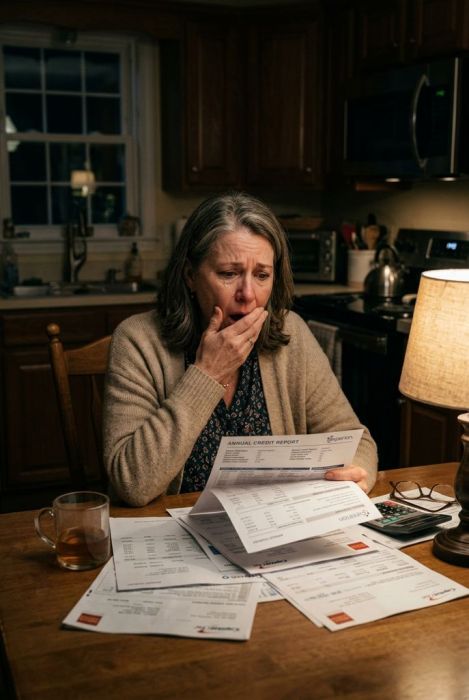
I found the documents two days later, tucked in a folder on the kitchen counter that Evelyn had left out, perhaps by accident, perhaps because she was getting careless. My hands were shaking as I read them. There was a durable power of attorney, naming Evelyn as Bill's agent. There was a deed transfer form for our farmhouse — my farmhouse, the one my great-grandfather had built and my father had left to me in a trust that could never be sold or signed away. And there were two pages of retirement account beneficiary changes, signatures on every line. They were in Bill's handwriting. That was what broke my heart first — he'd signed them all, trusting the woman who raised him.
But then I looked closer. And what I realized was almost worse.
Bill's signature had a distinctive little flourish on the "l" — a habit my father-in-law had taught him, and one Bill never abandoned even when his hands got shaky. On those papers, the flourish was there, perfect and bold, on a signature for a date in mid-November. Except on that exact date, Bill had been in the hospital for three days with a kidney infection, sedated and barely able to hold a spoon, let alone a pen. I still had his discharge papers, timestamped. He could not have signed anything on November fifteenth. He had never signed these pages at all.
I stood in my own kitchen, the forged documents in my hands, and for the first time in thirty-four years I felt the cold certainty that my husband's own mother meant to take everything — the house, the money, and ultimately him, by convincing him he couldn't trust the one person who actually loved him.
I didn't confront her that day. I had learned, across the months, to stop fighting with a woman who turned every argument into a performance. Instead, I went to Emily. I told her everything — the notebook, the forged signatures, the hospital timestamps. My daughter, the one person Evelyn had tried hardest to recruit, did the most surprising thing of all: she believed me. And she told me something I hadn't known.
"I found Momma's old tax records when I helped her organize the garage, Mom," Emily said quietly. "There were letters. Years of letters, back and forth with a lawyer in Harrisburg. She's been planning this since right after Dad's funeral."
It turned out Evelyn had never fully accepted that her husband's estate was modest and that the real money — and the land — came from my side of the family. For thirty years she'd simmered with resentment that her son lived in "Margaret's house." Now that Bill was older and softer, more suggestible, she saw her window. A forged power of attorney, a signed-over deed, a son convinced his wife was losing her mind — and she'd have everything, and the pleasure of watching me lose it.
Twelve days. That's how long it took me to put my trap together while I smiled and served her tea. I copied every document, had them notarized and dated. I pulled the trust agreement my father's lawyer had kept for decades, which named me and only me as lifetime beneficiary, irrevocable. I gathered the discharge papers and the telephone records. And I bought a small recorder, because I had a strong suspicion that Evelyn, in her arrogance, would say the damning words if I gave her the right chance.
She did. On Christmas Eve, after Bill had gone to bed, she cornered me in the kitchen while I wrapped Emily's gifts, and the months of pretense finally cracked.
"You know he'd have left you years ago if not for that house," she hissed, low and vicious, the mask gone. "He stayed for your money, Maggie. And now the house will be mine, and he'll be mine, and you'll have nothing. I've seen to it. He signs what I tell him to sign."
I let her talk. I let her lay it all out — the forged papers, her lawyer, her plan, even the date she'd intended to "help" Bill file for divorce. She thought she was destroying me. She was building the case that would save us.
The confrontation happened on New Year's Day, with the whole family gathered in our living room — Bill's sister Carol, her husband, Emily and her family, even the lawyer from Harrisburg I'd quietly invited to join us. I didn't raise my voice. I didn't have to. I played the recording first. The silence in that room was total, and I watched Bill's face go through several lifetimes in the span of a minute.
Then I passed out the notarized copies of the forged documents, and I placed the hospital discharge papers beside them, and I asked the lawyer to read the date aloud. November fifteenth, and the perfect signature — the flourish that Bill could not have made from a sedated hospital bed.
Bill's sister Carol was the one who finally spoke. "Momma," she said, and her voice was ice, "you can't even look at me."
Evelyn tried to scrape it back together. She called me a liar, a schemer, a woman who'd turned her son against her. But she couldn't explain the recording, and she couldn't explain the forgery, and she couldn't explain why the Harrisburg lawyer looked like he wanted the floor to swallow him whole. When the police arrived, summoned by the lawyer, Evelyn finally went quiet. Elder fraud and forgery, they said. They took her statement in my living room, and I stood by the window holding Bill's hand while his mother was led out past the house she'd tried to steal.
Bill didn't cry. He'd spent weeks being erased, and his shock was bigger than his grief. But that night, alone with me in the bedroom we'd shared for three decades, he finally let himself break.
"I trusted her," he whispered. "All my life, I trusted her. And she made me doubt you. The only one who was ever really here."
The bank reversed the beneficiary changes. The deed transfer crumbled the moment the trust agreement was read — my father had built it to be untouchable, and Evelyn had never been able to finalize even that. She was charged with forgery and attempted fraud, and the judge, after hearing the whole story, was not gentle. She would spend her remaining years in state care, where her manipulation found no purchase, and where her only visitors would be the nurses who knew her history.
Carol came to see me a month later, and we cried together on the porch, and for the first time in thirty years I think we both understood what a cold, exacting mother had cost this family.
Bill is better now. His forgetfulness, it turned out, had a name, and we caught it early because Evelyn's fraud forced the issue — we found him a specialist, and the medication slowed everything down. He remembers our daughter's name again. He remembers the anniversary, and the farmhouse, and why he married me.
Evelyn took almost nothing in the end except her own freedom, and I watched her trade that for a scheme that failed so completely I almost felt sorry for her. Almost.
Our farmhouse stands on the corner of the road just as it always has, and every spring I plant the roses my mother loved, and every winter I hang fresh garlands in the windows. Bill sits in his chair by the fire, and sometimes he looks at me with that old light in his eyes, the one that had been so nearly stolen from us.
"I was a fool," he told me the other day, quite plainly. "I thought I'd lose you. I didn't realize, until she was gone, that I'd almost lost the best thing I ever had."
I didn't argue. Some things are better sealed in silence, like a letter you never need to send. I have the house, and the truth, and my husband back. That's more than Evelyn ever hoped to leave me with — and it's exactly what she would have hated most.