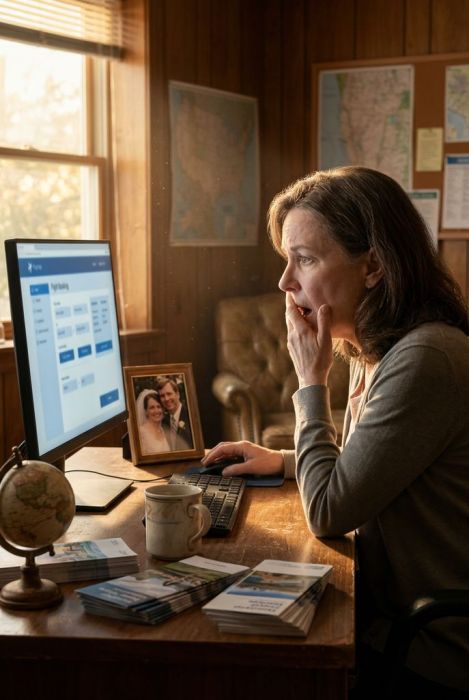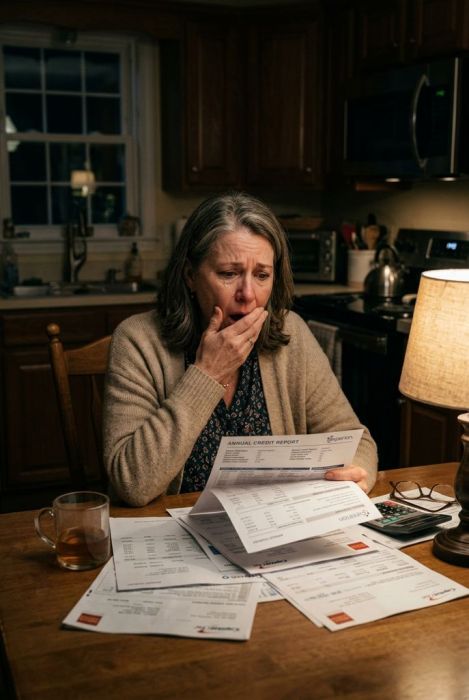
The first time I saw the envelopes, I almost laughed. They were spread across my mother's kitchen table like winning cards in a crooked game, all glossy gold and red, with "FINAL NOTICE — YOUR PRIZE AWAITS" printed in carnival letters. Mom was beaming at me, coffee mug steaming, looking like she'd just pulled the ace of hearts out of her sleeve.
"You're looking at a very rich woman, Diane," she said.
I set down the casserole dish. "Mom, what is all this?"
"They're from the National Grand Prize Claims office," she said, patting the biggest envelope. "I won their quarterly sweepstakes. Seven hundred and fifty thousand dollars, honey."
I could not believe it. Ruth Calder had never won so much as a free coffee in her life. She was a retired first-grade teacher who still clipped coupons and rinsed out Ziploc bags, a woman who taught thirty-four years and saved every penny of her pension as a promise to my father. And there she sat, telling me she'd won three-quarters of a million dollars from a company I'd never heard of.
"Do they need anything from you?" I asked carefully.
"Just the processing fee," she said, waving her hand. "They can't release the prize until the taxes and transfer fees are paid. I already sent the first one. Eleven hundred dollars."
My stomach dropped into my shoes. My mother's pension was eleven hundred dollars a month, and she'd handed an entire month of it to strangers in an afternoon.
"Mom," I said gently, "I don't think this is real."
Her smile flickered, just for a second. Somewhere under the excitement, under the dream of one last windfall after a life of careful pennies, my mother knew. She knew, and she was hoping I'd be wrong. "Of course it's real," she said firmly. "They sent me a letter. On real letterhead. People don't send real letterhead to liars, Diane."
That was three Sundays ago. That was the day I found out that the one thing luckier than a con man's target is a con man's family.
My father died three years ago on the Upper Iowa River, his heart stopping like a clock that had simply had enough. After the funeral, Mom did what she always did — she stood up, refused to fall apart, and stayed in the old two-story on Elm Street with the rhubarb patch out back. "I'm not moving to some apartment full of people my age," she told me. "I'm fine."
That pride was her armor. It was also her blind spot. When strangers whispered sweet numbers in her ear, the woman who had taught generations of children to count didn't add a single column.
The letters kept coming. Every few days, another bright envelope: "Tier 2 Verification Complete," "Release Pending," "One Final Step." Mom started talking about what she'd do with the money — new windows, a gift for Greg's boy Landon, a trip to the ocean "where your father always wanted to take me."
I called the number on the letter. A man answered on the third ring, voice smooth as syrup. "Marcus Webb, National Grand Prize Claims. How can I make your day brighter?"
I told him I was Ruth Calder's daughter and wanted to verify the prize before my mother sent another cent.
"Ma'am, with respect, your mother is a grown woman," he said. "If she wants the prize, she'll complete the steps. Everything is fully legitimate. Have a blessed day."
He hung up before I could ask another question. And then I noticed something I'd been too worried to see before: the number had a 563 area code. National Grand Prize Claims — a company that printed the word "national" on everything — had an office nineteen miles away in this corner of northeast Iowa. That didn't feel like success. It felt like a fingerprint.
The next Sunday, I came early with the excuse of rhubarb pie. I let myself in, called out for Mom, and heard the shower running upstairs. And because I had a sick feeling in my chest, I opened the door to her bedroom closet.
On the top shelf, inside the old floral hatbox where she kept her winter scarves, I found a stack of receipts tied with a rubber band. Money orders. Two hundred and fifty dollars here, seven hundred there, one for a thousand, one for three thousand five hundred. I counted them twice, sitting on the edge of her bed with my hands shaking. Twenty-three thousand dollars. My mother had sent this faceless man her savings like she was mailing letters to a soldier.
I heard the shower stop. I put the receipts back, straightened the hatbox, and went downstairs. I confronted her over the pie, as gently as I could. "Mom, you have to stop sending them money."
Her jaw tightened. "They sent me a check, Diane. A real cashier's check for four thousand eight hundred dollars as an advance. I deposited it! It cleared!" Her voice rose. "Don't you think I deserve one good thing?"
"It's not real, Mom." And then, softer: "It's the oldest trick there is."
She didn't speak to me for four days. I used every one of them.
The fake check that "cleared" was the key. I took it to Marta Novak, the head teller at the credit union Mom had used since 1982, a woman with bifocals and a memory like a steel trap. Marta ran the routing number, then looked up over her glasses and said, "Diane, this is a counterfeit. It only cleared because the paper had a valid-looking MICR line. The bank will hit it in about ten business days and claw every penny back."
She also told me something worse. Mom wasn't the only one. Three other seniors from the same circle had been in that month, cashing similar checks, sending similar money orders. Betty Kowalski. Harold Ness. Marta printed the receipt list, her face grim. "I'd have reported it sooner, but they were all so happy, Diane. They were all so sure."
That was the moment I stopped being just a scared daughter and started being an investigator. I work at the Winneshiek County Records Office downtown. I've spent twenty-one years reading deeds, liens, and probate filings — the paper trail of a thousand small deceptions. Somewhere in this county, somebody was cashing those money orders. It took me three days to find him.
They were all cashed at Cedar Quick Cash, a fluorescent-lit storefront on the south end of town that asked no questions. The owner, Mike Ellison, had been in my graduating class. He didn't want to talk to me. He talked to me anyway, because I reminded him about the smoke bomb we set off in the gym in high school, and because I told him I would cry in his store until somebody helped me.
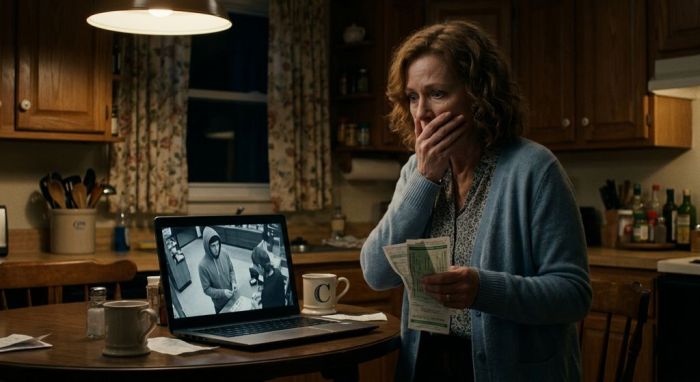
He pulled the tape. April 3, a Tuesday. April 12. April 19. The same figure every time: a young man, tall and lean, in a gray hoodie and a ball cap pulled low. The camera was grainy, but I would have known that walk anywhere — the way he rolled his shoulders, the way he pushed up his cap when he leaned in, the way he'd done a thousand times across my mother's kitchen table.
I stood in that little room and watched my nephew cash his grandmother's money orders, and I felt the world tilt sideways.
Landon. Twenty-four years old. My brother Greg's boy, the kid I used to read to at bedtime. He was the one who'd set up Mom's computer after Dad died, hooked up her printer, made her an email account "so we can stay close." He came to Sunday dinner every other week, kissed her cheek, called her Grandma, told her she looked lovely. And all the while — the letters, the phone calls, the golden envelopes, "Marcus Webb" with his syrup-sweet voice — all of it was him.
It took me a day to learn the rest. My brother Greg showed up on my porch looking like a man who'd been punched in the gut. Landon had lost his job at the lumber yard in February. He'd gotten into online sports betting that whispers on your phone at 2 a.m., and he'd emptied his savings, maxed four credit cards, and borrowed from a no-questions lender. When the debt hit eighty thousand dollars, he built his little empire out of a printer, four burner phones, and the one thing he knew better than anyone: his grandmother's love.
By the time Inspector Helen Marsh of the United States Postal Inspection Service finished with Landon's mailbox addresses and the bank records Marta had quietly flagged, we had a folder two inches thick. Eleven seniors across three counties. Sixty-seven thousand dollars. My mother was his biggest score — and the last one, the one that would put him away.
Inspector Marsh laid it out in my kitchen, her voice calm and flat. "He's got a notebook. Names, dates, amounts, who's ripe and who's dried up. Your mother is marked ripe for the final. He's calling her today to arrange the last payment — six thousand dollars to release the prize. He's sending a courier to her door. Cash only, for security."
I felt the blood drain from my face. "She was going to cash her CD."
"Can you stop her?"
I called her on the spot and told her to meet me at the credit union — that I had the money for her, that she didn't need to touch the CD. And when she got there, I told her the truth. All of it. In the little alcove by the notary's desk, with Marta standing guard at the door, I told my seventy-nine-year-old mother that the grandson who set up her computer was the man robbing her blind, and that he was coming to her house on Saturday with a box and a lie.
She didn't cry. That was the worst part. She went very still, the way she'd gone still at Dad's funeral, and stared out the window at the parking lot for a long time. Then she said, in a voice I barely recognized: "What do I need to do?"
The plan was simple, and it was cruel, and Mom insisted on being part of it. "I want to see it with my own eyes," she said. "I want him to look at me and say it."
Saturday, four o'clock. The light outside was going gold. Inspector Marsh and her partner parked two blocks down in an unmarked sedan. My brother Greg stood in the back bedroom, pressed against the wall, his face the color of ash. The courier box sat on Mom's kitchen table — evidence, wired. Six thousand dollars in marked bills — evidence, wired. And Mom sat in her chair by the window, in her best blue dress, wearing her pearls, waiting for her grandson.
He came up the walk with a bounce in his step, a black polo shirt, a cardboard box with "National Express" on the side. "Grandma! It's Landon! It's here!"
She let him in. He set the box on the table and beamed at her. "Big day, Grandma. Six thousand and it's all yours. Then you're a millionaire." He said it with love in his voice, genuine affection in his eyes. That was the thing that broke my heart open. He had stolen from his grandmother and smiled at her while doing it, and I think, in that moment, he almost believed his own story.
"Before we do this," Mom said quietly, "I want you to look at me and tell me that it's real."
He blinked. "Grandma, of course it's—"
"Tell me," she said, "that you didn't print these letters on the printer I bought you for Christmas. Tell me that Marcus Webb isn't you."
The color left his face. He looked from her to the box, to the doorway where Inspector Marsh now stood with her badge out, to the window where Greg had appeared, his own son's betrayal carved into his features. Landon's mouth opened. Nothing came out. And then he bolted — through the kitchen, past the rhubarb patch, toward the back fence, the way he'd run out of that yard a thousand times as a barefoot kid.
The fence had a new lock on it. Mom had asked me to put it on Thursday, "in case he tries to leave the way he came in." He hit it, bounced, turned — and ran straight into the officer Marsh had posted in the alley. They had him in cuffs before his knees touched the grass. And through the kitchen window, my nephew saw his grandmother standing at the table in her blue dress and her pearls, watching him, still as the river where my father's heart had stopped.
They tried him for mail fraud, wire fraud, and financial exploitation of an elderly person. He pleaded guilty when the prosecutor played the tape from the wiring in the courier box — the tape where Landon stood in his grandmother's kitchen and lied to her face, seconds before the badge came out. He got thirty months in federal custody and an order to pay restitution. The judge said, "You did not rob one woman, Mr. Calder. You robbed every senior who trusted you, and you dressed it up as their victory."
The credit union clawed back the counterfeit advance check, and Marta had frozen Mom's CD in time, so the worst of it never touched her savings. Betty got most of her money back from the restitution fund. Harold died the following spring without ever seeing his nine thousand dollars return, and Mom planted tulips on his grave and didn't say a word about it in church, which was her way of praying.
For a long time, my mother was ashamed. She had been the smart one — and a boy with a printer had taken twenty-three thousand dollars and her pride along with it. Then Inspector Marsh came to visit, not in uniform, with a box of pastries, and asked her to help teach the fraud class at the senior center. "You'll tell them better than I can, Mrs. Calder. You know what it feels like."
Mom said no, four times. Then she said yes.
She stands in front of that room now, once a month, in her blue dress and her pearls, holding up a golden envelope with "FINAL NOTICE" on it. "This right here," she says, "is the most expensive piece of paper I ever owned. Let me tell you how it works, so it doesn't own you."
Greg comes to Sunday dinner again. It took him a year to look me in the eye, but he came. Landon wrote my mother a letter from prison — eleven pages, all about how sorry he was, how it was the gambling and the fear, how she was the only one who ever believed in him. She read it twice, very slowly, then folded it, took it upstairs, and put it in the hatbox where the receipts used to be.
"He has to live with himself," she told me that night, hanging her pearls on their little hook. "That's not an easy person to live with, Diane."
On the first warm day of spring, I came over with rhubarb pie and found her on the porch with her coffee. The phone rang inside — eleven a.m., like clockwork, the robocall that told her her credit card had been compromised by a lady in a call center three states away. She raised an eyebrow and said, "Bless your heart," in the direction of the kitchen, and didn't move an inch.
"Are you going to get that?" I asked.
"Not today," she said, and she sipped her coffee, and the sun fell across the porch, and my mother smiled the way she hadn't smiled since before the golden envelopes started coming. "It's a beautiful day, honey. Let's sit a while."