The night my husband of thirty-eight years came home crying, I believed every word he said. Mark stood in our kitchen doorway, soaked through, holding a manila folder like it held a bomb. "Ruth," he whispered, and my heart stopped before he even said it. "It's pancreatic cancer. Six months, they think. Maybe less."
I held him until his shoulders stopped shaking. I made tea I couldn't drink, and I sat beside him while he described the scans, the word "inoperable," the doctor's quiet voice. We'd married at twenty-three. I'd taught third grade for thirty-one years; he'd sold insurance until his company downsized him at fifty-five. We'd built a life, and now we were going to lose it.
I didn't read the folder that night. I didn't question a single thing. I just promised him I'd do anything to save him. That was my first mistake. It wouldn't be my last.
In the weeks that followed, my dying husband became a very busy man. He had appointments I was never invited to, specialists who "didn't take questions from spouses," and a trial drug that cost forty-eight thousand dollars out of pocket. He was too weak to take out the trash but strong enough to call the bank three times a day. "The insurance is screwing us, Ruth. We need to move the money before they attach it."
First it was my pension. Then it was my mother's bungalow in Ohio, the one she'd left me when she passed, the one I rented to a sweet young couple for almost nothing. "Sell it," Mark said, his voice thin and brave. "We'll need the cash for Houston. And give me power of attorney, sweetheart, so I can handle the paperwork without exhausting you."
I wanted to believe him. God, I wanted to believe him. But I've spent three decades watching children try to lie to me, and I know the shape of a lie when it sits in front of me. Mark never once asked me to come to his appointments. He never let me meet his doctor. And the pill bottles on his nightstand — the ones for the chemo that was "saving his life" — never seemed to get lighter.
The pharmacy is where it cracked. Susan Nguyen had worked that counter for twenty years; she'd watched Mark and me grow old from behind the register. When I asked her to refill his chemo pills, she pulled up his file and frowned. "Ruth, Mark hasn't filled a prescription here in four months. Last thing I have is his blood pressure medication."
"Maybe he switched pharmacies," I heard myself say. "Maybe," Susan said gently, and I saw the look in her eyes — the pity you give someone who's about to be hurt. "You want me to call Brighton Oncology and see who they use?" I thanked her and walked out into the parking lot, and the world felt tilted, like one of those snow globes turned upside down.
I called the number on the card myself. A man's voice on the machine: "You've reached the office of Dr. Paul Marsh. Please leave a message." I left one. No one ever called back — not that day, not ever. And that same afternoon, I found Mark's old golf bag in the garage, the one he'd sworn he sold years ago. Inside were four prescription bottles, all sealed, all dated after his diagnosis, all completely untouched.
I stood in that garage a long time, holding those full bottles in my shaking hands. I remembered the night he came home from the appointment he never let me attend. I remembered the smell on his coat that night — rain, and something sweet, some perfume I'd never bought. I wanted to scream. I wanted to throw the bottles at his feet. But I'd been married to Mark Callahan for thirty-eight years, and I knew he always had an answer, always had a story. So I didn't confront him. I waited.
On Thursday morning he kissed my cheek and said he had his weekly chemotherapy. I waited exactly four minutes, then I followed him. He didn't go to a hospital. He drove to the Maplewood, a beige apartment complex across town with a dead pool and a sign that said "Senior Living, Quiet and Safe." He parked, knocked on unit 214, and a woman in her forties opened the door and kissed him like a man who wasn't dying. Like a man with all the time in the world.
I sat in my car and watched them laugh into that apartment. I watched the curtains close. And I understood, with a cold and terrible clarity, that my husband wasn't dying. He was leaving — and he'd planned to leave with everything I had.
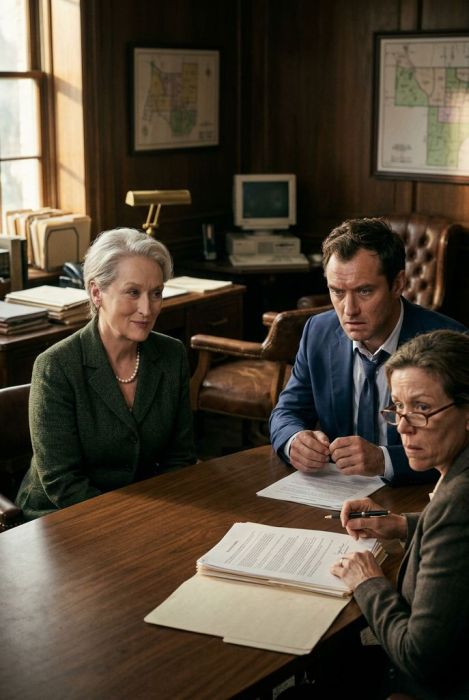
I went home and called the only person who'd ever made me feel safe: Grant Ellison, the lawyer who'd handled my mother's estate since I was a girl with braids. He listened, wrote everything down, then asked one question I'll never forget. "Ruth, how much money has he asked you to move in the last three weeks?" I told him about the pension, the bungalow, the power of attorney. "Good," he said. "That's attempted fraud, forgery of medical documents, and financial exploitation of a spouse. Don't sign anything. Don't say a word. Let him keep talking, and let me do the rest."
The rest took six weeks, and it changed me. Grant hired a private investigator named Delores Ramos — Dee, a tiny woman with enormous glasses and no mercy at all. Dee found things that made my knees buckle. Mark had done this before: eleven years ago a "debilitating back injury" that bought him two years of disability checks while he fished in Florida. The woman in unit 214 wasn't a nurse; she was Tanya Voss, sister of a man Mark had owed gambling debts to for fifteen years. And the "trial drug" money wasn't going to Houston. It was going into a joint account under a false name in Nevada.
But the piece that broke me — and then rebuilt me — came from a place I never expected. To keep up the act, Mark had dragged me to a cancer support group at St. Anne's church basement. The people there were good, brave, broken in ways I understood. And one of them, a woman named Carol Whitfield, found me after the meeting with a photograph in her hand. "I know you from the news," she whispered. "No," I said. "You know him." The photo was fifteen years old: a younger Mark, laughing at a charity gala in Phoenix. Carol's sister had been swindled by a man who claimed terminal ALS — a charming man who emptied her accounts and vanished. The volunteer who ran that charity kept his photo. Carol had never forgotten his face. "He calls himself dying," she said, "but he's been a professional death for thirty years."
I think that's the moment I stopped being his victim and started being his problem. I stopped crying. I made a list. I worked with Dee and Grant and a fraud detective named Alvarez, who took one look at the sealed pill bottles and said, "Ma'am, you've got a hall of fame case here." They traced the "Dr. Marsh" voicemail to a burner phone bought at a Target in the name of Raymond Voss — Tanya's brother. They found the Nevada account. They found the plane tickets to Reno for two, booked for the week after I was supposed to sign the power of attorney.
And then there was Kevin. Our son, thirty-five years old, a high school principal who'd believed his father's tears and scolded me for being cold when I hesitated. I didn't blame him. I'd believed too. But when I finally showed him the bottles, the pharmacy records, the photos of the Maplewood, Kevin went very quiet. Then he said, "He used to take me to see 'his friends' on Thursdays. When I was a kid. Same day." He sat down, put his head in his hands, and when he looked up, his face was steel. "Whatever you need, Mom. I'm in."
The end came on a Sunday, the way all good endings do, over a pot roast that was never really about dinner. Mark had arranged it himself: the notary would come to the house so we could finalize the power of attorney and the deed transfer — "protecting the house from medical creditors." I told him that sounded smart. I told him I'd make pot roast. I invited Kevin "for moral support," and Mark loved that, because he loved an audience.
The notary arrived at six, a thin man in a cheap suit named Raymond Voss, who flashed a laminated badge and didn't seem to blink. Mark beamed. He slid the papers across the table. "Just sign here, sweetheart. This is for us. This is how we survive this." And I picked up the pen, and I looked at him — my husband, the man I'd loved since I was twenty-three — and I said, "Mark. Tell me one more time. How do the pills work?"
"What?"
"The chemo pills on your nightstand," I said, calm as a Sunday. "Tell me how you take them. Then sign your own papers, and I'll sign mine." His smile flickered. Kevin stood up and locked the front door. Raymond Voss looked at the window. And from the kitchen, Grant Ellison and Detective Alvarez walked in, followed by Dee with a folder as thick as my mother's Bible.
I slid the folder across the table. Inside: the sealed pill bottles, the pharmacy statement, the surveillance photos of the Maplewood, the Nevada account records, the Phoenix gala photo Carol had given me, and the voicemail from "Dr. Marsh" — traced to a burner phone bought with Raymond's credit card. "You're not dying, Mark," I said. "You're just a liar who got slow."
I won't describe the rest in detail; some things are private, even for a man who tried to steal his wife's entire life. But I'll tell you this much: it involved two county detectives, a very loud neighbor, Tanya Voss telling investigators everything within eleven minutes — she'd been promised a house in Reno, not a jail cell — and Raymond trying to climb out a bathroom window in his cheap suit. He didn't fit. I'm not proud of how good that felt.
Mark was charged with multiple felonies: attempted fraud, forgery, identity theft, financial exploitation of a vulnerable adult. His gambling debts came out in the trial like termites from a wall. He declared bankruptcy before the verdict was even read. He never touched a dollar of my money, because Grant had frozen everything the week I called him — before Mark ever got a chance to spend the dream.
I sold the bungalow. On my own terms, at my own price, to a couple who reminded me of Mark and me back when we were too young to know what loss tasted like. I bought a small condo two blocks from the ocean, where the air is salt and the mornings are light. I kept the pill bottles — not for spite, but because whenever I doubt my own judgment, I hold one and remember that I was brave enough to look.
The divorce was final on a Tuesday. The judge looked at Mark across the courtroom and said, "Mr. Callahan, I've seen a lot of men in this room, but I have never seen a man lie about dying to steal his wife's pension. I hope you think about that every morning." He did. I heard he does.
I still go to the support group at St. Anne's — not as a mourner, but as a listener. Carol and I became friends; we drink terrible coffee and laugh about life's second acts. Kevin brings his girls every Sunday, and they've learned to make my mother's pot roast. There's a volunteer there, a retired fire captain with kind eyes, who always saves me a seat by the window. We talk about books, about the sea, about everything and nothing. I'm not in a hurry. Some things, I've learned, are worth waiting for.
People ask me if I'm angry, and the honest answer is: not anymore. Anger is a heavy coat, and I've set mine down. I'm sixty-one years old, I'm free, and I've finally learned the most important lesson my husband ever taught me — by being the worst example of it. Some people spend their whole lives waiting for the truth. I spent six weeks finding mine. And it was the best thing my husband never gave me.