
The phone rang at 8:47 on a Tuesday morning, and I almost let it go to voicemail. I was pulling a coffee cake out of the oven. But something made me grab the cordless phone anyway. Mother's instinct, maybe. Or the way the number just read "Unknown."
"Grandma?"
The voice cracked on the second syllable. A boy's voice, high with panic, muffled, like he was holding the phone too close to his mouth. My heart lurched before my brain could catch up.
"Grandma, it's me. Please don't hang up. Please don't be mad."
"Tyler?" I set the pan down. "Baby, what's wrong? Are you okay?"
"No, Grandma, I'm not okay." He was crying now, the ugly kind that comes out in ragged gasps. "I'm in so much trouble. I swear it wasn't me, Grandma. My buddy Kevin asked me to drive him to the store, and there was — there was stuff in his backpack. I didn't know. I didn't know."
"Tyler, slow down. Where are you? Where's your mother?"
"You can't call Mom!" His voice jumped an octave. "Grandma, please, she'll kill me. She'll take away everything. Please don't tell her."
I sank into the chair by the window. My grandson, Tyler Whitfield, twenty years old, a sophomore at the University of Arizona, the light of my life. And he was in jail.
Through sobs, he told me the rest: a traffic stop, a search, a backpack with something that wasn't his, handcuffs, a holding cell. A public defender named Curtis Hoffman said bail would be eight thousand five hundred dollars, cash or cards.
"Grandma, please," the voice begged. "Please don't let me stay in here. Grandma, I'm scared."
A scared child, calling home. Because that's what we do, we grandmothers — we answer.
But then he said something that stopped me cold.
"Goose," he whispered. "Please, Goose. It's me. You know it's me."
My hand tightened on the phone. Goose. Nobody in the world called me that except Tyler. It went back to when he was four years old, sitting on my lap while I read him Mother Goose rhymes, and he decided I wasn't "Grandma" anymore — I was Goose. "You're my Goose," he used to say, "and I'm your Gosling." The goose salt shaker he bought me at a flea market still sits on my windowsill.
No stranger could know that. And for that one terrible moment, I believed it was him.
So I told him I'd get the money, told him to be brave, that Goose was coming. I hung up, and I cried until my coffee went cold.
Then I called my daughter.
"Mom, it's six in the morning here," Diane said, her voice thick with sleep. "What's wrong?"
I told her, sobbing by the third sentence, asking her to call the jail, to find out what the bond was.
And Diane went quiet for a long moment.
"Mom," she said slowly, "Tyler is sitting right next to me. We went to the Grand Canyon for the weekend. He's eating a waffle."
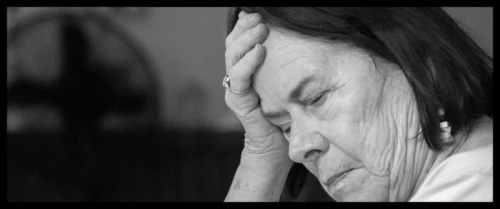
I remember the sound the phone made when it hit the floor. Or maybe that was my heart.
Tyler got on the line — annoyed, sleepy, alive — and said, "Grandma, who's using my name? Should I be worried?" I laughed through my tears, that shaky laugh you do when you're so relieved you feel sick. Someone had used my grandson's voice to scare an old woman. And that old woman was me.
I taught second grade for thirty-seven years in Green Valley, Arizona. I can spot a fib from across a classroom. But I also know what love does to a person. Love doesn't have a lie detector. Love just opens its door.
Tyler was my only grandchild, raised by my daughter Diane alone after a divorce. We had a standing date every Christmas Eve: popcorn, cocoa, and our movie. It's a Wonderful Life. We'd watched it together every year since he was eleven, and every year he'd say the same thing at the end: "Every time, Goose. Every time." And I'd say, "That's the point, Gosling."
That was ours. That was the question no stranger could answer.
So when Diane told me what to do next, I didn't argue. "They're going to call you back, Mom. Keep them on the phone as long as you can. I'm calling the police."
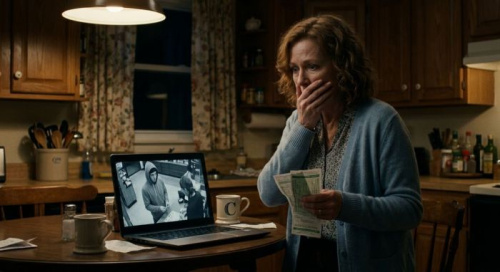
And they did call back. Forty minutes later, an email arrived from "Curtis Hoffman, Public Defender" — a block of legal-sounding lies with a badge number and my address spelled correctly, which made my skin crawl. How did they know where I lived?
"Mrs. Whitfield," the man on the phone said, his voice smooth and practiced. "The quickest way to secure your grandson's release is with the gift cards. Walmart is fine. Five hundred each, as we discussed. The court system — well, it's old-fashioned. Cash or cards only. Once he's out, you'll be reimbursed."
I stood in my kitchen, phone to my ear, looking at the goose salt shaker on my windowsill. And I played the part. I let my voice shake. I wrote down his instructions like a good little pigeon being plucked.
Because by then, I wasn't a scared grandmother anymore. I was furious. And a furious schoolteacher, I can tell you, is a force of nature.
The scammer had told me to buy nine cards of five hundred dollars and call him from the parking lot before I read the codes. I loaded nine cards into my cart at the Walmart on Duval Road, and at the self-checkout my hands started shaking so badly I couldn't scan the first one.
"Ma'am? You okay?"
I looked up at the young man in the blue vest. Marcus Delgado, his name tag said. Maybe twenty-four.
"I'm fine, honey," I said. "Just tired."
"You're buying nine five-hundred-dollar gift cards." He said it gently, like he was commenting on the weather. "And you were crying in the parking lot for about five minutes."
I opened my mouth to lie, and nothing came out. And then, because I'm seventy-one years old and I've learned that some kindness costs you your pride but saves your bacon, I told him the truth. Every word of it. The phone call. The jail. The voice that knew about Goose.
Marcus didn't blink. "Ma'am, I need you to come to the back with me." He was already reaching for the cards. "Tell me — have you read any of these codes to anyone yet?"
"No," I whispered. "I was going to call him from the car."
He exhaled like he'd been holding his breath. "Good. That's really good. Because this is a scam, and you just did the smartest thing you could've done — you got stopped before you paid the toll."
I cried right there in the customer service room behind the photo counter, all the fear I'd been feeding into anger flooding back out. Marcus gave me a bottle of water and a box of Kleenex and called the police. When Detective Alvarez walked in twenty minutes later — a short, serious woman with a badge clipped to her belt — I was calm again. Furious-calmed.
"Do you want to catch them?" she asked.
I didn't hesitate. "Yes."
"Then we're going to ask you to do something hard. Call them back and play along. Get them to think you have the cards. Keep them talking."
"I know," I said. "Let them think they won."
I called "Curtis Hoffman" back that afternoon. My hands were steady. Detective Alvarez sat beside me with a notepad, and on the other end of the line, the scammer sounded delighted.
"Excellent, Mrs. Whitfield. Now, before you read the codes, I want to put you on with Tyler so he can thank you. Would you like that?"
My heart threw itself against my ribs. "Yes," I said.
There was a click, a shuffle, and then the voice came back — the shaky, tearful, perfect imitation of a frightened boy.
"Grandma? Grandma, is it you?"
"Hey, Goose," I said softly. "I just want to ask you something before these nice people let you out, okay? So I know it's really you."
"Okay, Grandma. Anything."
"You remember what we watch every Christmas Eve? Our movie?"
A beat of silence. A long one.
"Uh — yeah," the voice said. "White Christmas, right? Grandma, c'mon, that's easy."
"No, honey," I said, my voice very quiet. "It's It's a Wonderful Life. It's always been It's a Wonderful Life. And my Tyler wouldn't forget that, because he's said the same thing to me every single year since he was eleven."
The line went so quiet I could hear my own blood in my ears.
Then a click. Then a dial tone.
Detective Alvarez took the phone from my trembling hands. "They hung up," she said. "That's fine. That's better than fine."
The trace took three days. Three days of looking at every face I knew and wondering if the voice behind that phone had smiled at me over a casserole dish.
Then, on a Thursday afternoon, Detective Alvarez came to my door and said, without even sitting down, "Mrs. Whitfield, do you know a man named Gary McCallister?"
The name hit me like a slap.
Gary. My sister Carol Ann's boy. My nephew.
"Gary is my sister's son," I said slowly. "He's... he's family."
"He's the one who bought the burner phones," the detective said. "We have the credit card receipts, the store footage, and the phone records connecting both numbers to his account. And we have a statement from his fiancée: he's been tense for months, losing money at the casinos, owing people. She found a notebook with your address and Tyler's schedule in it."
I sat down hard on my own sofa. And I remembered, suddenly, horribly, my birthday party in June. Gary had come, all smiles and compliments. He'd sat in my kitchen and asked about Tyler — college, girls, trouble — with such innocent-sounding enthusiasm. And I'd laughed and told him the old story about Mother Goose, and he'd said, "He still calls you that? That's adorable, Aunt Nora."
The whole time, he'd been taking notes. In his head, in his phone, in that hungry little smile.
The man who'd whispered "Goose" to me in my darkest hour was my own sister's son. He'd gambled away his future at a blackjack table in Phoenix, and when the wolves came for payment, he decided to feed them his elderly aunt instead.
"You have to understand," I said, and my voice cracked, "I changed that boy's diapers. I taught him to read. I gave him money for his first car. And he —"
"Ma'am," Detective Alvarez said softly, "he's done this before. At least four other calls that we can prove. You're the first one who fought back."
So I did what my mother would have done. I sat up straight, poured us both a glass of iced tea, and said, "What happens now?"
What happened next was almost too perfect. Two days later, on a Saturday morning, my doorbell rang, and I looked through the peephole and saw Gary standing on my porch with a box of donuts.
I opened the door. "Gary," I said, surprised, and only a little. "What a nice surprise."
"Just checkin' on you, Aunt Nora." He came in like he belonged, kissing my cheek, setting the donuts on my counter. "Heard about that scare you had. Somebody called pretending to be Tyler, huh? Scary stuff."
"It was," I said. "Very scary."
"You gotta be careful, Aunt Nora," he said. "These scammers, they get creative. They learn people's names."
"Sit down, sweetheart," I said. "Let me get you some coffee."
The wire was in my blouse pocket, the size of a button. Detective Alvarez was listening in the unmarked car two houses down.
We made small talk for a while. Then he set down his coffee cup, his eyes flicking to the goose salt shaker, and said, so casually, "So, did Tyler ever tell you about that trip? The one that got him out of trouble? I'm just glad it all worked out."
I went very still. "Tyler?"
"Yeah," he said. "The little hiccup. The thing that scared you." He waved a hand. "Guess it was all a misunderstanding in the end."
Sweet Lord. He was fishing. He wanted to know if I'd actually sent the money he'd never received, whether his "Goose" trick had paid out before the cards got frozen.
"No," I said slowly, "I don't think there was any misunderstanding." And then, because I've never been able to let a moment like that pass, I added, "There was just a boy on the phone who knew my nickname. You know how that happened, Gary? At my birthday. When I told the story about Mother Goose."
His face changed. Not guilty — caught. There's a difference. Guilt is heavy; caught is sharp. He stood up, losing his cool for one, two, three seconds, and that was all the time Detective Alvarez needed to open the front door she'd told me to leave unlocked.
Gary turned. Two officers were standing in my kitchen, and his face went the color of old dishwater.
"Gary McCallister," the detective said, "you're under arrest for identity theft, fraud, and attempted theft of property from an elderly person."
"Wait — Aunt Nora —" He spun to me, hands up, something awful in his eyes. "Aunt Nora, you can't do this. I'm family. We're blood. Please — I was desperate, you don't understand, those men are going to break my legs —"
"My Tyler," I said quietly, "spent four days scared that his grandmother was going to lose her life savings to a stranger who used his name." I looked at this man, whom I'd loved from a baby, who'd fed me to his gambling debts like I was nothing. "You told him I wasn't safe to protect. So no, Gary. I don't have to understand a single thing."
Gary was arrested in my kitchen on a Saturday morning with a dozen donuts on my counter, and I think that was the moment my sister Carol Ann finally understood what he'd done. She came to my house that night and stood on my porch and cried before she could even say hello. "He's my son," she kept saying, "but he's not my child anymore."
I held her hand, and I didn't say "I told you so," because there was nothing to win. Gary pleaded guilty, soon after, to wire fraud and attempting to steal from a vulnerable adult. He lost his job, his fiancée, and his freedom. But my sister kept her dignity, and that mattered more to me than a courtroom victory.
The gift cards? Marcus Delgado and the store's fraud team froze them before a single code was read, and Walmart returned every cent. I bought two things with the money, in the end: a goose-shaped birdbath for my garden, and a plane ticket.
Tyler came home for Thanksgiving, and I told him the whole story — all of it, including the part about Gary. He was quiet for a long time, and then he said, "You asked him about the movie."
"I did," I said.
"Every time," he whispered, and I laughed so hard I cried. "Every time, Goose. Every time."
That winter, I started a class at the senior center: Scam-Proof Your Family. We talk about codes and gift cards and the sound a stranger makes when he's trying to imitate someone you love.
And every Christmas Eve, Tyler comes over for popcorn, cocoa, and It's a Wonderful Life. He still says the same thing at the end, and I still say the same thing back. Some doors you open for the world, and some doors you keep for the people who know the word. That's the point of the goose salt shaker, sitting on my windowsill in the Arizona sun, watching over everything I kept safe.