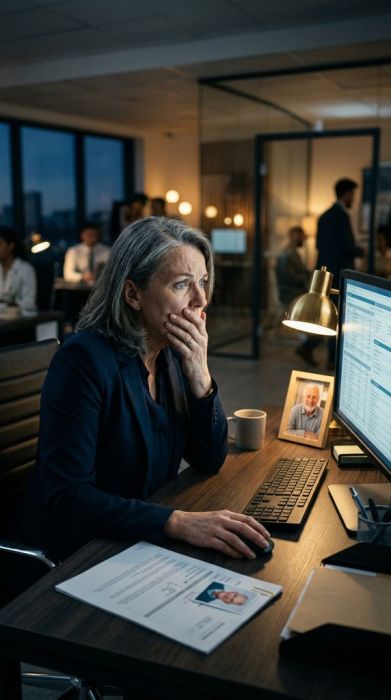
The first time I saw her name on my father's accounts, I thought the bank's system had glitched. Delilah Crane. Joint owner, right of survivorship. My father, Walter Bates, had been a widower for exactly three years, and in fifty-four years of knowing the man, I had never once heard him say the name Delilah.
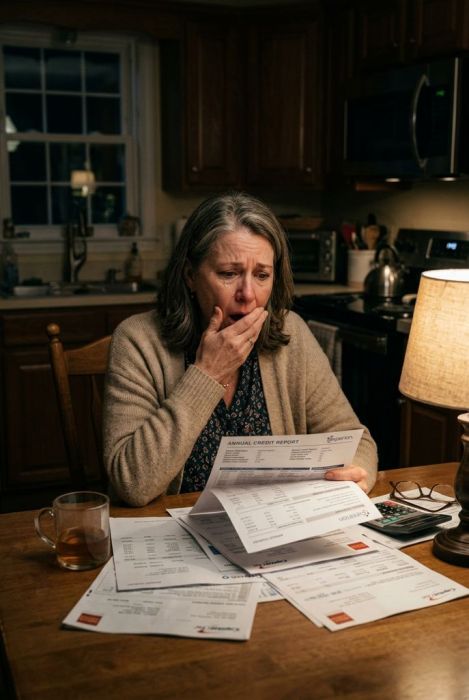
I sat in my corner office at Lakeshore Bank in Fort Wayne, Indiana, on a gray Tuesday morning and told myself there had to be an explanation. Dad was seventy-eight years old. Maybe he had added a granddaughter to help with bills. Maybe there was another Delilah Crane in the world and this was a clerical mistake. But a daughter's stomach knows the truth before her head does. I printed the account forms, and there it was — his signature, shakier than I remembered, right beside the words "Joint Account with Right of Survivorship." He had signed my mother's savings account over to a woman I had never met.
My mother, June, had been gone three years. Ovarian cancer took her fast, the way it does, and it took a piece of my father with it. For the first year he barely left the ranch-style house on Marigold Lane where they had raised my brother Michael and me. I drove over every Sunday with a casserole, and he would eat it standing at the kitchen counter, staring out at my mother's rose bushes like he was waiting for her to come back and deadhead them. Michael lived in Phoenix and called once a week. We both worried. We both knew there was no medicine for a broken heart.
Then, last spring, Dad came to Sunday dinner wearing a new polo shirt and smelling like aftershave, and he could not stop smiling. He had joined the senior center's line dancing class. When I asked how it was, he went on for ten minutes about a woman named Delilah who taught the class, how she was from Florida, how she "made everyone feel young." I was happy for him. Truly. My mother would have wanted him to laugh again, and he was laughing. I told myself to be grateful that my father had found a spark.
The first red flag was small enough to ignore. His class ring disappeared — the one from Purdue, the one he had worn since 1968. He said he must have left it at the locker room. A week later, my mother's good watch went missing from the bedroom drawer. Dad shrugged it off and said he couldn't remember. That was the thing I should have noticed first, the way "I can't remember" started sliding off his tongue like a reflex.
I met Delilah in June, at a cookout Dad hosted in the backyard. She was sixty-one, glamorous in a way our town had never seen, with silver-blonde hair and a laugh that carried. She brought a key lime pie and called my father "Walter, darling" every other sentence. She kissed my cheek and told me I looked just like my mother, which I knew was a lie, but it was a generous one. Michael thought she was wonderful. I wanted to think she was wonderful. Then she asked me, sweetly, whether I had ever thought about letting Dad "slow down," and whether Michael and I had "discussed the house."
By July, Dad had signed a durable power of attorney giving Delilah authority over his medical decisions. He told me over the phone, casually, that she was "handling the paperwork now" so he wouldn't have to worry. When I drove over, panicked, he laughed at my face. "Carol, honey, she's taking care of me. That's all." He showed me a folder she had organized — bills paid, appointments scheduled, everything in neat tabs. My own father looked at me like I was the one acting strange. That night I cried in my husband Dan's arms and told him I hated the woman I was becoming, the suspicious daughter who saw a wolf in every kind stranger.
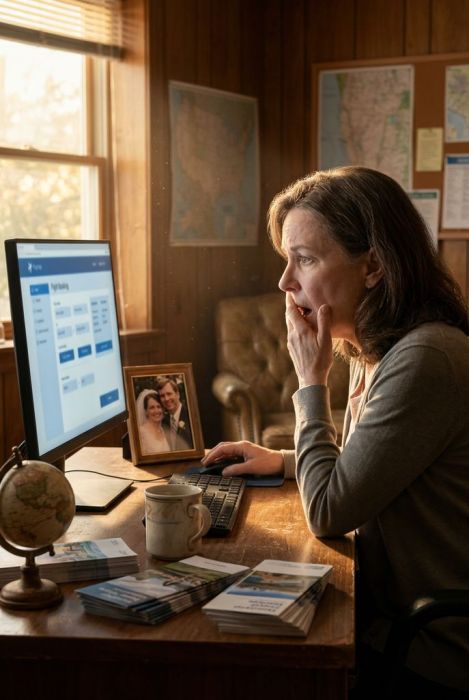
The wire transfer is what broke me open. It came across my desk on a Thursday: $210,000, from Dad's brokerage account, headed to a shell company in Tampa called Crane Holdings LLC. I knew that name. I had seen it once, months earlier, on a check he had written for "investment purposes." My hands shook as I pulled the signature card, the withdrawal slip, the joint account forms. And that was when I finally did what I should have done in June. I ran her name through the bank's fraud database — and then through the shared alerts from other institutions.
The screen went cold for a second. Then her face came up.
I had seen her face before, and I had never met her. It was the same woman, ten years younger, with darker hair and a different name: Linda Hassett. The alert was from a bank in Arizona. It said she had been convicted in 2009 of financial exploitation of an elderly man — a widower she met at a community center dance class, who signed over joint accounts and a new will before his daughter caught on. There was a second alert from Nevada, an open investigation, a woman calling herself Rosemarie Fox, same playbook. The victims' affidavits used the exact phrases Delilah had used on my father. "You deserve someone who takes care of you." "Let me handle the paperwork, darling." "Your children just don't understand how much you're struggling."
I locked my office door and threw up in the trash can.
The next weeks were the hardest of my life, because I could not simply march home and tell my father the truth. I work in banking, and I know the law. My father had signed over authority to her, and I had to be careful, precise, and patient, or every scrap of evidence would be ruined before it could matter. So I did what my job has taught me to do: I built a file. I called Detective Hale of the Fort Wayne financial crimes unit, and he knew the name Linda Hassett the moment I said it. He had been waiting years for her to cross state lines into Indiana. Then I found the notary, a retired florist named Fred Pelham who had "witnessed" the new will Delilah had coaxed out of my father. Fred was not a crook — he was a fool. She had told him she was Walter's wife of two years. When the detective showed Fred the mugshot, the man turned pale and signed a statement recanting everything within the hour.
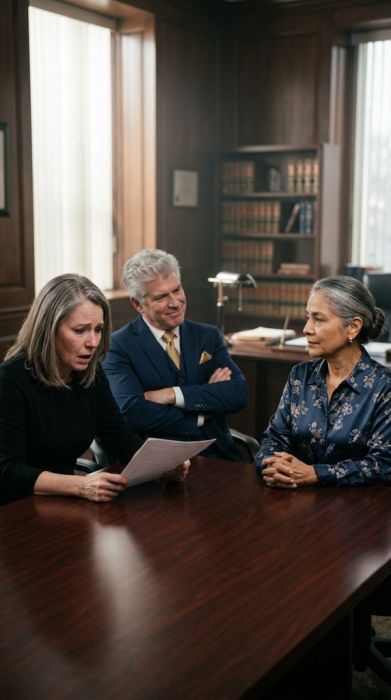
The trap was set the first week of October. I approved the wire transfer to Tampa — subject, as our policy required, to an in-person verification at the branch. Delilah was thrilled. She arrived on a Friday morning wearing a cream suit like she was closing on a mansion, my father smiling beside her in his best shirt. We met them in the conference room, the one with the big windows looking out at the lobby. I was there with a tray of coffee, and Detective Hale was there in an off-duty polo shirt that made him look like a customer. Dad's face lit up when he saw me. "Carol! Isn't this great? Delilah found us an investment that'll set me up for good."
I remember the exact second I hated myself most. I handed him the folder — not the wire folder, the other one. Photographs. Affidavits. The Arizona court documents. Linda Hassett's booking photo from 2009, and the Nevada alert, and the bank records showing Crane Holdings LLC had been registered in Tampa by a woman using a fake ID. "Dad," I said, "I need you to look at this before we sign anything."
He looked. He looked a long time. Delilah reached for his hand and said, "Walter, darling, you don't have to read any of that." And my father — my sweet, trusting, heartbroken father — pulled his hand away and read every single page. I watched his face change. I watched seventy-eight years of a good man's kindness drain out of him and leave something cold behind. "That's her," he whispered finally, pointing at the booking photo. "That's my Delilah."
She launched out of the chair like a cat. "This is insane! Your daughter is sabotaging us! She's jealous of what we have!" And then she tried to walk out, right past the man in the polo shirt who had been pretending to look at his phone. Detective Hale stood up and showed her his badge, and for one beautiful, terrible moment, Delilah Crane — Linda Hassett, Rosemarie Fox, whatever name she was wearing that morning — went completely still. In the lobby, three customers and two tellers watched her get handcuffed. One of the tellers later said it was the most satisfying Friday she'd ever worked.
The charges came down like a hammer: attempted financial exploitation of an at-risk adult, forgery, identity fraud, theft by deception. In Arizona, the judge had gone easy on her the first time. Indiana does not go easy twice, and she had crossed state lines with a fake name, which the federal prosecutor found very interesting indeed. She is serving eight years, and the restitution order alone will follow her for the rest of her life. The wire transfer never happened. The new will was torn up by my father's own hands at our kitchen table, and he burned it in the backyard grill like a man burning a bad memory.
The hardest part came after the arrest, when my father turned to me with a face I had never seen on him. "You knew," he said. "You knew, and you let me keep trusting her. You let me bring her into our house." I had no answer that would have helped. I could have stopped her sooner and ruined the case, or waited and hated myself forever. Instead, I sat down across from him and said, "I'm sorry, Dad. I didn't want to lose you, and I was afraid telling you would push you into her arms." He looked at me for a long time. Then he said, "You didn't lose me, honey. She almost did."
Michael flew in from Phoenix and stayed a week. He stood in my kitchen, red-faced, and said the words I never expected: "You were right. I'm sorry." He had signed a birthday card full of love to the woman who was draining our father's accounts, and he would not forgive himself easily. I told him we both had to, because Dad needed us whole.
Dad stayed in our converted sunroom for three months, and I will treasure that time for the rest of my life. He helped Dan fix the porch railing. He taught my youngest how to change a tire. Little by little, the light came back into his eyes, and little by little, we started talking about Mom the way we used to — the good stories, the laughing ones, not the grief. When spring came, he went back to his own house on Marigold Lane, because he wanted to, and he was ready. He hired a visiting nurse for the mornings and kept his independence, and the first thing he did was replant my mother's roses.
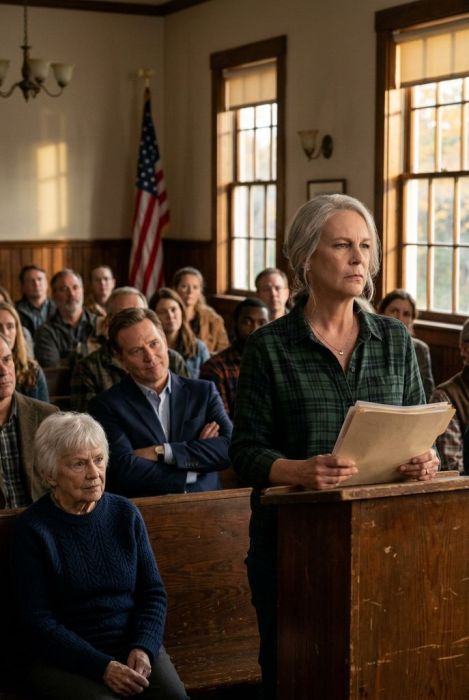
The senior center asked him to speak at a fraud awareness workshop that April. I sat in the back row, prepared to be proud and prepared to cry. Dad stood at the podium in his new polo shirt and told forty people about a woman named Delilah who danced like an angel and smiled like a friend. "If a stranger is in a hurry to love you," he said, "ask yourself why. If they tell you your own children don't understand you, that's the moment to look closer. I know. I fell for it." And then he looked out at the crowd and found me in the back row, and he said, "But my daughter — my daughter never stopped fighting for me. And she's the reason I'm standing here today."
I drive over every Sunday still. He makes the coffee now, and he does the crossword, and he has started line dancing again with a group of widowers who look out for one another. There is no Delilah in his life. There is only my father, laughing at the kitchen counter, roses blooming in the yard, and a peace we both fought hard to earn. Somewhere in a federal prison in Indiana, a woman in an orange jumpsuit is counting the years she stole from him — and the ones she will never take from anyone else again.