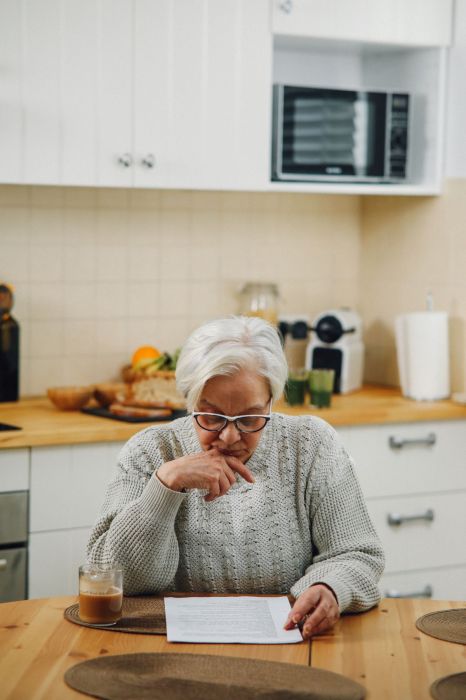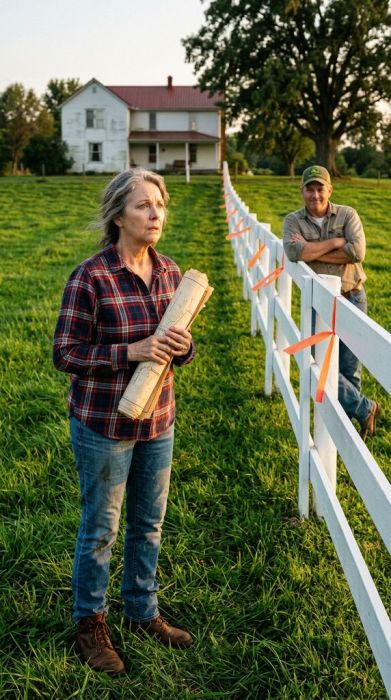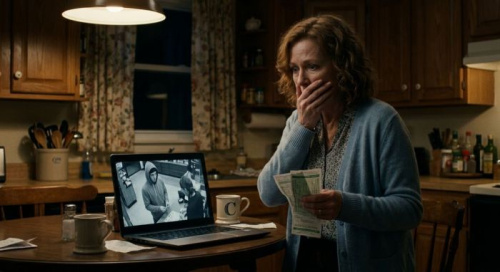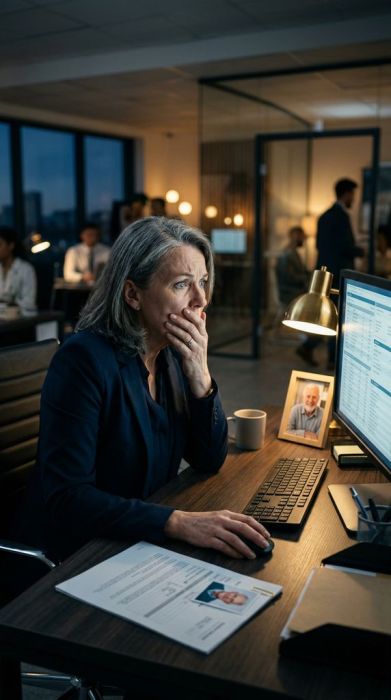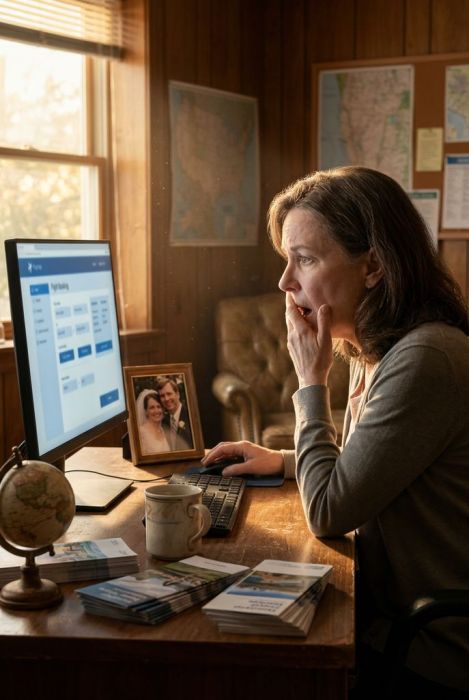

The envelope felt heavier than it had any right to be. Walt pressed it into my hands on the porch of my own house — the same porch where Mike and I had watched our babies learn to walk — and said, "Ellen, I'm sorry, but this has to be done." Behind him, the last funeral cars were pulling out of the driveway, their headlights sweeping the lawn like searchlights. I opened the envelope right there, still in my black dress, and read the words "Quitclaim Deed" before my knees gave way.
According to that piece of paper, my husband — the man I had buried that morning — had signed the farmhouse over to his father on April 12, 2019. "For estate planning," Walt said gently, which was the cruelest word I had ever heard him use. "Mike never told you. He didn't want to worry you. The house stays in the Mercer name, he said. That's what he wanted."
I stood in the doorway of the home Mike and I had built together for twenty-six years, and I could not find my voice. Because the strange, terrible thing was this: part of me almost believed him.
Mike and I bought this place in 1996 from Walt himself, who had inherited it from his own parents and could not wait to leave Holbrook, Ohio behind. He had been living in a condo in Naples, Florida ever since, calling us once a year at Christmas and reminding Mike, every single time, that he had "done him a favor" by selling cheap. Mike would hang up the phone and shake his head, and I would watch him stare out the kitchen window at the maple trees his grandfather had planted, and I would know he was thinking about the father who had never quite approved of anything he did.
That included me. Walt made it clear from the very first dinner he ever had at our table that I was the city girl — a Columbus transplant who had stolen his only son. He said it like a joke, the way people say hateful things and call it honesty. Mike would squeeze my hand under the table, and I would let it go, because that was who we were. We had been married long enough to know that love means choosing each other about a thousand times a day, and I chose him, and he chose me, right up until the morning he walked onto a job site last spring with his heart pounding and never came home.
He was fifty-six. He had left me a note on the counter that morning — he always did, a silly little thing about the coffee or the birds — and I still keep it in my Bible, worn soft at the creases. The kids came home for the funeral. Kyle, twenty-five, flew in from Charlotte, and Emily, twenty-one, drove up from Columbus, and the three of us stood in the cemetery holding each other while the minister talked about a man the whole town already missed.
Walt arrived two days later, suitcase in hand, to help. There was no refusing him. He was family, after all, and grief makes you say yes to things you would never allow in bright daylight. He took the guest room. He sat in Mike's chair at the kitchen table. He told me, kindly, that I should probably think about what a woman alone needs with a five-bedroom farmhouse.
It took exactly eleven days for the kindness to fall away. He came home from a walk one afternoon — the same walk that took him past the real estate office, I would learn later — and stood in the kitchen with that deed in his hand. "I've been patient," he said, "but the house belongs to the Mercer name. Mike knew that. You'll have thirty days."
Kyle wanted to fight. Emily wanted to fight harder. But I looked at that deed, at the signature that looked so much like Mike's — Walt had always said his son had his hand for signatures — and I felt the ground shift under me. Could Mike have signed it without telling me? He had kept things from me before, small ridiculous things, surprise trips and hidden chocolate. Could a man hide something this big?
Then I remembered the date. April twelfth, 2019.
I went up to the attic that night and pulled down the cardboard box marked Hospital. Mike had a ruptured appendix in April of 2019. He had been in St. Luke's in Springfield for six days, out of his head with fever and painkillers, and I had slept in a recliner beside his bed for three of those nights. I have a photograph from that week — the two of us, him in a hospital gown with an IV in his arm, me in yesterday's clothes, both of us grinning because he had just made the nurse laugh. There is a copy of the Springfield Journal-News in that box, bought from the gift shop, dated Tuesday, April 12, with his name on the crossword puzzle he had filled in with a pencil.
April 12, 2019. The exact date on the deed. The date my husband was in surgery, two hours away from any notary.
I sat on the attic floor with that photograph in my hands and wept, because I understood what it meant. Someone had made that deed with Mike's name on purpose — and it had not been Mike. The only person in the world who had been pushing "the house stays in the Mercer name" like it was a prayer was sitting downstairs in my kitchen, drinking my late husband's coffee.
I did not confront him. I do not know if I am proud of that or not, but I did what years of living with a complicated father-in-law had taught me: I smiled, I nodded, and I started quietly taking notes. I called the notary listed on the deed, a retired bookkeeper named Sandra Doyle, and asked if she remembered notarizing a quitclaim for Walter Mercer in April of 2019. There was a long silence, and then Sandra said, "Honey, I had my own hip replaced that April. I was not notarizing anything for anybody for four months. And I kept a commission log my whole career — you want me to find it?"
I drove to the county recorder's office pretending to be a confused widow researching the deed I had supposedly handed over. The clerk, a kind woman named Mary who had known Mike all his life, pulled the property records and frowned. The deed in Walt's hand had never been recorded. And the parcel number printed on it was the old parcel number, the one the county had retired during the renumbering in 2004.
Walt had copied that parcel number from an old tax stub. The kind of tax stub that sat in a desk drawer in the attic, twenty feet from where I had found the hospital box.
He grew bolder by the day. He had a moving company come out for a quote and left their estimate on the kitchen counter like a place card. He told Emily, when she called to check on me, that I had made it clear I was ready to downsize, and I had to listen to my own daughter cry over the phone before I could tell her the truth. He even brought a real estate agent into the house one afternoon, a slick young man from the agency on Main Street, to start the listing process.
I let him. I played the defeated widow in the black dress, the woman too broken to argue, and all the while I was building a wall of paper that would crush him. Sandra's letter arrived, with a copy of her commission log showing no Walter Mercer anywhere in April of 2019. St. Luke's sent me Mike's full medical records, stamped and certified, showing he was admitted on April 11 and discharged on April 17. Barb, my best friend since we were girls, worked in that hospital's billing department and walked the documents through herself, no questions asked.
The last piece was the one that nearly broke me. I called Raymond Feld, the attorney who had handled our wills, to ask what I could do about a forged deed — and Ray said, very quietly, "Ellen, you'd better come in."
Mike had gone to see Ray three weeks before he died. Not for a new will, because the will had been in place for years. He had gone to swear an affidavit, sitting in Ray's office in his work boots, still smelling of sawdust: "If my father ever shows up with a piece of paper saying I gave him the house, it's a forgery. I know him. He's been asking me to sign it over for years." And then he told Ray about the summer morning he had watched Walt photocopying old tax stubs in the attic, and about the typewritten draft he had found once in Walt's desk in Naples, a deed with a blank date and his own name typed at the bottom. Mike had closed the drawer and said nothing. He just came home, kissed me on the forehead, and started building walls around me that I never knew existed.
Ray handed me the affidavit and the trust papers. Mike, in those final weeks, had placed the farmhouse in a trust with me named as sole trustee and beneficiary. "He said to tell you, only if it ever came to this," Ray said, "that he loved you, and that the house was never the Mercer name. It was yours."
I sat in Ray's office and cried so hard I had to ask for a glass of water.
On the night of Walt's thirty-day deadline, I did the hardest acting of my life. I called the family together to sign the necessary papers, as Walt put it, and I set the kitchen table the way Mike used to set it for holidays — the good china, the linen napkins, the pitcher of sweet tea. Walt arrived in his best suit, freshly shaved, practically glowing. Carol, Mike's sister, came down from Cleveland with her husband. Kyle stood by the window with his arms crossed. Emily held my hand under the table.
Walt placed his copy of the deed on the table, and Raymond Feld placed a folder beside it. Walt looked at Ray, then at me, and his smile started to flicker. "What's this?"
"An audit," I said, and I opened the folder.
I laid it out the way Mike used to lay out his blueprints: the photograph from the hospital, dated and time-stamped. The Springfield Journal-News with the crossword filled in. St. Luke's certified records. Sandra's letter and her commission log. The recorder's office confirmation that the deed had never been recorded, and the parcel number that belonged to a county that no longer existed. And then Mike's affidavit, with a notary's seal from Raymond Feld's own office.
Ray read the key lines aloud, his voice steady: "I have never signed, and will never sign, any document transferring the property at 214 Maple Lane to my father, Walter Mercer. Any such document, now or in the future, is a forgery."
Walt stood up so fast his chair scraped the floor. "This is a conspiracy," he said. "That woman turned my son against me. She's been poisoning him for twenty-six years." He pointed that shaking finger at me, and for one split second I saw fear underneath the rage, real fear, the kind a man feels when he is finally cornered in his own lies.
And then Carol pushed back her chair and said the words I will never forget: "Dad. I found the draft. In your desk in Naples. The one with the date left blank, and your practice lines in the margin — you wrote Mike's name forty times, over and over, like you were learning penmanship."
The room went still. Walt stared at his own daughter like she had hit him.
"It was in the bottom drawer, behind the tax files, the spring I flew down to help you after Maxine passed," Carol said. "I told myself I was seeing things. I told myself you would never."
The deputy from the county sheriff's office came in through the back door, exactly as arranged, because Ray had filed the forgery report the week before. Walt's mouth opened and closed like a fish on a dock. They read him his rights in Mike's kitchen, in front of Mike's family, and the last thing he said before they took him out was my name, low and ugly, like a curse he had been saving up.
I did not answer him. I just watched the cruiser lights sweep across the maple trees his own grandfather had planted, and I thought about the note Mike had left me that last morning, the one about the coffee and the birds. He had known. He had known his father was capable of this, and he had built a wall around me anyway, brick by brick, while I slept in a recliner beside his fevered bed.
Walt fought for eight months. He hired a lawyer with money he clearly did not have, and the district attorney's office built a case that was beautiful in its simplicity — the hospital records, the notary's log, the wrong parcel number, the photograph Carol had snapped of the draft deed in that bottom drawer in Naples. Two other families came forward in the end, small claims from years earlier, old feuds where Walt had helped widows and cousins with their paperwork. The judge was not gentle. Walt pleaded to attempted fraud and forgery as part of a deal; he lost the Naples condo to legal fees, lost his place in the church directory, and lost his phone calls home because his own daughter stopped answering.
The house stayed mine. Not because of the Mercer name, but because my husband had chosen me, out loud and on paper, with his boots still on and his sawdust in the air.
Emily moved home that spring. She had always had a gift for growing things, and she spent the whole summer turning the old barn into a little flower stand — Emily's Blooms, she called it, with a hand-painted sign that made me laugh and cry in the same breath. Kyle comes home more than he used to; he repainted the porch swing this fall, and one evening he sat with me on it, quiet, and said, "Dad would have loved how you handled it."
I think about Mike every single day. I still keep his note in my Bible. But somewhere in the middle of all that cruelty, I learned something I did not expect: a home is not a name, and it is not a piece of paper, and it is not a father's ledger of what he thinks he is owed. A home is the people who show up for you when the world gets ugly, and the quiet plans someone made in the dark so you would never have to stand alone.
The maple trees are turning gold now, the way they always do in late October. Emily hung a string of lights along the porch rail, and Carol comes down from Cleveland once a month, and the three of us sit there with sweet tea, women who chose each other. Walt's letters go unanswered. The deed sits in a box in the attic, next to the one marked "Hospital," and I like to think of it as what it is: the proof that love builds fences stronger than any forged paper can ever climb.