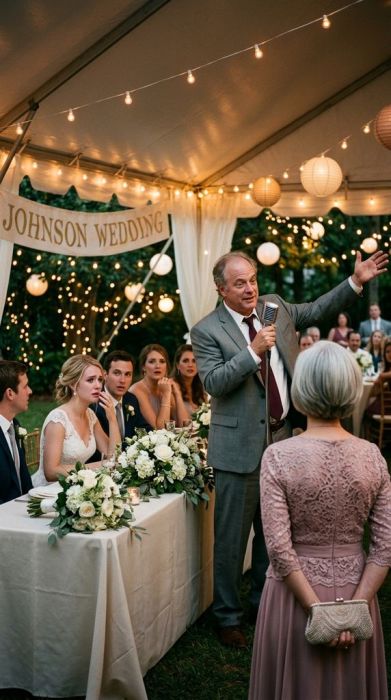
When Gary Whitman grabbed the microphone at my daughter's wedding, the music died like someone had unplugged the world. The band froze mid-note. Emily's smile slid off her face. And I went colder than I'd been in twenty-three years.
"Ladies and gentlemen," Gary said, spreading his arms wide like a man about to receive an award. "I'm Emily's father. And I have something to say today."
I was on my feet before I knew I'd moved. My sister Carol grabbed my wrist, and I felt the weight of everything I'd carried for twenty-three years settle into my bones. Because Gary Whitman wasn't just late to this party. He was early. He'd been circling for months, sniffing around, counting the money he believed he was owed.
I didn't scream. I didn't run. I walked slowly toward the head table, the way you approach a rattlesnake you know is coiled in your path. Because I knew exactly what he was about to do. I'd known since Tuesday, when he showed up on my porch in Savannah with a smile and a proposition that turned my stomach.
I met Gary at the county fair in the summer of 1994, when I was nineteen and dumb enough to believe a handsome stranger who could sell ice to a widow in January. He sold me a future — a little house, a couple of kids, a whole life. We were married six weeks before I turned twenty-one, and Emily came two years later.
For a while, I believed in the life he sold. But the life had holes in it. The commissions dried up. The gambling started. The nights he didn't come home kept adding up. By the time Emily was three, the only thing Gary contributed was a stream of promises he never kept and a stack of bills I paid alone.
Then, one rainy Tuesday, he packed his father's duffel bag, stood in the doorway of our little rental on Waters Avenue, and told me he was done. "Daddy, don't go," Emily said from behind my legs. I can still hear her tiny voice. I can still see the way Gary didn't even look at her.
"I'll send money when I can," he said, the way other men say "have a nice day." He never sent a penny. Not one. The state finally caught up with him four years later and handed me a judgment for thirty-four thousand dollars in back child support.
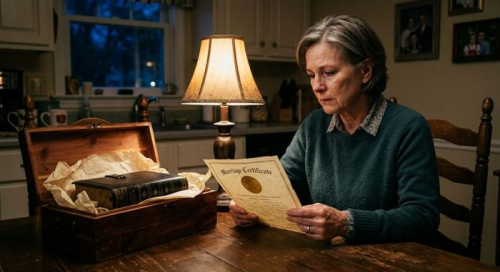
Gary's answer was a notarized document — I still have it, yellowed now, his handwriting as smooth and slippery as he was — voluntarily relinquishing all parental rights and responsibilities for Emily in exchange for release from the arrears. He signed it in front of a judge in 2002. The judge looked sick doing it. But a deal was a deal, and I took it, because I needed him gone more than I needed the money.
After that, Emily grew. She stopped asking if her daddy still loved her. She learned to be fierce instead of fragile. I worked medical billing by day and took catering jobs on weekends. I taught myself to decorate cakes from library books, and when Emily turned twelve, I started a small event business from my kitchen.
Those were lean years, and I mean lean. There were Christmases with one gift under the tree and a ham we stretched for three meals. Emily never complained. She drew family pictures with just two people in them — her and me — and I hung every single one.
By her senior year, I could finally breathe. Then Marcus came along, a gentle high school science teacher with kind eyes, and Emily lit up like a Christmas tree. Two nights before the wedding, I asked her if she wanted me to try to find her father and tell him she was getting married.
She looked at me for a long moment. "Mom," she said, "he's not my father. He's just a man I used to be related to." She had my mother's spine. God, I was proud of her.
Gary found out about the wedding through the announcement in the local paper. On Tuesday, he appeared on my porch, softer in the middle, grayer at the temples, but with the same calculating eyes. He said he wanted to "be there for Emily." I refused. His smile never slipped.
"Maggie, let's be smart about this," he said. "She's got that trust fund from your daddy — and from my mother? I'm her father. I'm owed." My father had left Emily a trust, a hundred and twelve thousand dollars, for her wedding or her first home. And Gary's own mother, Violet, had cut him out of her will entirely and left Emily her pearls and a small inheritance, because he'd drained her accounts during his gambling years.
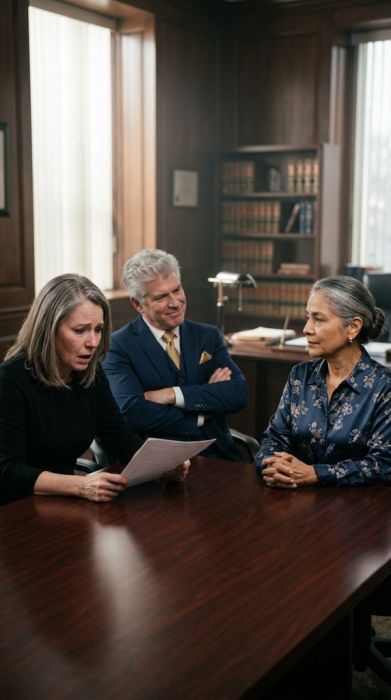
"If you don't want a scene at the wedding," Gary said, "write me a check for fifty thousand. I'll be a stranger again. I promise." He told me what he'd do if I refused — tell everyone I'd kept his daughter from him, poison her reputation, make the wedding about him — and I let him talk, all of it, while the phone in my apron pocket recorded every word. Carol is a retired court reporter. She taught me long ago that the best seat in any courtroom belongs to the one holding the tape.
I didn't call the police, because I had nothing to charge him with yet. I didn't warn Emily, because I refused to let him shadow her wedding day. Instead, I made copies. Carol slid the recording to Brian, the DJ — a friend of Marcus's since high school — with one quiet instruction: "If the man with the microphone says the words 'trust fund,' play the file." And I folded three documents into my clutch, next to my lipstick, where I would keep them for the rest of my life.
The day of the wedding was perfect until it wasn't. The garden was glowing, the tent was strung with a thousand lights, and Emily looked like something out of a dream. I saw Gary before the ceremony began, standing at the back near the roses, and my heart dropped. He slipped into a seat in the last row and watched his daughter walk down the aisle like a man at an auction, estimating the table.
Emily's eyes met mine halfway down. For a heartbeat, I saw her waver. Then she lifted her chin — my mother's chin — and walked the rest of the way steady, straight into Marcus's waiting hands.
At the reception, Gary found me by the dessert table. "Last chance, Maggie," he murmured, close enough that his breath smelled of whiskey. "Fifty thousand, cash or check. Or I make this wedding a story everyone in Savannah remembers."
"You already made it one, Gary," I said. And I walked away.
An hour later, he grabbed the microphone.
"This is my daughter," he said, gesturing at Emily, who had gone white. "And nobody — not her mother, not anybody — was going to keep me from her big day. Emily, sweetheart. Daddy's here."
A few people clapped, the way you clap for a stranger's speech at a funeral. Most sat frozen. Marcus's hand found Emily's under the table. I saw her knuckles go white.
"Now," Gary said, and his voice slid into that oily salesman's tone I remembered too well, "there's a matter of business we need to settle. My mother, Violet Whitman — God rest her — left money and property to her granddaughter. My granddaughter. But my ex-wife here has been holding it back. So I've asked my attorney to join us today."
A man in a too-new suit stood up near the back, holding a folder. He nodded at the room like a game-show host. David, Carol's husband — a real attorney, licensed and boring and wonderfully decent — leaned over and murmured, "Never seen him before in my life."
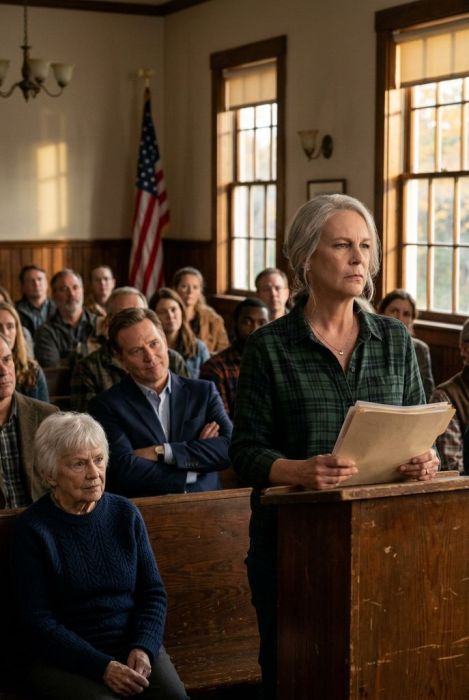
I stood up. The whole room turned to me. "Gary," I said, and my voice carried the way it used to when Emily was small and I needed her to hear me across a crowded park. "You want to talk about what you're owed? Let's talk."
I nodded at Brian. And from the speakers, Gary's own voice filled the tent: "She's got that trust fund from your daddy... I'm her father. I'm owed. If you don't want a scene at the wedding, write me a check for fifty thousand. I'll be a stranger again."
The silence that followed was enormous. Gary's face went from red to gray in about four seconds. Somewhere, a woman gasped. I opened my clutch.
"Twenty-three years ago," I said, "this man walked out on a three-year-old girl and never paid a dime of child support. When the state came for the money, he signed this." I held up the notarized document, dated and stamped with the judge's seal. "He voluntarily gave up every right to Emily. He has no standing to claim her trust, no standing to speak at her wedding, and no standing to call himself her father."
"That's a forgery!" Gary shouted.
"It's your signature," I said. "Take a closer look. I've kept it in a fireproof box since 2002." I held up the second paper. "And this is your mother's will, filed with the probate court. Violet Whitman disinherited you and left everything she had to Emily." I paused. "You drained your own mother's accounts, Gary. She wrote about it in a letter. Would you like me to read it aloud?"
Gary's jaw worked but nothing came out. The man in the too-new suit had gone very still. Emily was standing now, tears streaming down her face — but she wasn't crying like a hurt child. She was crying like a woman setting down a weight she'd carried since she was three.
"You have no idea what you're doing," Gary hissed at me.
"I have every idea," I said. "I've been perfectly clear for twenty-three years. The only person who was ever confused is standing at that microphone."
The fake attorney folded his folder and began to edge toward the exit — straight into the broad chest of David, who asked him, pleasantly, "Bar number, counselor?" The folder dropped. Papers scattered. Somebody recognized him from a roofing scam over in Valdosta. And then the rear doors of the tent opened, and two Savannah police officers walked in.
Gary saw them and went pale as the sea. There was an outstanding warrant for him in Florida — he'd been running a roofing company that took deposits in cash and never put a roof on a single house. The officers were pleasant about it, the way they always are when the cuffs come out. "Gary Whitman? You're going to need to come with us, sir."
"This is a wedding!" he shouted as they took his arms. "You can't do this here!"
"Sir," one of the officers said, "you've been arrested at your ex-wife's house in 1998, at your mother's funeral in 2007, and outside a casino in Biloxi in 2015. You really want to argue with the venue?" Someone laughed — a small, shocked laugh, and then another, until the whole tent exhaled at once.
Gary Whitman was escorted out of my daughter's wedding in handcuffs, shouting threats and promises that meant nothing to anyone. The band looked at me. I looked at Emily. And Emily — my brave, fierce girl — walked across the dance floor, grabbed my hands, and said, "Mom. Dance with me."
The band started playing "My Girl," and we danced, mother and daughter, while the guests stood and clapped, some of them crying, and the tent filled with the sound of a family finally whole. Marcus joined us halfway through, then Carol, then David, and by the end, half the reception was on the floor, laughing and crying at the same time.
The trust fund went to what it was always meant for. Emily and Marcus bought their first home — a little blue farmhouse on the outskirts of Savannah with a porch big enough for two rocking chairs. My father's old leather chair sits in the corner of their living room, and Violet's pearls hang on the bathroom mirror, gathering light.
Gary's trial made the papers for two days. He'll be in prison for a good long while, and when he gets out, he'll find that his mother's house — the one he tried to sell out from under everyone — went to his granddaughter instead. He'll never touch a cent of it.
I still have the recording. I still have the documents. I don't need them anymore, but I keep them locked in the fireproof box, because they remind me that justice doesn't always ask for permission. It waits. It gathers. And then, at the most public moment you could imagine, it arrives wearing a dusty-rose dress and carrying a clutch full of proof.
Sometimes, late in the evening, I think about Emily dancing that night, lighter than she'd ever been. And I remember what she said when I tucked her in twenty-three years ago, her tiny hand wrapped around my thumb: "Mama, it's just you and me now." "I know, baby," I told her then. I was never wrong about that. The two of us were always enough — and now, with Marcus and Carol and the little farmhouse and the quiet peace of a life finally settled, we are exactly what we were always meant to be.