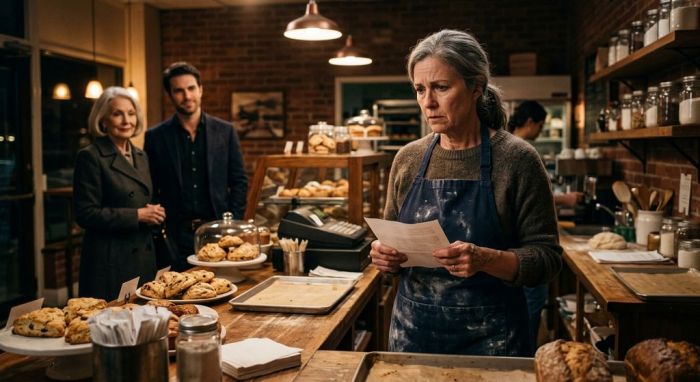
The first time I set eyes on Derek Ashford, I told myself to be grateful. My daughter Emily had been single for too long, burying herself in twelve-hour shifts at the hospital, coming home to my kitchen with shadows under her eyes and a weariness that broke my heart. So when she walked through the bakery door one November morning with a tall man whose suit cost more than my monthly mortgage, and she was smiling in a way I hadn't seen in years, I swallowed every instinct I had and smiled back.
"Mom, this is Derek," she said, and her voice trembled with happiness. "He's in commercial real estate. He works in Burlington."
Derek extended his hand, and his grip was warm and firm, his gaze steady. "Mrs. Callahan. Emily talks about you nonstop. I feel like I already know you." He glanced around my little shop, at the faded checkered curtains, the warped wooden shelves, the chalkboard menu I'd repainted a hundred times. "This place has charm. I love it." His eyes lingered a moment too long on the prime Main Street corner the building sat on, and something cold settled in my stomach that I couldn't name.
I named it later, when it was almost too late.
For a year, Derek was perfect. He sent Emily flowers every Friday. He learned my name for her coffee order. He charmed my whole congregation at the Hartwell Methodist Church potluck, praising my sourdough until old Mrs. Vandermeer nearly cried. He even helped me haul fifty-pound sacks of flour when my back gave out one humid afternoon. He was patient, attentive, just the way a man in love should be. And I wanted so badly to believe it.
Then Priscilla arrived.
Derek's mother flew in from somewhere in Connecticut for the engagement dinner, a sculpted woman in her sixties with a diamond the size of a grape on her ring finger and eyes that swept my bakery like she was already measuring it for demolition. "Margaret," she said, drawing my name out with practiced warmth that never reached her face. "I've heard so much. Derek says you've been here three decades. That's so quaint."
Quaint. The word hung in the air like smoke.
The engagement was announced at the end of that dinner, under the string lights I'd borrowed from Father Mike. Derek dropped to one knee in front of the register, and Emily's laughter rang through my little shop like church bells. Everyone clapped. I clapped too. But I watched Priscilla watching the deed on the wall behind the counter, and I knew with the bone-deep certainty of a woman who had read people for thirty-two years across a bakery counter that I had not met a kind mother. I had met a predator, and she had brought her hunting partner.
It happened three weeks before the wedding.
Emily was on a night shift, and Derek came by "just to say hi," the way he sometimes did, though he rarely bought anything and never sat long. I was kneading dough for the morning loaves, and he stood at the counter with that practiced smile and slid a manila envelope across the worn wood.
"Signature needed, Mrs. Callahan," he said lightly. "For the venue. A formality."
I wiped my hands on my apron and opened the envelope. It was not a venue form. It was a transfer of ownership agreement for Callahan's Bakery, drawn up in legal language I had to read three times, and beneath it, a gift deed naming him as sole proprietor.
My hands went very still.
"Emily and I want to secure our future," Derek said, and his voice had lost its warmth, turning silky and wrong. "This property is tied up in your name, and the bank has been difficult about the wedding loan. If the bakery were in our joint name, everything would be easier. It's just a gift, Mrs. Callahan. You'd still run it. Of course you would." He smiled. "You're getting older. You'd want someone to handle the paperwork, wouldn't you?"
I heard what he was really saying, and it sounded like a threat wearing a wedding bow.
"I'll need to think about it," I said, and my voice came out calm, though my heart was a trapped bird.
Derek's eyes went flat. "Emily is counting on this date. The venue, the vendors, the honeymoon—everything is paid for. If the paperwork isn't done by the end of the week, there won't be a wedding on the sixteenth." He slid the envelope closer. "Sign it tonight, Margaret. While you still have the chance to make your daughter happy."
After he left, I stood in my silent bakery for a long time, staring at the flickering light over the register. This was the shop my husband Frank and I had scraped and saved for, tile by tile, loan by loan, three years before the cancer took him. Every birthmark in the linoleum was a memory. Every crack in the floor was a year of my life. And I understood, with a chilling clarity, that Derek Ashford had not proposed to my daughter. He had proposed to my building.
I didn't sign.
For three days, Derek made good on his threat. The engagement was "postponed." Emily wept on my shoulder, begging me to understand, asking what I'd done wrong. I couldn't tell her, not yet, because I didn't have proof, and a mother's instinct is not an arrest warrant.
Then, on the fourth afternoon, old Pete Worthington shuffled into my shop for his usual black coffee and a bear claw. Pete had been a detective in Burlington for forty years before retiring to Hartwell to fish and gossip. He took one look at my face and sat down heavily on the stool at the end of the counter.
"You look like a woman who's been handed a bad apple and told it's a peach," he said.
I poured him his coffee and told him everything. All of it. The deed, the threat, Priscilla's measuring eyes. Pete listened without interrupting, which is rare for a man who talks to seagulls. When I finished, he set down his mug with a soft click.
"Ashford," he said slowly. "Derek Ashford. Commercial real estate out of Burlington."
"You know him?"
"I know a case file." Pete leaned forward, and his voice dropped. "Five years back, there was a woman in Rutland, ran a carpet store her father left her. Engaged to a charming developer named Ashford. He pressured her to transfer the property into their joint names, 'as a wedding gift.' She signed two weeks before the ceremony. He sold the building to a strip-mall developer, stopped the wedding cold, and the money walked." Pete shook his head. "She fought it in court for two years and lost. I don't know the name behind the corporation. But I remember the pattern."
My blood ran cold. "Why didn't he end up in prison?"
"Because it wasn't fraud on paper," Pete said. "She signed it willingly. Gifts are gifts, Margaret. The law won't uncook that soup." He looked at me with old, kind eyes. "But if he's done it before, he's done it twice. And there might be more victims who aren't ashamed to talk."
That night, while Emily cried in her room, I opened my safe and pulled out the box of papers Frank and I had kept for thirty years. I found the title, the deed, the tax records, everything. And I found something else—a letter I'd almost forgotten, signed by Frank's old lawyer, confirming that when Frank passed, the building was mine free and clear, with an ironclad clause that it could never be pledged, transferred, or sold without my signature, witnessed by two people and notarized. Frank had been a cautious man. He'd protected me from beyond the grave.
The next morning, I called Pete's old partner still on the force in Burlington. I didn't get Derek arrested—not yet. I did something better. I gathered evidence.
For a week, I played the fool. I giggled nervously whenever Derek or Priscilla talked about "the eventual transfer." I let Derek believe I was warming to the idea. And all the while, my regulars—a whole town of retired teachers, farmers, and fishermen who had been coming to my counter for decades—became my quiet army. The man who ran the print shop down the street found a shell corporation called Ashford Holdings with four other small-business properties tied to it. The widow who sold real estate part-time dug up the Rutland carpet store's sale records. Even old Mrs. Vandermeer, who pretended to be deaf when it suited her, "happened" to overhear Priscilla on the phone one afternoon discussing a developer's offer for "the corner lot on Main."
I fed every scrap to Pete, and Pete fed it to his old partner, and slowly, a case began to take shape that a real prosecutor could actually run with.
Then came the night before the wedding.
Emily believed the wedding was back on—Derek had "forgiven" my hesitation and agreed to keep the date. She was radiant, fitted in her white gown, surrounded by lace and hope. And Derek cornered me in the back office of my bakery with a fresh set of papers and a pen.
"Sign it now," he said, and his warm charm was gone entirely, replaced by something hard and impatient. "The wedding is tomorrow. You've had your little bout of cold feet. Play the loving mother, Margaret. Give your daughter her day." He tapped the signature line. "Or I walk, and I take her heart with me."
"This isn't about Emily," I said quietly. "It never was."
Priscilla appeared in the doorway, sleek and furious. "The corner of Main is worth a fortune to the right buyer, and Derek has waited long enough. You will sign that paper, or we will make your life a very public misery."
And that was when the back door of my bakery opened, and Pete stepped in with a Burlington detective in a plain suit, and behind them, a woman with tired eyes and a crisp folder—the carpet store owner from Rutland, who had flown up to tell her story to anyone who would finally listen.
Derek's face went white. Then red. "This is harassment. This is—"
"It's fraud, Mr. Ashford," the detective said, and he read Derek his rights there in my flour-dusted kitchen ringed with rolling pins, while Priscilla sputtered and lunged for the papers and I simply stepped back and let thirty years of my life fall out of the mouth of a liar.
They took them out in handcuffs, past the shocked faces of a few early customers, past old Pete grinning like a man who'd just landed a prize fish. I didn't watch the cruiser pull away. I walked through my empty shop, ran my hand over the counter where Frank and I had learned our first recipe together, and I thought about how love and grief and flour all get mixed in the same bowl and you never quite know what you're baking until it's done.
Emily found out that night, in my kitchen, over a cup of the same chamomile I'd given her as a frightened little girl. She cried until her shoulders shook, and I held her and let her cry, because some truths have to bleed before they heal.
"He never loved me at all," she whispered.
"No," I said softly. "He loved the corner of Main Street. And that, my darling, was never yours to give away."
Derek Ashford and Priscilla were charged with fraud, identity theft, and attempted theft by deception. The prosecutor found three more former fiancées, women in four states, all of them small-business owners with beloved shops and prime real estate. Derek had been running the same con for more than a decade, and this time, the evidence came with a paper trail three inches thick and an entire town that refused to stay quiet.
Emily grieved the way a person grieves a death, because in a way it was one. But she is a nurse, and nurses know that you cannot spend your life weeping over a wound you're going to heal. Six months later, she started dating a gentle man from the hospital's cardiology wing, a quiet redhead with flour on his elbows because he had started coming to my Saturday bread classes to make his grandmother's recipe. He loves her without conditions, and I have watched my daughter learn to be loved properly, which is a gift no amount of money could ever buy.
As for my bakery—the town rallied around it after the story spread, the way small towns do. They held a "Keep Callahan's Open" supper, and the mayor presented me with a plaque calling my shop the heart of Hartwell. Business has never been better. The corner of Main Street that Derek and his mother had hungered after, that they had been willing to tear down decades of my happiness to possess, is still mine. It is still warm bread and morning light and the smell of cinnamon. It is still the place where my daughter met a man who was worthy of her.
And on the first anniversary of the day they locked Derek Ashford away, I added a small brass plaque above my register, hidden where the careful eye would find it. It read: To Frank, who built this. To Emily, who fills it. And to the whole town who knew the difference between a gift and a theft.
Pete never paid for another bear claw after that. He insists I keep a tab, and I pretend I don't see him leave a twenty in the tip jar when he thinks I'm not looking. Some debts, I've learned, are sweeter when they're never quite settled.
Every morning when I open my shutters and the light spills across the floor Frank and I laid by hand, I think about how the corner of Main Street nearly became a lesson I couldn't afford. But Hartwell taught me the truth: a home is not a price on a piece of paper. It is the people who will stand beside you with a phone number, a photograph, and a memory of your name, ready to fight for you the way you fought for everything they love.
The bakery still stands. The wedding that almost wasn't became the foundation of a sweeter life than any of them could have stolen. And somewhere in the haze of my mornings, I swear I can still hear Frank's voice whispering over the rising dough.
"Keep it safe, Maggie," he says. And I do.