The call from Heartland Savings came at 9:14 on a Tuesday morning, and I will remember the exact pitch of the young woman's voice on the other end of the line for the rest of my life.
"Ma'am, this is just a confirmation call," she said. "We're processing a wire transfer of forty-two thousand dollars from your account."
"I didn't authorize any wire," I told her.
There was a pause, then the soft click of a keyboard. "Ma'am, the request came through online banking at 6:03 this morning, from a device we have on file for you. The recipient name is Lauren Halbert."
Lauren. My daughter. My only child.
I sat down at the kitchen table. The room felt suddenly cold, even though the September sun was already warming the wallpaper Frank and I had hung together forty-one years ago.
"Ma'am, are you still there? We need to know whether to process this."
"No," I said, and my voice came out steadier than I felt. "Do not process it. Freeze the account. I'll be there within the hour."
I hung up and stared at the wall. I had wanted Lauren's wedding to be beautiful. I had wanted her to be happy. I just never imagined she would try to buy that happiness with the account Frank had built through thirty-eight years of electrician's work. But here is the strangest part: I wasn't surprised. Not really.
What I was, was grateful. Because I had something sitting on the second shelf above my stove — an old blue ceramic cookie jar that Frank's mother gave us the year Lauren was born — and it had quietly become the only thing in my life that still told the truth.
Frank died three years ago on a Thursday, ten minutes into fixing a lamp in the garage. No warning, no goodbye, just the quiet end of a good man. He left me the house on Elm Street, a nine-year-old Honda, and a retirement fund we had never touched except for true emergencies. With my teacher's pension and my Social Security, I didn't need much. We weren't rich. But I was safe. Frank had said that word — safe — like it was the entire point of a life.
Lauren is thirty-four, a personal banker at Midlands Bank in Des Moines. She's sharp, she's beautiful, and she has been chasing one thing her whole life: belonging to people like the Ashcrofts. Brett Ashcroft proposed in February. His father Don owns a chain of car dealerships, his mother Marianne runs a charity gala every spring, and they live in a house in West Des Moines with a fountain in the front yard. I liked Brett. I did. He was kind, a little quiet, almost embarrassed by the money. I told myself Lauren would be happy now.
Then she showed up at my door with a bridal magazine and a plan.
"Mom, the Ashcrofts are going to expect a certain kind of wedding. The venue alone is eighteen thousand. I can't have them thinking I'm some nobody who doesn't fit in."
"Sweetheart, they don't think that."
"You don't know them like I do, Mom. You don't know how they look at people."
She was so bright about it that I let it go. I gave her seven thousand toward the venue. A month later, four thousand for the caterer. Then three thousand more for the wedding planner, because the planner was the one who made everything happen, according to Lauren. She hugged me every time. She called me three times a day. It felt like the old Lauren was back, the little girl who used to help me bake and begged me to read her the same story twice every night. I told myself this was what the money was for. Her happiness.
Then, in July, the first strange thing. A credit card I never applied for arrived in the mail, in my name, with a limit of twelve thousand dollars. When I called the issuer, the account had been opened online two weeks before, using my Social Security number and my address. I filed a fraud report and froze my credit with all three bureaus that same afternoon.
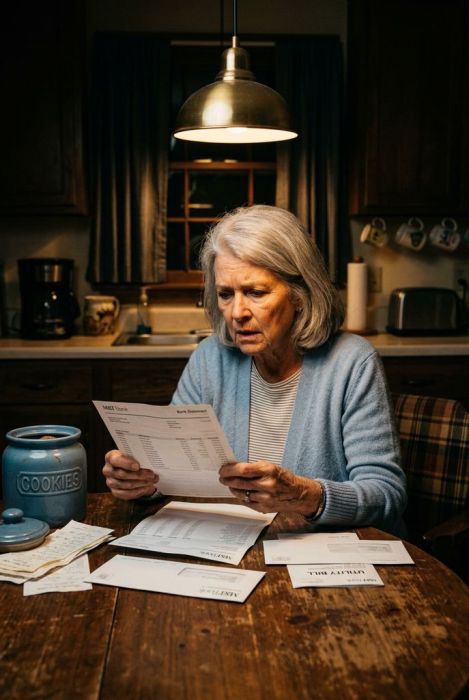
And that, more than anything else, was what changed me. I stopped trusting the invisible world of online banking. I started doing what my mother had done: I printed every statement, and I kept them in the cookie jar on the second shelf, tucked between the flour and the sugar. Forty years ago, that jar had held Frank's mother's sugar cookies. Now it held the only records I trusted.
It also made me careful. In the second week of August, I walked into Iowa Prairie Credit Union downtown and opened a savings account in my name alone. Over the next three weeks, I moved the bulk of my retirement there in small pieces — under the radar amounts, the way Frank used to say he'd never put all his eggs in one basket. I left forty-two thousand dollars in Heartland, out in the open, because it felt paranoid to take everything. I told myself I was being silly.
The day before my sixty-ninth birthday, Lauren came over with a form. "Mom, I want to be on your account in case something happens," she said. "If you get sick, I can pay your bills. It's just easier." She held my hand across the table, and there were tears in her eyes. So I signed, and she was on the account the next business day.
I should have seen it sooner. The way she kept asking what my total was, curious in a new way, like a banker who smells fees. The way she stopped arguing when I said I wanted to be buried next to her father, like the house and everything in it was already spoken for. The way she looked at my furniture, my china, my grandmother's silver with a measuring, appraising eye. But I didn't see it. I saw my daughter, and I was lonely, and loneliness makes you generous past the point of wisdom.
Then came the Tuesday morning. The 9:14 call. The wire. What I didn't know yet was that Lauren had been quietly testing the waters for weeks. Small transfers, under the reporting radar: two thousand here, three thousand there, a little siphoned planner deposit that went into her own account at Midlands. She had spent nine thousand of it on a designer dress and two wedding deposits before she ever tried the big grab. She needed it fast, because the final venue payment was due in the morning and the wedding was ten days away.
So at 6:03 that Tuesday, she logged into my Heartland account with the access I had given her. She set up her own account as a payee — a new payee, and a big one. That is what saved me. Banks get nervous when a sixty-nine-year-old wires her entire visible balance to her thirty-four-year-old daughter at six in the morning. Heartland's fraud team called to confirm.
And I said no.
Ms. Delgado, the fraud specialist who took my call that day, was the kind of professional who has heard every sad story in the book and still believes the next one. She placed a freeze on my account within minutes. She had the pending wire reversed before settlement, and she flagged the earlier transfers with a single word: pattern. Then she told me the part that made my head spin.
"If you hadn't caught this today, Lauren would have had everything by Friday. The way she set it up, she would have been gone before the wedding with the whole thing."
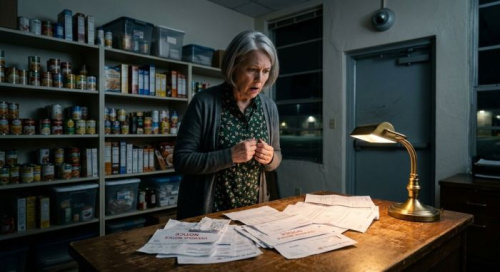
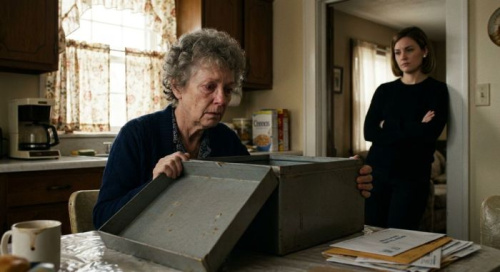
I thanked her, hung up, and sat in my kitchen for a long time. Then I walked to the shelf, lifted the blue cookie jar, and spread the paper statements out across the table like a winning hand I hadn't known I was holding. My credit union statements showed one hundred forty-four thousand dollars, safe, in my name alone. My Heartland statements showed the exact trail of Lauren's quiet little transfers — six of them, all the same shape, all dated on days she had called to tell me she loved me. The July fraud report was there too, the credit card she had opened in my name and tried to use before I froze it.
I didn't cry. Maybe because some small, stubborn part of me had been waiting for this — the way you wait for a storm you saw building for months. I called the Polk County Sheriff's office and filed a report. The detective who came to my house, a young man named Avery, spent fifteen minutes with the cookie jar and said, "Ma'am, this is the cleanest elder-fraud case we've seen in a year." Then he asked me a question that surprised me.
"Do you want to press charges? Or do you want to handle it privately?"
"I want her to look me in the eye," I said.
I told no one. Not Lauren, not Brett, not the Ashcrofts. I went about the next ten days quiet, polite, and watching. When Lauren called to ask about the wire, I let it ring, and then I told her the bank had put a hold on my account for suspicious activity and I was getting it sorted out. She went very quiet on the other end of the phone. I could hear her wedding unraveling, one thread at a time.
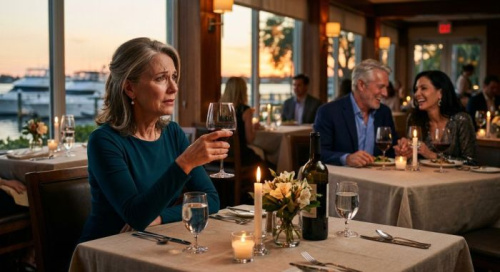
The rehearsal dinner was Thursday night at the country club, two days before the wedding. Fifty-three people and a hired harpist playing in the corner. I wore the blue dress Frank had always loved and sat at the table with the Ashcrofts like a woman who had nothing to hide.
Lauren was a wreck and trying not to show it. The venue had called that morning demanding the final payment. Her account at Midlands was thin. The wire had never landed. She had plastered a smile on her face, but I saw her hands shaking when she raised her champagne glass for the toast.
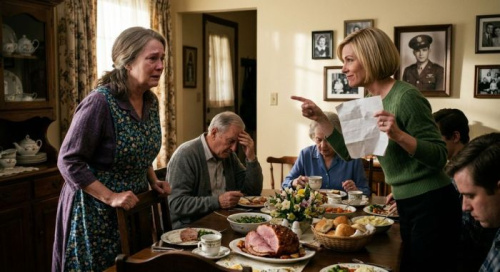
"Mama," she said, standing at the head of the table, "I want to thank you for the most generous gift any mother could give. She's given us the wedding of our dreams, hasn't she?" She turned to the room with that brittle, brilliant smile. "A toast to my mother — the woman who paid for all of this."
There was polite applause. And Don Ashcroft — quiet, sharp-eyed Don, who at that moment was buttering a roll — looked at me for a long second before glancing down at his plate.
I stood up. I had folded, inside my clutch purse, exactly three pieces of paper: my Heartland statement, my credit union statement, and the July fraud report.
"I did save for years," I said, and my voice carried the way it used to when I was a teacher and the whole class had gone quiet. "That's the whole problem. I saved it, and somebody tried to take it."
"Mom," Lauren laughed, a little too fast, "you're confused. You're always confused lately."
"Lauren, I am not confused," I said. "I have never been less confused in my life."
Then I handed the papers to Don Ashcroft. Not to her. To Don.
"Mr. Ashcroft, you have every right to know what you're marrying your son into. That first page is a frozen wire. Forty-two thousand dollars, from my account to my daughter's, stopped at nine-fourteen on Tuesday morning. The second page is a credit union statement showing where I moved the rest — in my name, over three weeks, starting the day I found the credit card she opened in my name. And the third page is the fraud report I filed in July. I'm not asking for your sympathy. I just can't be toasted for a crime."
Lauren tried to laugh again. "Mom has dementia, everyone. She's been getting confused for months. I was going to take her to the doctor next week, I swear."
And that's when Don Ashcroft, retired from thirty years at the Federal Deposit Insurance Corporation, set down his fork and said, very quietly, in a voice that carried to every corner of that room:
"Lauren. I investigated bank fraud for three decades. You want to try that again?"
I have never heard a room go silent that fast. Brett's face went white. Marianne folded her napkin and stared at her plate. Someone at the far end whispered, "Should we call the car service?" And Brett — sweet, quiet Brett, who I had liked from the first dinner — slid his chair back, pulled the ring off his finger, and set it on the tablecloth between the salad forks.
"I'm sorry, Nora," he said. "I'm so sorry."
The Ashcrofts left together without another word. Marianne paused at the door, came back, and squeezed my hand. "You raised her with so much love, Nora," she whispered. "This isn't your shame. It was never your shame."
Lauren stayed at the table a long time after everyone was gone, staring at the ring Brett had left behind, the way you stare at a thing you know you have lost forever.
The wedding was canceled. The venue kept its deposit. So did the caterer, the band, and the florist. Her savings, what was left of them, were attached by the courts. Midlands Bank terminated her employment two days after the police report hit the news — a banker who tries to steal from her own mother finds doors closing fast. The State of Iowa charged her with first-degree theft and attempted theft of a dependent adult's property. Through her lawyer, she took a plea: restitution, probation, and a criminal record that will follow her like a shadow.
Her restitution payment — three hundred dollars a month — arrives in my mailbox like clockwork. I don't spend it. I put it in an envelope in the freezer, next to the emergency cash Frank always said a woman needed. It's not for me. It's the proof I keep that she's alive, that she's out there.
I don't know if I'll ever see that girl again. I hope so. I wrote Lauren a letter when the trial ended, telling her I'd left the porch light on, and I meant it. She hasn't come yet. Maybe she will someday. Maybe she won't. That part is hers now, and God knows I've done my best to give her every chance to choose better than this.
As for me? I kept the house on Elm Street. I kept the Honda. I kept my pension and my Social Security and the one hundred forty-four thousand dollars that never once stopped being mine. I adopted a beagle mix from the county shelter and named her Cookie, because some names are too good to retire. I go back to Jefferson Elementary twice a week now, reading to the second graders, and Mrs. Hartwell's classroom smells the same as it did when I taught there.
The blue cookie jar still sits on the second shelf above my stove, between the flour and the sugar, exactly where it has sat for forty-one years. These days, it holds nothing but paper statements. That's the way I like it. That's the way Frank would have wanted it: the truth, out in the open, exactly where you can put your hand on it.
Because in the end, it wasn't the forty-two thousand dollars that mattered. It was discovering that my own daughter had been measuring my love in withdrawals — and finding that even with my eyes open, my hands were full of something money can't take.
I'm safe. And that word — safe — still means what Frank meant when he said it. It means I can sit in my own kitchen, with my dog asleep at my feet and my statements in the cookie jar, and not be afraid of the phone when it rings.