Carl Horton was the first person to hug me at my father's funeral, and he hugged me the longest. His work shirt smelled of diesel and salt, the way Dad's always had, and for one raw, ugly moment I let myself believe that the man who had stood beside Frank Callahan for twenty-five years was grieving the way I was grieving. I was wrong. Six days after we lowered my father into the ground, Carl Horton parked his truck at the Gulf Harbor Marina office and came out holding a piece of paper that was supposed to take away the only thing my father had ever left me.
Miss Elaine. Not a woman, though she carried my mother's name. A thirty-eight-foot sportfisher with a white hull, a faded blue stripe, and a crooked "E" on the stern that Dad repainted every spring and never once managed to straighten. My mother died when I was twenty-two, and Dad buried his grief in that boat the way other men bury themselves in work. Every summer of my childhood, and every summer of my daughter Ellie's childhood after that, Miss Elaine ran charters out of this little Florida Gulf town.
I never went to sea. I taught history in Tampa, sixty-five miles away, and my life ran on lesson plans and parent-teacher conferences instead of tides and bottom lines. But I came home whenever I could. I sat in the galley while Dad filleted his catch and talked, and I folded his receipts into neat stacks even though he insisted he had a system. The system was a rusty coffee can under the console, and the receipts were for bait and fuel and the occasional loaf of bread Dad bought for the seagulls he fed by name.
Carl came into the picture when I was twelve, a sunburned deckhand with a fast smile and an easy way of talking. He rose from deckhand to first mate to partner, and Dad talked about him the way he talked about the boat itself — with grudging affection and a permanent list of complaints. "Carl's a good man," Dad used to say, "as long as somebody's watching the till." I never thought much about that sentence. I should have.
My father left me the boat in his will, along with the slip lease and the two bank accounts that held the charter earnings, because I was all he had left. He never left me a note about Carl, and in the weeks after the funeral I convinced myself that silence meant everything was settled. It meant nothing of the sort. Frank Callahan had a way of leaving instructions where people least expected them, and the last instruction he left me was sitting in the dark of that boat's engine room, waiting.
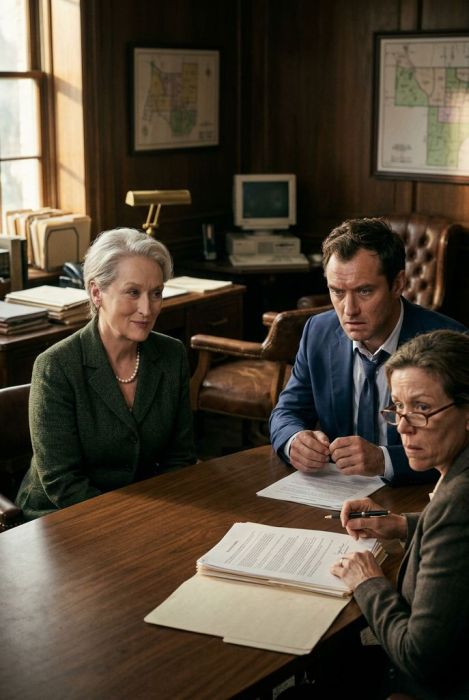
The meeting was called for a Tuesday, in the marina office where Dad had drunk coffee with the dockmaster for thirty years. I had come down to Miss Elaine to gather his personal things — his lucky rod, his old tackle box, the faded photograph of Mom he kept taped inside the cabin door. Old Pete, the dockmaster, met me at the fuel dock with a face like bad weather. "You might want to be there for this one, Nora," he said. I didn't know what he meant until I walked into that office and saw Carl standing behind the desk.
"Nora." Carl's eyes did that sad, practiced thing. "I know this is hard. But Frank and I had an arrangement. He signed this the week before he went into the hospital." He slid a bill of sale across the desk. My father's name was at the bottom, in ink that looked too fresh, and beside it was the notary stamp of Margaret Delgado, who had retired from the school district office a decade ago. The paper transferred Miss Elaine to Carl Horton for the sum of one dollar.
I read it twice. The signature was close — so close it turned my stomach — the same sloping C, the same impatient tail on the last letter. But my father had spent six weeks in that hospital, and he had never once mentioned signing anything. His last clear morning, he had asked me to tell him about the seagulls, and I had held his hand and lied that they were doing fine. He did not talk about one-dollar boats.
"You're telling me Dad sold you his boat for a dollar," I said, "six days before he died." Carl shrugged, the shrug of a man who believed he had already won. "It was a gift, Nora. A gesture. Twenty-five years I ran that boat with your father. He wanted me to have her when he was gone."
And here's the part that shames me. Part of me almost believed him, because Carl had been there. When Mom died, he was the one who kept Miss Elaine running so Dad could fall apart in private. When I couldn't get home for a birthday, Carl fished with Dad and let him talk. He had earned a place in our family's story, and the tired part of me — the part that just wanted to bury my father and go back to Tampa — wanted to hand him the keys and be done with it.
But I had learned something from my father in all those years. Frank Callahan was not a sentimental man, and he was not a careless one. He kept his important papers the way he kept his boat: sealed against weather, thieves, and surprise. And he had told me the same thing since I was old enough to hold a flashlight: "If anything ever happens to me, girl, the answers are in the engine room. Folks never look in the engine room."
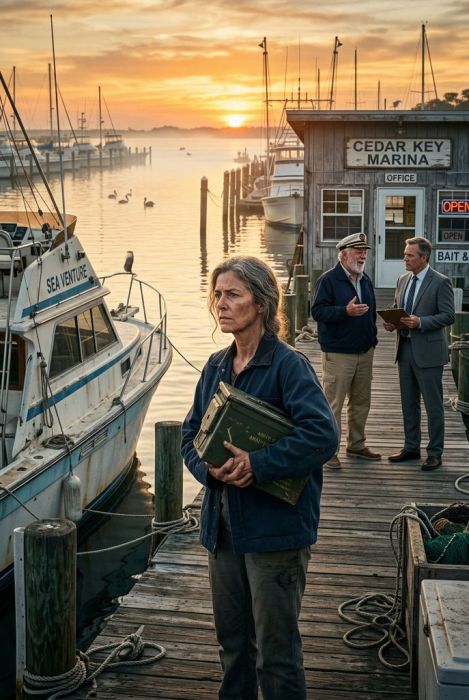
So while Carl talked about hull valuations, survey appointments, and the buyer he had lined up from up the coast, I sat with my hands folded and my eyes on his face, and I did not tell him that I had already been in the engine room that morning. I had gone there to be close to my father, not looking for anything. Under the battery box I had found what he had left me — the old Army ammo can he had carried for forty years, wrapped in a trash bag and sealed with electrical tape.
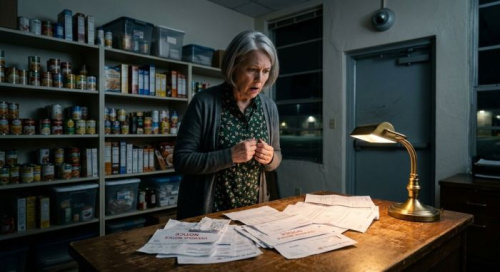
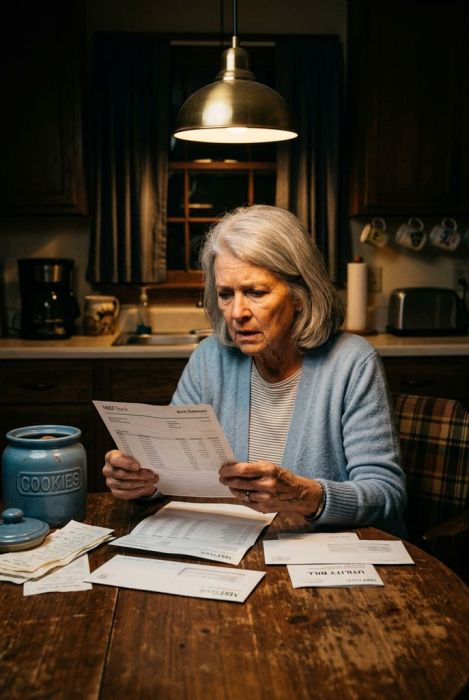
I didn't open it in front of Carl. I went home that night, to the little house Dad had left me at the end of Harbor Lane, and I sat at his kitchen table, under the fluorescent light that still flickered no matter how often I changed the bulb, and I opened that ammo can for the second time.
Inside, wrapped in wax paper like a fish he was saving for a special dinner, were three things. The first was a Certificate of Documentation from the United States Coast Guard, listing the vessel Miss Elaine, hull identification number and all, with the registered owner's name in clean black ink: Nora Callahan. Dated fourteen months before my father died.
The second was the original bill of sale, signed by Frank Callahan, transferring the boat to me for "love and consideration," and notarized properly by my father's own lawyer, Benjamin Barlow. There was a stamped file number on it, the kind the Coast Guard puts on documents they have actually received. My father had not just signed his boat away to me in secret. He had filed it. The government had a record that Carl Horton's paper did not exist.
The third thing was a letter, written in my father's tight, careful hand, on the back of a torn fuel receipt. It was short, because Frank Callahan had never wasted words. "Nora. If you're reading this, I'm gone, and Carl has made his move. He's been taking cash charters and pocketing the fares for three years. I caught him last spring, and instead of firing him, I got scared and I got quiet, like I always do. Don't you be quiet like me. She's yours. She was always going to be yours."
I read it four times, and then I cried the way I hadn't let myself cry at the funeral, with my face in my hands and my father's words on the table in front of me. He had not trusted me with this while he was alive, and I understood why. He was protecting me from Carl, and from the choice he had been too tired and too sad to make himself. And the last thing he had asked of me was to be braver than he had been.
Carl got bolder in the days that followed. He changed the padlock on the slip gate and told the marina he was taking over "pending the paperwork." He went so far as to have a sign painter put "Horton Charters" in blue paint over the faded Callahan lettering on the dock office window, right over my father's name. Old Pete called me each time, worried, and each time I told him the same thing: "Let him paint. Let him talk."
I spent those days quietly, the way my father had raised me to work a problem. I called Benjamin Barlow, who confirmed the will and the documentation and told me in his careful lawyer voice that Carl's bill of sale would not survive a ten-minute conversation with the Coast Guard documentation office. I called Margaret Delgado, the retired district secretary, who told me she had not notarized a single document since she retired and had never stamped anything for Carl Horton. I wrote both facts down, in my father's coffee can, which now lived on my desk.
And I waited, because I knew Carl. He had a buyer from Naples coming to close the sale at the marina office the following Saturday, and a man like Carl always wanted witnesses for his victories.
The buyer's broker was a sharp man named Marcus Webb, the kind who had never touched a fishing line but knew documented title down to the dollar. I watched from the fuel dock as he and Carl shook hands on the walkway, watched Carl lead him into the office like a salesman with a prize. Old Pete stood beside me, arms crossed. "You're sure about this, Nora?" he said. "I'm sure," I said, and I picked up the ammo can.
The office went quiet when I walked in. Carl's face cycled through surprise, annoyance, and then that practiced patience he used on difficult women. "Nora, this is a business meeting. We can settle the boat's accounts another day." "Yes," I said. "We can settle them today." I set the ammo can on the desk between his papers and Mr. Webb's calculator, and I opened it.
I did not say much. I didn't need to. I put the Coast Guard certificate on the desk first, and I watched Marcus Webb's eyebrows go up when he read the owner's name. Then I put down the original bill of sale, and the file number, and finally my father's letter, face down, because that was private. "Mr. Webb," I said, "before you hand that man any money, you should know that this vessel has been documented in my name for fourteen months, and that the notary on Mr. Horton's bill of sale retired before I got my first teaching job."
Carl laughed, and it was an ugly sound. "You found a piece of paper, Nora. That's cute. Frank and I had a deal, and I've got his signature to prove it." "Then let's call the notary," I said, and I took my phone out of my pocket and pressed the call button, because Margaret Delgado had been waiting by her phone all week and answered on the second ring.
I put the call on speaker. "Is this Margaret Delgado?" Carl asked, still playing along. "It is," she said, in her school-office voice, the one that had quieted three generations of rowdy children. "And I want it on the record that I haven't notarized a single document since I retired in 2013. I never met a Carl Horton in my life, and I never signed a bill of sale for any boat. If my name is on any paper dated last year, somebody forged it."
The silence that followed was the loudest thing I have ever heard. Carl's face did something complicated, and for the first time since the funeral I saw the man my father had described — the one who got mean when cornered. "This is my boat," he said, his voice low and dangerous. "Frank promised me." He said it like he believed it, and maybe some part of him did. But believing a thing never made it true.
Marcus Webb was already packing his briefcase. "Mr. Horton," he said, "I don't know what kind of deal you and the deceased had, but my client is not in the business of buying boats with forged titles. This transaction is off." He looked at me, then, and I think he saw something in my face he recognized. "Ma'am, if I were you, I'd call the sheriff before that piece of paper gets used on somebody else." Then he walked out, and the screen door banged behind him.
Carl did not come for me. For one terrible second, I thought he might, and I braced myself on the edge of the desk, with my father's ammo can between us like a shield. But Carl Horton was many things; a fool was not one of them, and there were witnesses on the dock now, men who had known my father and men who had just watched him try to sell a boat that was never his. He stood there, red-faced, and said nothing. I walked out of that office, past Old Pete, past the sign painter's fresh blue letters, and I did not look back.
I called the sheriff's office myself, from my father's kitchen table, while the fluorescent light flickered overhead. Two deputies came for Carl Horton before the tide went out, and the charge sheet mentioned forgery and attempted fraud. It turned out Carl had done this before — a charter captain up in Apalachicola had a nearly identical story, and a dive boat operator in Destin had a stack of letters about the same notary-stamp trick. He was not a grieving partner. He was a professional at other people's grief, and my father had known it all along.
There was a hearing and then a trial, and through all of it Carl Horton maintained that Frank Callahan had promised him the boat. Maybe Dad had, in some weak moment, said something Carl chose to believe. But promises made in the dark do not move vessels documented in the light, and the judge was unmoved. The gel coat of my father's boat carried more weight than the word of a convicted forger, and I walked out of that courthouse with Miss Elaine still mine.
That was two summers ago. Miss Elaine still runs charters out of Gulf Harbor, but the hand on her wheel is a young local named Danny Reyes, who my father taught to tie knots when Danny was ten. I still teach history in Tampa, but I come home most weekends, and I have learned, at fifty-five, that you are never too old to learn the sea. I gut fish badly. I moor the boat worse. But every spring I repaint the crooked E on the stern myself, and I never manage to straighten it, and I understand now that straight was never the point.
The seagulls still get their bread. Danny calls them by the names my father gave them, and when I stand at the end of the slip with the gulf breeze in my face, I can almost hear Dad's voice over the water, telling me he always knew I'd find the engine room. He raised a daughter who read the fine print, and that, in the end, was the only inheritance he ever needed to leave me.