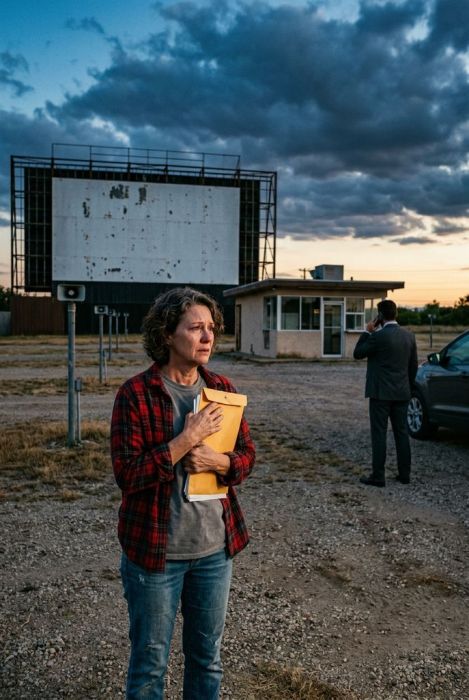
The morning the SOLD sign went up in front of the Star-Lite, I was inside on my knees waxing the concession floor. That's how I'd spent every spring for thirty-four years, ever since Dad handed me a push broom on my fifteenth birthday and said a clean floor was the first promise you made to a customer. So there I was, drowning in lemon-scented polish, when my older brother Earl's sedan crunched across the gravel and he climbed out with two cups of fancy coffee like he'd just won a prize.
"Put the buffer down, Maggie," he called through the glass door. "You and me need to talk about the future of this place."
I knew that smile. I'd seen it the night he talked Dad into cosigning a loan for a used-car lot that went bankrupt in eleven months. I'd seen it at Mom's funeral when he announced he'd "handle" her jewelry, and I never saw her good pearls again. Whatever Earl was smiling about, somebody was about to lose something.
"The future of this place opens at sundown in six weeks," I said, "same as it has since 1961."
"Not this place." He pulled a folded document from his jacket and held it up like a winning lottery ticket. "Not anymore."
It was a purchase agreement with Vance Properties out of Columbus. Earl had signed the Star-Lite Drive-In away for two point one million dollars while I was checking marquee bulbs and reordering popcorn oil.
"He left it to both of us, Earl."
"Dad left his half to me and his half to you," he said, tapping the paper. "And there's nothing in his will that says I can't sell my interest. So here's your chance, sis — match the price and it's all yours."
Two point one million dollars. I'd taught fourth grade for thirty-one years. I couldn't match the price of a new roof, let alone a developer's checkbook.
I should have packed my wax and walked away. I probably would have, too, if I hadn't spent the last two years of Dad's life spooning soup into him while he stared out the window at the marquee. He'd made me promise the same thing every night, in that foggy voice that got a little clearer each time he said it.
"Keep the lights on, Margaret."
So I didn't walk away. I stayed. And I started digging.
The Star-Lite wasn't just a business. Grandpa Bill built it in the summer of 1961, cutting the gravel lot himself with a borrowed tractor. Dad took it over in 1978, the year I turned nine, and I basically grew up behind the snack bar. I met my husband Danny there in 1984 — he showed up in a hand-me-down Chevelle with a dented fender and the audacity to ask for extra butter. We married in '86, and for thirty-two years every Friday was date night under the stars. Danny died ten years ago, a heart attack in the garden, gone before the ambulance arrived. The drive-in is what kept me from falling apart after that.
Earl left for Cleveland the week he turned eighteen and never once looked back. He called the Star-Lite "Dad's rusty money pit." When Dad got his diagnosis, lung cancer, stage four, Earl visited exactly three times — once to complain about a fence line, once to ask about the will, and once to sit in the kitchen pretending to be the caring son while Dad slept.
I was the one who moved into the farmhouse. I was the one who learned to change oxygen tanks and give sponge baths while Dad coughed until his ribs ached. On the worst nights, I'd push his wheelchair to the top of the hill behind the screen, and we'd watch the headlights of cars pulling into the lot below while he told me stories.
"Your grandpa built that fence by hand," he'd say. "Never used a machine once."
Then he'd squeeze my hand and say the other thing, like a prayer. "Keep the lights on, Margaret." I promised him every time.
He died on a Tuesday in February, in his own bed, with his hand in mine. Earl showed up for the funeral in a new SUV and gave a eulogy about what a great man Dad was — a man he'd seen maybe four times in fifteen years. Then he shook hands with the lawyer and drove back to Cleveland, and I thought that was that.
I should have known better.
A month after the funeral, the county sent me a notice in the mail. I almost threw it away with the junk — it looked like one of those official envelopes that turn out to be credit card offers. But the return address said RECORDER OF DEEDS, and when I opened it, my hands went cold.
It was a receipt for a recorded quitclaim deed. From me, Margaret Ann Calloway, to my brother Earl Francis Calloway. The property description covered the whole drive-in: the lot, the snack bar, the screen, all of it.
Dated January 9th. Two weeks before Dad died. Which was impossible, because I spent January 9th sitting in a hospital hallway while Earl "helped" by running errands.
I drove straight to the courthouse. The clerk, a woman named Doris, pulled the file for me. And there it was — a quitclaim deed with my signature on it. Except it wasn't my signature. It was close — somebody had practiced it, using the loan guaranty I'd signed for Earl back in 2009 when his dealership was going under. "Just so the bank sees family support," he'd said. I signed it without reading, because family signs.
The notary on the deed was a man named Leonard Peck. Doris made a face at the name. "That fella lost his commission in Indiana back in '04," she said. "Still stamps things over here occasionally."
I thanked her and drove home in a daze. Earl had stolen my half of the drive-in with a forged piece of paper, and by the time I figured out how to fight it, the land would belong to Vance Properties and there'd be nothing left to fight for.
That's when I remembered Dad's box.
Dad kept everything — every receipt, every deed, every scrap of paper that ever touched his life — in an old metal toolbox under the farmhouse stairs. I'd gone through it after he died, but I'd been half-blind with grief and had only skimmed it. So I hauled it out again and went through every single piece.
Underneath it all, wrapped in a rubber band, was a folder labeled STAR-LITE — FRONTAGE.
Inside were two things that changed everything.
The first was a deed, recorded in July of 1997, the year Dad refinanced to build the new snack bar. The loan company had required the property to be split into two parcels — the big lot out back, and the front strip of land along Route 9: sixty feet of highway frontage, the marquee, and the entrance lane. And Dad, trying to save on taxes or just being Dad, had deeded that front parcel to me. For love and affection, the deed said. Gift to daughter, Margaret Ann Calloway.
I'd signed the deed receipt in 1997 and never thought about it again. It was just Dad shuffling papers around. "It's so the bank is happy, honey," he'd said, and I'd shrugged and gone back to scrubbing the popcorn machine.
The second thing in the folder was a single yellow page in Dad's shaky handwriting, a list of important numbers. At the very bottom, in capital letters, he'd written:
MAGGIE OWNS THE FRONT DOOR. NOBODY GETS IN WITHOUT HER.
I laughed. Then I cried. Then I started planning.
The developer's project — I got the site plan from the county planning office, where it was public record — called for a gated community of sixty condos and a small retail strip on the Star-Lite's gravel lot. The whole thing hinged on one line: ACCESS: EXISTING CURB CUT, ROUTE 9, 60 FOOT FRONTAGE. The county had refused a new curb cut anywhere else along that stretch because of the curve in the highway. The only legal way in or out of that property was through my sixty feet of frontage. My entrance lane. My marquee.
Earl had sold the developer a building with no front door. And Dad, God love him, had made sure that front door was mine.
I called a lawyer — a young woman over in Millbrook named Patricia Nguyen, sharper than anyone in the county. I laid it all out: the forged quitclaim, the suspended notary, the 1997 gift deed, the site plan. She listened for forty minutes without interrupting. When I was done, she said the sweetest sentence I'd heard in ten years.
"We're going to enjoy this."
We filed a quiet title action on my parcel the next week and flagged the quitclaim deed for investigation. But we didn't tell Earl. We didn't tell anybody. And I kept going to the drive-in every day, because I wasn't going to let him see me quit.
The closing was set for the first Friday in May — the day after the Star-Lite would have opened for the season. Earl had the whole thing planned: champagne, his girlfriend, a photographer hired to document him closing the deal of a lifetime. He didn't invite me.
I went anyway.
The closing was held at the title company's office downtown. Earl was already there when I walked in, grinning at the developer's lawyer like they were old friends.
"Maggie," he said, and his smile flickered for just a second. "This is a private meeting."
"Not anymore," I said.
The developer's lawyer, a tired-looking man named Gerald Brandt, stood up. "Ma'am, I'm going to have to ask you to—"
"Mr. Brandt," Patricia said, stepping forward, "my client owns a material portion of the subject property. I'd suggest you hear her out before anyone wires any money."
She put the deed on the table. The 1997 deed, my name in Dad's careful handwriting, the county seal, the parcel number that matched — precisely — the sixty-foot frontage line in their site plan.
Gerald Brandt went very still. He pulled the site plan out of his own stack and laid it next to the deed, then looked at Earl — and I watched the color drain from my brother's face like somebody had pulled a plug.
"This parcel's not in the conveyance, Earl," Brandt said quietly. "You sold us the lot. You didn't sell us the access."
"It's all the same property!" Earl's voice cracked. "It's the Star-Lite, it's one piece, it's—"
"It was split in 1997." Patricia's voice was calm, almost gentle. "Your sister has held recorded title to the Route 9 frontage for twenty-nine years. And per the county's planning records, that frontage is the only approved access point for this site. So I'll be blunt, Mr. Brandt — you just paid two point one million dollars for a parking lot with no way in."
"That's fraud," Brandt said at last, very slowly. He wasn't looking at me. He was looking at Earl. "You either knew about this parcel, or you never checked — and either way, you sold us something you couldn't deliver." He picked up his phone. "I'm calling the title company. And the police."
Earl started talking fast — it was a mistake, a mix-up, he'd make it right, it was Dad's fault for not telling him — and that's when Patricia put the second document on the table. The quitclaim deed from me to Earl, stamped by Leonard Peck, who was by then under investigation himself and had, as it turned out, been in a Las Vegas casino with Earl on the very day he'd "witnessed" my signature.
"I'll also note," Patricia said, "that my client was at the hospital with her dying father on January 9th. There are nurses' notes. There's a visitor log. And there's a handwriting analyst ready to compare that signature to anything your client has signed in twenty years."
Earl stood up and knocked over his champagne. And then two sheriff's deputies came through the door, because Gerald Brandt didn't like being conned and had already made the call.
They read Earl his rights right there in front of the developer, the title agent, and the photographer hired to capture his victory. The photos ran on the front page of the Fox Hollow Sun the following week: EARL CALLOWAY ARRESTED IN DRIVE-IN FRAUD.
The charges came down like rain: forgery, tampering with records, theft by deception. The Vance Properties deal dissolved faster than sugar in water — their lender pulled the financing that same afternoon. Earl's dealership in Cleveland let him go the following Monday. Not that it mattered much; he'd already put the earnest money toward a bookie in Parma who, I'm told, was considerably less understanding than a judge.
I didn't go to the trial. Patricia did. She called me after the verdict — three years, plus restitution and probation — and said Earl had spent most of the proceedings staring at his hands like they belonged to someone else.
Maybe they did. Whoever that man was, he wasn't the brother I remembered, the one who taught me to ride a bike and threatened to beat up a boy who pulled my hair. Somewhere along the way, the Star-Lite stopped being a family place and became a score. He bet everything on his greed, and he lost.
I got the drive-in back — all of it, including my father's gift of the front door, which I'd apparently owned for twenty-nine years without ever knowing it. The county even sent me a letter about an easement for drainage work along Route 9, and their check covered the new digital projector I'd been pricing for years.
The town found out about the fundraiser before I could stop them. Shelby from the diner organized it — SAVE THE STAR-LITE, hand-painted on a bedsheet, a spaghetti dinner at the VFW, a car wash that took in eight hundred dollars from teenagers who'd never seen a drive-in movie. I cried twice during the spaghetti dinner.
We opened on a Saturday night in June, one month late and a lifetime stronger. The marquee lights came on at seven — all nine hundred new bulbs — and the sign read STAR-LITE, EST. 1961. I'd thought about changing it to something clever, but some promises don't need updating.
Mom came from the care home in a wheelchair, and for one perfect hour she was sharper than she'd been in years. She watched the previews and said, "Your father hated that actor." She was right.
The feature was Field of Dreams, which felt like Dad's kind of joke — a movie about a man who builds something impossible on farmland, and the ghosts who come home to see it. Halfway through, I walked up the hill behind the screen the way I used to with Dad and looked down at three hundred cars, headlights glowing, families sprawled on hoods and lawn chairs, kids discovering the magic of movies under the sky.
"Keep the lights on, Margaret," Dad had said every night those last two years. I'd thought it was the sickness talking, the same loop over and over.
I know now it was the same thing Grandpa told him in 1961, and the same thing he was telling me from wherever he was watching: this place belongs to the people who love it. And nobody — not Earl, not a developer, not even death — gets the front door. That's mine.
The lights stayed on past midnight. A few cars were still there when I locked up, and I stood on my gravel, my gravel, and looked at the marquee one last time.
EST. 1961.
Some stories end. This one just kept playing.