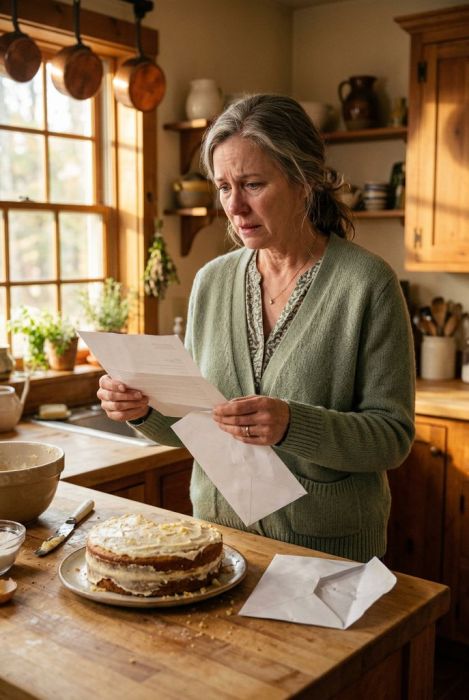
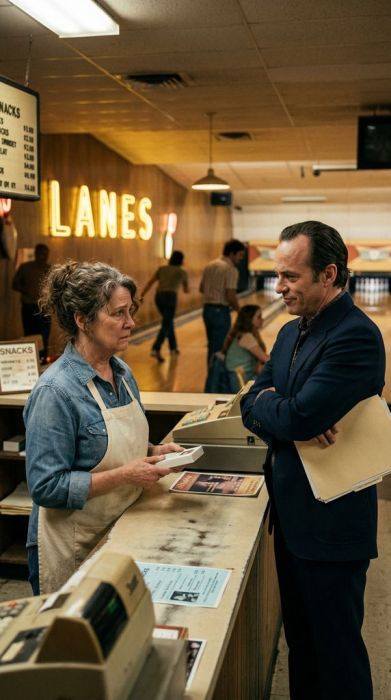
The lawyer's letter arrived on a gray Tuesday in March, eleven months after we buried my father. It was addressed to me at Lucky Lanes, and the return address was a firm I'd never heard of — Brandt, Kolby & Associates, three floors of marble somewhere in downtown Erie. One crisp page informed me that my younger brother Curtis had been granted power of attorney over Dad's affairs in his final months, and that Dad had signed a gift deed transferring the bowling alley to Curtis outright. "You are kindly asked to vacate the premises within thirty days," the letter said. I read it at the front counter with the smell of buttered popcorn in my nose, and I think I laughed before I cried.
I called Curtis that same afternoon. He answered on the fifth ring, and before I could say a word he told me not to bother with a lawyer. "Dad wanted me to have it, Wendy. You had decades to ask him for a piece of paper, and you didn't. That's not my fault." I reminded him that Dad had run Lucky Lanes for forty years and told me a thousand times the place would be mine. "People say all kinds of things when they're tired," Curtis said. "The paper is the paper." Then he hung up, and I stood there holding the phone, staring at the neon sign my father had hand-painted in 1978 — LUCKY LANES — and I realized my brother had been planning this long before Dad's heart gave out.
Dad built the alley with his own hands when I was four years old, on a stretch of Cherry Street that everyone said was going to fail. He poured the concrete slab with his brother and a borrowed mixer. He installed the lanes himself — secondhand lanes bought from a place in Buffalo that was going out of business — and he sanded and polished every board until they shone like honey. By the time I was ten, Lucky Lanes was the heart of our neighborhood: birthday parties on weekends, the senior league on Tuesday mornings, the smell of fries and coffee that never quite left your coat. My mother worked the register until she got sick in 1999, and after she died, it was just Dad and me behind that counter.
Curtis was nine years younger and never set foot behind it. He was out back with Dad's keys, in Dad's car, taking Dad's money, always with a grin and a promise that he'd pay it back someday. He never did. When Dad's heart started failing last winter, I was the one who drove him to every appointment. I was the one who slept in the chair beside his hospital bed, who learned to read his monitors, who held the water cup while he took his pills. Curtis showed up twice — once to argue about the life insurance and once to ask if Dad had "thought about what happens to the alley." Dad waved him off both times, but I saw the way his face changed after those visits.
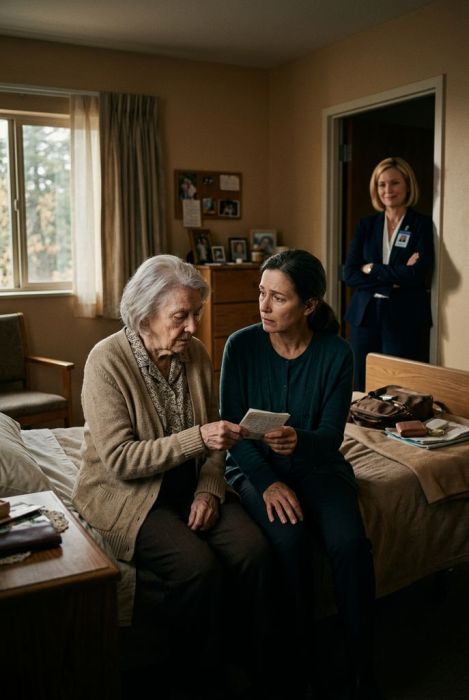
He got quieter. He started making phone calls when he thought I wasn't listening. Three weeks before he died, he grabbed my wrist with a strength that surprised me and pulled me close. "The pins will tell the truth, Wendy," he whispered. "Remember the boiler room. Don't let anyone tell you different." I thought it was fever talk. I told him I loved him and smoothed his blanket, and I did not think about those words again until the day Curtis's letter arrived.
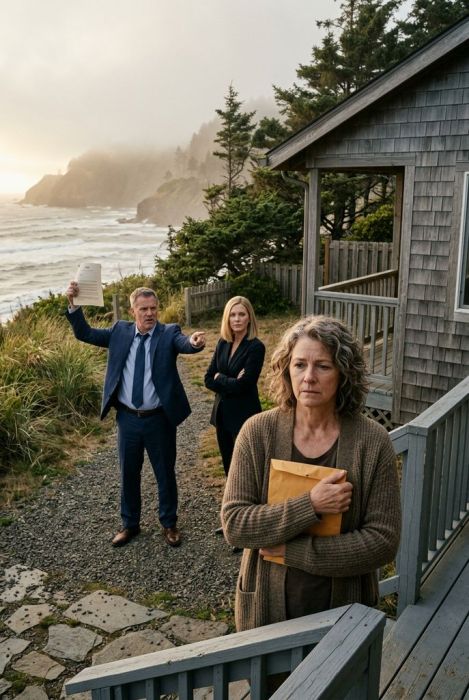
The thirty days came and went. Curtis showed up with a locksmith and a woman from the county recorder's office, and I stood on the sidewalk in my coat while they changed the locks on the door I had opened every morning for forty years. The senior league members watched from their cars — old Frank Kowalski leaning on his cane, Mrs. Delgado shaking her head. Nobody said a word, because what was there to say? The paper was the paper. Curtis hired a "management consultant" named Blake who wore sneakers with his suit and talked about monetizing the nostalgia. They fired Darla, who had been making the chili for thirty years. They canceled the Tuesday senior league because it wasn't profitable. They took down my mother's framed photo from behind the register and put up a poster of a man in a bowling shirt doing a disco pose.
I did not fight. That was the part that ate at me. I had spent my whole life being the steady one, the one who never made a scene, and I told myself that doing it quietly would make it easier on everyone. I started working a few mornings a week at St. Anne's thrift shop just to have somewhere to be. My son Matt drove down from Buffalo every weekend and sat with me on the porch of my little house, eating handfuls of pretzels and listening to me not talk about it. "Mom," he said once, gentle as anything, "Dad left you the shop in that trust. You know what a trust is, right? It means he didn't want anyone arguing." I nodded and said nothing, because Matt didn't know about the other thing — the thing I had found three weeks after Dad died, in the back of the boiler room, in a box I'd been told never to open.
The boiler room at Lucky Lanes was a cramped, dusty little cave where Dad kept the old air compressor and the gallon cans of lane oil and, in a metal cabinet that hadn't been opened in years, a cardboard box labeled TROPHIES 1987. I found it the week after the funeral, when I went to the alley to turn on the lights one last time, and the cabinet's latch finally rusted open in my hand. Inside was not trophies. Inside was an old camcorder — one of those giant silver ones that sat on your shoulder — and a stack of videotapes in white cases with my father's handwriting on the labels. One label said: FOR WENDY. ONLY. The date on it was three weeks before he died.
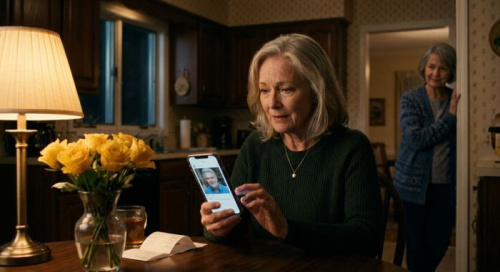
I didn't watch it that night. It took me three months to watch it, and I only did it because Matt plugged the camcorder into his laptop and set it up on my kitchen table. The tape was blue for a moment, then hiss, then my father's face — thinner than I remembered, but his eyes were the same, and he was sitting in his favorite chair in the alley office, with the trophy case behind him. "Wendy, honey," he said. "If you're watching this, I'm gone, and I need you to listen to me real careful."
Dad spoke for eleven minutes. He told me that Curtis had come to see him at the hospital in February, crying, begging Dad to fix his name onto the deed so Curtis could borrow against the building to pay off a gambling debt that was about to cost him his house. Dad had refused. And Curtis had gotten angry — not ugly angry, but the cold, quiet anger Dad knew from every other time in Curtis's life when the world told him no. "I know my son," Dad said on the tape, and the sorrow in his voice made my chest hurt. "He's going to tell you that I gave him the alley. He's going to have papers, maybe. Don't you believe him, Wendy. I made sure of everything years ago, when you turned forty. There's a box at First Erie Trust, in the name Lucky's Legacy. I left it for you. It's the deed to this building — it's had your name on it since 2010. I never told a soul. I wanted it to be a surprise." He laughed, then, a small sad laugh. "I guess it's a surprise now."
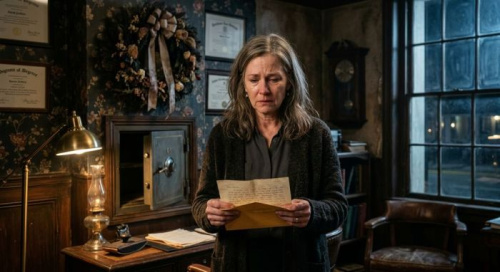
The next morning I called in sick to the thrift shop and drove to First Erie Trust. The box was exactly where he said — metal, cool, in the basement vault, under the name Lucky's Legacy, and my name was on the signature card. Inside was a deed, dated the year I turned forty, transferring the building at 412 Cherry Street from Lawrence P. Novak to Wendy Marie Novak, signed by my father in his own careful hand, notarized by a woman named Esther Bloom, who I remembered as Dad's friend from church. There was also an envelope, and inside that envelope was a letter addressed to me, written on the back of an old score sheet. "In case Curtis ever gets ideas," Dad had written, "remember that the only thing he ever inherited from me was his charm." And then a list — a short, devastating list of every time Curtis had taken money from the register, the safe, and, once, from my mother's jewelry box, with dates and amounts, in Dad's unmistakable handwriting.
I sat in my car in the bank parking lot and cried until I had no tears left. Then I dried my face, put the deed and the letter in my purse, and drove home to make a plan — not the plan of a woman who had been wronged, but the plan of a daughter who had been loved. My father had spent his last months making sure I would never have to fight alone. The least I could do was make sure his voice was heard.
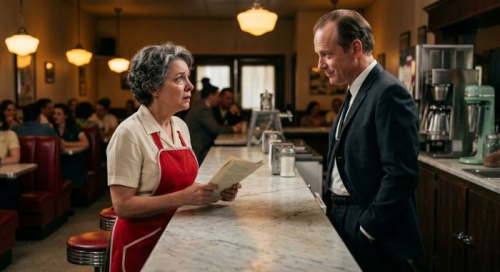
Curtis, meanwhile, was having the time of his life. He announced a Grand Reopening Gala for the first Saturday in June — champagne, caterers, a local news crew, and, most importantly, a developer named Henry Voss who wanted to buy the whole block and turn it into condos with a vintage bowling theme. Curtis walked through my alley touching things like he owned them — like he had always owned them — and when he saw me at the counter one afternoon, dropping off a box of Dad's old things for Darla, he actually had the nerve to smile. "Clean up nicely, why don't you," he said. "I've got a spare ticket to the gala if you want to come see what a real owner does." He waited for me to cry, or to shout, or to do what I had always done — nothing. Instead, I looked at him for a long moment, and I said, "I'll be there." He blinked. "Good," he said, but his eyes had gone uncertain, and I could tell that somewhere in his greedy little heart, the pins had started to rattle.
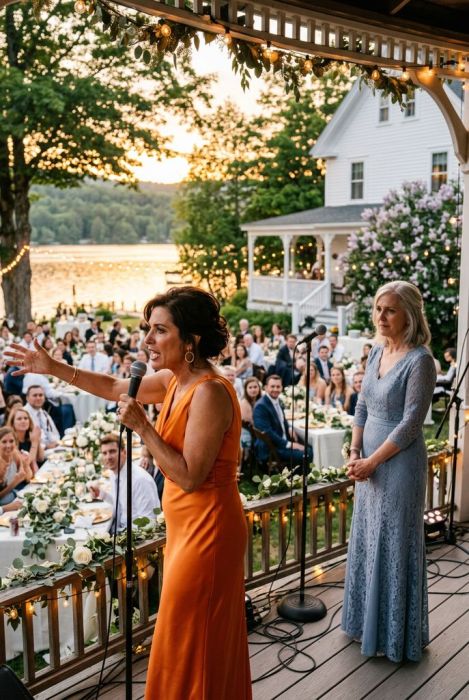
The gala was everything Curtis wanted. Strings of Edison bulbs. A caterer in a white jacket. The news crew setting up their camera by lane seven. Henry Voss in a blazer that cost more than my car, shaking hands and looking at the ceiling joists like he was already subtracting them. And there, near the back, by the trophy case, stood the members of the Tuesday senior league — Frank Kowalski, Mrs. Delgado, the whole crew, in their league shirts — because they had come to bear witness, and because Darla had called me that morning and told me, "Whatever you're planning, Wendy, we're standing with you." Curtis took the microphone at seven o'clock. He talked about legacy. He talked about family. He said, "My father believed in this alley, and I'm going to take it to the next level," and the crowd clapped politely, and then Curtis said, "And I'd like to thank my sister, who is here tonight, for gracefully stepping aside."
That was my cue. I walked to the little projector room behind lane one — the one Dad had built to show the bowling films he loved — and I pushed play. The big screen above the lanes flickered, and my father's face appeared, larger than life, in the same chair, with the same trophy case behind him, and the room went quiet so fast that the only sound was the projector and the soft gasp of Mrs. Delgado's hand over her mouth. "Wendy, honey," Dad's voice said, warm and familiar as the smell of lane oil. "If you're watching this, I'm gone, and I need you to listen real careful." I watched Curtis's face change — watched the color drain from it like water going down a drain — as my father said, in front of the developer, in front of the news crew, in front of the entire city of Erie, "My son Curtis is going to tell you I gave him this alley. I did not. I never would. He has been taking from this family since he was twelve years old, and I have the receipts to prove it."
Curtis screamed at me to stop it, to turn it off, that it was faked, that Dad was senile — and that was the moment Esther Bloom stepped out from behind the trophy case. The notary. Eighty years old, hair in a blue rinse, a little gold cross around her neck, and she stood in front of the crowd and said, in a voice that carried to the back of the room, "I notarized that deed in 2010. I watched Lawrence Novak sign it with his own hand. And I've known Curtis Novak since he was a boy, and I will tell you right now, the only false paper in this building is the one he filed." Henry Voss, the developer, had his phone out, and his face had gone the color of old newspaper. His people had run a title search that morning — of course they had. People like Henry Voss don't write big checks without checking who owns the land. "The property belongs to Wendy Novak," he said slowly, out loud, so everyone could hear. "Your paperwork is a fabrication, Curtis. You'll be hearing from my attorneys — and I suspect the district attorney's office as well."
The police arrived before the caterers finished packing up. Two officers in dark blue, who took their time walking the length of the alley, past the lanes Dad had sanded by hand, past the senior league members who did not move an inch. They spoke to Curtis quietly, and then, with the news camera rolling, they read him his rights. Forgery. Filing false documents. Grand theft by deception. Curtis shouted at me as they led him out — called me every name he could think of in front of the whole city — but his voice cracked on the last one, and I saw, for just a second, the scared little boy who had always wanted what wasn't his, and I felt nothing but sad. Not angry. Just sad, the way you're sad when you finally understand that some people spend their whole lives burning down the house to feel the warmth.
The next morning, Darla unlocked the front door, and I walked in behind her, and the senior league was already there, sitting on the benches in their Tuesday shirts, coffee cups in hand, exactly like nothing had ever happened. Frank Kowalski looked at me and said, "Lucky Lanes is open today, isn't it, Wendy?" and that was it. That was the whole conversation. We opened. I fired Blake, the management consultant, who tried to argue but left when I pointed at the deed framed above the register. I put my mother's photo back behind the counter. I rescinded the cancellation of the Tuesday league before anyone even asked. And six months later, when the alley smelled like chili and lane oil again, and the neon sign Dad painted in 1978 was back on, brighter than ever, I took the box of tapes from the boiler room and put them in the bank vault beside the deed — under the name Lucky's Legacy.
Curtis was sentenced to eighteen months. His wife divorced him, and the house he'd been so desperate to save went to the bank anyway. I didn't attend the sentencing, but I heard he asked about me, and I heard the jail had a bowling program on Thursday nights. I like to think, on a good week, that he rolls a spare. Maybe, someday, if he ever tells the truth about what he did — to the court, to himself, to me — I'll let him bowl a frame or two at lane seven, the lane Dad always called the lucky one. I keep his old bag there, polished, ready, because a person can be wrong and still be family, and because some doors should never lock as tight as the one he tried to lock on me.
Dad always said the pins will tell the truth. He was right. They rattled, and they fell, and they set themselves back up — the way they always do if you give them time.